

Forget your environment sorrows




nepenthe builds, versions, and distributes large shared conda/PyPI environments. Describe an environment once, solve it once with rattler, freeze it into a portable lockfile, and publish that lock to a versioned registry on any storage backend — so every machine installs the exact same environment without re-solving.
- Manifest-based composition — declarative environments instead of scattered requirement files
- Native solving — rattler in pure Rust, no Python interpreter overhead
- Portable locks — multi-platform
rattler_lockfiles, reproducible by construction - Cross-platform — solve
linux-64/osx-arm64/win-64from one host into a single multi-platform lock - Pluggable backends — read/write specs to
file://,s3://,https://; channels point at any server (e.g. an internal Artifactory) - Versioned registry — independent per-environment versioning, immutable content-addressed locks
- Install without conda — link a lock into a prefix with rattler; no conda/mamba/micromamba required
- Conda-compatible — export any lock as an
@EXPLICITspec forconda create --file - Secure by default — credentials injected at use time, never written into artifacts
nepenthe covers the full producer → consumer lifecycle: compose a manifest,
solve and freeze multi-platform locks, publish them to a versioned registry, and
install them without conda — from the CLI or Python, with air-gapped pack /
unpack bundles and a pyproject.toml integration that keeps a project's
dependencies in sync with the environment it consumes.
Why nepenthe?
To behave consistently across many machines and over time, you want frozen environments. But pinning everything by hand makes upgrades miserable and leads to dependency hell.
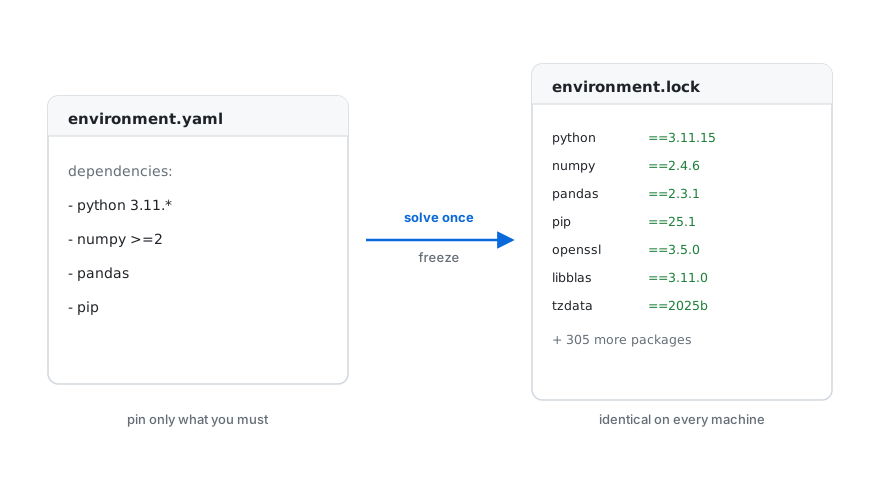
nepenthe starts from a list of dependencies where you pin only what you must. Each release solves once and freezes the result into a fully-pinned collection, so every download gives the same packages — installed without re-solving.
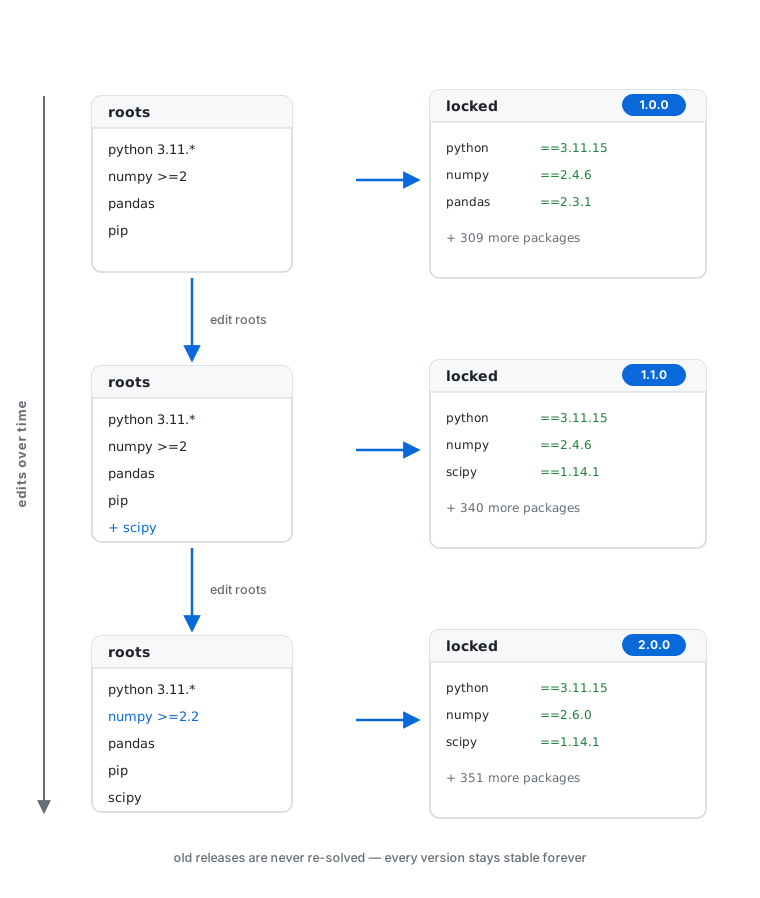
You evolve an environment by editing its root dependencies, not the solved set; each release produces a new frozen environment, and teams move between versions on their own timeline.
This is different from per-project lockfiles (pixi, uv) and re-solved manifests
(environment.yml): nepenthe builds and distributes a shared environment that
many repos consume, versioned and immutable. See
Motivation for the full comparison.
Documentation
| For | Read |
|---|---|
| Why it exists — the problem & alternatives | Motivation |
| Users — concepts and how-to | The wiki: Concepts, Manifests, Channels & Artifactory, Registry, Installing, Consuming in a Project, Packing, Python API, Backends |
| Getting started | Installation |
| Contributors — how it's built | Architecture |
Quickstart
From a dependency list to a solved environment — a portable lockfile and a conda-installable spec file — with no registry and no conda. Describe the environment in a small manifest, pinning only what you must:
# environment.yaml
project:
  name: demo
  channels: [conda-forge]
  platforms: [linux-64]
  python: ["3.11"]

dependencies:
  - numpy >=2
  - pip

environments:
  app: []
Solve it once into a fully-pinned, multi-platform lockfile — no registry, no conda:
nepenthe build --manifest environment.yaml --env app --output-dir .
# → app-py3.11.lock      the reproducible artifact: every install gives these exact packages
Want a conda spec? Render the lock as a conda create --file (@EXPLICIT)
spec — so people who use conda/mamba can install it too:
nepenthe export --env app --lock app-py3.11.lock --platform linux-64 -o app.txt
# → app.txt              @EXPLICIT list of package URLs
Install it — straight from the spec with conda, or from the lock with nepenthe (no conda required):
# with conda/mamba, from the spec — nepenthe not needed on this machine
conda create --name app --file app.txt

# …or publish the lock to a versioned registry and install with nepenthe — no conda:
nepenthe build --manifest environment.yaml --env app \
  --registry file:///srv/nepenthe --version 1.0.0
nepenthe create app --registry file:///srv/nepenthe --python 3.11 --prefix ./envs/app
eval "$(nepenthe activate --prefix ./envs/app)"
That's the whole vision: describe once, solve once, distribute everywhere —
as a versioned lock for nepenthe consumers and an @EXPLICIT spec for conda
users, from the same solve.
The CLI is a single multicall binary: np and npb are symlinks to nepenthe
(dispatch on the invoked name). np behaves exactly like nepenthe, and npb
is a shortcut for nepenthe build (so the build step above is just
npb --manifest environment.yaml --env app --output-dir .).
The same lifecycle is available from Python (a binding that mirrors the CLI, no conda required):
import nepenthe

# producer: solve "app" and publish its lock as v1.0.0
nepenthe.build("environment.yaml", "app", registry="file:///srv/nepenthe", version="1.0.0")

# consumer: install the latest published lock into a prefix
nepenthe.create("app", "file:///srv/nepenthe", "./envs/app")
print(nepenthe.activate("./envs/app"))
A repo that consumes a shared environment can pin it in its pyproject.toml and
keep its own dependencies honest against it:
[tool.nepenthe]
environment = "app"
registry = "file:///srv/nepenthe"
version = "1.0.0"
nepenthe sync      # install the referenced environment into .venv
nepenthe check     # verify [project.dependencies] are compatible (fails on conflicts)
See Installing Environments for the complete CLI
reference, Consuming in a Project for the
pyproject.toml workflow, Python API for the Python
surface, Manifests for the manifest format, and the
runnable rust/examples/ for the producer side.
Contributing
Contributions are welcome under the Apache 2.0 license. See Contributing and Build from Source.
License
Apache-2.0 — see LICENSE for details.


Release files for nepenthe 0.1.2
For a detailed explanation of source distributions (sdists) and built distributions (wheels), please see the package formats documentation.
Source distribution (sdist)
| File | Size | Uploaded | |
|---|---|---|---|
| nepenthe-0.1.2.tar.gz | 10.6 MB | Details |
Built distributions (wheels)
| File | Reset | |||
|---|---|---|---|---|
| nepenthe-0.1.2-cp311-abi3-win_amd64.whl | CPython 3.11 | abi3 | Windows x86-64 | Details |
| nepenthe-0.1.2-cp311-abi3-manylinux_2_28_x86_64.whl | CPython 3.11 | abi3 | Linux glibc 2.28+ x86-64 | Details |
| nepenthe-0.1.2-cp311-abi3-manylinux_2_28_aarch64.whl | CPython 3.11 | abi3 | Linux glibc 2.28+ ARM64 | Details |
| nepenthe-0.1.2-cp311-abi3-macosx_11_0_arm64.whl | CPython 3.11 | abi3 | macOS 11.0+ ARM64 | Details |
Total release size: 97.9 MB
Release files / nepenthe-0.1.2.tar.gz
| Download URL | nepenthe-0.1.2.tar.gz |
|---|---|
| Size | 10.6 MB |
| Tags | Source |
|
SHA-256 checksum How to use checksums |
79b7e3800cda97c363eea9cf092a4da1c3df047aad642762570fdd883bbbbf41
|
|
BLAKE2b-256 checksum How to use checksums |
85ca567b23101bad6159d930191e82cc1b60e4e8ed1928d37a69e4dbc6a474ab
|
| Upload date | |
|
Uploaded using Trusted Publishing? What is trusted publishing? |
No |
| Uploaded via |
twine/7.0.0 CPython/3.12.14
|
Release files / nepenthe-0.1.2-cp311-abi3-win_amd64.whl
| Download URL | nepenthe-0.1.2-cp311-abi3-win_amd64.whl |
|---|---|
| Size | 19.5 MB |
| Tags | CPython 3.11 Windows x86-64 abi3 |
|
SHA-256 checksum How to use checksums |
d5a1c52dc76c3cb5fc15d0651ae82205b642e5e8d59e7adcbfcabf833eff734d
|
|
BLAKE2b-256 checksum How to use checksums |
1624adb687d0b6ada7b12cc6615d843ef66074f70fee79396c829056a4c3ef8a
|
| Upload date | |
|
Uploaded using Trusted Publishing? What is trusted publishing? |
No |
| Uploaded via |
twine/7.0.0 CPython/3.12.14
|
Release files / nepenthe-0.1.2-cp311-abi3-manylinux_2_28_x86_64.whl
| Download URL | nepenthe-0.1.2-cp311-abi3-manylinux_2_28_x86_64.whl |
|---|---|
| Size | 23.3 MB |
| Tags | CPython 3.11 Linux glibc 2.28+ x86-64 abi3 |
|
SHA-256 checksum How to use checksums |
6e8ede5d8a1c90f6392fecd04a1d0a84650b706cb967c0e84ca8465d5a7f4d8a
|
|
BLAKE2b-256 checksum How to use checksums |
41e53c8922ba89dcd903d5466b6134af9e194d41fde2cfc0b1b7686cae629b28
|
| Upload date | |
|
Uploaded using Trusted Publishing? What is trusted publishing? |
No |
| Uploaded via |
twine/7.0.0 CPython/3.12.14
|
Release files / nepenthe-0.1.2-cp311-abi3-manylinux_2_28_aarch64.whl
| Download URL | nepenthe-0.1.2-cp311-abi3-manylinux_2_28_aarch64.whl |
|---|---|
| Size | 23.7 MB |
| Tags | CPython 3.11 Linux glibc 2.28+ ARM64 abi3 |
|
SHA-256 checksum How to use checksums |
7be65f46db08e8921c971f50e9b8c21fb202a1699f7cc3300ca3df31398109ef
|
|
BLAKE2b-256 checksum How to use checksums |
0f88373376f8270a8721f95ba751cb9ee25f27dad87f6c9e81bf6d4ac0843a4e
|
| Upload date | |
|
Uploaded using Trusted Publishing? What is trusted publishing? |
No |
| Uploaded via |
twine/7.0.0 CPython/3.12.14
|
Release files / nepenthe-0.1.2-cp311-abi3-macosx_11_0_arm64.whl
| Download URL | nepenthe-0.1.2-cp311-abi3-macosx_11_0_arm64.whl |
|---|---|
| Size | 20.8 MB |
| Tags | CPython 3.11 abi3 macOS 11.0+ ARM64 |
|
SHA-256 checksum How to use checksums |
c26f86906e60c77d2d2df572b4f3f66850252244f6e0f3b6df567e4e9f739cf1
|
|
BLAKE2b-256 checksum How to use checksums |
834961047a85b589b978a84969f9e261442a0cdd662db09b769c32272c1d861c
|
| Upload date | |
|
Uploaded using Trusted Publishing? What is trusted publishing? |
No |
| Uploaded via |
twine/7.0.0 CPython/3.12.14
|














