





Website · Quickstart · Documentation · Discussions · Changelog
Nestor is an open-source framework for a household assistant. It runs on your machine with the model you choose, answers in a message or aloud, keeps watch for you, and finds the right person in the right place. Every word it says is in a journal you can read.
What it does
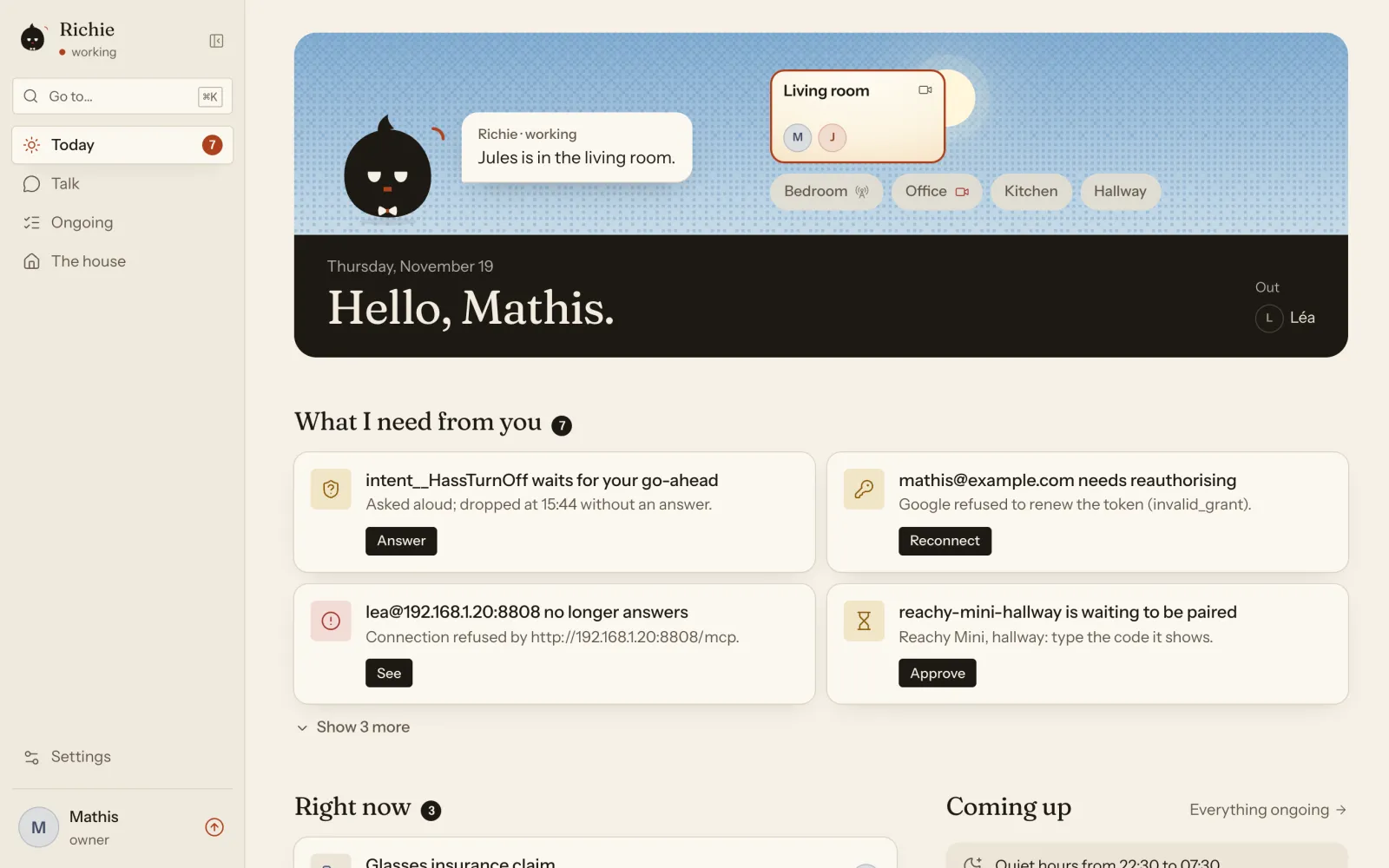
- One assistant, every channel. Satellites in each room (a speaker, a Reachy Mini, a browser, a terminal), the admin's chat and messaging apps (Telegram, WhatsApp, Signal, Discord, Slack, Matrix…) reach the same agent, with the same memory. Satellites can type, talk, film, or all three.
- Native Home Assistant. Presence, rooms and devices come from Home Assistant, and Nestor acts through its MCP server. Locks, alarms and garage doors wait for a confirmation in writing.
- It speaks first when it matters. Watches on your mail, reminders and recurring checks, messages between members of the household. The courier says it aloud in your room or writes to you when you are out, respects quiet hours, and stays silent when a check finds nothing.
- Memory you can read. Dated, sourced facts and summaries of past conversations, found by words and by meaning, all visible and editable in the admin.
- Your accounts and tools. Google, Microsoft 365, CalDAV and IMAP accounts, each kept to its owner; web search (free tiers without a key), pages, weather, maps, and any MCP server.
- Long work, elsewhere. Long tasks go to executors: Hermes, OpenAI Codex, Claude Code, with the files they make; a slow tool keeps running in the background and its result comes back into the conversation.
- Any model. Any OpenAI-compatible server, hosted or local (Ollama, LM Studio, vLLM, llama.cpp), one for speaking and another for writing if you like.
- Who is speaking. Optional voice recognition, run on your server and opt-in per person. It personalises; it never authorises.
- A journal of everything. Every turn, tool call, decision and delivery is an event in SQLite, with why it happened. The admin is built on it.
Quickstart
With uv and a model key (OpenRouter or any OpenAI-compatible server):
uv tool install nestor-home
mkdir nestor && cd nestor
nestor init          # asks a few questions, writes nestor.yaml, .env and your admin login
nestor check         # after filling MODEL_API_KEY in .env
nestor run           # the admin is on http://localhost:8470
Talk to it from a second terminal, with a text satellite:
nestor satellites add --room office --name Terminal
uvx nestor-satellite run --room office --text --no-voice --pairing-uri 'nestor+http://…'
With Docker:
docker run -it --rm -v ./nestor:/data ghcr.io/nestor-home/nestor init
docker run -d --name nestor --restart unless-stopped -v ./nestor:/data -p 8470:8470 -p 8471:8471 ghcr.io/nestor-home/nestor
Voice is an extra (nestor-home[voice]), and so is voice recognition (nestor-home[voice-id]). See
Installation, Configuration
and Models.
How it fits together
flowchart LR
  subgraph rooms[Where people are]
    sat[Satellites<br/>voice or text]
    tg[Telegram]
  end
  subgraph nestor[Nestor]
    agent[Central agent]
    courier[Courier]
    journal[(Event journal<br/>SQLite)]
    memory[(Memory)]
  end
  sat <--> agent
  tg <--> agent
  courier --> sat
  courier --> tg
  agent --- journal
  agent --- memory
  agent --> ha[Home Assistant]
  agent --> mcp[MCP servers]
  agent --> exec[Executors]
  agent --> llm[Your models]
The central agent stays fast: what is long goes to an executor, and what comes back later (a task's result, a watch, a reminder) enters the conversation as a notification that the courier delivers where the person is. How it works goes further.
Integrations
| Models | Any OpenAI-compatible API: OpenRouter, OpenAI, Anthropic, Mistral, Groq, Gemini; locally Ollama, LM Studio, vLLM, llama.cpp |
| Voice | ElevenLabs (transcription and speech), voice recognition with sherpa-onnx |
| Home | Home Assistant, and everything it controls (Hue, IKEA, Sonos, tado°…) |
| Channels | Satellites (nestor.satellite/1), Telegram |
| Gmail, IMAP | |
| Tools and work | Any MCP server, Hermes, Codex, Claude Code |
Each one is a plugin: another provider is another adapter, with no change to the core.
Satellites
A satellite is any device in a room that types, listens or speaks, connected over the
nestor.satellite/1 protocol.
nestor satellites conformance checks one written in any language.
| Package | Repository | |
|---|---|---|
| Python | nestor-satellite |
nestor-satellite-python |
| TypeScript | @nestor-home/satellite |
nestor-satellite-typescript |
| Rust | nestor-satellite |
nestor-satellite-rust |
| Reachy Mini | nestor-reachy |
nestor-reachy |
To start your own, use a template: Python, TypeScript or Rust.
Status
Preview. Nestor works end to end, but it is young and moves fast. Until it is declared stable, a release may change the configuration or the journal's format without a migration: read the changelog before you upgrade, and expect to start your data over now and then. Questions and ideas are welcome in Discussions.
Development
uv sync
uv run lefthook install   # once: checks the files you push
uv run ruff check && uv run ruff format --check && uv run ty check && uv run pytest
The admin (web/) is a React app built into the package and served by Nestor. It needs Node 22 or
later and pnpm:
cd web
pnpm install
pnpm dev                                    # on the mock API; sign in as mathis / nestor
NESTOR_API=http://localhost:8470 pnpm dev   # against a running Nestor
pnpm lint && pnpm typecheck && pnpm test && pnpm build
pnpm e2e                                    # Playwright on the mocks, light and dark
nestor bench measures a part of Nestor on a dataset and compares configurations, for instance which
small model sorts your mail best and at what cost:
nestor bench list
nestor bench run watch-triage --variant a.yaml --variant b.yaml --repeat 3
nestor bench report bench-results/watch-triage/<run>
How the code is laid out and the rules it follows are in AGENTS.md; how pull requests and releases work is in the contributing guide. Questions and ideas go to Discussions, vulnerabilities to the security policy.
License
1 maintainer

Metadata
1 maintainer
Release files for nestor-home 0.17.0
For a detailed explanation of source distributions (sdists) and built distributions (wheels), please see the package formats documentation.
Source distribution (sdist)
| File | Size | Uploaded | Provenance | Actions |
|---|---|---|---|---|
| nestor_home-0.17.0.tar.gz | 2.1 MB | Without provenance | Details for nestor_home-0.17.0.tar.gz |
Built distribution (wheel)
| File | Interpreter | ABI | Platform | Actions Reset |
|---|---|---|---|---|
| nestor_home-0.17.0-py3-none-any.whl | Python 3 | none | any | Details for nestor_home-0.17.0-py3-none-any.whl |
Total release size: 4.5 MB
Release files / nestor_home-0.17.0.tar.gz
| Download URL | nestor_home-0.17.0.tar.gz |
|---|---|
| Size | 2.1 MB |
| Tags | Source |
|
SHA-256 checksum How to use checksums |
d3a0eba7e7b31ce54aaab06ae8f1a4dc401f154d5d62cf172c7f508c268629fe
|
|
BLAKE2b-256 checksum How to use checksums |
6cb4f83637d78f53fd1a62b02f2b61acb824b1f928384e0450acc745985da785
|
| Upload date | |
|
Uploaded using Trusted Publishing? What is trusted publishing? |
Yes |
| Uploaded via |
uv/0.13.9 {"installer":{"name":"uv","version":"0.13.9","subcommand":["publish"]},"python":null,"implementation":{"name":null,"version":null},"distro":{"name":"Ubuntu","version":"26.04","id":"resolute","libc":null},"system":{"name":null,"release":null},"cpu":null,"openssl_version":null,"setuptools_version":null,"rustc_version":null,"ci":true}
|
Release files / nestor_home-0.17.0-py3-none-any.whl
| Download URL | nestor_home-0.17.0-py3-none-any.whl |
|---|---|
| Size | 2.4 MB |
| Tags | Python 3 |
|
SHA-256 checksum How to use checksums |
17bbdcb43f4442451ded1826b7e3e86a74bc65dba3f2ebd2c69f1a03652be8a3
|
|
BLAKE2b-256 checksum How to use checksums |
c351caec32a42938f998cffeebc3e8bf42e846e9922a30cda5d0688a538a957c
|
| Upload date | |
|
Uploaded using Trusted Publishing? What is trusted publishing? |
Yes |
| Uploaded via |
uv/0.13.9 {"installer":{"name":"uv","version":"0.13.9","subcommand":["publish"]},"python":null,"implementation":{"name":null,"version":null},"distro":{"name":"Ubuntu","version":"26.04","id":"resolute","libc":null},"system":{"name":null,"release":null},"cpu":null,"openssl_version":null,"setuptools_version":null,"rustc_version":null,"ci":true}
|
Security for nestor-home 0.17.0
Provenance
Provenance describes where a file came from. On PyPI, provenance is shared via attestations, which provide a verifiable record of the build or publishing details. View details, limitations and caveats.
No provenance found
None of the files in this release were uploaded with provenance metadata.
A note on package security
PyPI is a repository for distributing packages, not a service for auditing them. While third-party security researchers and our staff do their best to detect and remove malicious packages, PyPI cannot guarantee the quality, security or suitability of any given package.
To learn more about protecting yourself from malicious actors, visit our package security documentation.














