
netbox-inventree-sync
A NetBox plugin that synchronizes NetBox inventory data to InvenTree.
NetBox is the source of truth: mapped objects are pushed to InvenTree on every change (create/update via a background job, delete via remote deactivation — InvenTree objects are never deleted), and a recurring reconcile pass re-verifies every link against the live InvenTree state and repairs drift. Mappings pair NetBox fields with InvenTree endpoint fields through a type-compatibility matrix, with pointer→related pairs resolving depth-first through pairing mappings (e.g. Inventory Item Role → Part Category before the part that references it).
Development environment
One-time setup:
./scripts/setup_netbox.sh     # clone NetBox v4.7.4, build netbox/venv, migrate, seed admin+token, install this plugin
./scripts/setup_inventree.sh  # InvenTree 1.7 stack (docker compose), seed admin+token
Daily start (idempotent — re-running restarts the detached processes and picks up code changes):
./scripts/start.sh # docker compose up -d + NetBox runserver + rqworker (supervised, logs under /tmp/opencode/netbox-inventree-sync/)
After that:
- NetBox at http://localhost:8000 (admin / admin); its API token is
written to
.envasNETBOX_TOKEN. - InvenTree at http://localhost:1337; its API token is written to
.envasINVENTREE_TOKEN. - The RQ worker must be running for signal-driven syncs and reconciles
(
start.shstarts it; check/api/core/background-workers/).
Requires: Python 3.12+ (a uv-managed install works — see
scripts/setup_netbox.sh), Docker with compose v2.
Installing into a running production environment
The development setup above builds a throwaway stack. This section is for adding the plugin to NetBox and InvenTree installations that already run with real data.
What the plugin touches — and what it never touches:
- In NetBox, the plugin creates only its own tables
(
netbox_inventree_sync_*: connections, mappings, field pairs, the link table, the sync log). It never modifies, migrates or deletes any existing NetBox table, and it never writes to NetBox objects — the engine only reads mapped objects. - InvenTree is contacted exclusively through its REST API with a token you configure. The plugin never connects to InvenTree's database.
- The InvenTree side is never deleted from: removing a NetBox object
deactivates its remote counterpart. Existing InvenTree parts are
adopted through match keys only when the match is unambiguous
(
name→nameby default); anything ambiguous or blank is flagged for manual review and left untouched.
Consequently, installing — or removing — the plugin cannot lose data in
either system. Still, take a standard backup before any production
change (pg_dump of the NetBox database at minimum).
Steps:
-
Backup —
pg_dumpthe NetBox database (and InvenTree's, if you want the extra comfort). -
Create an InvenTree API token for a dedicated service user with write access limited to what you plan to sync (parts, companies, categories). The token is stored in NetBox's database (plaintext at rest, write-only over the API — treat your DB backups accordingly).
-
Install the package into NetBox's Python environment (the same virtualenv/containers that run NetBox):
pip install netbox-inventree-sync
To track the project's development instead of a PyPI release, install from the repository directly:
pip install git+https://github.com/edurbs/netbox-inventree-sync.git.For containerized NetBox (e.g. netbox-docker), install the package inside the image build (a custom
Dockerfileextending the official image with thepip installabove) so it survives recreation. -
Enable the plugin in
configuration.py(no plugin settings are required):PLUGINS = ['netbox_inventree_sync']
-
Migrate and collect static files — this only creates the plugin's own tables:
python manage.py migrate
python manage.py collectstatic --no-input
-
Restart every NetBox process — including the RQ worker(s). The web processes serve the plugin's UI; the workers execute the sync jobs. A worker that was not restarted will not know the plugin exists.
-
Roll out gradually: create the connection, run
seed_starter_mappings --connection <name> --validate(everything is created disabled), review the pairs in the builder, then enable one mapping and watch Synced Objects / Sync Log. Be aware of the first-reconcile note below: enabling a mapping publishes every mapped-but-unlinked NetBox object, so on a large catalog the first pass is long.
Rollback / removal: disable all mappings (this cancels their
recurring schedules and stops event-driven pushes), remove the plugin
from PLUGINS, restart the processes. Optionally drop the plugin's
tables or simply delete its rows — no NetBox inventory data is involved.
InvenTree keeps whatever was synced (deactivated items stay
deactivated); simply delete or reactivate them there if you retire the
integration.
Usage walkthrough
-
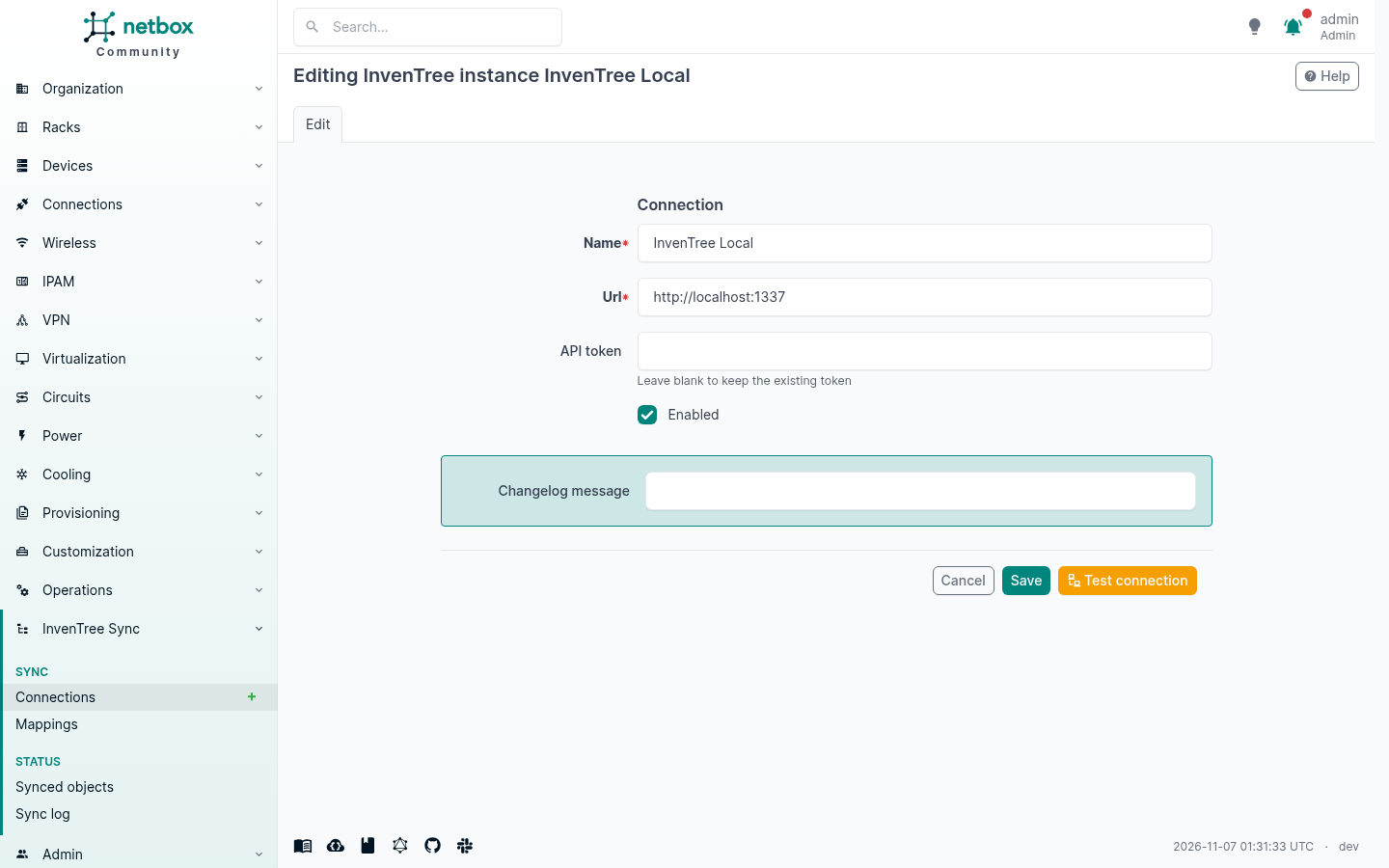
Create a connection — Plugins → InvenTree Sync → InvenTree Instances → Add: base URL (e.g.
http://localhost:1337) and an API token of a InvenTree user with write access. The token is stored server-side and never returned by the API. The edit form offers a Test connection probe (the token field stays blank on edit — leaving it blank keeps the stored token): -
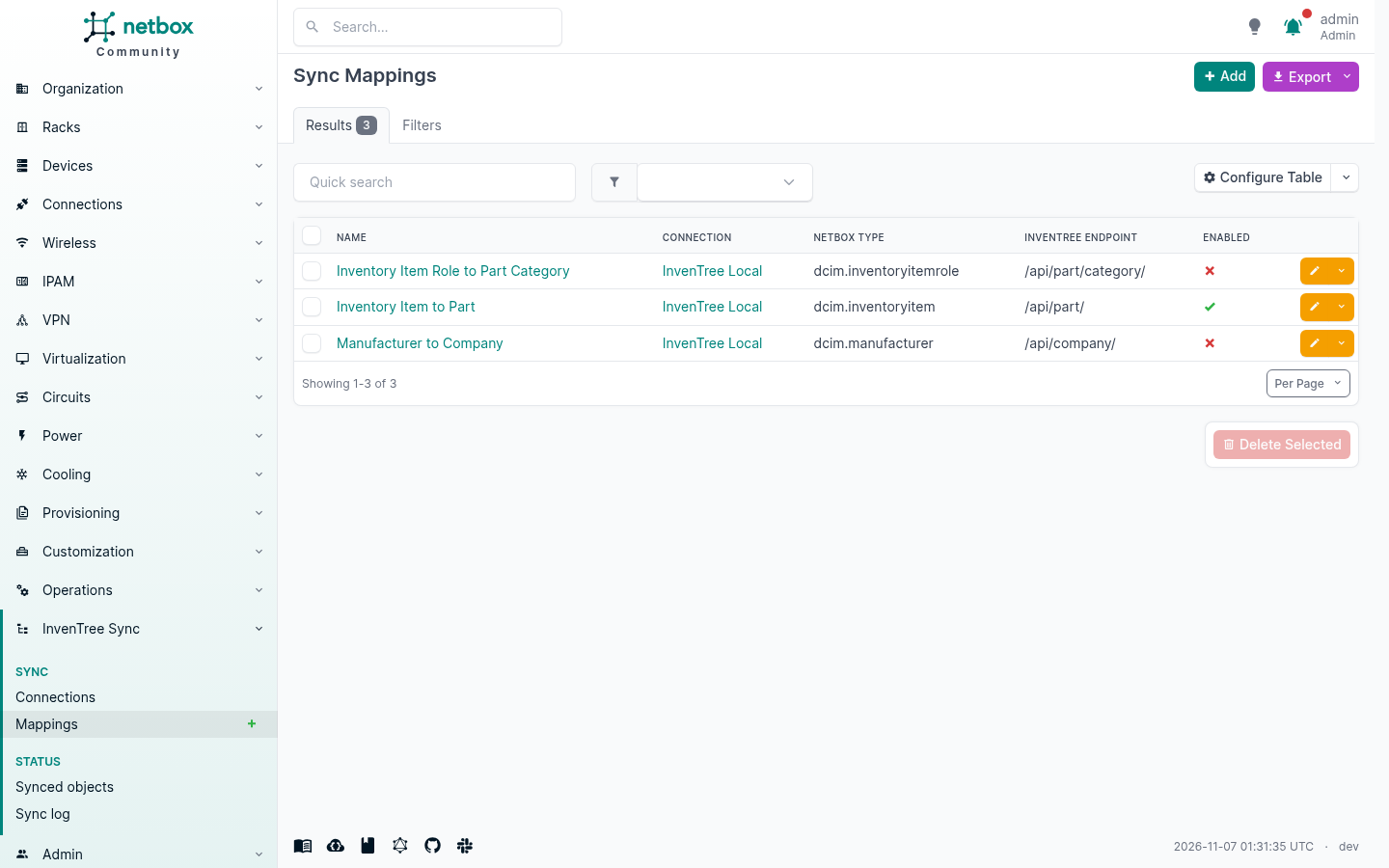
Seed the starter mappings (or add mappings by hand):
netbox/venv/bin/python netbox/netbox/manage.py seed_starter_mappings --connection <id-or-name> --validate
This creates three disabled mappings: Inventory Item →
/api/part/(name→name, part_id→IPN, description→description,manufacturer.name→keywords), Manufacturer →/api/company/, and Inventory Item Role →/api/part/category/, each with name→name as its match (adopt) key.--validatechecks every pair against the live InvenTree field metadata. After seeding, the Mappings list shows all three (✔/✗ in the Enabled column): -
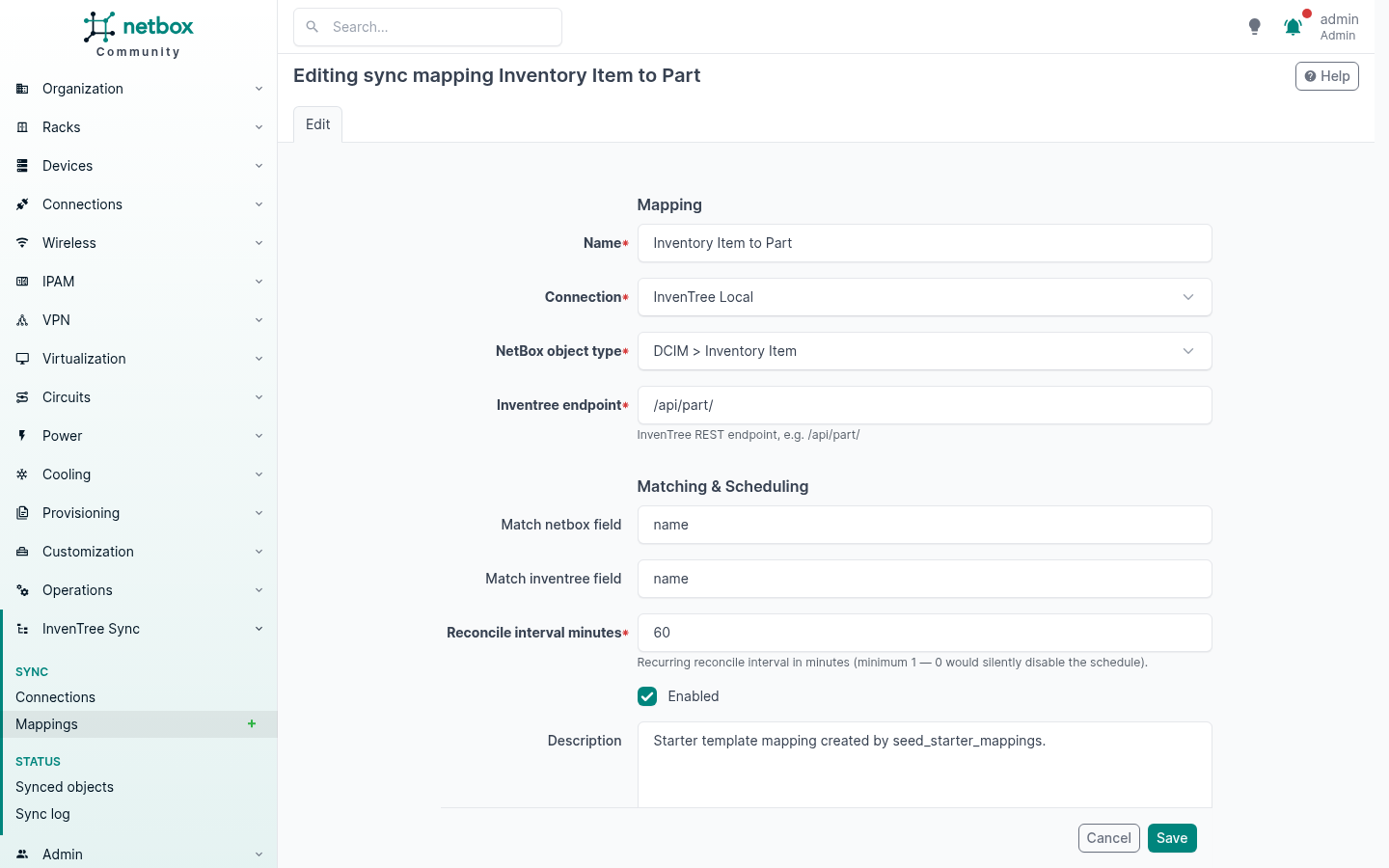
Enable a mapping — edit it in the UI (or
PATCH .../mappings/<id>/{"enabled": true}). Enabling schedules a recurring reconcile job at the mapping'sreconcile_interval_minutes(default 60); the interval schedule is replaced whenever the mapping is saved with a new interval and removed when the mapping is disabled: -
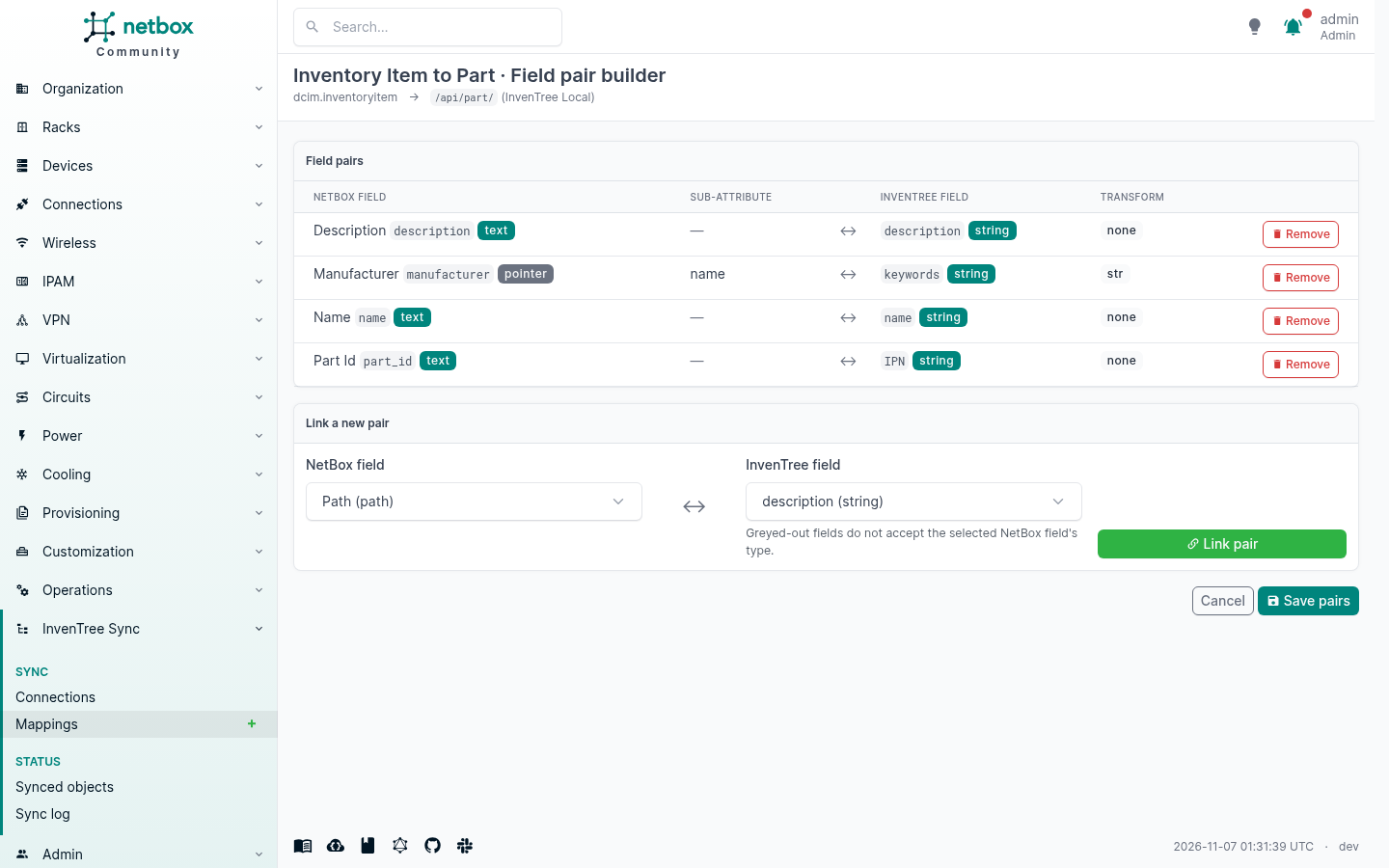
Open the mapping builder — the Field pairs tab of a mapping renders both field lists (NetBox content-type fields incl. custom fields and tags; the InvenTree endpoint's writable fields) with incompatible pairings greyed out. Saving validates server-side through the same compatibility gate as the REST API:
-
Sync now — the Sync now button on a mapping (or
POST /api/plugins/netbox_inventree_sync/mappings/<id>/sync/) enqueues a one-shot reconcile in addition to the recurring schedule. This works on disabled mappings too (deliberate): the action runs regardless of theenabledflag, so a mapping can be exercised once before its schedule and event-driven pushes are turned on:
From then on, saving a mapped NetBox object enqueues a push, and deleting one deactivates (never deletes) the remote counterpart. Status per object: Plugins → InvenTree Sync → Synced Objects; every push attempt is logged in Sync Log.
Seeing it in action
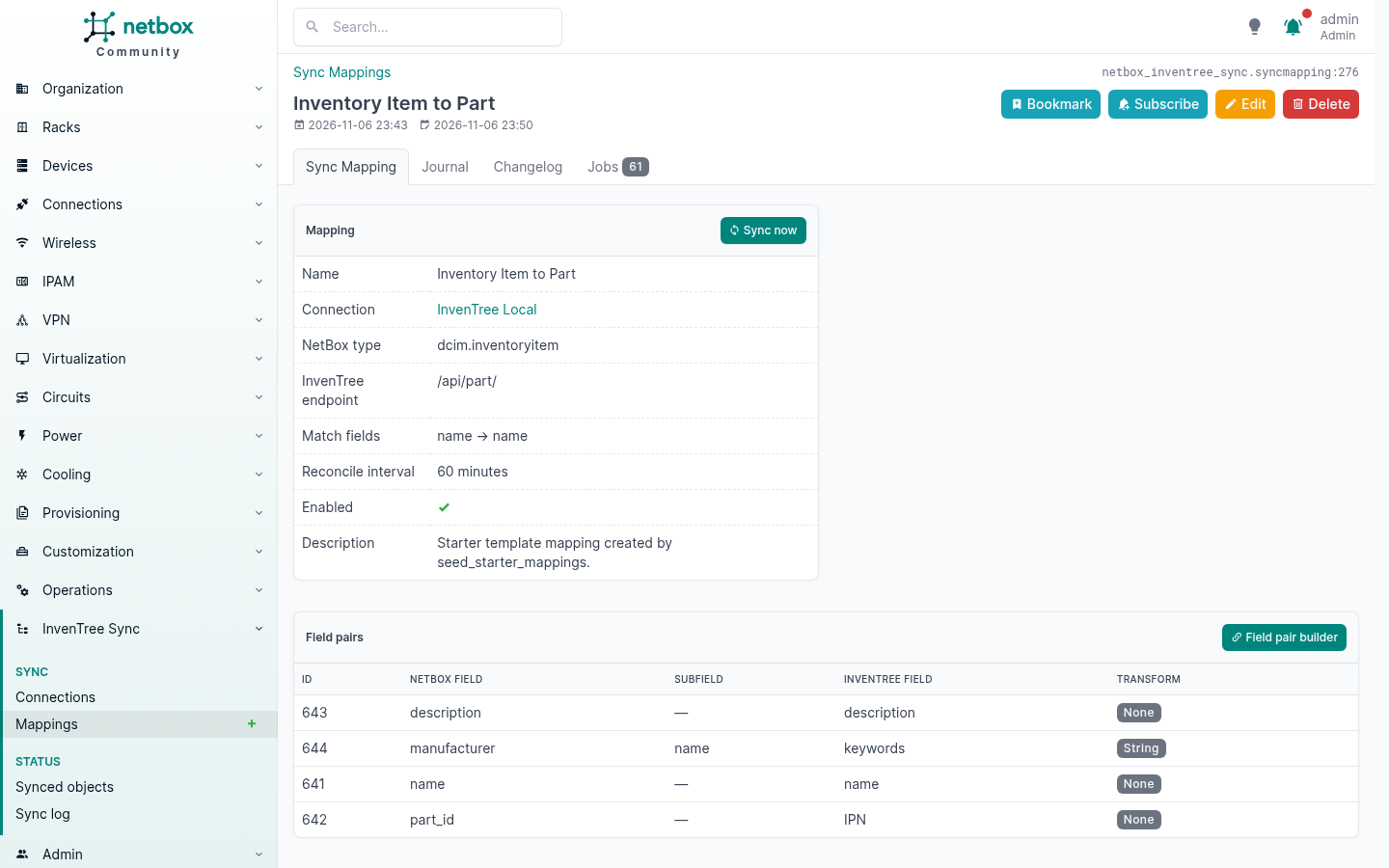
The screenshots below show how the application works, taken from the live dev stack. First, the mapping's field-pair builder: NetBox fields on the left, the InvenTree endpoint's fields on the right, linked pairs with type badges — and options whose types don't accept the selected NetBox field are greyed out (the helper line under the selects says so; the server enforces it on save). This example is the starter Inventory Item → Part mapping (name→name, part_id→IPN, description→description, and the manufacturer pointer rendered as text into keywords):
Next, one complete round trip of a sync under the Inventory Item → Part
mapping (starter field pairs: name→name, part_id→IPN,
description→description, manufacturer.name→keywords).
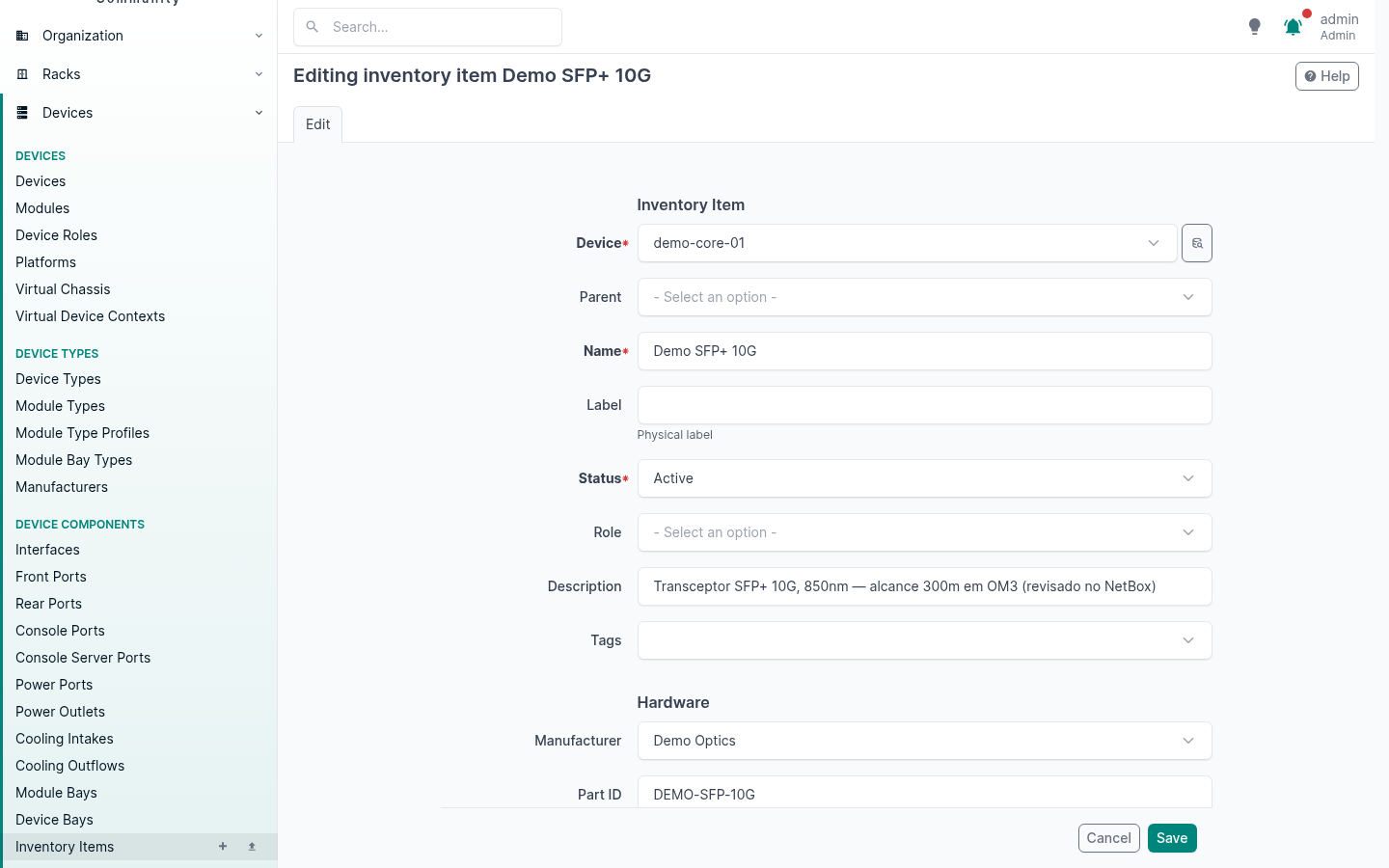
1. The modification is made in the NetBox UI — editing the
Demo SFP+ 10G inventory item and changing its Description to
"Transceptor SFP+ 10G, 850nm — alcance 300m em OM3 (revisado no NetBox)":
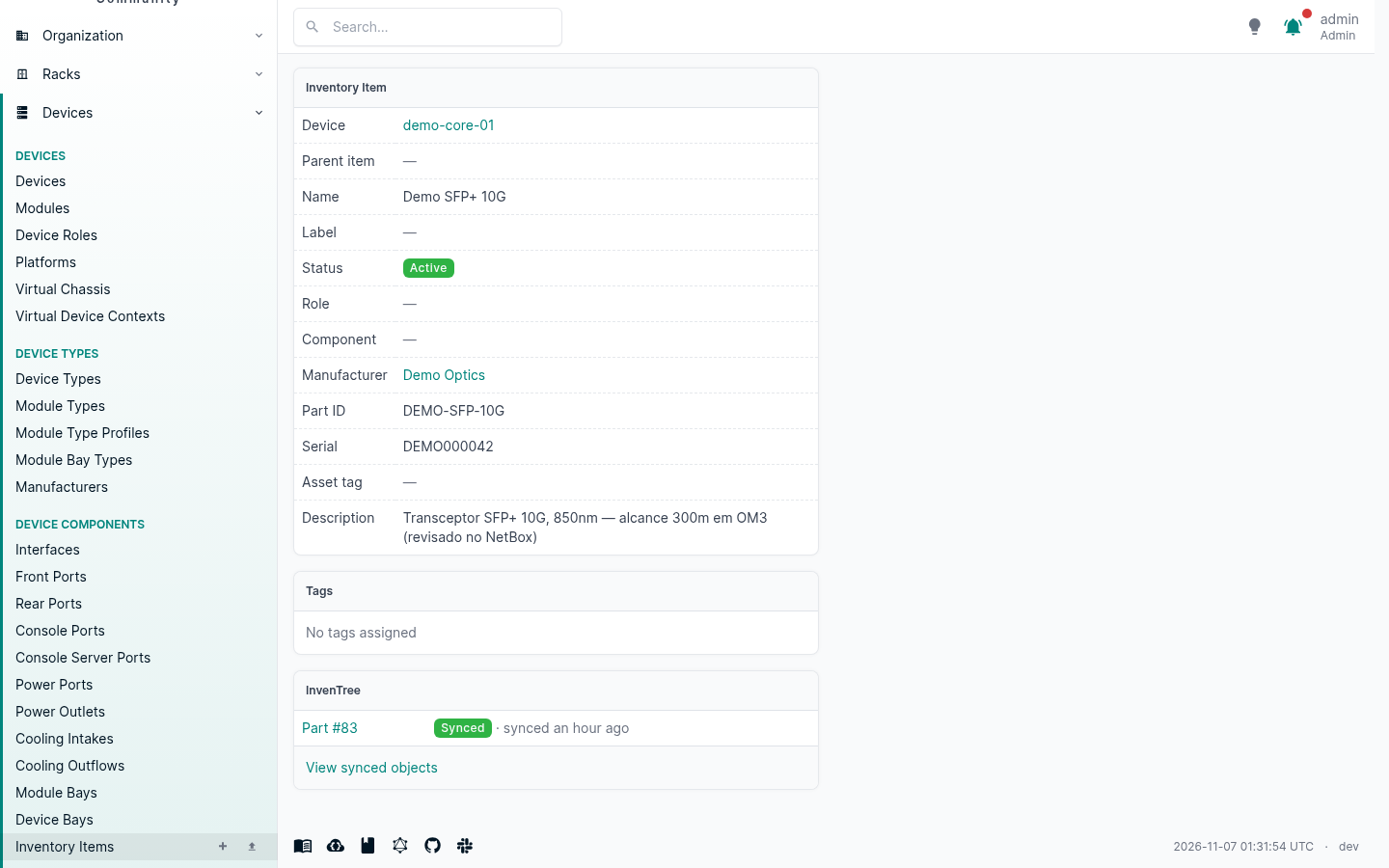
2. Saving enqueues the push — the object's detail page now shows the
InvenTree panel (added by the plugin) with the link's status: the part
was pushed and is Synced, with the InvenTree object (Part #83) one
click away:
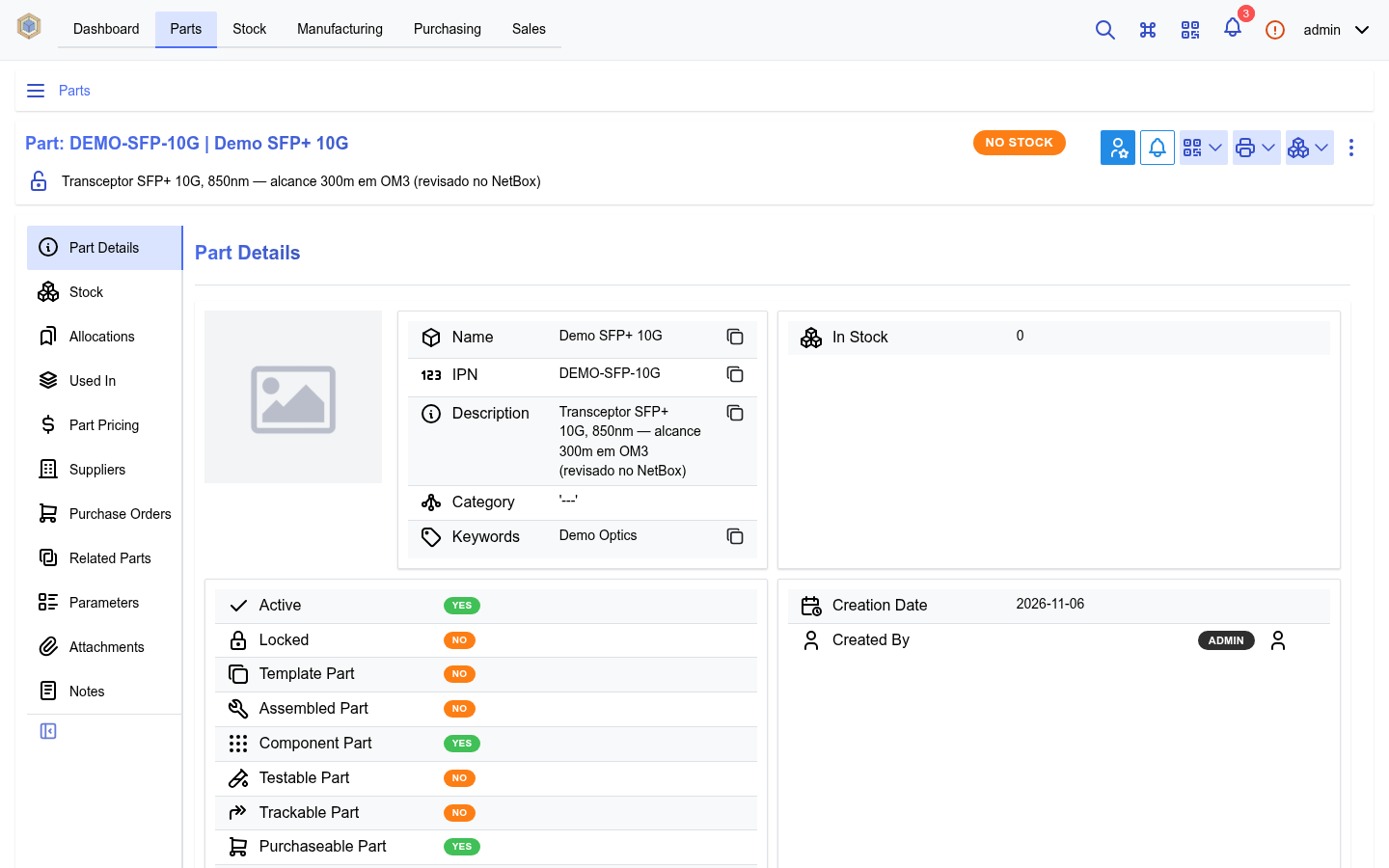
3. The change is reflected in the InvenTree UI — opening that part in InvenTree shows the description exactly as saved in NetBox (and the other mapped fields: IPN, name, and keywords carrying the manufacturer name). No one touched InvenTree — the background job pushed the edit within seconds of the save:
The same happens on create (a new mapped object publishes a new InvenTree part) and on delete (the InvenTree object is deactivated, never deleted); manual edits made directly in InvenTree are overwritten by the next push or reconcile, since NetBox is the source of truth.
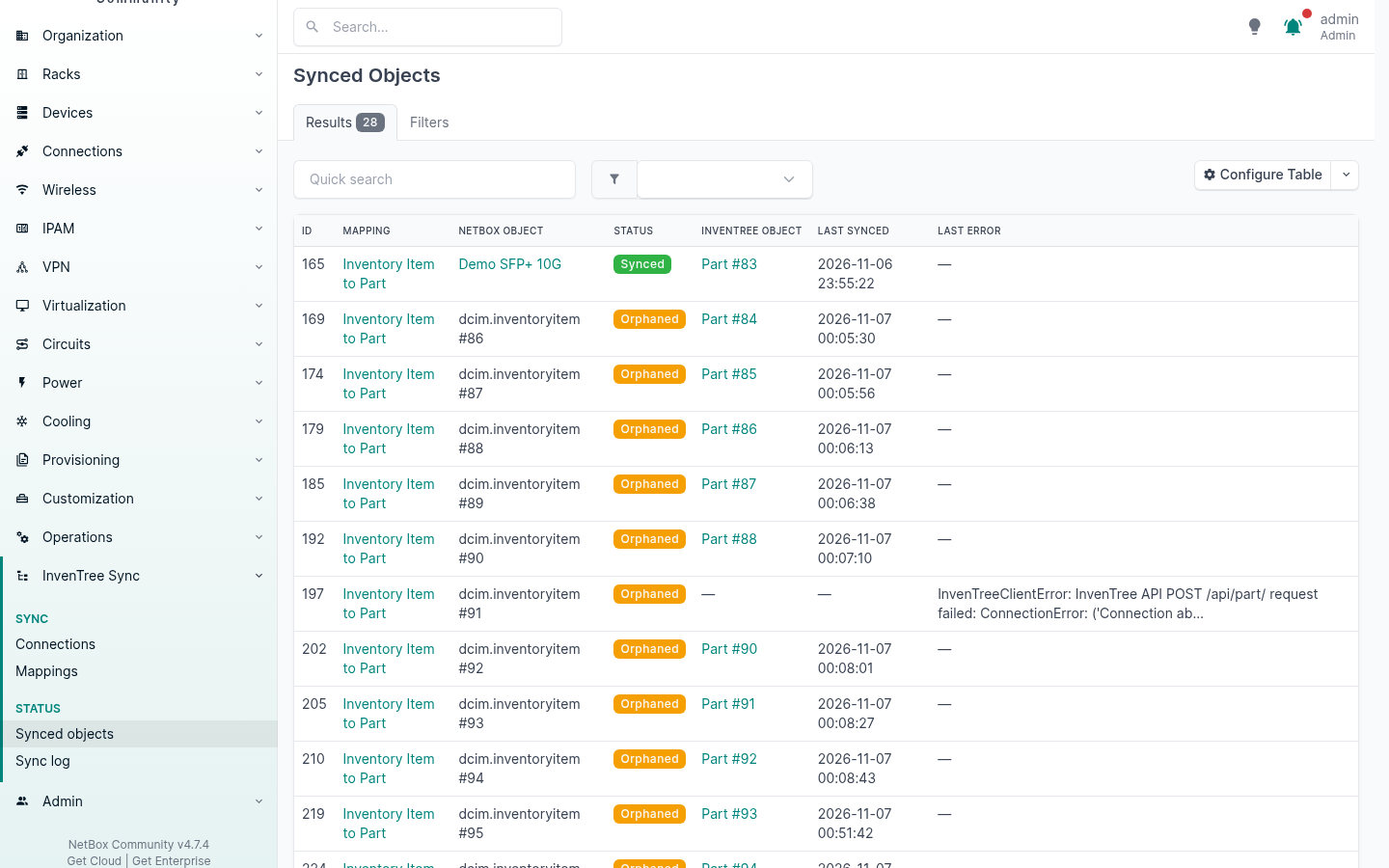
Every link is visible under Plugins → InvenTree Sync → Synced Objects, with per-object status, the InvenTree counterpart one click away, and the last error (if any) — here showing green Synced rows alongside orange Orphaned ones (links whose NetBox object was deleted):
Sync log retention:
SyncLogEntrygrows unboundedly — one row per push attempt, reconcile included. There is no automatic retention in v1; prune old rows manually if the table grows too large (e.g.SyncLogEntry.objects.filter(created__lt=...)in a shell).
Deterministic sync from the CLI
The inventree_sync management command runs the production job classes
inline (no worker round-trip) — the E2E determinism tool:
netbox/venv/bin/python netbox/netbox/manage.py inventree_sync --mapping '<name>'                     # every pending/failed link
netbox/venv/bin/python netbox/netbox/manage.py inventree_sync --mapping '<name>' --object dcim.inventoryitem:42
netbox/venv/bin/python netbox/netbox/manage.py inventree_sync --mapping '<name>' --reconcile
Exit code 1 when any processed object ended failed.
Reconcile intervals
Each enabled mapping carries reconcile_interval_minutes (default 60).
The recurring ReconcileJob authoritatively re-verifies every synced
link (drift in InvenTree is overwritten, vanished remotes re-created),
retries failed links, publishes unlinked NetBox objects through the
mapping's match/adopt policy, and orphans links whose NetBox object is
gone. Keep the interval short for busy catalogs (each pass GETs every
linked remote object).
Note on scale: the first reconcile after a mapping starts working publishes every mapped NetBox object that has no link yet — on a large catalog that is one InvenTree create per object, so expect a long first pass (and a correspondingly large first-pass sync log).
Running plugin tests
Unit suite (Django test runner, own database; hermetic — InvenTree is stubbed):
NETBOX_CONFIGURATION=netbox.configuration_test \
    netbox/venv/bin/python netbox/netbox/manage.py test netbox_inventree_sync -v 1 --keepdb --noinput
setup_netbox.sh provisions netbox/netbox/netbox/configuration_test.py
for this: it mirrors the dev config but disables DEBUG, so the Django
debug toolbar is not installed (with DEBUG = True every manage.py test
run fails at the debug_toolbar.E001 system check before any test
executes).
E2E suite (pytest, tests/e2e/) against the live pair — prerequisites:
the full stack from ./scripts/start.sh (runserver and rqworker) plus
the InvenTree containers, and NETBOX_TOKEN / INVENTREE_TOKEN in .env
(both written by the setup scripts):
cd netbox && ./venv/bin/python -m pytest ../tests/e2e -v
URLs/tokens can be overridden with NETBOX_URL, NETBOX_TOKEN,
INVENTREE_URL, INVENTREE_TOKEN environment variables. Every test
cleans up what it created in both systems (engine-created InvenTree
objects included) and isolates itself with unique e2e-<run> name
prefixes, so the suite can be re-run back-to-back. One scenario stops and
restarts the inventree-web compose service (~90 s); the async-path
scenario needs the RQ worker. Expect a full run to take 3–4 minutes
(each deterministic sync boots Django once).
Troubleshooting
- Ports: NetBox dev server on :8000, InvenTree on :1337, NetBox
Postgres on :15432 and Redis on :16379 (InvenTree's own Postgres/Redis
are not published).
docker compose psshows the backing services. - Tokens: both API tokens live in
.env(written by the setup scripts). The plugin connection stores its own copy of the InvenTree token; if you regenerate the InvenTree token, update the connection. - "Jobs cannot be assigned to this object type (… Sync Mapping)" when
enabling a mapping right after a code update: NetBox caches each
model's supported features in the
core_objecttypetable, refreshed only by thepost_migratesignal. Runnetbox/venv/bin/python netbox/netbox/manage.py migrateonce (a no-op migrate is enough) to refresh it. - Worker: signal-driven syncs and reconciles need the rqworker
(
./scripts/start.sh; verify via/api/core/background-workers/). Without it, changes only sync on the nextinventree_syncrun or reconcile. - A mapping's field pairs don't validate:
POST /mappings/and the builder validate against the endpoint's live OPTIONS metadata; an unreachable InvenTree fails the request (502 from the builder view) rather than accepting an unvalidated mapping.
Support
Issues: https://github.com/edurbs/netbox-inventree-sync/issues
Before opening an issue, check COMPATIBILITY.md for the supported NetBox / InvenTree / Python version matrix.
License
Released under the MIT license — see LICENSE.
1 maintainer

Metadata
1 maintainer
Release files for netbox-inventree-sync 0.1.3
For a detailed explanation of source distributions (sdists) and built distributions (wheels), please see the package formats documentation.
Source distribution (sdist)
| File | Size | Uploaded | Provenance | Actions |
|---|---|---|---|---|
| netbox_inventree_sync-0.1.3.tar.gz | 111.8 kB | With provenance | Details for netbox_inventree_sync-0.1.3.tar.gz |
Built distribution (wheel)
| File | Interpreter | ABI | Platform | Actions Reset |
|---|---|---|---|---|
| netbox_inventree_sync-0.1.3-py3-none-any.whl | Python 3 | none | any | Details for netbox_inventree_sync-0.1.3-py3-none-any.whl |
Total release size: 245.6 kB
Release files / netbox_inventree_sync-0.1.3.tar.gz
| Download URL | netbox_inventree_sync-0.1.3.tar.gz |
|---|---|
| Size | 111.8 kB |
| Tags | Source |
|
SHA-256 checksum How to use checksums |
54dd0ce556d235a88191be5106875b31257b954697701c44a5738d11011f1581
|
|
BLAKE2b-256 checksum How to use checksums |
22ddc8c9d1fbb883e578bb95709b1566b5a3a157f17a533fff3976579d1042ed
|
| Upload date | |
|
Uploaded using Trusted Publishing? What is trusted publishing? |
Yes |
| Uploaded via |
twine/7.0.0 CPython/3.13.16
|
Provenance
Provenance describes where a file came from. On PyPI, provenance is shared via attestations, which provide a verifiable record of the build or publishing details. View details, limitations and caveats.


PyPI Publish Attestation
PyPI verified that this artifact, at this checksum, originated from the publisher listed below.
Signed by GitHub Actions, verified by PyPI on Nov 9, 2026.
Transparency logRelease files / netbox_inventree_sync-0.1.3-py3-none-any.whl
| Download URL | netbox_inventree_sync-0.1.3-py3-none-any.whl |
|---|---|
| Size | 133.8 kB |
| Tags | Python 3 |
|
SHA-256 checksum How to use checksums |
ba875df551141bd9434c9d16e7a1bf6d6082e3e80eb9a7f2bc9b3d240fb2e781
|
|
BLAKE2b-256 checksum How to use checksums |
c1db96d47204b0aad5cb922f3ea0bc56a72a10e9c6e1b3f39d6c846ca1447df7
|
| Upload date | |
|
Uploaded using Trusted Publishing? What is trusted publishing? |
Yes |
| Uploaded via |
twine/7.0.0 CPython/3.13.16
|
Provenance
Provenance describes where a file came from. On PyPI, provenance is shared via attestations, which provide a verifiable record of the build or publishing details. View details, limitations and caveats.
PyPI Publish Attestation
PyPI verified that this artifact, at this checksum, originated from the publisher listed below.
Signed by GitHub Actions, verified by PyPI on Nov 9, 2026.
Transparency logSecurity for netbox-inventree-sync 0.1.3
Provenance
Provenance describes where a file came from. On PyPI, provenance is shared via attestations, which provide a verifiable record of the build or publishing details. View details, limitations and caveats.
Full provenance
Both files in this release have been uploaded with provenance metadata.
Attestation for netbox_inventree_sync-0.1.3.tar.gz
PyPI Publish Attestation
PyPI verified that this artifact, at this checksum, originated from the publisher listed below.
Signed by GitHub Actions, verified by PyPI on Nov 9, 2026.
Transparency logA note on package security
PyPI is a repository for distributing packages, not a service for auditing them. While third-party security researchers and our staff do their best to detect and remove malicious packages, PyPI cannot guarantee the quality, security or suitability of any given package.
To learn more about protecting yourself from malicious actors, visit our package security documentation.














