


GitHub | PyPI | Docker Image | Model Download | Dataset Download | Inference Space





Netra NMT: A Compact Bidirectional Encoder-Decoder Transformer for English-Khmer Translation
English or Khmer text in, the other language out. One 77M-parameter model for both directions, trained from scratch, that runs on a CPU without PyTorch.
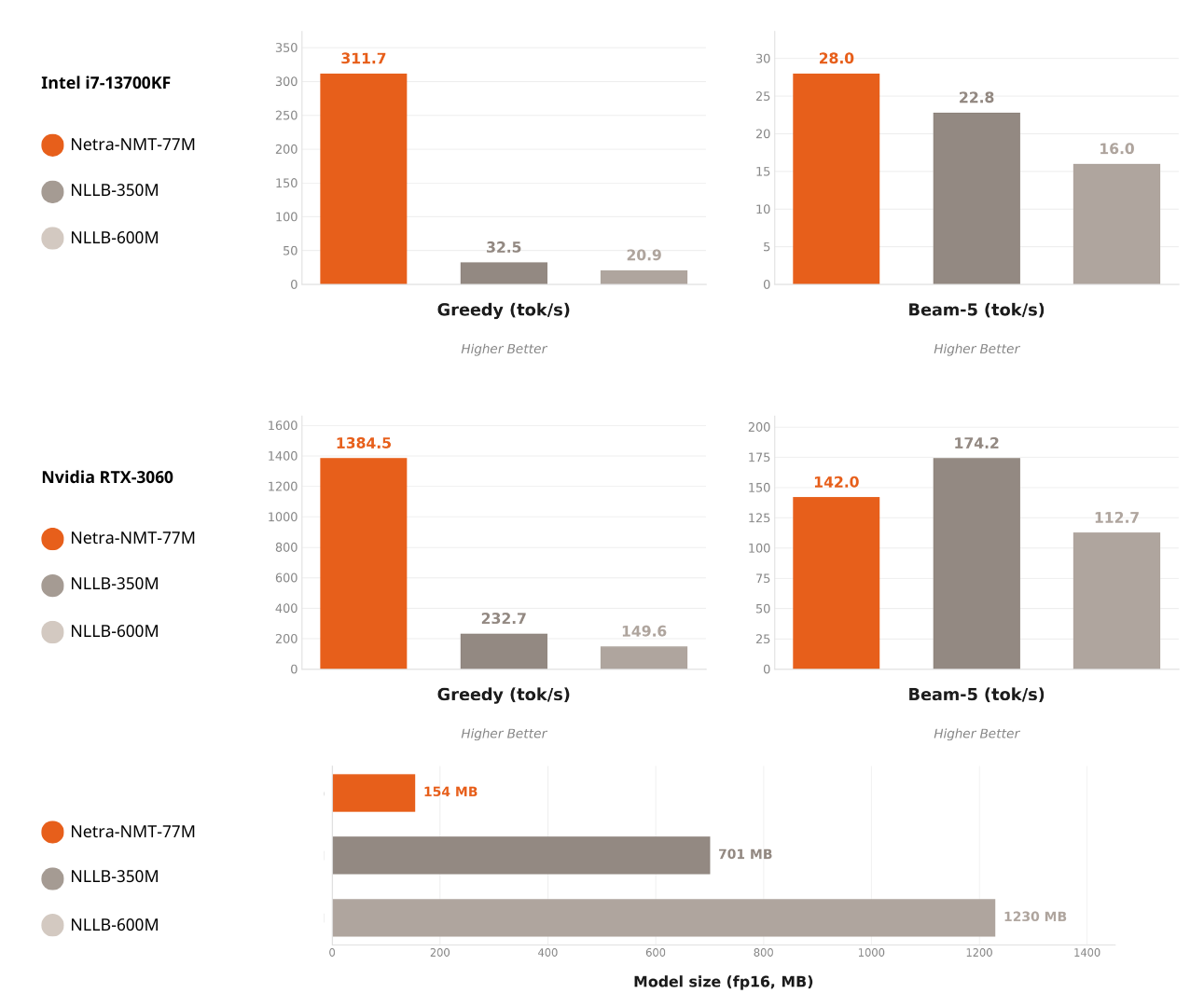
English→Khmer speed on an Intel i7-13700KF (16 threads) and an RTX 3060, greedy and beam-5, median ms per sentence over 20 sentences (PyTorch). On CPU, greedy, Netra NMT is 8–16× faster than both NLLB models; with beam-5 the gap shrinks to 1.1–2.1×, and on GPU beam-5 it trails NLLB-350M (144 vs 105 ms).
1. Abstract
This repository presents Netra NMT, a compact 77M-parameter encoder-decoder transformer for English↔Khmer translation, trained from scratch on 220 million tokens of parallel text (4.2M bidirectional examples). The encoder reads the source with bidirectional self-attention, like BERT; the decoder generates the translation with causal self-attention and cross-attention over the encoder output.
- A modern transformer recipe: rotary position embeddings (RoPE), RMSNorm with pre-normalisation, SwiGLU feed-forward blocks, and one embedding table shared by the encoder, the decoder and the tied output projection.
- Deep encoder, shallow decoder (12 and 2 layers, after Kasai et al., 2021), with a KV cache, so the part that runs once per output token is small.
- Khmer word segmentation with khmercut before a shared 32K SentencePiece vocabulary, so the tokenizer sees real word boundaries in a language written without spaces.
On the ALT test set (1,018 pairs, greedy) it scores 25.83 spBLEU English→Khmer, against 18.89 for NLLB-350M (EN-KM), 16.62 for NLLB-200 1.3B and 28.93 for Google Translate. Khmer→English is weaker: 19.47 spBLEU, against 35.15 for NLLB-200 1.3B. On CPU it translates a sentence in 65.6 ms greedy, 8× faster than NLLB-350M.
The package runs the model on ONNX Runtime: pip install "netra-nmt[cpu]" (199 MB installed, no PyTorch) and a 189 MB model download, at 39 ms per sentence greedy and 64 ms beam-5 on a desktop CPU.
2. Dataset
Netra NMT was trained on 220 million tokens from about 2.4 million unique English-Khmer sentence pairs (4.2 million examples once both directions are counted). The corpus combines LLM-generated synthetic data with web-crawled parallel text, spanning legal, literary, medical, technical and conversational domains. The cleaned bilingual set is published as Netra-Lab/bilingual-en-km.
Sources
| Dataset | Type | Pairs | Domains |
|---|---|---|---|
| Netra-Lab/khmer-english-pairs-raw (MIT) | Synthetic | 200K | Legal, literary, governmental |
| lyfeyvutha/nllb-en-km-316K | Synthetic | 316K | General |
| KrorngAI/ParaCrawl-English-Khmer-v2 | Web crawl (ParaCrawl) | 1.5M | Web, general |
| SeyhaLite/Translate-English-Khmer-All | — | 366K | General |
| Total | 2.4M |
Preprocessing
- Deduplication. Exact duplicate pairs are removed across all sources.
- Length filtering. Pairs with extreme source/target length mismatches are discarded.
- Empty removal. Pairs where either side is empty or below a minimum token count are dropped.
- English source normalisation. English is NFC-normalised, whitespace-collapsed and lowercased only when it is the
en2kmsource, so "I love Cambodia" and "i love cambodia" become the same input. English as akm2entarget keeps its casing. - Khmer word segmentation. Khmer is segmented with khmercut wherever it appears (the
en2kmtarget and thekm2ensource), matching the segmented tokenizer. Khmer output is de-segmented back to natural text at inference time.
Each surviving pair is then used in both directions with a target-language marker (<2km> / <2en>), giving about 4.2 million training examples. The whole pipeline is in training/netra_nmt_train/scripts/recipe/.
3. Model Architecture

Figure 1: The encoder (left) reads the source sentence with bidirectional self-attention; the decoder (right) generates the target sentence one token at a time with causal self-attention and cross-attention over the encoder output. Both sides share a 32K SentencePiece tokenizer.
Encoder. The source sentence, tokenized by the shared 32K SentencePiece model (Khmer word-segmented first), goes through 12 transformer layers with bidirectional self-attention. Positions are encoded by rotating queries and keys (RoPE) inside self-attention; there is no learned position table. A final RMSNorm feeds the decoder's cross-attention.
Decoder. The partly generated translation goes through only 2 layers, each with three sub-layers: causal self-attention with RoPE over the tokens so far, backed by a KV cache; cross-attention over the encoder output; and a SwiGLU feed-forward block. A final RMSNorm feeds the tied output projection. Most of the capacity lives in the encoder, which runs once per sentence; the decoder, which runs once per output token, stays cheap.
| Feature | Detail |
|---|---|
| Rotary position embeddings | Q/K rotated inside self-attention; no learned position table, no hard length cap |
| RMSNorm (pre-norm) | Root-mean-square normalisation before each sub-layer; as stable as LayerNorm and cheaper |
| SwiGLU FFN | SwiGLU activation instead of ReLU in the feed-forward blocks |
| Shared embeddings | One table for the encoder input, the decoder input and the tied output head |
| Deep encoder / shallow decoder | 12-layer encoder, 2-layer decoder (Kasai et al., 2021) |
| KV cache | Past keys and values are kept between steps, so each step only processes the new token |
| Khmer word segmentation | khmercut before SentencePiece, so the vocabulary learns real word boundaries |
| Hyperparameter | Value |
|---|---|
| d_model | 512 |
| Encoder / decoder layers | 12 / 2 |
| Attention heads | 8 |
| FFN hidden size | 2048 |
| Position encoding | Rotary (RoPE) |
| Normalisation | RMSNorm (pre-norm) |
| Vocabulary | 32K (SentencePiece unigram, shared, Khmer-segmented) |
| Total parameters | 77M |
4. Evaluation

| Direction | Metric | NLLB-350M (EN-KM) | NLLB-200 600M | NLLB-200 1.3B | MADLAD-400 3B | Google Translate | Netra NMT (77M) |
|---|---|---|---|---|---|---|---|
| EN → KM | spBLEU ↑ | 18.89 | 9.24 | 16.62 | 16.19 | 28.93 | 25.83 |
| EN → KM | chrF++ ↑ | 30.07 | 34.38 | 36.14 | 32.24 | 40.21 | 38.05 |
| EN → KM | TER ↓ | 73.89 | 78.68 | 69.90 | 101.99 | 65.56 | 60.47 |
| EN → KM | COMET ↑ | 71.28 | 76.54 | 79.68 | 79.95 | 82.74 | 78.14 |
| EN → KM | BERTScore F1 ↑ | 87.89 | 88.24 | 89.11 | 89.28 | 90.66 | 90.02 |
| KM → EN | spBLEU ↑ | 0.26 | 31.28 | 35.15 | 36.13 | 34.86 | 19.47 |
| KM → EN | chrF++ ↑ | 1.59 | 54.14 | 57.36 | 58.28 | 57.51 | 46.01 |
| KM → EN | TER ↓ | 238.81 | 55.34 | 51.14 | 51.12 | 51.14 | 69.79 |
| KM → EN | COMET ↑ | 34.74 | 84.25 | 85.87 | 86.88 | 86.48 | 77.02 |
| KM → EN | BERTScore F1 ↑ | 78.65 | 93.62 | 94.13 | 94.33 | 94.31 | 91.79 |
- Scoring. The
mutiyama/alttest split (1,018 usable pairs), greedy decoding, PyTorch. spBLEU uses the FLORES-200 tokenizer; chrF++ is chrF with word bigrams; TER on khmercut-segmented text for Khmer targets; COMET isUnbabel/wmt22-comet-da; BERTScore F1 usesxlm-roberta-base. Netra NMT was not fine-tuned on ALT. Produced byevaluate_alt.py; per-model JSON inresults/. - English → Khmer is the strong direction: the best TER of all systems, and the best spBLEU and chrF++ after Google Translate, ahead of models 4–40× larger. On the neural metrics (COMET, BERTScore) NLLB-200 1.3B and MADLAD-400 3B are slightly ahead.
- Khmer → English trails NLLB-200 600M, 1.3B and MADLAD-400 3B by 11.8–16.7 spBLEU.
- Speed. On CPU, 65.6 ms per sentence greedy against 550.8 for NLLB-350M and 1074.9 for NLLB-600M; beam-5 735.2 against 802.7 and 1567.5 (the figure above;
results/speed_hw.json). - The package is faster than the figure. netra-nmt 1.0.0 (ONNX Runtime) takes 39.1 ms per sentence greedy and 63.5 ms beam-5 on the same CPU, against 62.6 and 701.1 for the PyTorch 0.1.0 package; beam search now stops as soon as no beam can still win, with identical output.
- The package matches the evaluated model. The ONNX model folder the package runs generates the same tokens as the PyTorch model on the ALT test set, greedy and beam-5, both directions (docs/RESULTS.md).
- More results. docs/RESULTS.md: the speed tables, ONNX Runtime against PyTorch, and the parity check.
5. Install
pip install "netra-nmt[cpu]"          # CPU
pip install "netra-nmt[gpu]"          # NVIDIA GPU (onnxruntime-gpu)
# or, from a checkout:  pip install -e ".[cpu,server]"
| Extra | Adds |
|---|---|
| (none) | numpy, sentencepiece, khmercut, huggingface_hub. Install cpu or gpu too: the model needs ONNX Runtime |
cpu |
onnxruntime |
gpu |
onnxruntime-gpu (CUDA). Install instead of cpu, not with it: the two conflict |
server |
FastAPI + uvicorn for the web app and REST API (netra-nmt serve) |
full |
cpu + server |
The first translation downloads the model from Hugging Face (model/, pinned to a commit in netra_nmt/models.py) and caches it under ~/.cache/huggingface (HF_HOME):
encoder.onnx136 MB,decoder_step.onnx52 MB, tokenizer 0.9 MB: 189 MB in all (weights stored as fp16, computed in fp32).
netra-nmt download fetches it ahead of time; after that, HF_HUB_OFFLINE=1 works. The CPU is enough; with the gpu extra, CUDA is used when available (NETRA_NMT_DEVICE=cpu|cuda overrides).
6. Usage
Python. translate loads a default translator once and reuses it.
from netra_nmt import translate

translate("Hello, how are you?")                        # English -> Khmer (default)
translate("ខ្ញុំស្រលាញ់ប្រទេសកម្ពុជា។", direction="km2en")   # -> "I love Cambodia."
translate(["Good morning.", "See you tomorrow."])       # a list in, a list out
NetraTranslator holds one model for repeated use, with the decoding options:
from netra_nmt import NetraTranslator

t = NetraTranslator(device="cpu")                       # "auto" (default), "cpu", "cuda", "cuda:1"
t.translate("Good morning, my friend.", mode="beam", beam_size=5)
t.translate("Good morning, my friend.", mode="sample", temperature=0.8, top_p=0.9, seed=0)
t.translate_batch(["Good morning.", "See you tomorrow."], direction="en2km")
direction is "en2km" (English→Khmer) or "km2en" (Khmer→English); mode is "greedy" (default), "beam" or "sample". NetraTranslator(local_dir="path/to/model") runs your own exported model folder.
Command line. One sentence, a file (one sentence per line), or an interactive session.
netra-nmt --text "Hello, how are you?"
netra-nmt --text "សួស្តី, តើអ្នកសុខសប្បាយទេ?" --direction km2en --mode beam
netra-nmt --file input.txt --output output.txt --direction en2km
netra-nmt                                   # interactive (:dir, :mode, :beam, :help)
Web app. A two-pane page (source left, translation right, EN⇄KM swap), from pip install "netra-nmt[server,cpu]":
netra-nmt serve                             # http://127.0.0.1:8000
netra-nmt serve --host 0.0.0.0 --port 8080 --device cpu
Or the Docker image, with the model inside (runs offline):
docker run --rm -p 8000:8000 ghcr.io/netra-ai-lab/netra-nmt:latest
REST API. The same server answers JSON:
curl -X POST http://127.0.0.1:8000/api/translate \
  -H 'Content-Type: application/json' \
  -d '{"text": "Hello, how are you?", "direction": "en2km", "mode": "greedy"}'
# {"translation": "...", "direction": "en2km"}
GET /api/health and GET /health report readiness, and GET /api/info returns the version, the model source and the device.
Train, fine-tune and evaluate. The full recipe and the tools to fine-tune on your own pairs live in training/, a separate package with PyTorch:
bash training/setup.sh                                            # .venv with the package + the training code
bash training/check_data.sh my_pairs.tsv                          # en<TAB>km per line
bash training/finetune.sh my_pairs.tsv --name my-model            # fine-tune the published model on it
bash training/evaluate.sh published training/runs/my-model/checkpoints/best/checkpoint.pt
bash training/export.sh training/runs/my-model/checkpoints/best/checkpoint.pt   # the model folder the package runs
| Reference | |
|---|---|
| training/README.md | Setting up, data formats, fine-tuning, the full recipe, evaluation and export |
| docs/RESULTS.md | Every measured number: quality, speed (PyTorch and ONNX Runtime), the parity check |
| docs/ARCHITECTURE.md | The package, the two ONNX graphs and the model folder format |
| docs/RELEASING.md | Releasing to Hugging Face, PyPI and GHCR |
7. Limitations
- Khmer → English is the weaker direction. It trails NLLB-200 1.3B by 15.7 spBLEU on ALT. For Khmer→English quality, a larger multilingual model is the better choice when you can afford it.
- One sentence at a time. Sources are cut at 256 tokens, and long paragraphs lose quality. Split documents into sentences first (Netra-Translate does this).
- News-like domain in evaluation. ALT is Wikinews; quality on other domains (chat, legal, medical) is not measured here.
- Rare names and terms get mistranslated: in the first ALT test sentence, Khmer→English renders "Randwick Racecourse" as "Trophystic Racing Square".
8. Licensing
This project is released under the MIT License (see LICENSE).
- Weights: MIT, like the code.
- Libraries: SentencePiece and khmercut are Apache-2.0; ONNX Runtime is MIT. See THIRD_PARTY_LICENSES.md.
- Training data: Netra-Lab/khmer-english-pairs-raw is MIT. The other three sources are third-party and keep the terms of their original repos: lyfeyvutha/nllb-en-km-316K, KrorngAI/ParaCrawl-English-Khmer-v2 and SeyhaLite/Translate-English-Khmer-All (Apache-2.0). The combined Netra-Lab/bilingual-en-km passes those terms on. Check them before commercial use.
- Example data:
training/examples/pairs.tsvis 50 ALT validation pairs, CC BY 4.0 (NICT).
References
-
Deep Encoder, Shallow Decoder: Reevaluating Non-autoregressive Machine Translation
Jungo Kasai, Nikolaos Pappas, Hao Peng, James Cross, Noah A. Smith
ICLR 2021.
arXiv:2006.10369 -
RoFormer: Enhanced Transformer with Rotary Position Embedding
Jianlin Su, Yu Lu, Shengfeng Pan, Ahmed Murtadha, Bo Wen, Yunfeng Liu
arXiv:2104.09864 -
Root Mean Square Layer Normalization
Biao Zhang, Rico Sennrich
NeurIPS 2019.
arXiv:1910.07467 -
GLU Variants Improve Transformer
Noam Shazeer
arXiv:2002.05202 -
No Language Left Behind: Scaling Human-Centered Machine Translation
NLLB Team
arXiv:2207.04672
1 maintainer

Metadata
1 maintainer
Release files for netra-nmt 1.0.0
For a detailed explanation of source distributions (sdists) and built distributions (wheels), please see the package formats documentation.
Source distribution (sdist)
| File | Size | Uploaded | Provenance | Actions |
|---|---|---|---|---|
| netra_nmt-1.0.0.tar.gz | 41.1 kB | With provenance | Details for netra_nmt-1.0.0.tar.gz |
Built distribution (wheel)
| File | Interpreter | ABI | Platform | Actions Reset |
|---|---|---|---|---|
| netra_nmt-1.0.0-py3-none-any.whl | Python 3 | none | any | Details for netra_nmt-1.0.0-py3-none-any.whl |
Total release size: 76.6 kB
Release files / netra_nmt-1.0.0.tar.gz
| Download URL | netra_nmt-1.0.0.tar.gz |
|---|---|
| Size | 41.1 kB |
| Tags | Source |
|
SHA-256 checksum How to use checksums |
26c41bb47f59a1e1a30eaf395d1375e540361fe122515ca552fe49319dac1399
|
|
BLAKE2b-256 checksum How to use checksums |
8fc21ebd8a1b2e374a7c7037e1cf25a18b1cd1236faf4f2937f0ddd0a43653b2
|
| Upload date | |
|
Uploaded using Trusted Publishing? What is trusted publishing? |
Yes |
| Uploaded via |
twine/7.0.0 CPython/3.13.16
|
Provenance
Provenance describes where a file came from. On PyPI, provenance is shared via attestations, which provide a verifiable record of the build or publishing details. View details, limitations and caveats.


PyPI Publish Attestation
PyPI verified that this artifact, at this checksum, originated from the publisher listed below.
Signed by GitHub Actions, verified by PyPI on Nov 1, 2026.
Transparency logRelease files / netra_nmt-1.0.0-py3-none-any.whl
| Download URL | netra_nmt-1.0.0-py3-none-any.whl |
|---|---|
| Size | 35.5 kB |
| Tags | Python 3 |
|
SHA-256 checksum How to use checksums |
329b9e1ecb65db6e2f059c4d745c6944948a71c6db31e4bf098abcb64f600b28
|
|
BLAKE2b-256 checksum How to use checksums |
2fa3e43ffb478e20dbf4a8fd3de0c45149ce30170caed2979d4f66eb0b832e40
|
| Upload date | |
|
Uploaded using Trusted Publishing? What is trusted publishing? |
Yes |
| Uploaded via |
twine/7.0.0 CPython/3.13.16
|
Provenance
Provenance describes where a file came from. On PyPI, provenance is shared via attestations, which provide a verifiable record of the build or publishing details. View details, limitations and caveats.
PyPI Publish Attestation
PyPI verified that this artifact, at this checksum, originated from the publisher listed below.
Signed by GitHub Actions, verified by PyPI on Nov 1, 2026.
Transparency logSecurity for netra-nmt 1.0.0
Provenance
Provenance describes where a file came from. On PyPI, provenance is shared via attestations, which provide a verifiable record of the build or publishing details. View details, limitations and caveats.
Full provenance
Both files in this release have been uploaded with provenance metadata.
Attestation for netra_nmt-1.0.0.tar.gz
PyPI Publish Attestation
PyPI verified that this artifact, at this checksum, originated from the publisher listed below.
Signed by GitHub Actions, verified by PyPI on Nov 1, 2026.
Transparency logA note on package security
PyPI is a repository for distributing packages, not a service for auditing them. While third-party security researchers and our staff do their best to detect and remove malicious packages, PyPI cannot guarantee the quality, security or suitability of any given package.
To learn more about protecting yourself from malicious actors, visit our package security documentation.














