

AkaraAlpha: An Efficient Romanized Khmer-Khmer Script Transliteration Model
Overview
An English–Khmer transliteration system built on an Attention-Based Bidirectional GRU architecture. The model automatically converts romanized Khmer text written in the Latin alphabet into its corresponding Khmer script form. To enhance accuracy and ensure linguistic validity, the system incorporates a Khmer dictionary-based post-processing step for proof checking and correction.
Dataset
The dataset used in this project was sourced from the Khmer Text Transliteration Dataset by Chhunneng (2023), which provides parallel pairs of English–Khmer transliterations for machine learning research.
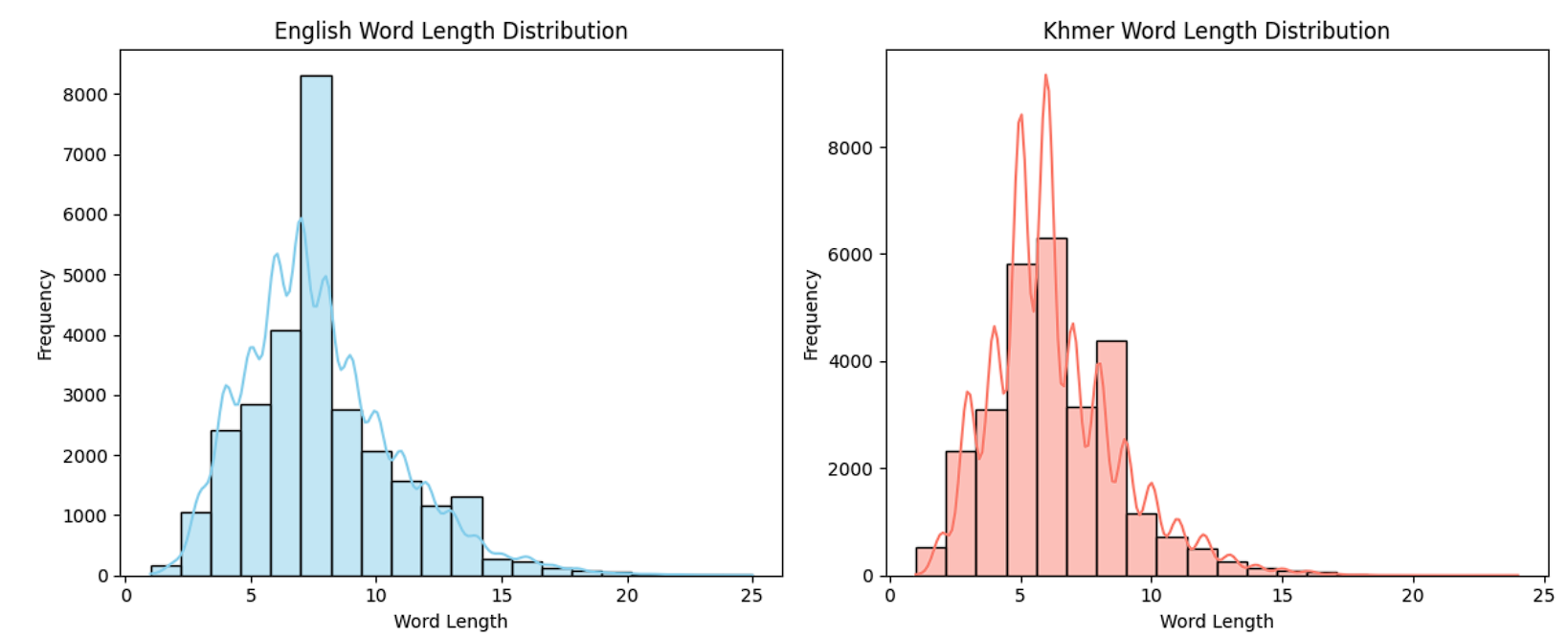
There are 77 unique Khmer characters and 26 unique English characters in the dataset. The maximum sequence length for English (romanized Khmer) inputs is 25 characters, while the maximum Khmer output length is 24 characters.
- Total Samples: 28,569
- Train Set: 22,855 (80%)
- Validation Set: 5,714 (20%)
- Format: Parallel text pairs (
brodae: ប្រដែ)
Model Architecture
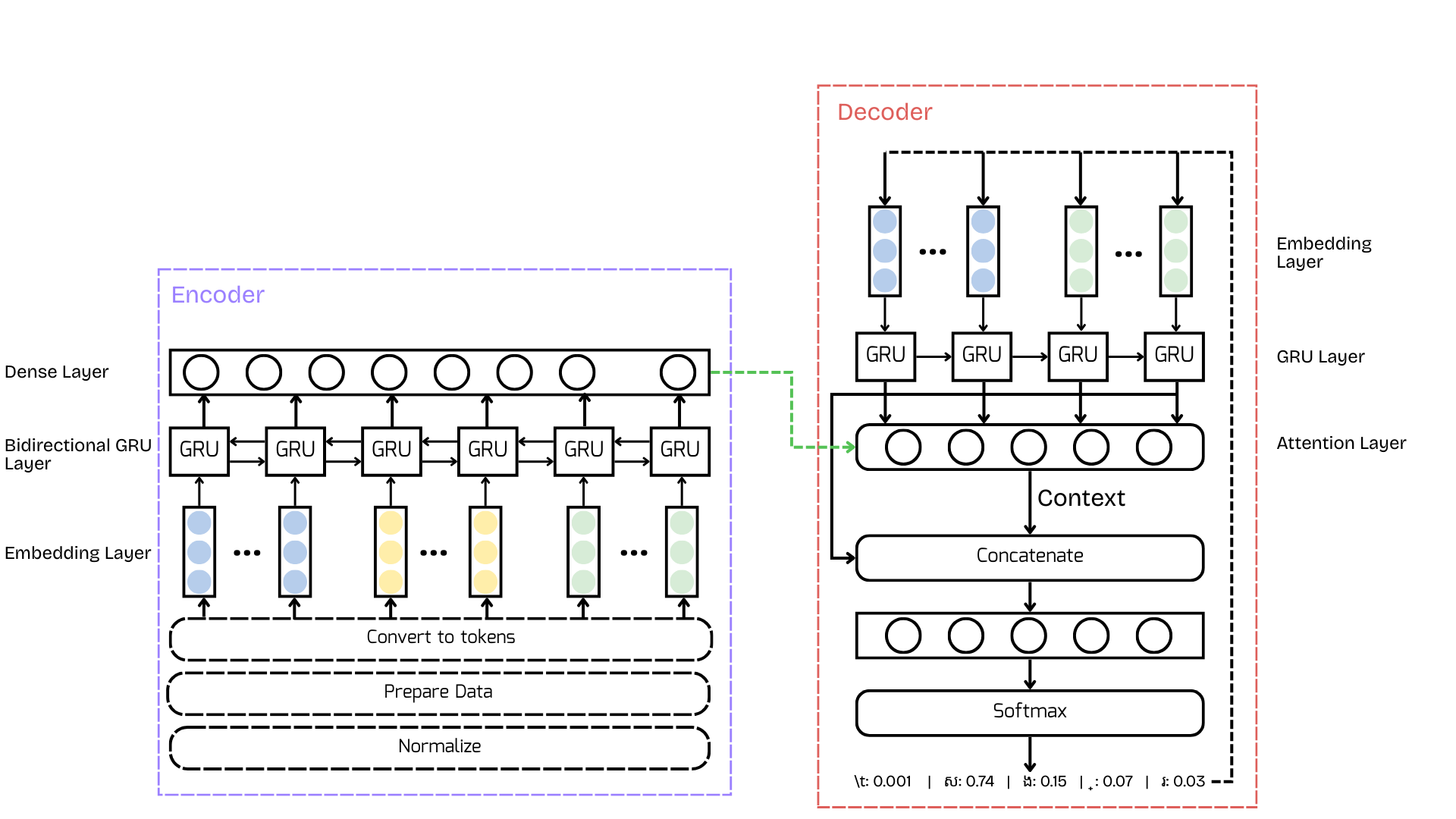
The model is based on an Attention-Based Bidirectional GRU architecture designed for sequence-to-sequence transliteration. It follows an encoder–decoder structure, where the encoder processes the input Latin Script (English) sequence, and the decoder generates the corresponding Khmer script sequence character by character.
Encoder
The encoder uses a Bidirectional GRU layer to process text from both start and end directions within the input sequence. This allows the model to better understand dependencies across the entire input text, which is particularly useful for transliteration tasks where phonetic relationships depend on both preceding and succeeding characters.
Each input token is first mapped into a continuous vector space through an embedding layer, which converts discrete character indices into dense embeddings of dimension 32. The bidirectional GRU then encodes these embeddings into a hidden state representation that encapsulates forward and backward context information.
Decoder
The decoder consists of a GRU layer that processes the output sequence one Khmer character at a time. At each decoding step, it receives the previously predicted token and the projected hidden state from the encoder. The attention mechanism then combines the encoder’s output representations with the decoder’s current hidden state to generate a context vector, which helps the model focus on the most relevant parts of the input sequence. This context vector is concatenated with the decoder’s GRU output and passed through a dense softmax layer to produce the final character prediction.
- Embedding Dimension: 32
- GRU Units: 64
- Attention Mechanism: Additive Attention
Training Configuration
- Batch Size: 64
- Epochs: 50
- Validation Split: 20%
- Optimizer: Adam
- Loss Function: Sparse Categorical Crossentropy
- Learning Rate Scheduler: ReduceLROnPlateau (factor=0.5, patience=3)
Post-Processing Technique
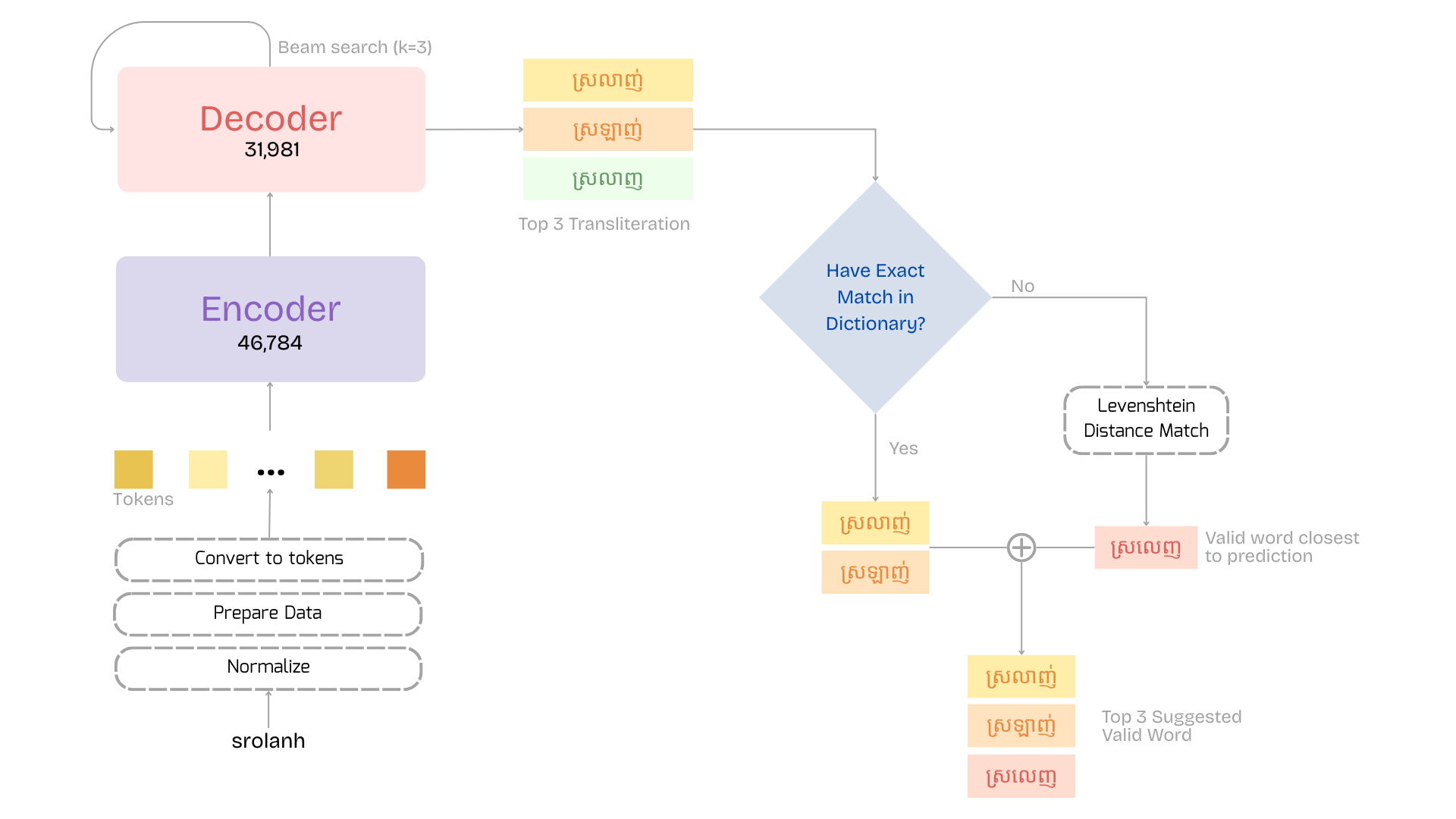
To maximize accuracy without adding model bloat, our post-processing pipeline ensures all outputs are valid Khmer words. The model first generates three candidate transliterations using Beam Search (k=3). These are cross-referenced with a standard dictionary; if no exact match exists, a Levenshtein distance fallback corrects the prediction to the closest valid word (up to a 2-character edit limit).
Results and Analysis
1. Evaluation Metrics - CER
To evaluate the performance of the model, Character Error Rate (CER) was used. CER quantifies the number of errors at the character level, providing a direct measure of the model's accuracy in converting individual Romanized graphemes to their corresponding Khmer script. It is calculated as:
$$CER = \frac{S + D + I}{N}$$
where $S$ represents the number of substitutions, $D$ is the number of deletions, $I$ is the number of insertions, and $N$ is the total number of characters in the ground truth sequence. A lower CER indicates higher accuracy in the transliteration output.
2. Evaluation Metrics – Top-1 and Top-k Hit Accuracy
Additionally, to evaluate the post-processing technique, we also assess word-level accuracy by measuring the Top-1 and Top-k hit accuracy. We define Top-1 accuracy as the percentages of test samples where the highest-ranked candidates produced by the system exactly matches the ground truth:
$$Top - 1 = \frac{1}{M} \sum_{i=1}^{M} (\hat{y}_{i,1} = y_i)$$
where $M$ is the total number of test samples, $y_i$ is the ground truth, and $\hat{y}_{i,1}$ is the number 1 ranked candidate produced by the system.
Top-k Hit accuracy measures the frequency with which the correct Khmer word appears within the list of $k$ candidates generated by the system:
$$Top - k = \frac{1}{M} \sum_{i=1}^{M} (y_i \in {\hat{y}{i,1}, \hat{y}{i,2}, \hat{y}{i,3}, \dots, \hat{y}{i,k}})$$
3. Quantitative Analysis
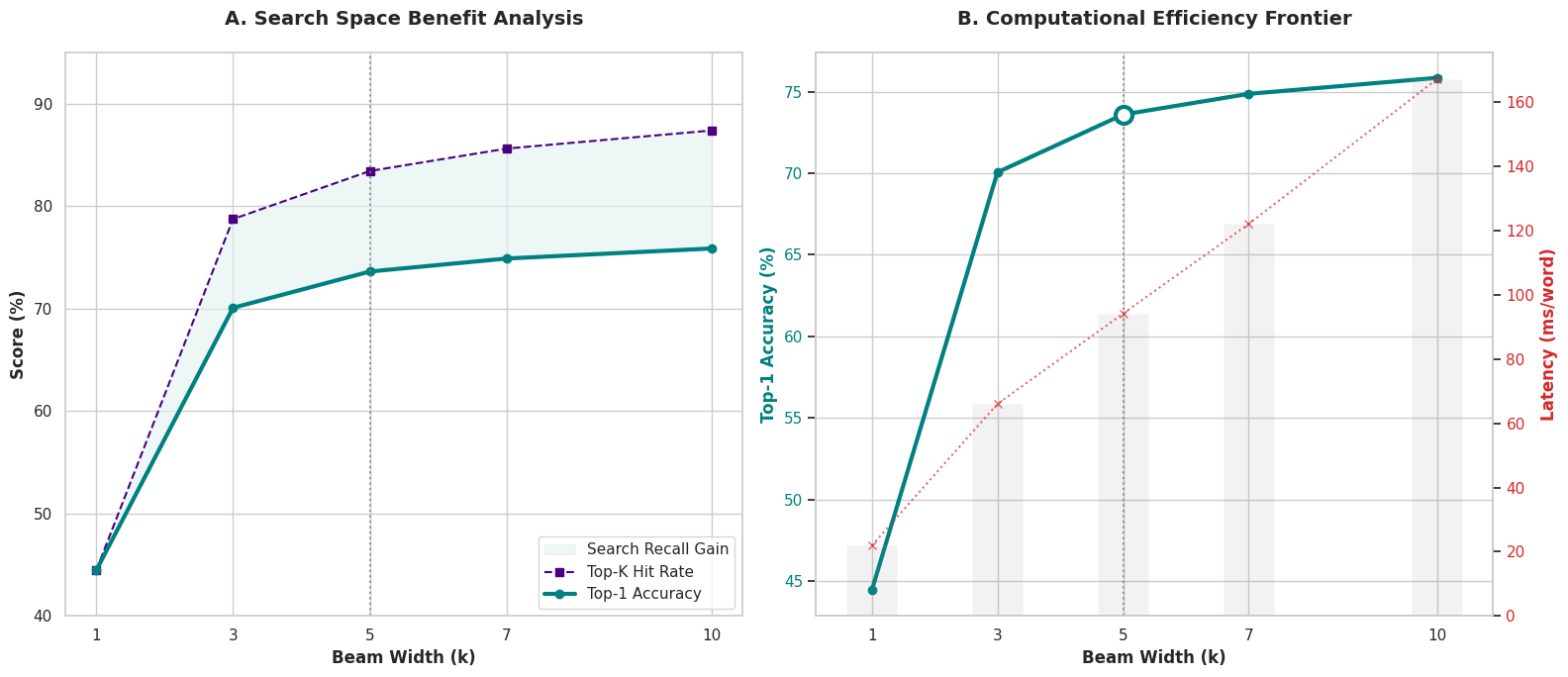
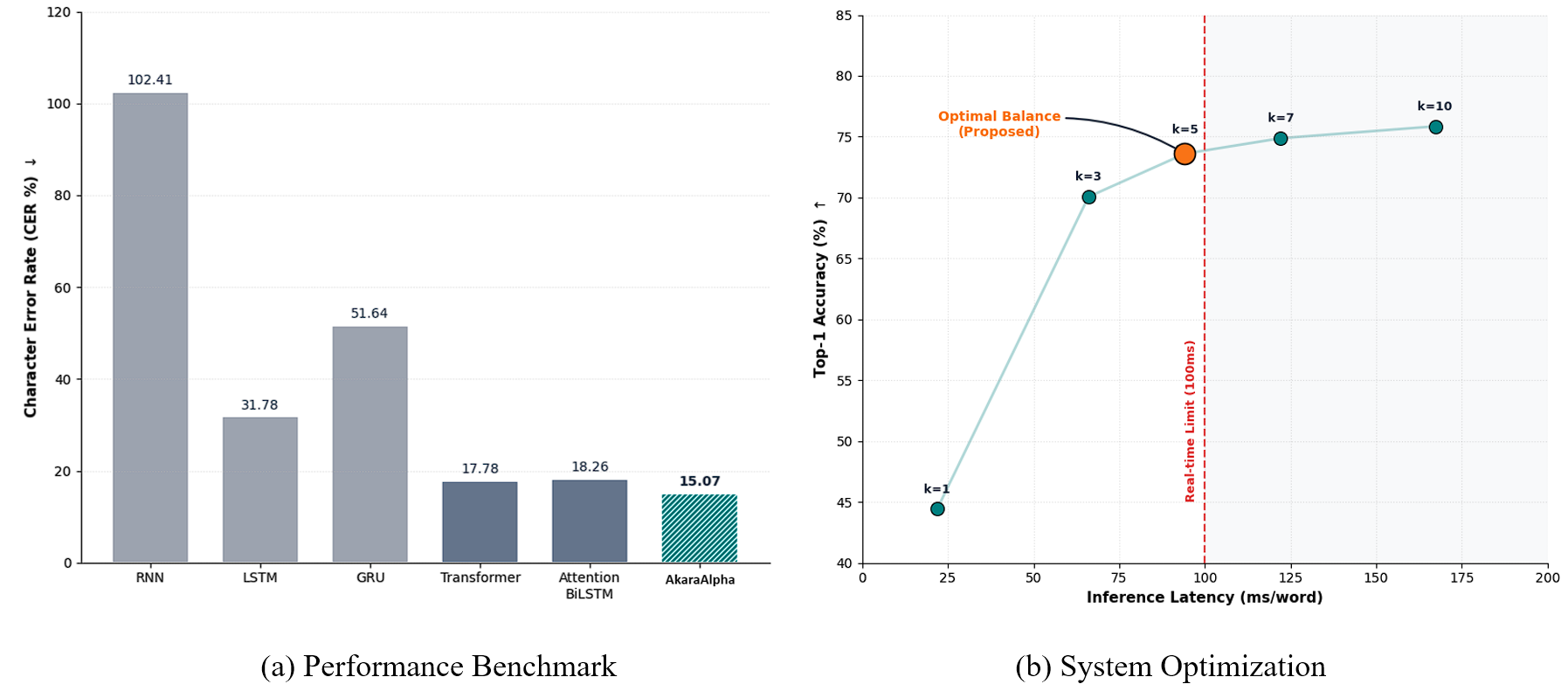
Table 1 | Model comparison on the validation set using Character Error Rates (CER %). Lower CER indicates better performance. The Lowest CER is bold and the second lowest is italicize.
| Model | CER (%) | Parameters |
|---|---|---|
| RNN | 102.41 | 42,609 |
| LSTM | 31.78 | 58,417 |
| GRU | 51.64 | 46,385 |
| Transformer | 17.78 | 248,337 |
| Attention BiLSTM | 18.26 | 96,753 |
| AkaraAlpha | 15.07 | 78,705 |
Table 2 | Performance comparison of system configuration. A comparative analysis of Top-1 accuracy, Top-K hit rate, and average inference latency across greedy decoding and varying beam search widths (k)
| Configuration | Top-1 | Top-K Hit | Latency (ms/word) |
|---|---|---|---|
| Greedy Decoding | 44.44% | 44.44% | 21.92 |
| K=3 | 70.06% | 78.72% | 66.03 |
| K=5 | 73.60% | 83.41% | 94.15 |
| K=7 | 74.87% | 85.60% | 122.10 |
| K=10 | 75.85% | 87.37% | 167.21 |
4. Qualitative Analysis
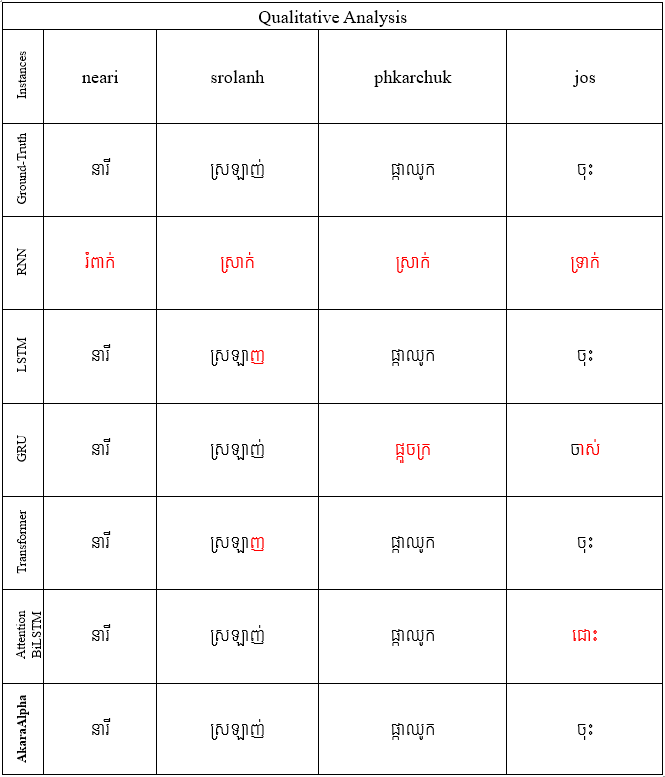
Table 3 | Qualitative comparison across all model showing model performance across various instances of Romanized Khmer Script ranging from short to long words.
Installation
From PyPI (recommended):
pip install netra-transliterate
From source:
git clone https://github.com/NDarayut/english-khmer-transliteration.git
cd english-khmer-transliteration
pip install -e .
Usage
Python API
1. Single best transliteration
from khmer_transliterator import transliterate

print(transliterate("brodae"))
# 'ប្រដែ'
2. Top-N candidates (raw model output)
from khmer_transliterator import transliterate_top_n

print(transliterate_top_n("brodae", n=3))
# ['ប្រដែ', 'បរដែ', 'ប្រតែ']
3. Top-N candidates with dictionary validation
from khmer_transliterator import transliterate_with_dict

print(transliterate_with_dict("brodae", n=3))
# ['ប្រដែ', 'រដែ', 'ប្រែ']
The Transliterator class is also available for explicit instantiation:
from khmer_transliterator import Transliterator

t = Transliterator()
print(t.transliterate("brodae"))
Note: The Keras model loads lazily on the first call (~1–2 s one-time cost).
Command Line
usage: netra-transliterate [-h] [-n N] [--no-dict] [--shell] [--serve] [--port PORT] [WORD ...]
Transliterate words directly:
netra-transliterate brodae
# brodae    ប្រដែ

netra-transliterate brodae sokha -n 3
# brodae:
#   1. ប្រដែ
#   2. រដែ
#   3. ប្រែ
# sokha:
#   1. សុខា
#   ...
Interactive shell:
netra-transliterate --shell
# or just:
netra-transliterate
Skip dictionary post-processing:
netra-transliterate brodae --no-dict
Web server:
netra-transliterate --serve
# Starting web server at http://localhost:5000

netra-transliterate --serve --port 8080
Web Application
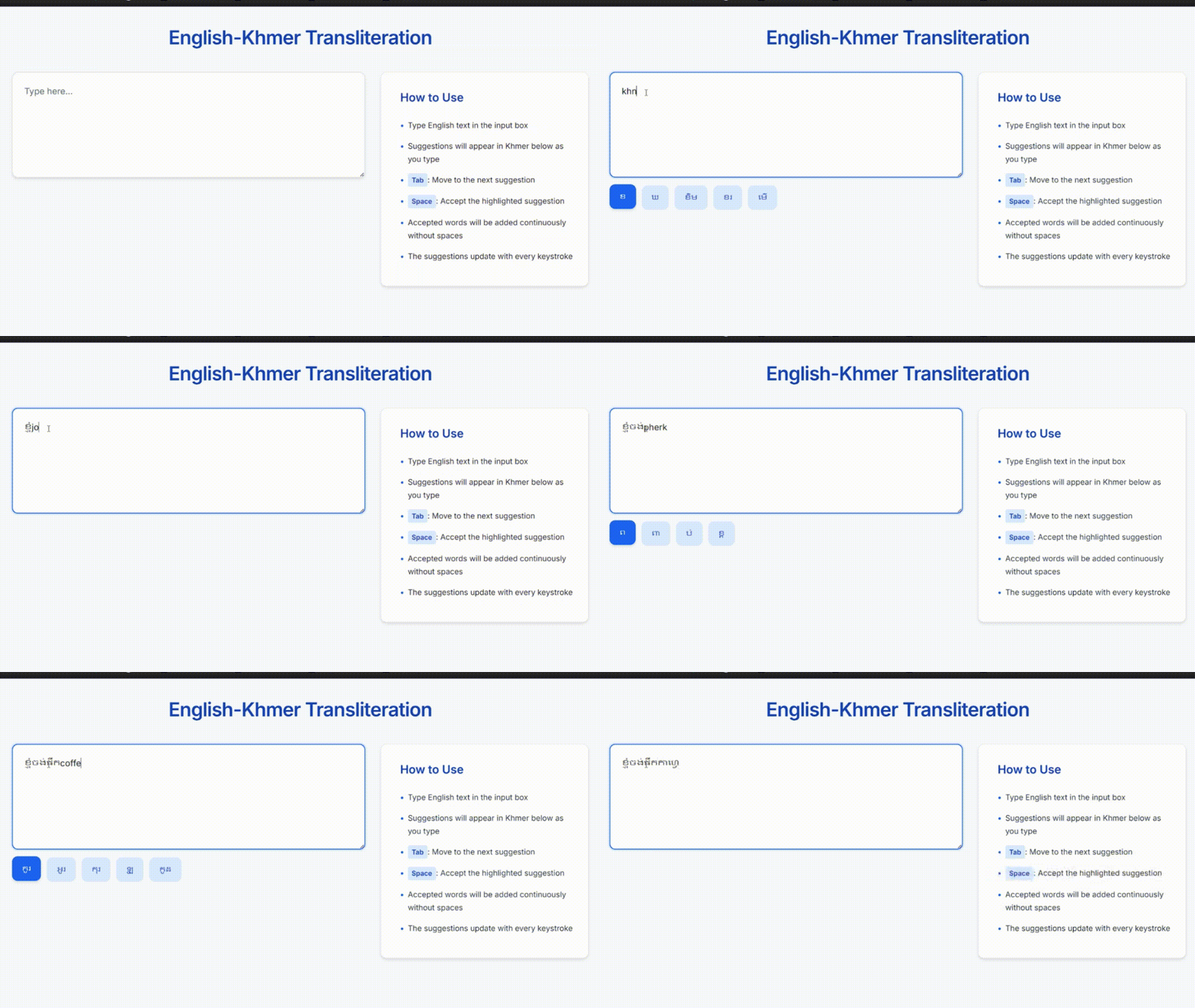
A browser-based UI is bundled with the package. Start it with:
netra-transliterate --serve
Then open http://localhost:5000 in your browser. Type a romanized Khmer word to see live suggestions; use Tab to cycle through candidates and Space to accept one.
Demo
Citation
Chhunneng. (2023). Khmer Text Transliteration Dataset. GitHub repository.
Available at: https://github.com/Chhunneng/khmer-text-transliteration
1 maintainer

Release files for netra-transliterate 1.0.1
For a detailed explanation of source distributions (sdists) and built distributions (wheels), please see the package formats documentation.
Source distribution (sdist)
| File | Size | Uploaded | |
|---|---|---|---|
| netra_transliterate-1.0.1.tar.gz | 1.1 MB | Details |
Built distribution (wheel)
| File | Interpreter | ABI | Platform | Reset |
|---|---|---|---|---|
| netra_transliterate-1.0.1-py3-none-any.whl | Python 3 | none | any | Details |
Total release size: 2.2 MB
Release files / netra_transliterate-1.0.1.tar.gz
| Download URL | netra_transliterate-1.0.1.tar.gz |
|---|---|
| Size | 1.1 MB |
| Tags | Source |
|
SHA-256 checksum How to use checksums |
3c3f861742a9d305b8b33666172a80d125add257f437e5a849bbbe900d9e6bc8
|
|
BLAKE2b-256 checksum How to use checksums |
ac7fe617a45810fca5521c12e967b361c84711500199e6da9aa3330b785a12d1
|
| Upload date | |
|
Uploaded using Trusted Publishing? What is trusted publishing? |
No |
| Uploaded via |
twine/6.2.0 CPython/3.11.9
|
Release files / netra_transliterate-1.0.1-py3-none-any.whl
| Download URL | netra_transliterate-1.0.1-py3-none-any.whl |
|---|---|
| Size | 1.1 MB |
| Tags | Python 3 |
|
SHA-256 checksum How to use checksums |
6878e5ad5e6b756c823a3dd752f4f4987a46c9a4817d5b96aafbe0470a664219
|
|
BLAKE2b-256 checksum How to use checksums |
23b28604dc4c7c60665938469ef00a6d4bf02642fcb27fca2107c4a2a332e7a0
|
| Upload date | |
|
Uploaded using Trusted Publishing? What is trusted publishing? |
No |
| Uploaded via |
twine/6.2.0 CPython/3.11.9
|














