
A Linux engine for deterministic nftables firewall testing inside isolated network namespaces.






Why NSE? • Oracle contract • Wire assertions • Features • Requirements • Installation • Quickstart • Examples • How It Works • Project Structure
Why NSE?
Testing firewall rulesets on a live Linux system poses significant risks: malformed rules can drop SSH management sessions, leak cleartext traffic during testing, or leave orphan firewall tables active on the host.
Network Sandbox Engine (NSE) provides a safe, reproducible testing harness. It constructs ephemeral Linux network namespaces, wires virtual ethernet pairs, compiles nftables rulesets, and injects synthetic Layer 2 and Layer 3 packets using Scapy. All evaluation happens inside the sandbox namespace: host firewall state is never altered.
Key architectural properties:
- The host firewall is never touched: the ruleset under test is loaded only inside the sandbox namespaces. What a run does create on the host is temporary and declared; see What a run changes on the host.
- Self-verifying Oracle: Every run injects a canary packet before the test packets and again after them, and reports a result only if the kernel trace for both was observed. See The oracle contract.
- Dual-Stack and Topologies: Native support for IPv4 and IPv6 traffic, plus multi-namespace Gateway topologies for router, NAT, and forwarding ruleset validation.
- Small, auditable surface: One package, no web server, no JavaScript, with 98% test coverage enforced by a ratchet.
What a run changes on the host
| Changed | Not changed |
|---|---|
Network namespaces nse_* (/var/run/netns) |
The host's nftables or iptables ruleset |
The host end of each veth link (vhr-*), with its addresses |
Host sysctls: forwarding and DAD settings are set inside the namespaces |
| In the gateway topology, routes to the sandbox subnets via that link | Existing interfaces, addresses and routes |
Ownership journals and locks under /run/nse |
Anything outside the run's own records |
With create_namespace(..., isolated_host=True) the host end of the link is not
in the host either: it goes into a namespace of its own, nsh_<name>, created and
removed with the sandbox. By default, traffic from the sandbox to the host end
is local input for the host and crosses the host's own firewall. firewalld, for
one, drops it. NSE warns when the host ruleset may filter it; see
the host endpoint.
Every one of these is recorded in an ownership journal before it is created, and removed at teardown, or by the next NSE start if a run was killed. Processes still running in a sandbox namespace are stopped before it is deleted.
Setup refuses to start rather than shadow anything: an interface name already in use, or a sandbox subnet overlapping an existing host route, is an error before the kernel is touched. A cleanup that cannot prove ownership preserves the resource and says so.
Requires root
NSE creates network namespaces, loads nftables rulesets and reads kernel trace events, so it runs as root. It does not open a socket, a port or an RPC endpoint of any kind — it is a library and a CLI that you invoke, and it holds privileges only for the duration of a run.
Version 2.1.0 removed the FastAPI/Svelte web interface that earlier releases
shipped. That interface ran in-process as root from 2.0.0 onward, which was a
large attack surface for a testing tool; the code remains in the git history at
tag v2.0.0 if you need it.
The oracle contract
A firewall test is a negative assertion — "this packet did not get through" — and a negative assertion is worth nothing unless the instrument is known to be working. A trace monitor that never attached to the kernel and a firewall that blocked everything produce byte-identical output.
NSE therefore refuses to report a verdict it cannot show it measured:
| Guarantee | Mechanism |
|---|---|
| The monitor was attached before the first test packet | A readiness canary is injected and re-injected until its kernel trace is observed. No observation, no run. |
| The monitor was still attached after the last one | A liveness canary runs after injection. If it is missed, the verdict stream is declared truncated. |
| The parser understood what the kernel said | Trace lines that no pattern matches are counted, and any count above zero is an error rather than a debug log. |
| The monitor did not die quietly | The read loop records why it ended — clean stop, unexpected EOF, timeout or crash — and only a clean stop is acceptable. |
| A missing verdict is not a pass | The CLI runner fails when the number of observed verdicts differs from the number expected, in either direction. |
Canary packets are excluded from results by trace id, so they never appear in your verdict stream.
The suite proves this holds, rather than asserting it: make test-blind forces
the parser to understand nothing, and the build fails unless the runner exits
non-zero. That job runs in CI on every push.
Asserting on the wire
nft monitor trace reports what the ruleset decided. It cannot report what
left an interface the ruleset never matched on, which is the question a
zero-leak claim actually asks. PCAPAsserter covers that: it captures on a
named interface, so a test can assert that a stimulus produced no frame.
from nse import PCAPAsserter

asserter = PCAPAsserter(iface="vhr-...")
await asserter.start()   # returns once the kernel socket is filtering and bound
# ... send the stimulus ...
leaked = await asserter.stop()   # raises CaptureError if the capture broke
assert not leaked, leaked
stop() raises when the capture itself failed, and stop_report() says
whether the window was complete. Long captures can go to a PCAP file with
bounded memory. For an interface in another namespace, pass netns=: only the
capture thread enters it.
None of that proves the capture was watching the path the stimulus took.
Readiness means the socket was armed on that interface; it does not mean the
stimulus crosses it. That evidence is the caller's to provide: capture the
stimulus once where it must be seen, and require it to be seen before
asserting its absence. examples/broken_observer.py
shows the claim "nothing leaves" passing on the wrong interface, and its
positive control rejecting it.
The default filter suppresses link-local noise, and nothing else.
DEFAULT_FILTER excludes ARP and ICMPv6 types 133-137 - Neighbour Discovery,
which carries a hop limit of 255 and cannot reach a remote observer. Everything
else is captured, including ICMPv6 echo to a globally routable address. A
filter argument is combined with that default; replace_default_filter=True
uses yours alone. The escape hatch exists because the filter is compiled into
BPF and evaluated in the kernel: a packet it excludes never reaches userspace,
so no consumer can recover it downstream. Until 2.1.2 the default read not arp and not icmp6, which discarded routable ICMPv6 as well - see
issue #14.
Features
- In-Process Engine: Direct Python API (
run_test_pipeline) returning structured Pydantic models (TestRequest,TraceEvent). - Scapy Packet Injection: Forge arbitrary TCP (with custom SYN, ACK, FIN, RST flags), UDP, ICMP, and ICMPv6 packets.
- Isolated Topologies:
- Simple: Single sandbox namespace (
nse_<id>) wired directly to the host. - Gateway: Router (
nse_router_<id>) and Server (nse_server_<id>) chain for forwarding and NAT testing.
- Simple: Single sandbox namespace (
- Wire-level Leak Assertions:
PCAPAssertercaptures on a named interface so a test can assert that a stimulus produced no frame at all. See Asserting on the wire. - Ownership-aware Cleanup: Private journals and owner locks protect active runs. Startup recovery removes only verified abandoned resources; prefix matches without ownership evidence are preserved. Failed teardowns retain their records for retry. See Namespace lifecycle.
- CLI YAML Test Runner: Execute declarative YAML test suites for automated CI/CD pipelines (
nse-runner). Exits non-zero on a wrong verdict, on a verdict it failed to observe, and on a run that did not clean up.--report-dirkeeps a JSON report and a SHA-256 manifest. - Reproducible experiment reports:
run_test_pipeline_report()records input, environment, outcome, observations and timings, so a CI artifact is enough to reconstruct a run. - Managed application processes: real servers and clients run in the sandbox with a verified UID, GID and capabilities, timeouts, and a namespace-wide process boundary.
- Strict Quality Standards: Full static type checking (
mypy --strict), architectural boundary enforcement (import-linter),ruffformatting, and a coverage ratchet (make coverage, floor 98%).
Requirements
- Linux OS (Kernel 5.4 or later with network namespace and nftables support)
- Python 3.10+
- nftables (
nft) - iproute2 (
ip) - Root privileges (required for
ip netnsand kernel trace operations)
On Debian or Ubuntu systems:
sudo apt update && sudo apt install -y nftables iproute2 conntrack
Installation
1. PyPI Package (Recommended)
Install the core engine with CLI support:
pip install "network-sandbox-engine[cli]"
Upgrading from 2.1.x needs no code change: the 2.1.2 API is checked by a test and on the installed packages. Some silent failures are now errors, and some workarounds are no longer needed. See Upgrading to 2.2.
2. Manual Source Install
For local development:
git clone https://github.com/onyks-os/NetworkSandboxEngine.git
cd NetworkSandboxEngine
make setup
Quickstart
1. Headless Python Library
import asyncio
from nse.core.netns_controller import NetnsController
from nse.core.pipeline import run_test_pipeline
from nse.models.test_request import TestRequest, PacketSpec

rules = """
table ip filter {
    chain input {
        type filter hook input priority 0; policy drop;
        tcp dport 80 accept
    }
}
"""

request = TestRequest(
    rules=rules,
    packets=[
        PacketSpec(protocol="tcp", src_ip="10.0.0.1", dst_ip="10.0.0.2", dst_port=80),
        PacketSpec(protocol="tcp", src_ip="10.0.0.1", dst_ip="10.0.0.2", dst_port=22),
    ],
)


async def main():
    controller = NetnsController()
    events = await run_test_pipeline(request=request, controller=controller)
    for evt in events:
        if evt.verdict:
            print(f"[{evt.chain}] Verdict: {evt.verdict}")


asyncio.run(main())
2. YAML Test Suite Runner (CLI)
Create a test file firewall_test.yaml:
tests:
  - name: "Allow HTTP Port 80, Drop SSH Port 22"
    topology: simple
    rules: |
      table ip filter {
        chain input {
          type filter hook input priority 0; policy drop;
          tcp dport 80 accept
        }
      }
    packets:
      - protocol: tcp
        src_ip: 10.0.0.1
        dst_ip: 10.0.0.2
        dst_port: 80
        expected_verdict: ACCEPT
      - protocol: tcp
        src_ip: 10.0.0.1
        dst_ip: 10.0.0.2
        dst_port: 22
        expected_verdict: DROP
expected_verdict is per packet. Unknown keys are rejected rather than
defaulted, so a typo fails the suite instead of quietly becoming an expectation
you never wrote.
Run the suite with root privileges:
sudo nse-runner --file firewall_test.yaml
Exit codes: 0 all packets matched; 1 a verdict was wrong or the engine
could not observe one. Oracle errors are reported separately from firewall
failures, because they mean the measurement broke, not the ruleset.
3. In a container
podman build -t nse .
podman run --rm --cap-add=NET_ADMIN --cap-add=NET_RAW \
    -v "$PWD/firewall_test.yaml:/suite.yaml:ro" nse --file /suite.yaml
Useful for pinning the nftables version your rules are tested against.
Examples
examples/ holds complete experiments, each with its input and
expected output. CI runs every one of them on a real kernel:
| Example | Shows |
|---|---|
workstation.yaml |
A drop-by-default workstation policy, IPv4 and IPv6 |
ipv6.yaml |
A service published over IPv6 only |
coexistence.yaml |
An accept in one table does not override a drop in another |
gateway_nat.yaml |
Forwarding and masquerade through the gateway topology |
real_application.py |
A real TCP/UDP server as nobody, a bounded file capture, positive controls |
broken_policy.py |
A wrong ruleset with a sound observer: caught |
broken_observer.py |
A blind oracle and a misplaced capture: both caught |
sudo nse-runner --file examples/gateway_nat.yaml
sudo python3 examples/real_application.py
Who relies on NSE, and what stays with them
NSE is qualified against two independent consumers. One is
TransparentTorProxy (TTP).
Its test suite drives NSE's controller, rule engine, trace harvester, mock
listeners and PCAPAsserter for rule and leak-containment tests. The other is
the NAT gateway example above, which needs nothing from TTP. NSE guarantees the
measurement: an observed verdict, a confirmed capture, a verified process
identity, a clean teardown. Some decisions stay with the consumer:
- which verdicts are correct, and what counts as a leak;
- which positive control proves that a capture watches the path a stimulus takes;
- the topology and addresses, including a host whose routes collide with the defaults;
- retries, and what a failed run blocks in their pipeline.
How It Works
NSE orchestrates Linux kernel network subsystems and trace interfaces through a structured multi-stage execution pipeline:
graph TD
subgraph Step1["1. Test Specification"]
Req["<b>TestRequest</b><br/>ruleset + packets + topology"]
end
subgraph Step2["2. Ephemeral Netns Sandbox"]
direction TB
Netns["<b>Netns Setup</b><br/>nse_<id> & veth links"]
RuleEng["<b>Rule Engine</b><br/>validate & load nftables"]
Inject["<b>Scapy Injector</b><br/>L2/L3 packet injection"]
NFT["<b>Kernel nftables</b><br/>meta nftrace set 1"]
Netns --> RuleEng
RuleEng --> Inject
Inject --> NFT
end
subgraph Step3["3. Trace Evaluation & Oracle"]
direction TB
Harvester["<b>Trace Harvester</b><br/>nft monitor trace stream"]
Oracle["<b>Deterministic Oracle</b><br/>TraceEvents & verdicts"]
Harvester --> Oracle
end
Step1 --> Step2
Step2 --> Step3
- Ruleset Validation:
RuleEngine.validate()dry-runs the ruleset usingnft --check -f. - Sandbox Provisioning:
NetnsControllercreates the isolated network namespace and configures virtual ethernet (veth) interfaces. - Trace Initialization: Rulesets are loaded into the namespace with kernel tracing armed (
meta nftrace set 1). - Packet Injection:
ScapyInjectorinjects synthetic frames across the veth link. - Verdict Harvesting:
TraceHarvestercapturesnft monitor traceevents and returns structuredTraceEventobjects. - Teardown: The namespace and all associated veth interfaces are automatically deleted.
For complete technical specifications, see the Technical Architecture Guide.
Project Structure
NetworkSandboxEngine/
├── nse/                        # Core PyPI package (network-sandbox-engine)
│   ├── core/                   # Kernel primitives, pipeline, and naming rules
│   ├── models/                 # Pydantic models (TestRequest, PacketSpec, TraceEvent)
│   └── cli/                    # Headless YAML runner entrypoint
├── docs/                       # Architecture specs and MkDocs web documentation
├── tests/                      # Unit, golden file, and privileged e2e tests
│   └── fixtures/nft_trace/     # Golden `nft monitor trace` corpus
├── pyproject.toml              # Build backend configuration
└── Makefile                    # Local automation and CI workflow
Releasing
One tag. git push origin vX.Y.Z builds, signs with Sigstore, publishes the
GitHub Release, uploads to TestPyPI, installs from TestPyPI and smoke-tests it,
and only then uploads to PyPI. Rehearse with make release-dry.
See docs/RELEASING.md.
Documentation
Full interactive web documentation is available at:
https://onyks-os.github.io/nse/
Build the documentation locally:
make docs
Serve the documentation with hot-reload on http://127.0.0.1:8000:
make docs-serve
Testing & Local CI
Run static linting and unit tests:
make verify
Run the full local CI pipeline (lint, type check, import boundaries, unit tests, docs build, and the release artifacts):
make ci-local
Project statistics



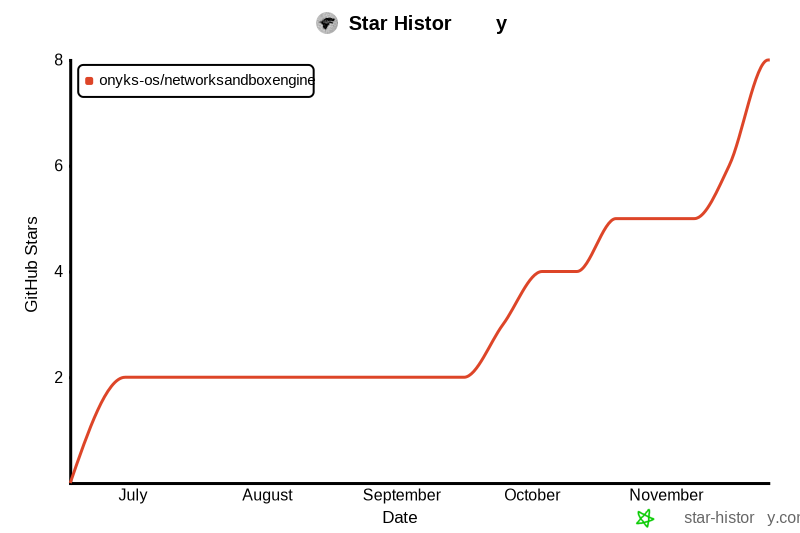
NSE has no telemetry and never will: these numbers are read from outside. NSE is installed from PyPI, so its download counts are PyPI's: monthly from pypistats, which leaves out known mirrors, and in total from pepy. Both include CI pipelines that install NSE on every run, and one person installing twice counts twice. The files attached to GitHub releases are not counted here. They exist for verification, and every one of them has been fetched once or twice, by automation as far as the counts can tell.
License
This project is licensed under the MIT License.
1 maintainer

Metadata
1 maintainer
Release files for network-sandbox-engine 2.3.0
For a detailed explanation of source distributions (sdists) and built distributions (wheels), please see the package formats documentation.
Source distribution (sdist)
| File | Size | Uploaded | Provenance | Actions |
|---|---|---|---|---|
| network_sandbox_engine-2.3.0.tar.gz | 175.6 kB | With provenance | Details for network_sandbox_engine-2.3.0.tar.gz |
Built distribution (wheel)
| File | Interpreter | ABI | Platform | Actions Reset |
|---|---|---|---|---|
| network_sandbox_engine-2.3.0-py3-none-any.whl | Python 3 | none | any | Details for network_sandbox_engine-2.3.0-py3-none-any.whl |
Total release size: 277.3 kB
Release files / network_sandbox_engine-2.3.0.tar.gz
| Download URL | network_sandbox_engine-2.3.0.tar.gz |
|---|---|
| Size | 175.6 kB |
| Tags | Source |
|
SHA-256 checksum How to use checksums |
c702ae3fbed74402e84852345b976552de48e9474762f34b96ffc5ad3f6c9088
|
|
BLAKE2b-256 checksum How to use checksums |
35b4e65efb4c39a07915a0c4e1f4b1a3107b01df182a3d2961b12a7076a5ec16
|
| Upload date | |
|
Uploaded using Trusted Publishing? What is trusted publishing? |
Yes |
| Uploaded via |
twine/7.0.0 CPython/3.13.16
|
Provenance
Provenance describes where a file came from. On PyPI, provenance is shared via attestations, which provide a verifiable record of the build or publishing details. View details, limitations and caveats.


PyPI Publish Attestation
PyPI verified that this artifact, at this checksum, originated from the publisher listed below.
Signed by GitHub Actions, verified by PyPI on Nov 21, 2026.
Transparency logRelease files / network_sandbox_engine-2.3.0-py3-none-any.whl
| Download URL | network_sandbox_engine-2.3.0-py3-none-any.whl |
|---|---|
| Size | 101.7 kB |
| Tags | Python 3 |
|
SHA-256 checksum How to use checksums |
962c8c291a9e0f039c4cb590cb19183f50a81cf2bd51402986c160a82e480468
|
|
BLAKE2b-256 checksum How to use checksums |
ae3cb726c7760834c007721e664fdbdbd92303fe2299888b2a76d1ea3d8b4b27
|
| Upload date | |
|
Uploaded using Trusted Publishing? What is trusted publishing? |
Yes |
| Uploaded via |
twine/7.0.0 CPython/3.13.16
|
Provenance
Provenance describes where a file came from. On PyPI, provenance is shared via attestations, which provide a verifiable record of the build or publishing details. View details, limitations and caveats.
PyPI Publish Attestation
PyPI verified that this artifact, at this checksum, originated from the publisher listed below.
Signed by GitHub Actions, verified by PyPI on Nov 21, 2026.
Transparency logSecurity for network-sandbox-engine 2.3.0
Provenance
Provenance describes where a file came from. On PyPI, provenance is shared via attestations, which provide a verifiable record of the build or publishing details. View details, limitations and caveats.
Full provenance
Both files in this release have been uploaded with provenance metadata.
Attestation for network_sandbox_engine-2.3.0.tar.gz
PyPI Publish Attestation
PyPI verified that this artifact, at this checksum, originated from the publisher listed below.
Signed by GitHub Actions, verified by PyPI on Nov 21, 2026.
Transparency logA note on package security
PyPI is a repository for distributing packages, not a service for auditing them. While third-party security researchers and our staff do their best to detect and remove malicious packages, PyPI cannot guarantee the quality, security or suitability of any given package.
To learn more about protecting yourself from malicious actors, visit our package security documentation.














