
Fitting Network Scale-up Models
Overview
This package fits several different network scale-up models (NSUM) to Aggregated Relational Data (ARD). ARD represents survey responses about how many people each respondent knows in different subpopulations through "How many X's do you know?" questions. Specifically, if 


In this package, we provide functions to estimate the size and accompanying parameters (e.g. degrees) from 4 papers:
- Killworth, P. D., Johnsen, E. C., McCarty, C., Shelley, G. A., and Bernard, H. R. (1998) plug-in MLE
- Killworth, P. D., McCarty, C., Bernard, H. R., Shelley, G. A., and Johnsen, E. C. (1998) MLE
- Zheng, T., Salganik, M. J., and Gelman, A. (2006) overdispersed model
- Laga, I., Bao, L., and Niu, X (2021) uncorrelated, correlated, and covariate models
Requirements
This package requires the following Python libraries:
numpy >= 1.24pandas >= 2.1scipy >= 1.11cmdstanpy >= 1.1
PIMLE
The plug-in MLE estimator from Killworth, P. D., Johnsen, E. C., McCarty, C., Shelley, G. A., and Bernard, H. R. (1998) is a two-stage estimator that first estimates the degrees for each respondent 
$$L(d_i;y,{N_k}) = \prod_{k=1}^{L} {d_i \choose y_{ik}} \left(\frac{N_k}{N}\right)^{y_{ik}}\left(1-\frac{N_k}{N}\right)^{d_i-y_{ik}}$$
where 
$$\frac{y_{ik}}{d_i} = \frac{N_k}{N}$$
and solves for the unknown
To summarize, stage 1 estimate 
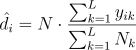
and then these estimates are used in stage 2 to estimate the unknown 
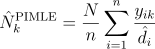
The following demonstrates how to use the killworth function to compute PIMLE estimates of unknown subpopulation sizes:
pimle_est = killworth(ard,
                      known_sizes = sizes[[0, 1, 3]],
                      known_ind = [0,1,3],
                      N = N,
                      model = "PIMLE")
Note that the function may provide a warning saying that at least one 

MLE
The MLE estimator from Killworth, P. D., McCarty, C., Bernard, H. R., Shelley, G. A., and Johnsen, E. C. (1998) is also a two-stage model with an identical first stage, i.e
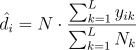
However, the second stage estimates
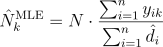
The following demonstrates how to use the killworth function to compute MLE estimates of unknown subpopulation sizes:
mle_est = killworth(ard,
                      known_sizes = np.ravel(sizes)[[0,1,3]],
                      known_ind = [0,1,3],
                      N = N,
                      model = "MLE")
Note that there is no warning here since the denominator depends on the summation of
Bayesian Models
Now we introduce the two Bayesian estimators implemented in this package.
Overdispersed Model
The overdispersed model proposed in Zheng et al. (2006) assumes the following likelihood:
$$y_{ik} \sim \text{Negative-Binomial}(\text{mean}=e^{a_i+b_k},\text{overdispersion}=\omega_k)$$
Please see the original manuscript for more details on the model structure and priors.
This package fits this overdispersed model either via the Gibbs-Metropolis algorithm provided in the original manuscript (overdispersed) or via Stan (overdispersedStan). We suggest using the Stan version since convergence and effective sample sizes are more satisfactory in the Stan implementation, and does not require tuning jumping scales for Metropolis updates.
In order to identity the 

The following demonstrates how to use the overdispersed and overdispersedStan functions to compute estimates of unknown subpopulation sizes using the Gibbs-Metropolis and Stan implementations of the overdispersed model. Note that in practice, both warmup and iter should be set to higher values:
overdisp_gibbs_metrop_est = overdispersed(
                         ard,
                         known_sizes = sizes[[0,1,3]],
                         known_ind = [0,1,3],
                         G1_ind = 0,
                         G2_ind = 1,
                         B2_ind = 3,
                         N=N,
                         warmup = 500,
                         iter = 1000,
                         verbose = True,
                         init = "MLE")

overdisp_stan = overdispersedStan(
                         ard,
                         known_sizes = sizes[[0,1,3]],
                         known_ind = [0,1,3],
                         G1_ind = 0,
                         G2_ind = 1,
                         B2_ind = 3,
                         N = N,
                         chains = 2,
                         cores = 2,
                         warmup = 250,
                         iter = 500)
Correlated Models
The correlated model proposed in Laga et al. (2023) assumes the following likelihood

where critically,
$$\textbf{b}_i \sim \mathcal{N}_k(\mu, \Sigma)$$
so that the responses for each respondent are correlated across subpopulations. Again, 

In this package, model parameters are estimated via Stan. Note that while the full model likelihood depends on 


model = uncorrelated in the correlatedStan function.
The following demonstrates how to use the correlatedStan function to compute estimates of unknown subpopulation sizes using the Stan implementations of the correlated model. Note that in practice, both warmup and iter should be set to higher values:
correlated_cov_stan = correlatedStan(
    ard,
    known_sizes = sizes[[0,1,3]],
    known_ind = [0,1,3],
    model = "correlated",
    scaling = "weighted",
    x = x,
    z_subpop = z_subpop,
    z_global = z_global,
    N = N,
    chains = 2,
    cores = 2,
    warmup = 250,
    iter = 500,
)

correlated_nocov_stan = correlatedStan(
    ard,
    known_sizes = sizes[[0,1,3]],
    known_ind = [0,1,3],
    model = "correlated",
    scaling = "all",
    N = N,
    chains = 2,
    cores = 2,
    warmup = 250,
    iter = 500,
)

uncorrelated_cov_stan = correlatedStan(
    ard,
    known_sizes = sizes[[0,1,3]],
    known_ind = [0,1,3],
    model = "uncorrelated",
    scaling = "all",
    x = x,
    z_subpop = z_subpop,
    z_global = z_global,
    N = N,
    chains = 2,
    cores = 2,
    warmup = 250,
    iter = 500,
)

uncorrelated_x_stan = correlatedStan(
    ard,
    known_sizes = sizes[[0,1,3]],
    known_ind = [0,1,3],
    model = "uncorrelated",
    scaling = "all",
    x = x,
    N = N,
    chains = 2,
    cores = 2,
    warmup = 250,
    iter = 500,
)
3 maintainers


Metadata
3 maintainers
Release files for networkscaleup 0.0.11
For a detailed explanation of source distributions (sdists) and built distributions (wheels), please see the package formats documentation.
Source distribution (sdist)
| File | Size | Uploaded | Provenance | |
|---|---|---|---|---|
| networkscaleup-0.0.11.tar.gz | 3.0 MB | Without provenance | Details |
Built distribution (wheel)
| File | Interpreter | ABI | Platform | Reset |
|---|---|---|---|---|
| networkscaleup-0.0.11-py3-none-any.whl | Python 3 | none | any | Details |
Total release size: 5.9 MB
Release files / networkscaleup-0.0.11.tar.gz
| Download URL | networkscaleup-0.0.11.tar.gz |
|---|---|
| Size | 3.0 MB |
| Tags | Source |
|
SHA-256 checksum How to use checksums |
56623c134cc5e4199c730a07f3fc2f09043f8d3f5041b052686734f30b593ae6
|
|
BLAKE2b-256 checksum How to use checksums |
536d676fed1b7b090376e47266618c7f15eee5dcbddb28bcb282ce1f27476330
|
| Upload date | |
|
Uploaded using Trusted Publishing? What is trusted publishing? |
No |
| Uploaded via |
twine/6.2.0 CPython/3.11.7
|
Release files / networkscaleup-0.0.11-py3-none-any.whl
| Download URL | networkscaleup-0.0.11-py3-none-any.whl |
|---|---|
| Size | 3.0 MB |
| Tags | Python 3 |
|
SHA-256 checksum How to use checksums |
cd725957a88ce576de5b03a038a9093f43fbddfa990ac0e54753f66a297c43ef
|
|
BLAKE2b-256 checksum How to use checksums |
66893d54c7db312f27263d662847c4898aabf9fc2ddab1e981d75eb33f2210bc
|
| Upload date | |
|
Uploaded using Trusted Publishing? What is trusted publishing? |
No |
| Uploaded via |
twine/6.2.0 CPython/3.11.7
|
Security for networkscaleup 0.0.11
Provenance
Provenance describes where a file came from. On PyPI, provenance is shared via attestations, which provide a verifiable record of the build or publishing details. View details, limitations and caveats.
No provenance found
None of the files in this release were uploaded with provenance metadata.
A note on package security
PyPI is a repository for distributing packages, not a service for auditing them. While third-party security researchers and our staff do their best to detect and remove malicious packages, PyPI cannot guarantee the quality, security or suitability of any given package.
To learn more about protecting yourself from malicious actors, visit our package security documentation.














