
NeuroSeq: Neuronal Sequencer



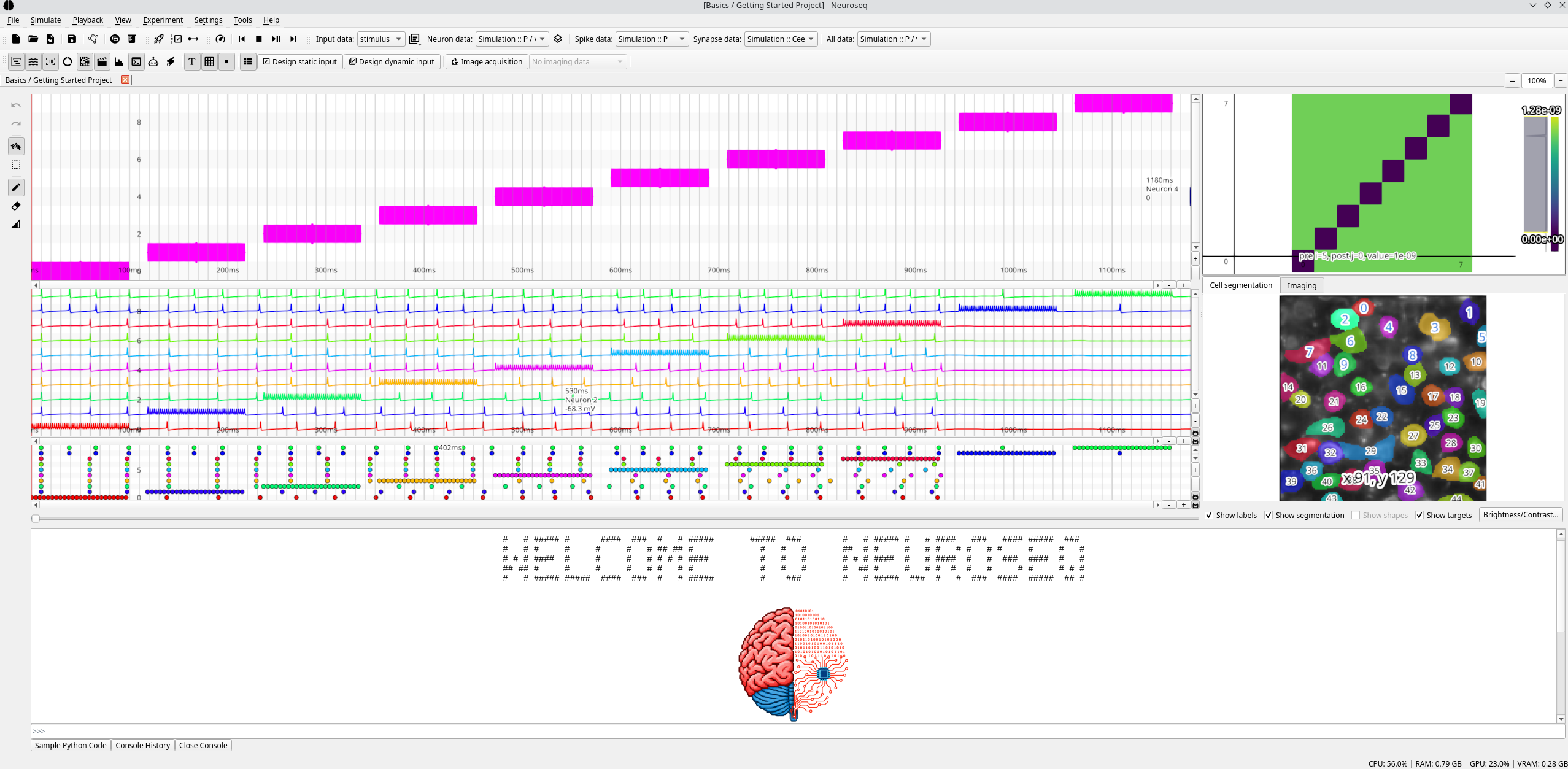
NeuroSeq controls the input to a neural network and reads out its output, whether the network is simulated, biological or neuromorphic. The same input protocol and the same analysis run on all three.
| Network | Input | Readout |
|---|---|---|
| Digital | Brian2 (built in) or external simulators | Voltage traces, spikes, synaptic weights |
| Biological | Two-photon holographic optogenetics (HOLO4D/SysCon2), patch clamp | Calcium imaging (ScanImage, suite2p), Igor2 |
| Neuromorphic | BrainScaleS-2 spike sources | Spikes and membrane traces |
Why
Simulations expose every input and every variable. Biological and neuromorphic networks usually do not, so the three fields developed separate methods. Modern all-optical and electrophysiological interfaces now give cell-level control and readout of living networks. NeuroSeq uses this to treat every network as a programmable system: design an input, deliver it, read the response, decide the next input.
This lets you:
- run real experiments and neuromorphic hardware almost like simulations,
- run models as if they were experiments, with realistic instrument constraints,
- test a protocol in simulation, then run it unchanged on a microscope or chip.
Features
- Input design: draw, paste or script input arrays (static input), or run interactive routines that choose the next input from the last response (dynamic input, e.g. rheobase search, STDP tuning).
- Neuron ID matching: links input rows to real cells via Cellpose segmentation.
- Delivery: Brian2, external simulators, SysCon2
.seqscripts, ScanImage acquisition, BrainScaleS-2, patch clamp input export. - Readout and analysis: import imaging (Cellpose + suite2p), Igor2 and patch clamp data; compare with simulations; extend with analysis plugins.
- Embedded Python console and an experimental LLM assistant.
Install
Python 3.12 or newer:
pip install neuroseq
neuroseq
See the installation guide (GPU, Windows) and the developer guide (uv or Conda checkout).
Documentation
neuroseq.github.io. Contributions to the docs are welcome, see the documentation guide.
Contributing
Extensions go in as plugins where possible: new network backends, analysis methods and input protocols. They need no core changes and get a lighter review. Changes to the core architecture should be discussed with the core developers first.
- Bugs and feature requests: GitHub issues
- Code: fork, branch, open a pull request. See the contributing guide.
License
MIT. Copyright © 2024-2026 Andrey Formozov. Contributors are listed in AUTHORS.md.


Release files for neuroseq 0.31.0
For a detailed explanation of source distributions (sdists) and built distributions (wheels), please see the package formats documentation.
Source distribution (sdist)
| File | Size | Uploaded | Provenance | Actions |
|---|---|---|---|---|
| neuroseq-0.31.0.tar.gz | 4.7 MB | With provenance | Details for neuroseq-0.31.0.tar.gz |
Built distribution (wheel)
| File | Interpreter | ABI | Platform | Actions Reset |
|---|---|---|---|---|
| neuroseq-0.31.0-py3-none-any.whl | Python 3 | none | any | Details for neuroseq-0.31.0-py3-none-any.whl |
Total release size: 8.5 MB
Release files / neuroseq-0.31.0.tar.gz
| Download URL | neuroseq-0.31.0.tar.gz |
|---|---|
| Size | 4.7 MB |
| Tags | Source |
|
SHA-256 checksum How to use checksums |
0a218a43f3cab1b91cb5462384449acfb08d09cd5ce6b47990b68261aa1d59b5
|
|
BLAKE2b-256 checksum How to use checksums |
79b54131483fd9e03ed0b5cfc92aa31f7a273fa884c90748438f1036ede7f0a5
|
| Upload date | |
|
Uploaded using Trusted Publishing? What is trusted publishing? |
Yes |
| Uploaded via |
twine/7.0.0 CPython/3.13.16
|
Provenance
Provenance describes where a file came from. On PyPI, provenance is shared via attestations, which provide a verifiable record of the build or publishing details. View details, limitations and caveats.


PyPI Publish Attestation
PyPI verified that this artifact, at this checksum, originated from the publisher listed below.
Signed by GitHub Actions, verified by PyPI on Nov 15, 2026.
Transparency logRelease files / neuroseq-0.31.0-py3-none-any.whl
| Download URL | neuroseq-0.31.0-py3-none-any.whl |
|---|---|
| Size | 3.8 MB |
| Tags | Python 3 |
|
SHA-256 checksum How to use checksums |
0cb4419fc4bca219631cb8fe6a6520fbc3393620f310a36316e8fa56c2d481fe
|
|
BLAKE2b-256 checksum How to use checksums |
c0ac5a73e189394a630356122edac333ba7b8e0e91261b1c315e2dbccfc54ad0
|
| Upload date | |
|
Uploaded using Trusted Publishing? What is trusted publishing? |
Yes |
| Uploaded via |
twine/7.0.0 CPython/3.13.16
|
Provenance
Provenance describes where a file came from. On PyPI, provenance is shared via attestations, which provide a verifiable record of the build or publishing details. View details, limitations and caveats.
PyPI Publish Attestation
PyPI verified that this artifact, at this checksum, originated from the publisher listed below.
Signed by GitHub Actions, verified by PyPI on Nov 15, 2026.
Transparency logSecurity for neuroseq 0.31.0
Provenance
Provenance describes where a file came from. On PyPI, provenance is shared via attestations, which provide a verifiable record of the build or publishing details. View details, limitations and caveats.
Full provenance
Both files in this release have been uploaded with provenance metadata.
Attestation for neuroseq-0.31.0.tar.gz
PyPI Publish Attestation
PyPI verified that this artifact, at this checksum, originated from the publisher listed below.
Signed by GitHub Actions, verified by PyPI on Nov 15, 2026.
Transparency logA note on package security
PyPI is a repository for distributing packages, not a service for auditing them. While third-party security researchers and our staff do their best to detect and remove malicious packages, PyPI cannot guarantee the quality, security or suitability of any given package.
To learn more about protecting yourself from malicious actors, visit our package security documentation.














