
neuroSush
Brain-inspired computing on PyTorch, validated against its mathematics.
neuroSush simulates spiking neural networks (leaky, exponential and adaptive integrate-and-fire neurons with dendritic compartments and delays, STDP-family plasticity with dopamine modulation) on a CPU or GPU, in batches. It implements the Thousand Brains and HTM models (sparse distributed representations, spatial pooler, temporal memory, grid cells, active dendrites, voting columns) and hierarchical predictive coding, which run on the CPU, one sample at a time (the active-dendrites layer also runs on a GPU), and it joins the two worlds: a spiking layer verified to compute the temporal memory (under derived timing conditions) and to learn the same sequences. Every model is tested against what it claims: exact solutions, closed-form probabilities and expectations, and qualitative properties reported in its papers, on small setups.
| Spiking networks | neurons, dendrites, delays, STDP, reward, homeostasis, batching, recording and checkpoints |
| Thousand Brains models | SDRs, encoders, spatial pooler, temporal memory, grid cells, active dendrites, voting columns, predictive coding |
| Spiking temporal memory | dendritic segments with NMDA-like plateaus, minicolumn inhibition, sequence learning in spike time |
| Validation | the mathematics every part is checked against |
| Benchmarks | steps per second on a CPU and a GPU, with and without CUDA graphs and batching |
Design
- Pure math, thin behaviors. Every equation is a small function that returns new tensors and has tests with hand-computed values; behaviors only hold state and call them.
- Explicit execution order. Each behavior class declares when it runs in a step; there is no global priority table and no special initialization order.
- Reproducible. All randomness comes from the network's seeded generator.
- One dependency.
torchonly at runtime. - Safe serialization. Structure specs load through a registry of classes, never
eval. - Validated. Every equation has tests with hand-computed values, and every model is checked against its mathematics (see Validation); examples that learn run in CI.
Install
pip install neurosush
Every GitHub release also carries
the wheel and the source archive. From source, with CPU PyTorch (on macOS use
pip install torch instead):
python -m venv .venv && source .venv/bin/activate
pip install torch --index-url https://download.pytorch.org/whl/cpu
pip install -e ".[dev]"
Python 3.10 or newer.
Quickstart
Twenty Poisson inputs drive two LIF neurons through plastic synapses:
import itertools

import torch

from neurosush.core.network import Network, NeuronGroup, SynapseGroup
from neurosush.data import spike_frames
from neurosush.encoding import rate_poisson
from neurosush.neurons.axon import Axon
from neurosush.neurons.dendrite import DendriteIntegration, DendriteStructure
from neurosush.neurons.inputs import SpikeInput
from neurosush.neurons.models import LIF, Fire
from neurosush.synapses.constraints import WeightClip
from neurosush.synapses.currents import DenseInput
from neurosush.synapses.init import WeightInit
from neurosush.synapses.plasticity import STDP
from neurosush.synapses.traces import SpikeGather, Traces

net = Network(seed=0)
train = rate_poisson(torch.full((20,), 0.3), 100, generator=net.generator)
source = NeuronGroup(net, 20, [SpikeInput(itertools.cycle(spike_frames([(train, None)]))), Axon()])
target = NeuronGroup(
    net,
    2,
    [
        DendriteStructure(),  # routes synaptic currents to the soma
        DendriteIntegration(),
        LIF(tau=10.0, threshold=-55.0, v_reset=-70.0, v_rest=-65.0),
        Fire(),
        Axon(),
    ],
)
synapse = SynapseGroup(
    net,
    source,
    target,
    [
        WeightInit(mode="uniform", scale=0.5),
        DenseInput(coef=5.0),
        SpikeGather(),
        Traces(tau_pre=10.0),
        STDP(a_plus=0.02, a_minus=0.01, bound="soft"),
        WeightClip(w_min=0.0, w_max=1.0),
    ],
)

spikes = 0
for _ in range(200):
    net.step()
    spikes += int(target.spikes.sum())
print(f"output spikes: {spikes}, mean weight: {synapse.weights.mean():.3f}")
examples/two_patterns.py goes further: two output neurons with
k-winners-take-all and homeostasis learn to respond to one input pattern each.
Concepts
- A
Networkowns neuron groups, synapse groups, the time stepdt, the dtype, the device and a seeded random generator. - A
NeuronGrouphas a shape(depth, height, width)(an intnmeans(1, 1, n)), and aSynapseGroupconnects two groups and targets one dendritic compartment of the destination:proximal(drives the soma),distalorapical(prime it). - A
Behaviorholds state and dynamics. Behaviors run in this order in every step (and are initialized in the same order):
| order | behaviors | order | behaviors |
|---|---|---|---|
| 0 | WeightInit, DelayInit |
310 | VoltageHomeostasis |
| 100 | Payoff |
330 | Refractory |
| 120 | Dopamine |
340 | Fire, SpikeInput, PoissonInput, CorrelatedPoissonInput |
| 180 | synaptic inputs, ActiveSegments |
350 | ActivityHomeostasis, AdaptiveThreshold |
| 200 | CurrentNormalization |
380 | Axon |
| 220 | DendriteStructure |
420 | SpikeGather |
| 240 | DendriteIntegration, ConductanceIntegration |
460 | Traces |
| 250 | SpikeTriggeredCurrent |
500 | STDP, RSTDP, ISTDP, TripletSTDP, SegmentLearning |
| 260 | LIF, ELIF, AdaptiveELIF, Izhikevich |
520, 540 | WeightNormalization, WeightClip |
| 280 | InherentNoise, PoissonDrive |
1000 | Recorder |
| 300 | KWTA, MinicolumnInhibition |
- Spikes travel through
SpikeGather: a synaptic input readssyn.pre_spike, whichSpikeGatherfills from the source'sAxon, so every synapse group with an input needs both; building without them is an error, not a silent network. - Delays are integers in steps:
src_delayis axonal (read from the source'sAxonhistory),dst_delayis dendritic (arrival in the destination'sDendriteStructure). - Units: every time constant shares the unit of
dt(milliseconds by convention). - Signs: weights are magnitudes;
NeuronGroup(..., inhibitory=True)makes its outgoing currents negative. - Batches:
Network(batch_size=B)simulatesBsamples side by side. State tensors get shape(B, size); weights and thresholds stay shared, and learning uses the batch mean. Feed it withspike_frames(samples, batch_size=B). On a GPU a small batch costs about as much as one sample, so throughput grows almost linearly withBat first: the CUDA-graph step costs about the same up to batch 32 and is 4.7 times slower at batch 2048 (Benchmarks). Learning from the batch mean is a different algorithm from presenting the samples one after another.Network(batch_size=B, independent=True)instead makes theBmembersBindependent networks, each with its own weights, thresholds and learning (no averaging), so several seeds or online-learning runs share one GPU; dense and one-to-one connectivity and the behaviors of the Diehl and Cook example are supported, anything else raises.
More in docs/ARCHITECTURE.md.
Recording and checkpoints
A Recorder copies attributes of its host at the end of every interval-th step. A
checkpoint saves the complete state of an initialized network (iteration, random
generator, every tensor and delay buffer, and behavior state such as homeostasis), and
loading it into a network built the same way continues the run exactly. To present many
samples one after another, net.reset_state() clears voltages, currents, traces, spike
histories and countdowns in place and keeps weights, thresholds and theta; add a
SpikeCounter to read each sample's response (see examples/diehl_cook_mnist.py):
import tempfile
from pathlib import Path

import torch

from neurosush import checkpoint
from neurosush.core.network import Network, NeuronGroup
from neurosush.neurons.competition import InherentNoise
from neurosush.neurons.dendrite import DendriteIntegration, DendriteStructure
from neurosush.neurons.models import LIF, Fire
from neurosush.recording import Recorder


def build():
    net = Network(seed=0)
    NeuronGroup(
        net,
        3,
        [
            DendriteStructure(),
            DendriteIntegration(),
            LIF(tau=10.0, threshold=-55.0, v_reset=-70.0, v_rest=-65.0),
            InherentNoise(scale=8.0),  # random drive from the network generator
            Fire(),
            Recorder("v", "spikes", interval=5),
        ],
    )
    return net


net = build()
net.run(50)
recorder = net.groups[0].behaviors[-1]
print(recorder.get("v").shape, recorder.steps[:3])  # torch.Size([10, 3]) [5, 10, 15]

path = Path(tempfile.mkdtemp()) / "net.pt"
checkpoint.save(net, path)
net.run(20)

resumed = build()
checkpoint.load(resumed, path)
resumed.run(20)
assert torch.equal(resumed.groups[0].v, net.groups[0].v)  # continues exactly
Loading uses torch.load(weights_only=True), so a checkpoint cannot run code. Input
streams (SpikeInput) are not part of it: resume them yourself.
CUDA graphs
On a GPU, a step of a small network is dozens of tiny kernels, and launching them costs
more than running them. GraphStepper captures a step once as a CUDA graph and replays
it; the results are bit-for-bit those of net.run (the tests check this):
import torch

from neurosush.core.network import Network, NeuronGroup
from neurosush.neurons.axon import Axon
from neurosush.neurons.competition import InherentNoise
from neurosush.neurons.models import LIF, Fire

if torch.cuda.is_available():
    from neurosush.core.graph import GraphStepper

    net = Network(device="cuda", seed=0)
    NeuronGroup(
        net,
        100,
        [
            LIF(tau=10.0, threshold=-55.0, v_reset=-70.0, v_rest=-65.0),
            InherentNoise(scale=8.0),
            Fire(),
            Axon(),
        ],
    )
    stepper = GraphStepper(net)  # initializes the network if needed
    stepper.run(100)  # a few eager warm-up steps, then it captures and replays a graph
    assert net.iteration == 100  # exactly as net.run(100) would leave it
It needs a network on a CUDA device whose behaviors are all graph-ready: their forward
makes no host-device synchronization and changes no Python-side state. A Python-side
decision (a homeostasis window ending, a behavior being enabled) becomes a graph key, and
the stepper keeps one graph per key. Not ready yet: Payoff, Dopamine, RSTDP and
transmission delays longer than one step; GraphStepper names every behavior that is not
ready. A Recorder runs after each replayed step.
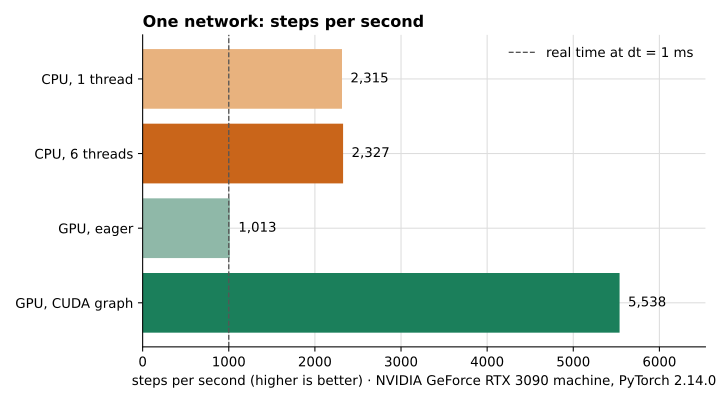
On an RTX 3090 (Windows) a 784-input, 400-neuron STDP network runs 5,538 steps per second as a graph, 5.5 times eager stepping and 2.4 times the fastest CPU run on the same machine; batched, it reaches 2.4 million sample-steps per second. On an RTX 3060 Laptop GPU (Linux) the same benchmark measured 3,887 graph steps per second against 1,746 eager (2.2 times, 2026-10-02). The gain depends on the platform's kernel-launch overhead. Benchmarks has the full results, the method and the pitfalls.
A graph still launches one kernel per tensor operation (154 per step for the Diehl and Cook
network). CompiledStepper (neurosush.core.compiled) is an opt-in alternative: it compiles
the whole step with torch.compile into a few fused kernels and, on CUDA, replays that as a
CUDA graph per key. It needs torch 2.3 or newer (it raises RuntimeError on older
versions; GraphStepper works from 2.1). It has the same step() and run(steps), works on CPU and CUDA and in
shared-batch and independent=True networks, and names the behaviors it cannot compile
(Behavior.compile_ready; delays longer than one step, RSTDP and, on the CPU, the unbatched
dense STDP are refused). Its results equal eager stepping to a tolerance, not bit for bit:
fused kernels round differently (membrane voltages agree to about 1e-5 in float32, and the
tests check spikes over several hundred steps), so GraphStepper and Network.run remain
the exact references. Random numbers are drawn eagerly in the eager order
(Behavior.draw), so the random stream is the same. The first step of each key compiles
(about 3 seconds for the Diehl and Cook network from an empty Inductor cache on the machine
below). On an RTX 3060 Laptop GPU (Linux, 2026-10-03, benchmarks/compiled.py), 100 neurons
unbatched ran 39,923 steps per second compiled against 5,934 as a graph and 1,011 eager;
with 16 independent members in one batch, 11,395 against 1,525 and 838.
Modules
| module | contents |
|---|---|
neurosush.core |
Network, NeuronGroup, SynapseGroup, Behavior, Order, delay buffers |
neurosush.neurons.models |
LIF, ELIF, AdaptiveELIF, Izhikevich, Refractory, Fire (equations in dynamics) |
neurosush.neurons.adaptation |
SpikeTriggeredCurrent (after-spike current, spike-frequency adaptation) |
neurosush.neurons.params |
helpers that check a parameter given as a number or one value per neuron |
neurosush.neurons.competition |
KWTA, MinicolumnInhibition, InherentNoise |
neurosush.neurons.axon, .dendrite |
Axon; DendriteStructure, DendriteIntegration, ConductanceIntegration |
neurosush.neurons.homeostasis |
ActivityHomeostasis, VoltageHomeostasis, AdaptiveThreshold |
neurosush.neurons.inputs |
SpikeInput, PoissonInput, PoissonDrive (Poisson count of delta synapses onto the membrane), CorrelatedPoissonInput (correlated trains) |
neurosush.synapses.init |
WeightInit (dense, sparse, or sparse with a fixed in-degree), DelayInit, sparse_random, fixed_in_degree |
neurosush.synapses.currents |
DenseInput, OneToOneInput, SparseInput, Conv2dInput, Local2dInput, LateralInput, AvgPool2dInput, MaxPool2dInput, delta_coef |
neurosush.synapses.traces |
SpikeGather, Traces (all-to-all or nearest-spike) |
neurosush.synapses.segments |
ActiveSegments (dendritic segments with NMDA-like plateaus) |
neurosush.synapses.segment_learning |
SegmentLearning (temporal memory learning in spike time) |
neurosush.synapses.plasticity |
STDP, RSTDP, ISTDP (bounds in bounds; pairing="nearest" for STDP and RSTDP) |
neurosush.synapses.triplet |
TripletSTDP (triplet STDP of Pfister and Gerstner 2006, all-to-all or nearest-spike; the Diehl and Cook 2015 rule is a special case) |
neurosush.synapses.constraints |
WeightClip, WeightNormalization, CurrentNormalization |
neurosush.modulation |
Payoff, Dopamine |
neurosush.encoding |
rate_poisson, interval_poisson, intensity_to_latency |
neurosush.filters, .transforms |
DoG (zero mean by default) and Gabor kernels; grid masks, polarity split, filter bank |
neurosush.data |
LocationDataset, spike_frames, load_mnist (IDX files, optional download) |
neurosush.structure |
layers, ports, connect, CorticalColumn, JSON specs, sequence_memory |
neurosush.recording |
Recorder, SpikeCounter (per-neuron spike counts, graph-safe) |
neurosush.readout |
assign_labels, classify, accuracy (label an unsupervised layer, Diehl and Cook 2015) |
neurosush.checkpoint |
state_dict, load_state_dict, save, load |
neurosush.htm.sdr, .encoders, .classifier |
SDR operations and match probabilities; scalar, RDSE and category encoders; SDRClassifier |
neurosush.htm.spatial_pooler, .temporal_memory |
SpatialPooler, TemporalMemory |
neurosush.htm.grid_cells |
GridCellModule, GridCellModules, hexagonal_rate |
neurosush.htm.active_dendrites |
ActiveDendrites, kwta |
neurosush.htm.objects |
ObjectLibrary, SensorColumn, ColumnEnsemble, vote |
neurosush.predictive_coding |
PredictiveCodingNetwork |
Structures and specs
A column is plain data. Building it twice gives two independent columns; JSON only names registered classes, so loading it never runs code.
from neurosush.core.network import Network
from neurosush.structure.spec import (
    BehaviorSpec,
    ColumnSpec,
    GroupSpec,
    LayerSpec,
    SynapseSpec,
    build_column,
    from_json,
    to_json,
)

lif = BehaviorSpec("LIF", {"tau": 10.0, "threshold": -55.0, "v_reset": -70.0, "v_rest": -65.0})
neurons = (
    BehaviorSpec("DendriteStructure"),
    BehaviorSpec("DendriteIntegration"),
    lif,
    BehaviorSpec("Fire"),
    BehaviorSpec("Axon"),
)
dense = (
    BehaviorSpec("WeightInit", {"mode": "uniform"}),
    BehaviorSpec("DenseInput"),
    BehaviorSpec("SpikeGather"),
)
layer = LayerSpec(
    groups={"exc": GroupSpec(8, neurons), "inh": GroupSpec(2, neurons, inhibitory=True)},
    synapses=(SynapseSpec("exc", "inh", dense), SynapseSpec("inh", "exc", dense)),
    outputs={"out": ("exc",)},
)
spec = ColumnSpec(
    layers={"L4": layer, "L23": layer},
    synapses=(SynapseSpec("L4.exc", "L23.exc", dense),),  # "layer.group" inside a column
    inputs={"in": "L4.in"},
    outputs={"out": "L23.out"},
)

assert from_json(to_json(spec)) == spec
net = Network(seed=0)
column = build_column(net, "C1", spec)
net.run(10)
print([group.name for group in column.output_port("out")])  # ['C1.L23.exc']
Thousand Brains models
neurosush.htm implements the algorithms of hierarchical temporal memory and the Thousand
Brains theory as tensor code, each checked against the mathematics of its paper. They run
on the CPU and learn one sample at a time; ActiveDendrites is a torch.nn.Module and runs
on any device, and SDRs and SDRClassifier accept tensors on any device.
| model | reference | validated by the tests |
|---|---|---|
| SDRs | Ahmad and Hawkins (2016) | exact false-match probabilities of a single SDR, confirmed by Monte Carlo; union match is the binomial approximation of Ahmad and Hawkins |
| encoders | Numenta encoders | overlap of scalar codes is max(0, w - distance) |
| spatial pooler | Cui et al. (2017) | exact update rules; learned codes stay stable under 20% input noise; boosting spreads activity |
| temporal memory | Hawkins and Ahmad (2016) | first- and high-order sequences, branching unions, punishment of wrong predictions |
| grid cells | Hawkins et al. (2019) | exact path integration on the torus; six-fold symmetric fields; several modules locate far beyond one scale |
| active dendrites | Iyer et al. (2022) | gating equations; context solves two tasks that give every input opposite labels |
| voting columns | Hawkins, Ahmad and Cui (2017); Lewis et al. (2019) | an exact, noise-free hypothesis-set model: the true object is never lost; elimination rates match closed-form expectations; more columns need fewer touches |
| predictive coding | Rao and Ballard (1999), Bogacz (2017) | inference and learning follow the free-energy gradient; the exact posterior mean of a linear Gaussian model; convergence to backprop (Whittington and Bogacz 2017) |
import torch

from neurosush.htm.encoders import CategoryEncoder
from neurosush.htm.sdr import match_probability
from neurosush.htm.temporal_memory import TemporalMemory

# chance that a random 40-of-2048 SDR shares 20 or more bits with a stored one
print(f"{match_probability(2048, 40, 40, 20):.1e}")

a, b, c, d = CategoryEncoder(256, 12, 4, seed=0).encode(torch.arange(4))
tm = TemporalMemory(
    256,
    8,
    activation_threshold=8,
    min_threshold=6,
    initial_permanence=0.51,
    max_new_synapses=12,
    max_synapses_per_segment=16,
)
for _ in range(3):
    tm.reset()
    for symbol in (a, b, c, d):
        tm.compute(symbol)
tm.reset()
tm.compute(a, learn=False)
tm.compute(b, learn=False)
assert torch.equal(tm.predicted_columns(), c)  # after A B it expects C
examples/sequence_prediction.py chains an encoder, the
spatial pooler, temporal memory and a classifier on sequences that differ only in their
first symbol; examples/object_recognition.py shows voting
columns recognizing objects in fewer touches.
Spiking temporal memory
The same sequence memory also runs as a spiking network. ActiveSegments gives every cell
distal segments that fire a dendritic spike when enough of their synapses see input within a
coincidence window, and hold a plateau that primes the cell below threshold.
MinicolumnInhibition lets the first cells of a minicolumn to reach threshold silence the
rest. Predicted cells therefore fire and the rest of their minicolumn is silenced (several
predicted cells in one minicolumn all fire, as in the temporal memory), and a minicolumn
without one fires all at once (a burst). tests/validation/test_sequence_math.py checks that such a layer
activates exactly the cells TemporalMemory activates, element by element, under timing
conditions it also checks.
SegmentLearning adds the temporal memory's learning in spike time (reinforcement, growth
towards the previous element's winners, new segments in bursting minicolumns, punishment
of wrong predictions), and sequence_memory builds the whole layer. It derives the
plateau, coincidence window and learning context from the neuron's exact race times and
refuses parameters under which the equivalence would fail. On sequences that share their
middle it learns like TemporalMemory. In experiments/sequence_learning.py (12
repetitions) the burst curves are identical in repetitions 0 to 3 and 8 to 11 and differ in
repetitions 4 to 7, because the two make different random choices. The final states agree in
the burst count per element, not in the synapses, and both still burst on D after XBC.
tests/validation/test_sequence_learning.py compares the first four and last two
repetitions.
A four-element sequence, learned in one repetition (initial_permanence=0.51 makes new
synapses connected at once):
import torch

from neurosush.core.behavior import Behavior
from neurosush.core.network import Network, NeuronGroup
from neurosush.core.order import Order
from neurosush.htm.sdr import random_sdr
from neurosush.neurons.axon import Axon
from neurosush.structure.sequence import sequence_memory

COLUMNS, PERIOD, WINDOW = 32, 60, 25
sequence = random_sdr(COLUMNS, 6, batch=(4,), generator=torch.Generator().manual_seed(0))


class Present(Behavior):
    """Drive the columns of element t // PERIOD for the first WINDOW steps of its period."""

    order = Order.FIRE

    def initialize(self, group):
        group.spikes = group.state(False, dtype=torch.bool)

    def forward(self, group):
        t = group.net.iteration - 1
        element, offset = divmod(t % (PERIOD * 6), PERIOD)  # 4 elements, then 2 silent
        on = element < len(sequence) and offset < WINDOW
        group.spikes = sequence[element].clone() if on else group.state(False, dtype=torch.bool)


net = Network(seed=0)
columns = NeuronGroup(net, COLUMNS, [Present(), Axon()])
layer, _ = sequence_memory(
    net, columns, cells_per_column=4, period=PERIOD, window=WINDOW, initial_permanence=0.51
)
for repetition in range(2):
    bursts = []
    for element in range(6):
        fired = torch.zeros(layer.size, dtype=torch.bool)
        for _ in range(PERIOD):
            net.step()
            fired |= layer.spikes
        if element < len(sequence):
            active = fired.view(COLUMNS, 4)[sequence[element]]
            bursts.append(int(active.all(-1).sum()))  # columns that were not predicted
    print(repetition, bursts)  # [6, 6, 6, 6], then [6, 0, 0, 0]: only the first element surprises
Examples
Each example is a script in examples/ with its run command, measured
numbers and deviations from the paper in the module docstring.
two_patterns.py: two output neurons learn two input patterns with STDP.sequence_prediction.py: spatial pooler, temporal memory and classifier on high-order sequences.object_recognition.py: voting columns recognize objects in fewer touches (Lewis et al. 2019).diehl_cook_mnist.py: unsupervised MNIST with STDP (Diehl and Cook 2015); a full-epoch run on a GPU is in progress.stdp_frequency.py: pair versus triplet STDP across pairing frequencies (Sjostrom et al. 2001; Pfister and Gerstner 2006).balanced_network.py: inhibitory STDP sets a firing-rate target (reduced Vogels et al. 2011).predictive_coding_mnist.py: predictive coding on MNIST (Whittington and Bogacz 2017).competitive_stdp.py: additive STDP makes the weights bimodal and the output rate nearly independent of the input rate (Song, Miller and Abbott 2000).spike_pattern_detection.py: STDP finds the start of a repeating spike pattern in noise (Masquelier, Guyonneau and Thorpe 2008).brunel_network.py: sparse excitatory/inhibitory LIF network in four dynamical regimes (Brunel 2000).conv_stdp_mnist.py: STDP-trained spiking convolutional network on MNIST (Kheradpisheh et al. 2018).intrinsic_timing_ramps.py: ramping activity from relaxation after a stimulus, with no prediction (illustrating Huang et al. 2026).
Validation
Besides unit tests, tests/validation checks the spiking core against the mathematics it
implements. The LIF reproduces the exact solution of its Euler scheme and converges to the
continuous solution at first order in dt; interspike intervals match the closed form, and
the exponential LIF starts firing exactly at its rheobase R I = theta_rh - v_rest - delta.
Traces respond to a spike with exactly (1 - dt/tau)^k; the STDP window is the exponential
a_plus c^k or -a_minus c^k, and uncorrelated spike trains drift the weights by the
expected amount. Inhibitory STDP settles the firing rate at its target, homeostasis settles
the spike count, Poisson spike counts are binomial with geometric intervals, and every spike
arrives exactly src_delay + dst_delay + 1 steps after it was fired. Conv, local, lateral and
pooling synapses equal their dense synapse-by-synapse definition, for both currents and
STDP; reward-modulated STDP matches the closed form of the three-factor rule. A reduced,
open-loop version of the distal reward problem of Izhikevich (2007) passes: 10 by 10
synapses, Bernoulli spike trains that the weights do not drive, rewards 50 to 150 steps after
the pairing; the rewarded synapse's credit is more than 3 standard deviations above the
others, against a control with identical spikes. TripletSTDP matches its closed forms,
reduces to pair STDP when the triplet terms are zero, and shows the frequency dependence of
Pfister and Gerstner.
Limitations
- Alpha. The API may still change between minor versions.
- Speed. A simulation step is a sequence of small tensor operations driven from Python, so small networks pay a fixed cost per step: for the 784-input, 400-neuron benchmark network about 0.4 ms on a desktop CPU, 1 ms on a GPU stepped eagerly and 0.18 ms replayed as a CUDA graph (Benchmarks). Batches spread that cost over many samples, especially on a GPU.
- CPU-only HTM models. The spatial pooler, temporal memory, grid cells, voting columns,
SegmentLearningandPredictiveCodingNetworkrun on the CPU, one sample at a time. - Checkpoints save a network's state but not the input streams feeding
SpikeInput. - Noise. The spiking temporal memory is checked only with noise-free input that fires on every step of the window; robustness to timing jitter or noise is not tested.
- Transmission takes one step. A disynaptic pathway such as excitation, inhibition, excitation takes two, unlike simulators that deliver within the step.
- The spiking temporal memory equals the algorithm only under the timing conditions
that
sequence_timingchecks;sequence_memoryrefuses other parameters.
Citing
If you use neuroSush in research, please cite it with the metadata in
CITATION.cff (GitHub shows it under "Cite this repository"), and
cite the papers of the models you use; each module names them.
Development
bash scripts/check.sh runs ruff (lint and format check), strict mypy and the full test
suite. python benchmarks/scaling.py measures steps per second across devices, threads,
batch sizes and CUDA graphs; python benchmarks/suite.py measures throughput (the Benchmarks workflow runs it
every week), and the scripts in experiments/ reproduce the numbers
behind the validation claims. Tests marked gpu compare CUDA with CPU results and run only
where a CUDA device exists. See CONTRIBUTING.md for the workflow and
code standards.
Releases
Releases are automatic. A commit on main that sets a new release version with its
changelog section triggers the Release workflow: it checks the version and the changelog,
runs the full CI, creates the tag and a GitHub release with the wheel and the sdist, and
publishes them to PyPI. The steps are in CONTRIBUTING.md; the history
is in CHANGELOG.md.
License
MIT, see LICENSE.
1 maintainer

Metadata
1 maintainer
Release files for neurosush 0.5.0
For a detailed explanation of source distributions (sdists) and built distributions (wheels), please see the package formats documentation.
Source distribution (sdist)
| File | Size | Uploaded | |
|---|---|---|---|
| neurosush-0.5.0.tar.gz | 331.2 kB | Details |
Built distribution (wheel)
| File | Interpreter | ABI | Platform | Reset |
|---|---|---|---|---|
| neurosush-0.5.0-py3-none-any.whl | Python 3 | none | any | Details |
Total release size: 461.3 kB
Release files / neurosush-0.5.0.tar.gz
| Download URL | neurosush-0.5.0.tar.gz |
|---|---|
| Size | 331.2 kB |
| Tags | Source |
|
SHA-256 checksum How to use checksums |
05df1df82cc2570340265f8575667d8b64bbbd12537457f0fa605c010e1f9702
|
|
BLAKE2b-256 checksum How to use checksums |
206ab753b902fdc159b38488d79aba7cf147dbed48f3b40f4977461b2c109fb4
|
| Upload date | |
|
Uploaded using Trusted Publishing? What is trusted publishing? |
Yes |
| Uploaded via |
twine/7.0.0 CPython/3.13.14
|
Provenance
Provenance describes where a file came from. On PyPI, provenance is shared via attestations, which provide a verifiable record of the build or publishing details. View details, limitations and caveats.


PyPI Publish Attestation
PyPI verified that this artifact, at this checksum, originated from the publisher listed below.
Signed by GitHub Actions, verified by PyPI on Oct 3, 2026.
Transparency logRelease files / neurosush-0.5.0-py3-none-any.whl
| Download URL | neurosush-0.5.0-py3-none-any.whl |
|---|---|
| Size | 130.1 kB |
| Tags | Python 3 |
|
SHA-256 checksum How to use checksums |
b560d0f418985b601838cbaabaa03d0f7c1c471d2f27ca89c85054e51d096419
|
|
BLAKE2b-256 checksum How to use checksums |
60325c2ef2de2e3760db624d64c733181292fdee81113eb1df1c7abc573f1210
|
| Upload date | |
|
Uploaded using Trusted Publishing? What is trusted publishing? |
Yes |
| Uploaded via |
twine/7.0.0 CPython/3.13.14
|
Provenance
Provenance describes where a file came from. On PyPI, provenance is shared via attestations, which provide a verifiable record of the build or publishing details. View details, limitations and caveats.
PyPI Publish Attestation
PyPI verified that this artifact, at this checksum, originated from the publisher listed below.
Signed by GitHub Actions, verified by PyPI on Oct 3, 2026.
Transparency log













