
Nicopal
Context
Nicopal provides perceptually uniform and colour-vision-deficiency-friendly colour palettes for scientific data visualisation. Inspired by the work of Fabio Crameri [1], these palettes are designed to represent data as faithfully as possible, ensuring consistent interpretation across all observers, regardless of their colour vision. Their design follows the perceptual uniformity guidelines of Peter Kovesi [2] and uses the colour-vision deficiency simulation model of Machado et al. [3]. They are also part of the broader effort, initiated as early as 2004 by Light & Bartlein [4], to move away from rainbow-type colourmaps, which are known to introduce perceptual artefacts and mislead interpretation.
These palettes can be used as a drop-in complement to the colour-vision deficiencies section of Matplotlib. For more context on colourmap best practices, see the colourmap selection flowchart and the Matplotlib colormaps documentation.
Developed by a protanope (red colour deficiency) student, for everyone.
I. Installation
In a Python console or terminal :
pip install nicopal # Standard installation
pip install nicopal'[advanced]' # Advanced installation
The advanced installation includes scipy and cartopy, which are only required for pal_demo_advanced (see Section 9).
II. Usage
0. Loading the package
import nicopal as ncp
1. Display the package version
print(ncp.version)
Displays the version and some information about the package.
2. Quickly test all palettes
ncp.pal_test()
Checks that all palettes load correctly and displays a confirmation message if everything is valid.
3. List available palettes
ncp.pal_list()
Returns a sorted list of all available palette names.
4. Visualize a palette
ncp.pal_show("Lithium")
Displays a gradient of the chosen palette.
pal_show can be used with any palette from pal_list().
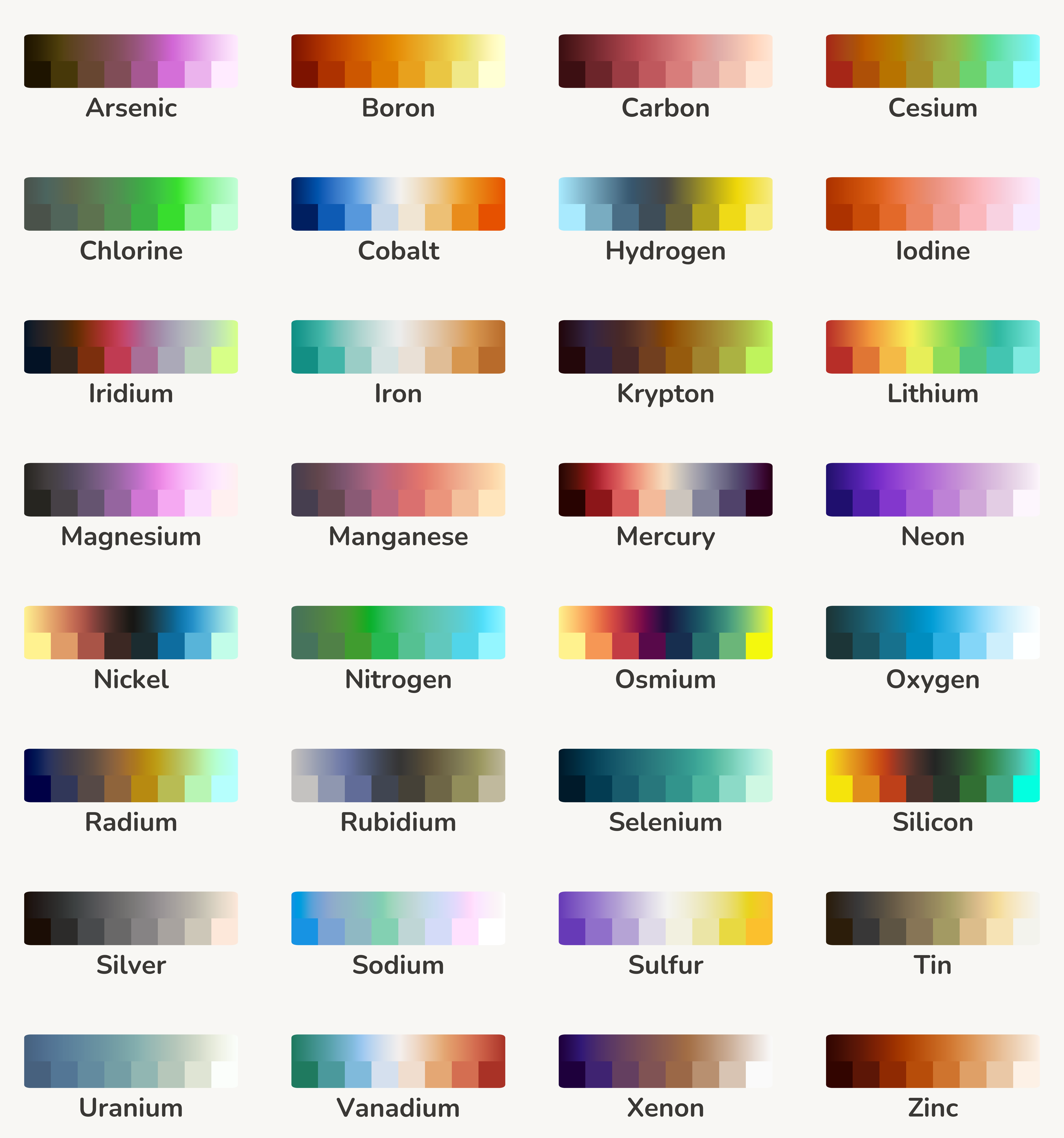
5. Visualize all palettes
ncp.pal_all()
Displays all palettes and their associated names (see Section 11).
6. Load a palette as a list of HEX colours
ncp.pal_hex("Lithium") # all stored colours
ncp.pal_hex("Lithium", N=10) # resample to exactly 10 colours
Returns the palette as a list of HEX color codes (e.g. ['#1a2b3c', ...]).
See the Matplotlib colour formats documentation for details on how to use these strings.
7. Use a palette as a colormap
colormap = ncp.pal("Lithium") # normal order
colormap_r = ncp.pal("Lithium", reverse=True) # reversed via parameter
colormap_r = ncp.pal("Lithium_r") # reversed via '_r' suffix
colormap_r = ncp.pal("Lithium_r").reversed() # reversed via Matplotlib native method
ax.contourf(x, y, z, cmap = colormap)
Palette names are case-insensitive:
"lithium","Lithium"and"LITHIUM"all work.
ax.contourfcan be replaced by any other Matplotlib function that accepts a colormap.
x,yandzare your data to visualise.
For more information on reversing and manipulating colormaps, see the Matplotlib colormap manipulation guide.
8. Extract colors from a palette
sample = ncp.pal_sample("Carbon", 6)
x = ["A", "B", "C", "D", "E", "F"]
y = [3, 7, 5, 6, 4, 8]
plt.bar(x, y, color = sample)
plt.show()
Returns n discrete colors extracted evenly from the palette.
9. Palette demonstration
ncp.pal_demo("Selenium")
ncp.pal_demo_advanced("Selenium")
Displays various types of plots using the specified color palette. The function pal_demo_advanced requires two additional optional libraries (scipy and cartopy), which enable visualizing the effect of a palette on maps. These two libraries are optional and not required when installing the package; however, they can be installed directly during package installation using the command pip install 'nicopal[advanced]'.
10. Palette badge
Display the badge and its explanation for Nicopal's sequential colour palettes.
ncp.pal_badge() # For all sequential palettes
ncp.pal_badge("Zinc") # For a single palette
The current badge system is available only for sequential colour palettes.
11. Palette names
Arsenic | Boron | Carbon | Cesium | Chlorine | Cobalt | Hydrogen| Iodine | Iridium | Iron | Krypton| Lithium | Magnesium | Manganese | Mercury | Neon | Nickel | Nitrogen | Osmium | Oxygen | Radium | Rubidium | Selenium | Silicon | Silver | Sodium | Sulfur | Tin | Uranium | Vanadium | Xenon| Zinc |
All names are case-insensitive. The
_rsuffix reverses any palette (e.g."Lithium_r").
III. Methodology
Documentation in progress...
Bibliography :
[1] Crameri, F., Shephard, G.E. & Heron, P.J. 2020. 'The Misuse of Colour in Science Communication'. Nature Communications 11(1): 5444. doi:10.1038/s41467-020-19160-7. Paper link
[2] Kovesi, P. 2015. 'Good Colour Maps: How to Design Them'. arXiv:1509.03700. Paper link
[3] Machado, G.M., Oliveira, M.M. & Fernandes, L.A.F. 2009. 'A Physiologically-based Model for Simulation of Color Vision Deficiency'. IEEE Transactions on Visualization and Computer Graphics 15(6): 1291–1298. doi:10.1109/TVCG.2009.113. Paper link
[4] Light, A., and P. J.Bartlein (2004), The end of the rainbow? Color schemes for improved data graphics, Eos Trans. AGU, 85(40), 385–391, doi:10.1029/2004EO400002. Paper link
Citation
If you use Nicopal in scientific publications, please cite the package.
Suggested acknowledgement
This work uses the Nicopal colour palettes developed by Nicolas Tharaud.
:) NT
1 maintainer

Metadata
1 maintainer
Release files for nicopal 0.8.4
For a detailed explanation of source distributions (sdists) and built distributions (wheels), please see the package formats documentation.
Source distribution (sdist)
| File | Size | Uploaded | Provenance | |
|---|---|---|---|---|
| nicopal-0.8.4.tar.gz | 1.5 MB | Without provenance | Details |
Built distribution (wheel)
| File | Interpreter | ABI | Platform | Reset |
|---|---|---|---|---|
| nicopal-0.8.4-py3-none-any.whl | Python 3 | none | any | Details |
Total release size: 3.0 MB
Release files / nicopal-0.8.4.tar.gz
| Download URL | nicopal-0.8.4.tar.gz |
|---|---|
| Size | 1.5 MB |
| Tags | Source |
|
SHA-256 checksum How to use checksums |
60484dce30bb698170c7290f3450b688037c98038125baf19b5d03fb469a8f6c
|
|
BLAKE2b-256 checksum How to use checksums |
ba14ed5fa6efb15fb46d4d35286a645bbc2f6c5d169a13590096eadcc5190ee0
|
| Upload date | |
|
Uploaded using Trusted Publishing? What is trusted publishing? |
No |
| Uploaded via |
twine/6.2.0 CPython/3.9.12
|
Release files / nicopal-0.8.4-py3-none-any.whl
| Download URL | nicopal-0.8.4-py3-none-any.whl |
|---|---|
| Size | 1.5 MB |
| Tags | Python 3 |
|
SHA-256 checksum How to use checksums |
76c5dd37fc9d7f3565127dce8e7c2af2325ed2ca86fae61396b94c0d3dcbfe4d
|
|
BLAKE2b-256 checksum How to use checksums |
004d0b1702351651a30177040279d769f9a1281a0c6f31f85b0cd6976f05da87
|
| Upload date | |
|
Uploaded using Trusted Publishing? What is trusted publishing? |
No |
| Uploaded via |
twine/6.2.0 CPython/3.9.12
|
Security for nicopal 0.8.4
Provenance
Provenance describes where a file came from. On PyPI, provenance is shared via attestations, which provide a verifiable record of the build or publishing details. View details, limitations and caveats.
No provenance found
None of the files in this release were uploaded with provenance metadata.
A note on package security
PyPI is a repository for distributing packages, not a service for auditing them. While third-party security researchers and our staff do their best to detect and remove malicious packages, PyPI cannot guarantee the quality, security or suitability of any given package.














