
NIFE — NIFE Is a Framework for Explanations



NIFE is a Python framework for explaining the predictions of machine-learning models. Today it provides counterfactual explanations of individual predictions, with one method and metrics to evaluate them; more kinds of explanations, methods and metrics are planned. NIFE is organized by kind of explanation, each with the methods that produce it, the metrics that evaluate it and the plots that show it, so that new ones plug into the same structure. It is in alpha: its API may change before version 1.0.
| Explanation | Methods | Evaluation |
|---|---|---|
| Counterfactual — the smallest change that would make the model predict something else, with a real counterpart from the data | TreeCounterfactualExplainer — surrogate decision tree, based on Silva, Aguilar and Salvini (2026) |
coverage and 8 metrics, for counterfactuals found by any method |
NIFE is for tabular data: images, text and time series are not supported. It works with any model
that has a predict method, for classification and regression, and calls only predict: a
counterfactual changes the predicted class or value, whatever the model's confidence. Besides the
model, it takes the data, usually the one the model was trained on, as a pandas DataFrame of
numeric features: encode categorical features as numbers and list them in categorical_features.
Classification is the default; for a regression model, pass mode="regression".
Installation
pip install nife-xai
The package is nife-xai on PyPI, and you import it as nife.
NIFE requires Python 3.10 or later, with NumPy, pandas, scikit-learn and matplotlib. To install the development version from GitHub:
pip install git+https://github.com/jurandirs/nife.git
Quickstart
from sklearn.datasets import load_wine
from sklearn.ensemble import RandomForestClassifier

from nife.counterfactual import TreeCounterfactualExplainer

X, y = load_wine(return_X_y=True, as_frame=True)
model = RandomForestClassifier(random_state=0).fit(X, y)

explainer = TreeCounterfactualExplainer(model, X, random_state=0)
explanation = explainer.explain(X.iloc[0])
print(explanation)
TreeCounterfactualExplanation (classification) of an instance predicted 0
  decision path: color_intensity > 3.437 and proline > 651.7
  relevant features: proline, color_intensity, flavanoids
  counterfactual rule: proline > 651.7 -> proline <= 651.7 (not confirmed: changing proline alone keeps the model's prediction)
  counterfactuals: 16, changing 2 features each (16 copied from evidence examples)
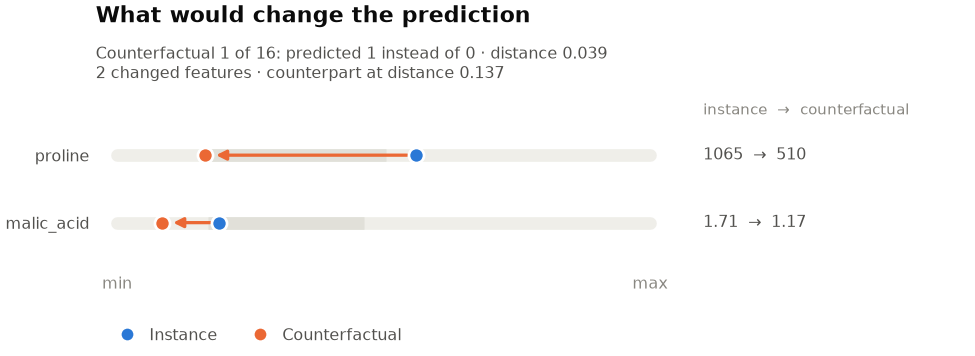
  closest: malic_acid 1.71 -> 1.17, proline 1065 -> 510; predicted 1 (distance 0.039; counterpart at distance 0.137)
  evidence: 42 examples of the data on the other side of the rule, the closest at distance 0.176
  fidelity: instance agreement True, local fidelity 1.00 (neighborhood: around the instance, scale 1)
A decision tree trained on the model's behavior around this wine explains its class: proline and
color_intensity drive it, and in the tree proline ≤ 651.7 would lead to class 1. The model
disagrees: changing proline alone keeps class 0. So NIFE looks for the fewest values that,
copied into the wine from the closest evidence — real wines on the other side of the rule that
the model puts in another class — change the model's prediction. Two are needed, so each
counterfactual changes two features: the closest takes proline and malic_acid from one of those
wines. Each counterfactual also has a counterpart, the closest real wine that the model puts in
its class (here, class 1). The
TreeCounterfactualExplainer notebook
explains this output line by line.
The counterfactuals are in explanation.counterfactuals, a DataFrame ranked from the closest to
the instance. explain also takes the outcome you want (desired=, a class or, in regression,
"higher" or "lower") and the number of counterfactuals to keep, and the explainer takes
immutable_features=. explainer.explain_many explains many instances at once, and
explainer.evaluate measures the counterfactuals.
explanation.plot() draws what the closest counterfactual changes, from the instance's values
(blue) to the counterfactual's (orange), on the range of each feature in the data (the darker part
of each bar is the middle 50% of the data):
explanation.plot()
Guarantees and limits
Every counterfactual that NIFE returns was checked with the model: its prediction is another outcome (or the desired one), and it does not change the immutable features. Beyond that:
- A counterfactual may not exist. NIFE can find none for an instance, mostly with many features and few examples; the evaluation reports the coverage.
- No constraints beyond immutable features. There are no allowed ranges and no direction of change (such as "only increase"). Plausibility is measured, with the counterpart and the evaluation metrics, not enforced.
- The tree is an approximation.
TreeCounterfactualExplainerexplains with a local surrogate tree whose agreement with the model (explanation.fidelity) depends on the model: check it before trusting the rules. - The model, not the real world. A counterfactual is a change that makes the model predict something else, not advice on what would change the real outcome.
- One-hot columns. NIFE does not know that several columns come from one variable: a
counterfactual can turn on two columns of the same group, or none, so it may not be a valid
category. When you can, give each categorical feature a single numeric code and list it in
categorical_features.
Explaining one instance took seconds in tests with up to 200,000 rows (20 features) and up to 1,000 features (500 rows).
Notebooks
Each kind of explanation and each method has its own notebook in notebooks/,
organized like the package. They run on datasets bundled with scikit-learn:
- Counterfactual explanations — what
NIFE calls a counterfactual and its counterpart, the options common to every method, how to
explain many instances at once, and the
changesplot:TreeCounterfactualExplainer— the surrogate decision tree method: the counterfactual rule and its evidence, the counterfactuals, the plots of the tree and its export, its options and its fidelity;TreeCounterfactualExplainerneighborhood — the perturbed samples that its tree is trained on: extract them, change them and pass them back, or explain with a sampler of your own;- Evaluating counterfactuals — the metrics, for counterfactuals found by any method, and how to add new ones.
- Plots — the plots of every explanation, and how to place them in figures of your own, save them and change their colors.
- Extending NIFE — new methods, metrics, plots and kinds of explanation, and how to document them.
The tests run every notebook, so they keep working as NIFE changes. To run the notebooks
yourself, install their requirements: pip install "nife-xai[notebooks]".
How to cite
If you use NIFE, please cite it:
@software{nife,
  author  = {Silva, Jurandir},
  title   = {{NIFE}: {NIFE} Is a Framework for Explanations},
  url     = {https://github.com/jurandirs/nife},
  version = {0.1.0},
  year    = {2026}
}
The "Cite this repository" button on GitHub gives the same citation, from
CITATION.cff.
If you use one of NIFE's methods, please also cite the work that introduced it; each method's notebook has its BibTeX entry:
| Method | Reference |
|---|---|
TreeCounterfactualExplainer |
Silva, J., Aguilar, E. and Salvini, R. (2026). Unveiling Concise Counterfactual Explanations and Feature Relevance in Machine Learning through Decision Trees. In Proceedings of the 18th International Conference on Agents and Artificial Intelligence (ICAART 2026) — Volume 4, pages 2941–2948. SciTePress. https://doi.org/10.5220/0014338700004052 |
TreeCounterfactualExplainer is based on this paper and extends it, for example with an adaptive
neighborhood and counterfactuals that the model confirms, so its defaults do not give the paper's
results. The notebook has a section on
reproducing the paper.
The concepts and metrics that NIFE uses have their own references, listed in each notebook.
Contributing
Bug reports, questions and pull requests are welcome — see CONTRIBUTING.md.
License
NIFE is released under the MIT License.
1 maintainer

Metadata
1 maintainer
Release files for nife-xai 0.1.0
For a detailed explanation of source distributions (sdists) and built distributions (wheels), please see the package formats documentation.
Source distribution (sdist)
| File | Size | Uploaded | Provenance | Actions |
|---|---|---|---|---|
| nife_xai-0.1.0.tar.gz | 52.2 kB | With provenance | Details for nife_xai-0.1.0.tar.gz |
Built distribution (wheel)
| File | Interpreter | ABI | Platform | Actions Reset |
|---|---|---|---|---|
| nife_xai-0.1.0-py3-none-any.whl | Python 3 | none | any | Details for nife_xai-0.1.0-py3-none-any.whl |
Total release size: 106.0 kB
Release files / nife_xai-0.1.0.tar.gz
| Download URL | nife_xai-0.1.0.tar.gz |
|---|---|
| Size | 52.2 kB |
| Tags | Source |
|
SHA-256 checksum How to use checksums |
0cebb296b958322d20a84e5bc7d652331091d45b978b8a02d2d817bcda357b5b
|
|
BLAKE2b-256 checksum How to use checksums |
7fca45acb1a00901e4be123ba260ac022d84453f75eb0f00725e7bed64bfd6a1
|
| Upload date | |
|
Uploaded using Trusted Publishing? What is trusted publishing? |
Yes |
| Uploaded via |
twine/7.0.0 CPython/3.13.16
|
Provenance
Provenance describes where a file came from. On PyPI, provenance is shared via attestations, which provide a verifiable record of the build or publishing details. View details, limitations and caveats.


PyPI Publish Attestation
PyPI verified that this artifact, at this checksum, originated from the publisher listed below.
Signed by GitHub Actions, verified by PyPI on Oct 30, 2026.
Transparency logRelease files / nife_xai-0.1.0-py3-none-any.whl
| Download URL | nife_xai-0.1.0-py3-none-any.whl |
|---|---|
| Size | 53.9 kB |
| Tags | Python 3 |
|
SHA-256 checksum How to use checksums |
76fff8b1a8ab33e82ede7d69d0cc5216fce49d2b578a1c8ee2fb62be1bf90a31
|
|
BLAKE2b-256 checksum How to use checksums |
17782bd7a09f1afc52a9a13b40907df7de23ff0df7cb789cf2e012026bc88994
|
| Upload date | |
|
Uploaded using Trusted Publishing? What is trusted publishing? |
Yes |
| Uploaded via |
twine/7.0.0 CPython/3.13.16
|
Provenance
Provenance describes where a file came from. On PyPI, provenance is shared via attestations, which provide a verifiable record of the build or publishing details. View details, limitations and caveats.
PyPI Publish Attestation
PyPI verified that this artifact, at this checksum, originated from the publisher listed below.
Signed by GitHub Actions, verified by PyPI on Oct 30, 2026.
Transparency logSecurity for nife-xai 0.1.0
Provenance
Provenance describes where a file came from. On PyPI, provenance is shared via attestations, which provide a verifiable record of the build or publishing details. View details, limitations and caveats.
Full provenance
Both files in this release have been uploaded with provenance metadata.
Attestation for nife_xai-0.1.0.tar.gz
PyPI Publish Attestation
PyPI verified that this artifact, at this checksum, originated from the publisher listed below.
Signed by GitHub Actions, verified by PyPI on Oct 30, 2026.
Transparency logA note on package security
PyPI is a repository for distributing packages, not a service for auditing them. While third-party security researchers and our staff do their best to detect and remove malicious packages, PyPI cannot guarantee the quality, security or suitability of any given package.
To learn more about protecting yourself from malicious actors, visit our package security documentation.













