
Nightshift Grid ⚡️


Turn idle laptops, office PCs and legacy mini-PCs into a zero-CapEx, fault-tolerant local AI batch and GraphRAG cluster.
uv tool install git+https://github.com/redd34/nightshift-grid    # or: pipx install git+https://...
nightshift up --mock --workers 3                                 # coordinator + 3 workers + live dashboard
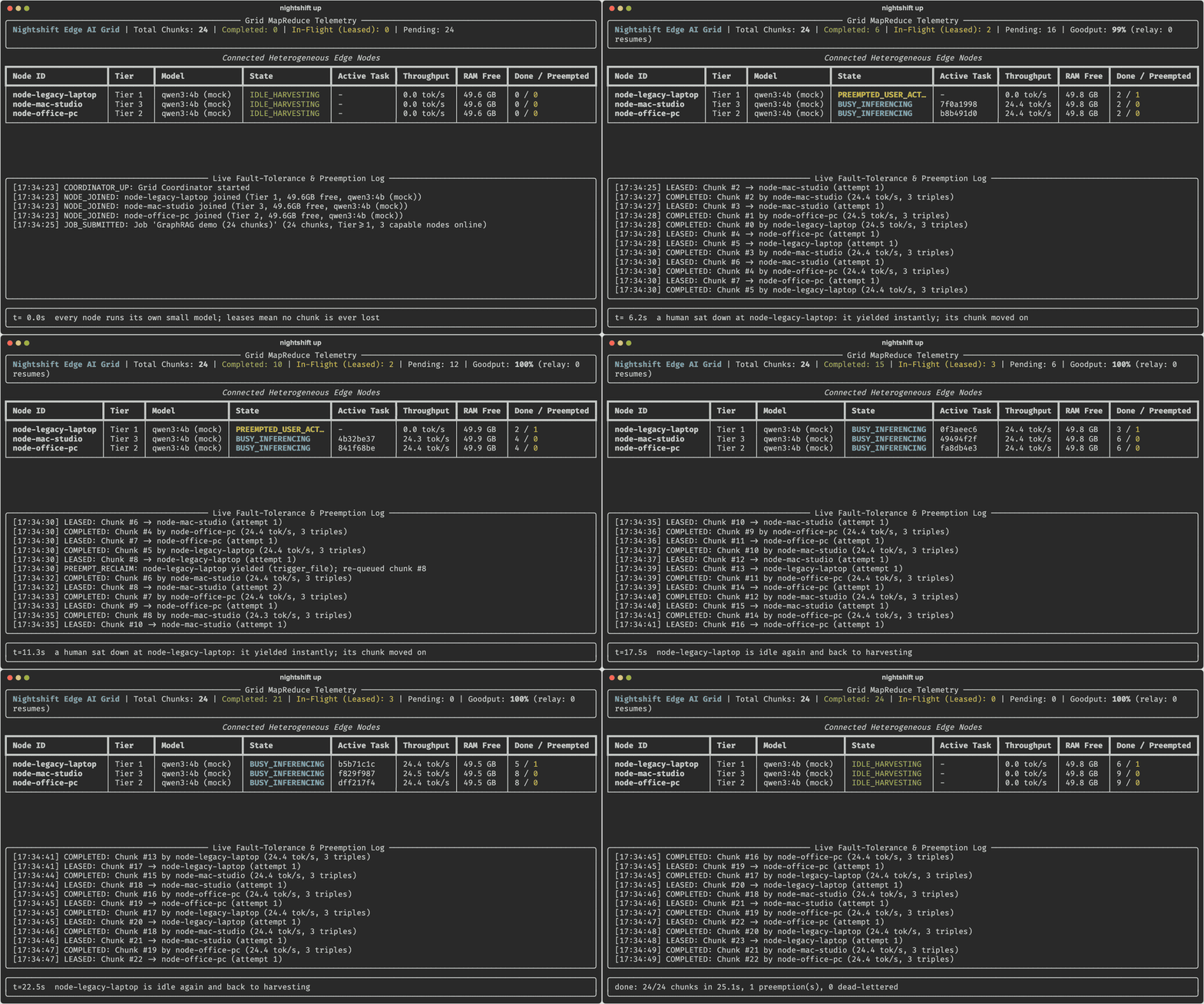
A real (mock-inference) run recorded with scripts/record_demo.py. Benchmarks so far are from a single Mac; see Known limitations.
Nightshift Grid is a lightweight distributed compute engine ("SETI@home meets local enterprise MapReduce"). It harvests idle cycles across mixed local machines without slowing down the people using them.
It doesn't slice one giant model across slow LAN links, where Wi-Fi jitter destroys token
throughput and one closed laptop lid kills the forward pass. Instead, every machine is a
preemptible, fenced micro-worker running its own quantized small model (qwen3:4b,
qwen2.5:3b, phi4-mini) via Ollama. A central coordinator hands out leased chunks.
When a human touches the machine, the node yields immediately and its chunk moves to another node.
           submit 24 chunks                      output_graph.jsonl
 client ──────────────────────▶ Coordinator ───────────────────────▶ (1 record / chunk)
                                 │  ▲  lease(task_id, lease_id) / heartbeat 3s / complete / preempt
                 ┌───────────────┼──┼────────────────┐
                 ▼               ▼  │                ▼
          node-office-pc   node-legacy-laptop   node-mac-studio     each: worker_daemon.py
            (Tier 2)          (Tier 1)             (Tier 3)              + local Ollama
Why this exists
Most teams have gigabytes to terabytes of unstructured PDFs, logs and tickets that can't go to cloud APIs for cost or privacy reasons. Meanwhile the office PCs, laptops and mini-PCs that could process them sit mostly idle all day and fully idle overnight.
The common ways to pool local machines leave a gap for batch pipelines:
| Approach | Typical failure mode for batch work | Nightshift Grid |
|---|---|---|
| Tensor/layer splitting (one big model sharded across machines) | Bound by LAN serialization. One node dropping mid-pass stalls the whole request. | Each node runs a whole small model on independent chunks. A dropped node costs one chunk retry. |
| Stateless request routing (load-balance chat requests across nodes) | No durable job state, so a node dying mid-request fails that request. | Stateful MapReduce queue with fenced leases. Every chunk completes or is explicitly dead-lettered. |
| Dedicated inference pools | Machines must be handed over to the cluster. | Good-citizen harvesting: the human always wins and the grid backs off in milliseconds. |
Capability tiers decide what each node gets: Tier 1 (<8GB free) does embeddings and chunking, Tier 2 (8–24GB) does 3B–8B INT4 entity/relationship extraction, and Tier 3 (>24GB, or Apple Silicon with ≥16GB free) does heavy verification and synthesis.
Key highlights and live benchmarks
1. Sub-250ms GPU yield, including during model load and prompt eval
A common trap when wrapping Ollama or llama.cpp in Python is breaking out of the token loop
without closing the underlying socket. The server keeps generating, and the GPU stays pegged
until the response finishes. A second trap is checking for user activity only when a token
arrives. That leaves a blind spot while the model is loading weights or evaluating a long prompt.
Nightshift runs inference in its own asyncio task. An out-of-band activity watcher polls the
chaos trigger file every 100ms and OS HID idle time every 500ms: ioreg -c IOHIDSystem on macOS,
GetLastInputInfo on Windows, xprintidle on Linux. On activity it calls task.cancel(),
which unwinds async with client.stream(...) and closes the connection, so Ollama stops
generating.
Measured with qwen3:4b on Apple Silicon (GPU utilisation from IOKit, 250ms samples):
| Worker cancellation method | GPU utilisation afterwards |
|---|---|
| Stop the read loop, leave the response open | 84–94% until the model finishes |
Error raised inside async with client.stream |
0% by the first sample; next request ready in 0.04s |
Out-of-band task.cancel() (also covers model load and prompt eval) |
0% by the first sample |
2. End-to-end chaos benchmarks
Three workers (qwen3:4b, about 130 tok/s decode) processed a 24-chunk industrial-maintenance
GraphRAG extraction job per phase, with auth enabled (python nightshift.py chaos-test --model qwen3:4b). All three workers ran on one Mac sharing one Ollama
instance. Multi-machine runs are still to do.
| Chaos scenario / metric | Measured result |
|---|---|
Live human preemption (user returns mid-job on node-legacy-laptop) |
24/24 chunks in 47.3s, 0 failures |
| Activity → coordinator reclaims the lease (trigger file, 100ms poll) | 0.01–0.10s across runs (0.011s in the final run) |
| Lease reclaimed → re-assigned to another node | 0.8s |
| Activity → preempted chunk finished on the backup node | 5.2s |
| Work sent to the paused node while the human is active | 0 chunks |
Worker crash (SIGKILL node-office-pc mid-chunk) |
24/24 chunks in 45.8s |
SIGKILL → lease expiry (12s TTL) → re-assigned → done |
11.9s → +1.1s → 16.8s total |
Coordinator crash (SIGKILL coordinator mid-job, 3s outage, restart on same SQLite file) |
24/24 chunks in 46.4s, 24 attempts for 24 chunks (0 wasted) |
| Restart → ready; in-flight leases finished by their original holders | 0.23s; 2/2 |
Host CPU spike (busy-loop on all 16 cores mid-job, --max-host-cpu-pct 65) |
24/24 chunks in 54.4s; all 3 workers yielded (cpu_busy) in 1.9–2.7s, 0 leases while loaded, all resumed 2.1s after the load stopped |
| Unintended preemptions from the grid's own Ollama load (phases 1–3) | 0 |
| Auth (anonymous submit / worker token on client API / forged completion) | 401 / 401 / 401 |
| Output integrity (4 jobs) | 96/96 records, 0 missing, 0 duplicates, 434 triples |
With --native-idle-seconds, detection latency is bounded by the 500ms HID poll rather than the
100ms file poll. The HID path is covered by unit tests and a live ioreg read. An end-to-end
benchmark with real keyboard input is still to do, because synthesising HID events needs macOS
Accessibility permission.
Core guarantees
| Guarantee | Mechanism |
|---|---|
| No chunk lost | Every lease has a 12s TTL, extended by 3s heartbeats, and a reaper re-queues expired leases. Preemption and graceful SIGTERM hand leases back immediately. A worker can hold only one lease at a time. |
| Fenced leases (no split-brain) | Each assignment carries a unique lease_id. A partitioned or stalled worker can't heartbeat or complete a lease that was re-issued. The heartbeat reply (lease_valid: false) tells it to abort the zombie compute. |
| Race-free pull and pause | If a human returns while a pull is in flight, the new lease goes straight back. Preempt messages name their lease, so a late one can't revoke a newer lease. A paused node gets no work until it reports idle. |
| Dead-letter protection | Errors and lease expiries count toward MAX_FAILURES=3, after which the chunk is parked as FAILED. Human preemptions don't count as failures. |
| Clean graph output | Ollama structured outputs (a JSON schema) constrain decoding. normalize_extraction() coerces the output to [subject, RELATION, object] and canonicalises relation names (exceeded during → EXCEEDED_DURING) so edges merge across chunks. Reasoning tokens are disabled on thinking models (qwen3). Invalid output is a retryable failure. |
| Idempotent sink | output_graph.jsonl is fsynced per record and deduplicated by task_id, including across a coordinator restart or a failed fsync. Retried completions are no-ops. |
| Capability-aware scheduling | A worker serves the highest tier it's capable of first, so Tier 3 nodes aren't spent on Tier 1 work while Tier 3 work waits. Recovered chunks go to the front of the queue. |
| Survives coordinator crashes | Every state transition is journaled to SQLite (WAL) in one transaction. On restart, queue order, results and dead letters are recovered, and in-flight leases get a fresh TTL so workers that kept computing can still complete them. Workers retry completions for 30s to ride out the restart. About 11k durable transitions/s; a 50k-task job recovers in 0.3s. |
| Least-privilege auth | Separate bearer tokens for workers (/worker/*) and clients (/v1/*), so a compromised laptop can lease work but can't submit jobs or read results. Each worker registration gets a session secret (X-Nightshift-Session), so a live worker's id can't be hijacked. Constant-time comparison. Tokens come from files or env, never argv. Reused token files must be regular, owned by you and 0600 (no symlinks). The coordinator binds loopback by default and refuses a LAN bind without tokens. Browser Origin requests are refused, and in no-auth loopback mode untrusted Host headers are refused too (DNS-rebinding protection). |
| Good citizen beyond the keyboard | Workers also pause on battery power (--allow-battery to opt out) and under thermal throttling (macOS pmset, Linux sensors). They pause when other processes push host CPU over --max-host-cpu-pct (default 65; Ollama and co-located workers are excluded; sustain and hysteresis prevent flapping). They pause when free RAM drops under --min-free-ram-gb (default 2.0), evicting the model with keep_alive: 0; the resume threshold includes the model's size, so unloading can't cause a pause/reload loop. |
| Fail-closed idle sensing | With --native-idle-seconds, a worker that can't read HID idle time refuses to start (--allow-no-idle-sensor overrides). Sensors: macOS ioreg, Windows GetLastInputInfo, GNOME/Wayland Mutter and freedesktop ScreenSaver over D-Bus, X11 xprintidle. If a sensor dies at runtime, the worker pauses (idle_sensor_lost) rather than guessing. |
| Zero-config LAN discovery | worker_daemon.py --discover finds the coordinator over UDP broadcast. The reply carries an HMAC proof keyed by the worker token, so a rogue host can't impersonate the coordinator and harvest tokens. Replays fail (fresh nonce), two valid coordinators are an error, and responses are size-capped and rate-limited (not an amplifier). |
| Live vector index (optional) | --qdrant-url adds a Qdrant sink alongside the always-on JSONL. Writes are queued off the event loop, batched, embedded (nomic-embed-text, or a deterministic hash embedder) and upserted idempotently into nightshift_graph. Failures spool to disk and replay, and never fail a completion. One embedder per collection is enforced. |
| Preemption without lost work (Baton relay, opt-in) | With coordinator.py --relay, a worker streams its partial output to the coordinator as small deltas on the heartbeat it already sends, plus the exact text at the moment it yields. When a lease ends early (human returns, Wi-Fi drops, SIGKILL), the next worker on the same model continues the generation from that text instead of from token zero. Checkpoints are fenced by lease_id, only grow, and are journaled with the task, so they survive a coordinator crash too. A resumed attempt that fails validation drops the checkpoint, so a bad prefix can't loop. Live resume uses a raw prompt that's verified per model at worker startup (ChatML/Qwen today); other models restart as before. Decode accounting is always on: tokens generated, tokens in results, tokens wasted per node and goodput appear in /v1/grid/status → relay. |
Live fidelity (qwen3:4b, 3 chunks × 25/50/75% cuts, 2 runs):
- 18/18 resumed outputs are valid; 6/18 are identical to a fresh run.
- Mean triple overlap with the fresh run is 0.70, against 0.89 between two fresh runs.
- So resumed extractions drift more than run-to-run noise, mainly because an ungrammared continuation sometimes closes the object early.
- Relay therefore stays opt-in. It suits slow nodes and long outputs, where restarting costs most. | | Resilient workers | Non-JSON or 5xx responses are retried, not fatal. If the activity watcher or heartbeat task dies, the worker exits loudly instead of running unprotected. |
Quickstart
1. Install
As a tool (isolated environment; puts nightshift, nightshift-coordinator, nightshift-worker, nightshift-mcp,
nightshift-dashboard and nightshift-credential on your PATH):
uv tool install git+https://github.com/redd34/nightshift-grid     # or: pipx install git+https://github.com/redd34/nightshift-grid
ollama pull qwen3:4b                                              # any small chat model works; pass it with --model
From a checkout (for development; every command below also works as python <script>.py):
git clone https://github.com/redd34/nightshift-grid && cd nightshift-grid
python3 -m venv .venv && source .venv/bin/activate               # or: uv venv .venv
pip install -e ".[dev]"
2. Try it in 30 seconds
nightshift up --mock --workers 3          # coordinator + 3 workers + live dashboard, one terminal
nightshift submit --wait                  # (second terminal) 24-chunk demo job, zero config
nightshift status                         # one-shot table; `down` stops the grid and cleans up a crashed session
nightshift up --model qwen3:4b            # same, with real inference
up keeps tokens (0600), per-worker credentials, the state DB, output and logs in a state directory (.nightshift/
in a checkout, ~/.nightshift for an installed tool, or $NIGHTSHIFT_STATE_DIR), so submit/status need no flags.
3. Verify
python -m pytest -q tests                           # 379 tests: state machine, durability fuzz, guards, auth, TLS, relay, MCP...
python nightshift.py chaos-test --mock              # 4-phase chaos benchmark, Markdown table to stdout (~2.5 min)
python nightshift.py chaos-test --model qwen3:4b    # same, against live Ollama
4. Run a grid by hand
python coordinator.py --output output_graph.jsonl --db grid_state.db   # loopback, no auth: local dev
python worker_daemon.py --id node-office-pc     --tier 2 --model qwen3:4b
python worker_daemon.py --id node-legacy-laptop --tier 1 --model qwen3:4b --native-idle-seconds 60
python worker_daemon.py --id node-mac-studio    --tier 3 --model qwen3:4b
python dashboard.py                        # live rich TUI
python demo_submit.py --wait               # submit 24 chunks and wait for the summary
touch /tmp/preempt_node-legacy-laptop      # simulate a human; rm the file to release
5. From documents to an answerable graph (map → reduce → query)
python ingest.py docs/ --tier 2 --wait                 # chunk .txt/.md/.log/.csv/.jsonl/.pdf → grid job(s) + manifest
python reduce_graph.py output_graph.jsonl --out graph.json --graphml graph.graphml \
    --qdrant http://localhost:6333 --embed-model nomic-embed-text   # entity resolution + nightshift_* collections
python reduce_graph.py query graph.json "which bearing assemblies were replaced?" --qdrant http://localhost:6333
ingest.py keeps provenance in a sidecar <job>.manifest.jsonl, not in the prompt, so workers never see file paths.
reduce_graph.py merges surface variants such as Compressor turbine/Compressor: turbine, but never merges names
whose numbers differ (B-101 ≠ B-102, 4.2 ≠ 4.5 mm/s). It only ever writes Qdrant collections prefixed nightshift_,
and it never deletes or recreates a collection.
6. Drive it from an AI IDE (MCP)
claude mcp add nightshift --env NIGHTSHIFT_URL=http://127.0.0.1:8000 --env NIGHTSHIFT_MCP_ROOTS="$PWD" \
    -- "$PWD/.venv/bin/python" "$PWD/mcp_server.py"
The server exposes 4 tools: grid_status, dispatch_mapreduce_text, ingest_directory_to_graph and query_local_graph.
File access is limited to NIGHTSHIFT_MCP_ROOTS (symlinks resolved, secret files refused), and tools warn when data
would leave the machine. See docs/MCP.md for Claude Desktop config and the security model.
7. Deploy as services
deploy/gen_token.sh --env > coordinator.env          # GRID_WORKER_TOKEN / GRID_CLIENT_TOKEN
# Coordinator (Linux): hardened systemd unit, steps in deploy/README.md §2
# Worker on macOS (LaunchAgent) / Linux (systemd --user); preview first with --dry-run:
printf '%s\n' "$GRID_WORKER_TOKEN" | deploy/install_worker.sh \
    --coordinator http://10.0.0.5:8000 --model qwen3:4b --tier 2 --token-stdin
# Windows (at-logon task; add -WhatIf to preview):
#   deploy\windows\install_worker.ps1 -Coordinator http://10.0.0.5:8000 -TokenFile worker.token
# Remove: deploy/install_worker.sh --uninstall [--purge]   ·   Ops guide: deploy/README.md
Workers run as per-user services (a LaunchAgent, systemd --user, or an at-logon task), never as system daemons.
Only a per-user service can see the logged-in user's keyboard and mouse, which preemption depends on.
Useful worker flags:
--mocksimulates the token stream.--tier Noverrides hardware fingerprinting.--native-idle-seconds Npauses the worker while HID idle time is under N seconds.--unload-on-preempt auto|always|neversendskeep_alive: 0to free the model's RAM.autoonly does this under memory pressure.--allow-battery,--min-battery-percent P,--ignore-thermaland--max-temp-c Ccontrol the power and thermal guards.--num-ctx N(default 4096, envNIGHTSHIFT_NUM_CTX) is sent with every Ollama request. It is never left unset: Ollama would otherwise load the model at its own default context, which for qwen3 is 262k tokens (~40 GB).--max-host-cpu-pct P(default 65, 0 = off) and--cpu-busy-samples Ncontrol the CPU guard.--min-free-ram-gb G(default 2.0) controls the RAM guard.--allow-no-idle-sensorkeeps the worker running when no HID idle sensor is available.--discover(with--discovery-port) finds the coordinator on the LAN, and learns its TLS fingerprint through the authenticated reply.--token-file PATHsets the worker credential. Otherwise it comes from$GRID_WORKER_TOKEN,$GRID_TOKEN,$NIGHTSHIFT_TOKEN_FILEor$NIGHTSHIFT_TOKEN. With a per-worker credential,--idis optional, because the credential names its id.--tls-fingerprint sha256:…pins the coordinator's certificate.--ca-file PEMverifies it against a CA instead. The env equivalents are$NIGHTSHIFT_TLS_FINGERPRINTand$NIGHTSHIFT_CA_FILE, which the dashboard,demo_submit.py, the CLI and the MCP server also read.
Coordinator flags:
--hostdefaults to127.0.0.1.--db grid_state.dbsets the state file (none= in-memory).--outputsets the JSONL sink.--worker-token-fileand--client-token-fileset the tokens. Otherwise they come from$GRID_WORKER_TOKEN/$GRID_CLIENT_TOKEN, or$GRID_TOKENfor both.--auto-tlsserves HTTPS with a self-signed certificate. It's minted on the first run next to the db and reused afterwards, and its fingerprint is printed at startup. Alternatively, use--tls-cert/--tls-key. A non-loopback bind refuses plain HTTP unless you pass--allow-plaintext, which is for networks that are already encrypted, such as Tailscale/WireGuard.--worker-auth auto|per-worker|sharedsets how workers authenticate. The default,auto, meansper-workeron a LAN bind: each worker presents a credential bound to its own id, minted withpython grid_auth.py issue --id node-x --worker-token-file worker.token --out node-x.credential. The master worker token then never leaves the coordinator host.--allow-insecurepermits a LAN bind without tokens or TLS.--auto-tokengenerates and persists 0600 tokens on the first run.--advertise/--no-advertiseand--discovery-portcontrol LAN discovery. It's on by default for non-loopback binds.--qdrant-url URLor--qdrant-memory, plus--qdrant-collection nightshift_graphand--qdrant-embedder auto|ollama|hash, enable the live vector sink.python qdrant_sink.py backfillre-indexes from the JSONL.
API
With tokens configured, /worker/* requires Authorization: Bearer <worker credential> and /v1/* requires the client token. A per-worker credential is nsw1.<id>.<HMAC(master, id)>. It only works for its own worker_id: using it for any other id gets a 403, and it can't mint new ids.
| Endpoint | Purpose |
|---|---|
GET /healthz |
Liveness probe (unauthenticated, reveals nothing). |
POST /worker/register |
Join, or re-join. A re-join re-queues the node's old leases. |
POST /worker/pull-task?worker_id= |
Lease the next chunk → {task_id, lease_id, prompt}. |
POST /worker/heartbeat |
Extend the lease and report telemetry plus progress (gen_tokens, and with relay a checkpoint delta ckpt_from/ckpt_delta) → {lease_valid, ckpt_len}. |
POST /worker/preempt |
{worker_id, reason, detected_at, lease_id?, gen_tokens?, ckpt_from?, ckpt_delta?}: hand back the lease now, with the final checkpoint. With relay, the next pull of that chunk carries resume: {text, tokens}. |
POST /worker/complete / /worker/fail |
Fenced by lease_id. |
POST /v1/grid/mapreduce |
Submit {job_name, chunks[], required_tier}. |
GET /v1/grid/jobs/{id}?results=true |
Progress, attempts, preemptions, dead letters and results. |
GET /v1/grid/status, /v1/grid/events?since_seq= |
Dashboard snapshot and structured event log. Sequence numbers keep increasing across restarts. |
Project layout
| File | Role |
|---|---|
coordinator.py |
FastAPI control plane. GridState holds the whole lease state machine and takes an injectable clock, with index-backed O(leases) hot paths. |
grid_store.py |
SQLite (WAL) journal: one transaction per state transition, plus recovery. |
grid_auth.py |
Token resolution (file or env), bearer headers, and fail-fast 401 handling. |
worker_daemon.py |
Preemptible async worker: hardware fingerprinting, cancellable Ollama streaming, heartbeats. |
idle_detection.py |
ActivityMonitor with pluggable sources: trigger file, HID idle (macOS/Windows/Linux), battery, thermal, foreign CPU load. |
ingest.py |
Map-side input: walks files, chunks on paragraph/sentence boundaries with overlap, dedupes, submits jobs, writes a provenance manifest. |
reduce_graph.py |
Reduce side: entity resolution (key normalization, guarded embedding merge, union-find), graph.json/GraphML, Qdrant sink, and query. |
nightshift.py |
One-command CLI: up / down / submit / status / chaos-test / token. |
mcp_server.py |
MCP server (stdio) exposing the grid to Claude Code, Claude Desktop, Cursor and Kiro. See docs/MCP.md. |
discovery.py |
UDP LAN discovery with an HMAC proof of token possession. |
qdrant_sink.py |
Live Qdrant sink: background batching, disk spool, embedder consistency, and backfill. |
deploy/ |
Service installers and templates: macOS LaunchAgent, systemd, Windows Task Scheduler, plus a token generator. See deploy/README.md. |
graphrag.py |
Extraction prompt, JSON schema, normalizer and idempotent JSONL sink. |
relay.py |
Baton token relay helpers: JSON progress scanner and online validator, verified ChatML raw-prompt renderer, grammar-per-item structured resume. |
chaos_test.py |
E2E harness with auth on: human-preemption, worker-SIGKILL and coordinator-SIGKILL phases, with zero-loss and zero-duplicate checks. |
dashboard.py, demo_submit.py |
TUI and batch submitter. |
Known limitations and roadmap
- Single-host benchmarks so far. All three workers shared one Mac and one Ollama. The next milestone is a multi-machine pilot. Latency metrics compare worker and coordinator wall clocks, which is exact on one host but subject to NTP skew across hosts.
- Transport and identity. A LAN coordinator serves TLS (
--auto-tlsor your own certificate), and workers pin its fingerprint. Each worker holds a credential that's valid only for its own id, and every call is also bound to the current registration's session. What remains: a compromised worker can still submit bad results for chunks it leases (results aren't cross-checked yet), credentials are revoked only by rotating the master worker token, and the self-signed certificate's private key is only as safe as the coordinator host. - Single coordinator. It's durable, but not highly available. Finished jobs are never pruned, so the state DB grows with history.
- Mixed failure policy. HID idle sensing fails closed. Battery, thermal, CPU and RAM sensors fail open with one warning each.
- Qdrant sink and SIGKILL. Records still in the sink's in-memory queue when the coordinator is SIGKILLed (under a second's worth) are in the JSONL but not in Qdrant until
python qdrant_sink.py backfillruns. - Noisy hosts. The default 65% CPU guard pauses workers on a busy developer machine. That's intended, but tune
--max-host-cpu-pctfor build servers. - Not validated on real hardware: thermal throttling and battery unplugging (unit-tested with fakes only), the Linux and Windows installers (rendered and inspected, but never run on those OSes), and
systemd-analyze,shellcheckandpwshlinting. - Extraction quality from 3–4B models is unmeasured. Next: a small labelled set, plus Tier 3 verification/consensus on a sample.
1 maintainer

Metadata
1 maintainer
Release files for nightshift-grid 0.1.1
For a detailed explanation of source distributions (sdists) and built distributions (wheels), please see the package formats documentation.
Source distribution (sdist)
| File | Size | Uploaded | Provenance | Actions |
|---|---|---|---|---|
| nightshift_grid-0.1.1.tar.gz | 209.9 kB | With provenance | Details for nightshift_grid-0.1.1.tar.gz |
Built distribution (wheel)
| File | Interpreter | ABI | Platform | Actions Reset |
|---|---|---|---|---|
| nightshift_grid-0.1.1-py3-none-any.whl | Python 3 | none | any | Details for nightshift_grid-0.1.1-py3-none-any.whl |
Total release size: 369.1 kB
Release files / nightshift_grid-0.1.1.tar.gz
| Download URL | nightshift_grid-0.1.1.tar.gz |
|---|---|
| Size | 209.9 kB |
| Tags | Source |
|
SHA-256 checksum How to use checksums |
89446e69affd8e503488a8d51fdba8d7a5b18e0314b34f38d8af65c289088a3c
|
|
BLAKE2b-256 checksum How to use checksums |
139293aec43065b5b20bf466abcc1f96610a6fcecef80b096910e810694a6b66
|
| Upload date | |
|
Uploaded using Trusted Publishing? What is trusted publishing? |
Yes |
| Uploaded via |
twine/7.0.0 CPython/3.13.16
|
Provenance
Provenance describes where a file came from. On PyPI, provenance is shared via attestations, which provide a verifiable record of the build or publishing details. View details, limitations and caveats.


PyPI Publish Attestation
PyPI verified that this artifact, at this checksum, originated from the publisher listed below.
Signed by GitHub Actions, verified by PyPI on Nov 13, 2026.
Transparency logRelease files / nightshift_grid-0.1.1-py3-none-any.whl
| Download URL | nightshift_grid-0.1.1-py3-none-any.whl |
|---|---|
| Size | 159.2 kB |
| Tags | Python 3 |
|
SHA-256 checksum How to use checksums |
715be1ea238aef3212925a56e497c8677a2d9927cac3e04422df72782714ac28
|
|
BLAKE2b-256 checksum How to use checksums |
b94760223ae390b50052af9ded6907a2a8e97daa66afe5fee9402bdb38102e9d
|
| Upload date | |
|
Uploaded using Trusted Publishing? What is trusted publishing? |
Yes |
| Uploaded via |
twine/7.0.0 CPython/3.13.16
|
Provenance
Provenance describes where a file came from. On PyPI, provenance is shared via attestations, which provide a verifiable record of the build or publishing details. View details, limitations and caveats.
PyPI Publish Attestation
PyPI verified that this artifact, at this checksum, originated from the publisher listed below.
Signed by GitHub Actions, verified by PyPI on Nov 13, 2026.
Transparency logSecurity for nightshift-grid 0.1.1
Provenance
Provenance describes where a file came from. On PyPI, provenance is shared via attestations, which provide a verifiable record of the build or publishing details. View details, limitations and caveats.
Full provenance
Both files in this release have been uploaded with provenance metadata.
Attestation for nightshift_grid-0.1.1.tar.gz
PyPI Publish Attestation
PyPI verified that this artifact, at this checksum, originated from the publisher listed below.
Signed by GitHub Actions, verified by PyPI on Nov 13, 2026.
Transparency logA note on package security
PyPI is a repository for distributing packages, not a service for auditing them. While third-party security researchers and our staff do their best to detect and remove malicious packages, PyPI cannot guarantee the quality, security or suitability of any given package.
To learn more about protecting yourself from malicious actors, visit our package security documentation.














