
nightward
A regression gate for AI-made changes. Your AI agent can run the gate, but it can't approve it.
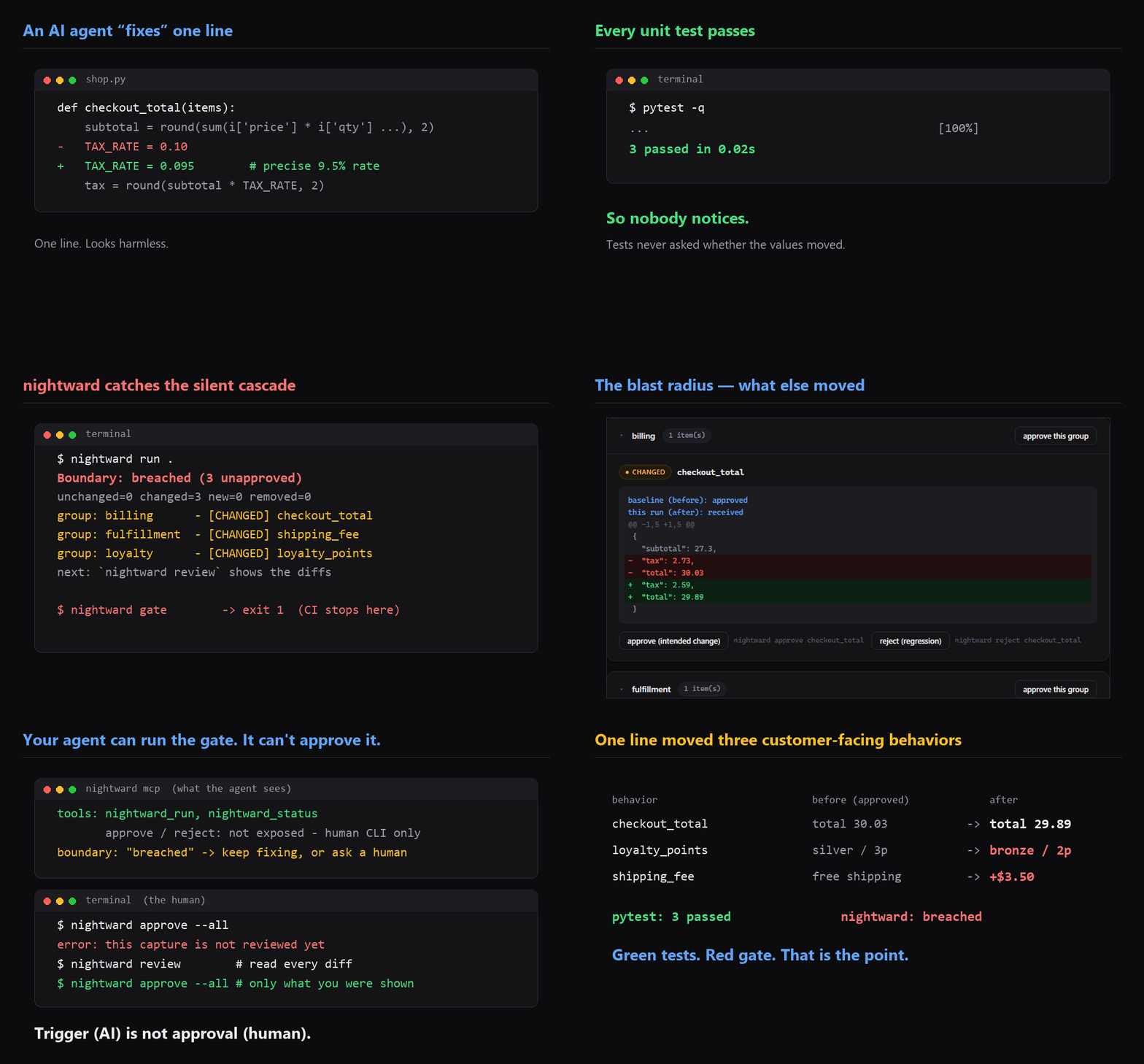
When an AI agent fixes A, it often moves B, C and D too, and the test suite stays green because no test pins down B, C or D. You find the side effects later, fix them, and the fixes move something else. An agent loop has no reliable way to know when it is done.
nightward gives that loop a definition of "done" that the agent can check but not change:
- Your tests capture what the code does today with a
behavior(...)pytest fixture. You don't write expected values. - A human reviews those captures and approves them once. That baseline is a set of JSON files committed next to your code.
- After every change, nightward captures again and lists everything that moved, grouped by feature (the blast radius). The gate stays closed until a human approves each change as intended or the code is fixed.
The agent gets run and status, on the command line or as MCP tools. Approving
is a human CLI command, and its result is a file diff that goes through code review.
nightward run       # capture behaviors and compare them with the approved baseline
nightward review    # a human reads the diffs
nightward approve   # the human accepts what review showed (intended changes only)
nightward gate      # exit 0 only when nothing unapproved remains (CI, agent loops)
nightward is not a test generator, and it has no idea what is correct. It only makes sure that no change to a captured behavior passes silently.
| vs. NL→test generators | nightward gates changes, it doesn't author tests |
| vs. plain snapshot libs | nightward aggregates a blast radius, emits a machine stop-signal for agent loops, and keeps approval human-only |
| vs. ordinary regression tests | no hand-written expected values, and a semantic judge can gate nondeterministic AI text |
What's new in 0.3.0, and what changes for 0.2 users: see the CHANGELOG.
Install
nightward needs Python 3.10+. Installing it also registers its pytest plugin, so
the behavior fixture is available in every test.
nightward is not on PyPI yet.
pip install nightwardis the command once 0.3.0 is published. Until then, install the pre-release from GitHub.
# pre-release (works today): the main branch from GitHub
pip install "git+https://github.com/LunenLabs/nightward"
pip install "nightward[mcp] @ git+https://github.com/LunenLabs/nightward"   # + MCP server

# after the PyPI release
pip install nightward
pip install "nightward[mcp]"      # + MCP server for AI agents
Other extras: [judge] (the Anthropic SDK, for the LLM judge) and [docs] (the
PDF, Word and Excel adapters).
Quickstart (5 minutes)
In an empty directory, create a tiny app and a test that captures its behavior.
app.py:
def checkout_total(items):
    subtotal = sum(i["price"] * i["qty"] for i in items)
    tax = round(subtotal * 0.1, 2)
    return {"subtotal": subtotal, "tax": tax, "total": round(subtotal + tax, 2)}


def user_login(username):
    return {"user": username, "status": "ok", "roles": ["member"]}
test_app.py writes no expected values. It captures what the code returns:
from app import checkout_total, user_login

CART = [{"price": 10.0, "qty": 2}, {"price": 5.5, "qty": 1}]


def test_checkout(behavior):
    behavior("checkout_total", checkout_total(CART), group="billing")


def test_login(behavior):
    behavior("user_login", user_login("alice"), group="auth")
1. Approve the current behavior as the baseline.
git init                    # skip in an existing repo
nightward init              # creates .nightward/ and git-ignores its per-run files
nightward run .             # runs pytest and captures; lists what moved (names only)
nightward review            # shows each diff; approve covers only what review showed
nightward approve --all
git add .gitignore .nightward   # commit baseline/, rejected/, judge/ (init ignores per-run files)
git add app.py test_app.py && git commit -m "nightward baseline"
run finds two NEW behaviors, review prints their JSON, and approve makes them
the baseline:
Boundary: breached (2 unapproved)
unchanged=0 changed=0 new=2 removed=0
...
approved checkout_total (c9ff6ed9)
approved user_login (b86be5a5)

Boundary: intact
unchanged=2 changed=0 new=0 removed=0
2. Make the kind of change an agent makes. In app.py, change the tax rate
0.1 to 0.2 (in bash: sed -i 's/subtotal \* 0.1/subtotal * 0.2/' app.py).
Then:
nightward run .             # the tests still pass
nightward gate              # exit code 1: not done
nightward status --json     # the same verdict, for a script or an agent
nightward approve --all     # refused: nobody has reviewed this change yet
nightward review            # the diff a human decides on
Boundary: breached (1 unapproved)
unchanged=1 changed=1 new=0 removed=0

group: billing
  - [CHANGED] checkout_total

boundary breached (1 unapproved) (as of the last run, ...)

{"boundary": "breached", "unapproved": 1, "changes": [{"name": "checkout_total", "kind": "CHANGED", "group": "billing"}], ...}

error: checkout_total changed since your review (the capture now in the store was taken by `nightward run` at ...). Run `nightward review checkout_total`, then approve what it shows.

[CHANGED] checkout_total
--- approved
+++ received
@@ -1,5 +1,5 @@
 {
   "subtotal": 25.5,
-  "tax": 2.55,
-  "total": 28.05
+  "tax": 5.1,
+  "total": 30.6
 }
3. Decide. If the change is a regression, fix the code: put 0.1 back, run
nightward run . again, and it reports Boundary: intact, so nightward gate
exits 0. If the change is intended, run nightward approve --all (it now
succeeds, because review showed you this diff) and commit the updated
.nightward/baseline/checkout_total.approved.json.
4. Optional: see the blast radius in a browser. nightward view builds a
static, read-only dashboard and serves it on localhost. nightward view --no-serve only builds nightward-site/, which init already git-ignored.
For a bigger cascade (one tax tweak moves three customer-facing behaviors), run the petshop example from a clone of this repo.
What to commit
| path | commit? | what it is |
|---|---|---|
.nightward/baseline/ |
yes | the approved behaviors: the boundary |
.nightward/rejected/ |
yes | changes a human confirmed as regressions |
.nightward/judge/ |
yes | the semantic judge's rulings (review them like the baseline) |
pending/, report.json, run_meta.json, reviewed.json, .lock |
no | per-run state, ignored by nightward init |
nightward-site/ |
no | the dashboard build: it contains your captured data |
Commands
| command | what it does |
|---|---|
nightward init |
create the store and the .gitignore rules (once per repo, and again after upgrading) |
nightward run [PATH] [-- PYTEST ARGS] |
run pytest, capture, compute the blast radius. Exit 1 if a capture test failed (the run is incomplete) |
nightward review [NAME...] [--group G] |
show the diffs. Only review and view mark changes as reviewed |
nightward approve --all / NAME... / --group G |
promote reviewed NEW/CHANGED behaviors into the baseline. Bulk approval never removes anything |
nightward approve --remove NAME... / --remove-group G |
drop REMOVED behaviors: removal is always this explicit act |
nightward reject NAME |
confirm a reviewed change as a regression. The gate stays breached |
nightward gate [--allow-not-run] |
the verdict as an exit code: 0 intact; 1 breached, partial, stale or incomplete; 2 no store, no report, or an error |
nightward status [--json] |
the verdict with the change list. --json is the machine signal |
nightward doctor [NAME...] |
explain what moved, and suggest scrub rules only for values that are volatile by evidence |
nightward report |
the verdict from a capture that pytest --nightward-record already wrote in your CI job |
nightward view |
build and serve the read-only dashboard |
nightward mcp |
stdio MCP server for AI agents: run and status, never approve |
nightward --version |
the installed version |
gate and status report the last run, so run nightward run again after
every code edit. The full reference (removals, stale reports, merge conflicts,
locking, and using the plugin inside an existing pytest job) is in
docs/commands.md.
AI agents (nightward mcp)
An agent loop needs a definition of "done" that it can check but not change.
nightward mcp is a stdio MCP server with two
tools: nightward_run (run the tests, capture, recompute the verdict) and
nightward_status (read the last verdict). approve and reject are not
exposed: if the agent that makes a change could also approve it, the gate would
turn into a changelog. The judge and the store are the humans' committed choices,
so the agent can't pick a lenient judge or point the server at another store.
pip install "nightward[mcp]"                      # the mcp 1.x SDK
claude mcp add nightward -- nightward mcp         # e.g. Claude Code; run it in the project root
Both tools return the status --json shape. The agent is done only when
boundary is intact and stale is false:
boundary |
meaning | what the agent should do |
|---|---|---|
intact |
no unapproved change | done |
breached |
unapproved changes | fix the code, or stop and ask a human to approve |
partial |
nothing unapproved among what ran, but approved behaviors were not checked (deselected, see not_run) |
run them: remove the -k/-m selection (it can't be waived over MCP) |
incomplete |
nothing unapproved, but capture tests failed or errored | fix the failing tests (see incomplete and pytest_output_tail) |
stale |
the baseline, capture or rejections moved since the report | call nightward_run again |
unknown |
no report yet | call nightward_run |
Setup for other MCP hosts, every argument and returned field, and the rules for the loop are in docs/mcp.md.
Gating AI text: the semantic judge
Free-text AI output changes its wording on every run, so an exact comparison
breaches every time. Mark such a behavior semantic=True and commit a judge in
pyproject.toml: [tool.nightward] judge = "anthropic:claude-haiku-4-5", or the
key-free persona:editor. The judge only decides whether two outputs mean the
same thing; approval stays human. Every ruling is recorded in the committed
ledger .nightward/judge/, and a judge that can't rule falls back to the exact
comparison. Details are in
docs/semantic-judge.md.
What "intact" means
"Boundary intact" means no captured behavior changed, nothing more:
- The gate sees only what
behavior()captures, so capture the behaviors you care about. - The gate is a convention, not a sandbox. An agent with a shell could run
approveor edit the baseline, but every bypass leaves a trace in git. Review baseline, ledger, scrub-rule and test diffs in every PR, protect your main branch, and let CI runnightward run && nightward gatefrom source. - A semantic judge can be wrong, so its rulings are recorded for review.
- Normalization defines "the same": timestamps and UUIDs are masked by default
(opt out with
scrub=False), and dict key order is ignored.
Read the threat model and what nightward normalizes before you rely on a green gate.
Documentation
- CHANGELOG: what's new in 0.3.0, and upgrading from 0.2
- Commands and workflow: every command, removals, stale reports, merge conflicts, and the plugin in an existing pytest job
- What nightward normalizes:
scrubbing, custom scrub rules, names, non-JSON values, and
doctor - Semantic judge
- AI agents (MCP)
- Dashboard
- Document & artifact inputs: PDF, Word, Excel, text and raw bytes
- Threat model
- CI recipe: GitHub Actions
Scope
In scope: pytest capture, the blast-radius diff, the gate, the loop signal,
scrubbing and doctor, the static dashboard, the MCP agent gate (run and status,
never approve), and the semantic judge. Out for now: PR-comment summaries,
call-graph grouping, and other languages. See CONTRIBUTING.md.
MIT licensed.
1 maintainer

Metadata
1 maintainer
Release files for nightward 0.3.0
For a detailed explanation of source distributions (sdists) and built distributions (wheels), please see the package formats documentation.
Source distribution (sdist)
| File | Size | Uploaded | |
|---|---|---|---|
| nightward-0.3.0.tar.gz | 188.6 kB | Details |
Built distribution (wheel)
| File | Interpreter | ABI | Platform | Reset |
|---|---|---|---|---|
| nightward-0.3.0-py3-none-any.whl | Python 3 | none | any | Details |
Total release size: 301.0 kB
Release files / nightward-0.3.0.tar.gz
| Download URL | nightward-0.3.0.tar.gz |
|---|---|
| Size | 188.6 kB |
| Tags | Source |
|
SHA-256 checksum How to use checksums |
b2b4f423bc4c84a397c2ca778be940fb80c7c3414c10a7cf630c60cc84a3d202
|
|
BLAKE2b-256 checksum How to use checksums |
0ab4eed867007dd94192508b3f899ebc3863e93641cc34a25243896077fdf0ce
|
| Upload date | |
|
Uploaded using Trusted Publishing? What is trusted publishing? |
Yes |
| Uploaded via |
twine/7.0.0 CPython/3.13.14
|
Provenance
Provenance describes where a file came from. On PyPI, provenance is shared via attestations, which provide a verifiable record of the build or publishing details. View details, limitations and caveats.


PyPI Publish Attestation
PyPI verified that this artifact, at this checksum, originated from the publisher listed below.
Signed by GitHub Actions, verified by PyPI on Oct 14, 2026.
Transparency logRelease files / nightward-0.3.0-py3-none-any.whl
| Download URL | nightward-0.3.0-py3-none-any.whl |
|---|---|
| Size | 112.5 kB |
| Tags | Python 3 |
|
SHA-256 checksum How to use checksums |
426ab2e1e5b545dbd8bb3ecec4d0b132af626ce24f019320dd7bb3b331ce7e12
|
|
BLAKE2b-256 checksum How to use checksums |
6b8437c1fb4ad42e3bbe18135875ec7e2dc3b43253f9b955192a7155e0be50e0
|
| Upload date | |
|
Uploaded using Trusted Publishing? What is trusted publishing? |
Yes |
| Uploaded via |
twine/7.0.0 CPython/3.13.14
|
Provenance
Provenance describes where a file came from. On PyPI, provenance is shared via attestations, which provide a verifiable record of the build or publishing details. View details, limitations and caveats.
PyPI Publish Attestation
PyPI verified that this artifact, at this checksum, originated from the publisher listed below.
Signed by GitHub Actions, verified by PyPI on Oct 14, 2026.
Transparency log













