
nnunet-mlx
Run pretrained nnU-Net v2 models locally on Apple Silicon with native MLX.





Liver model weights · Upstream · MedMLX
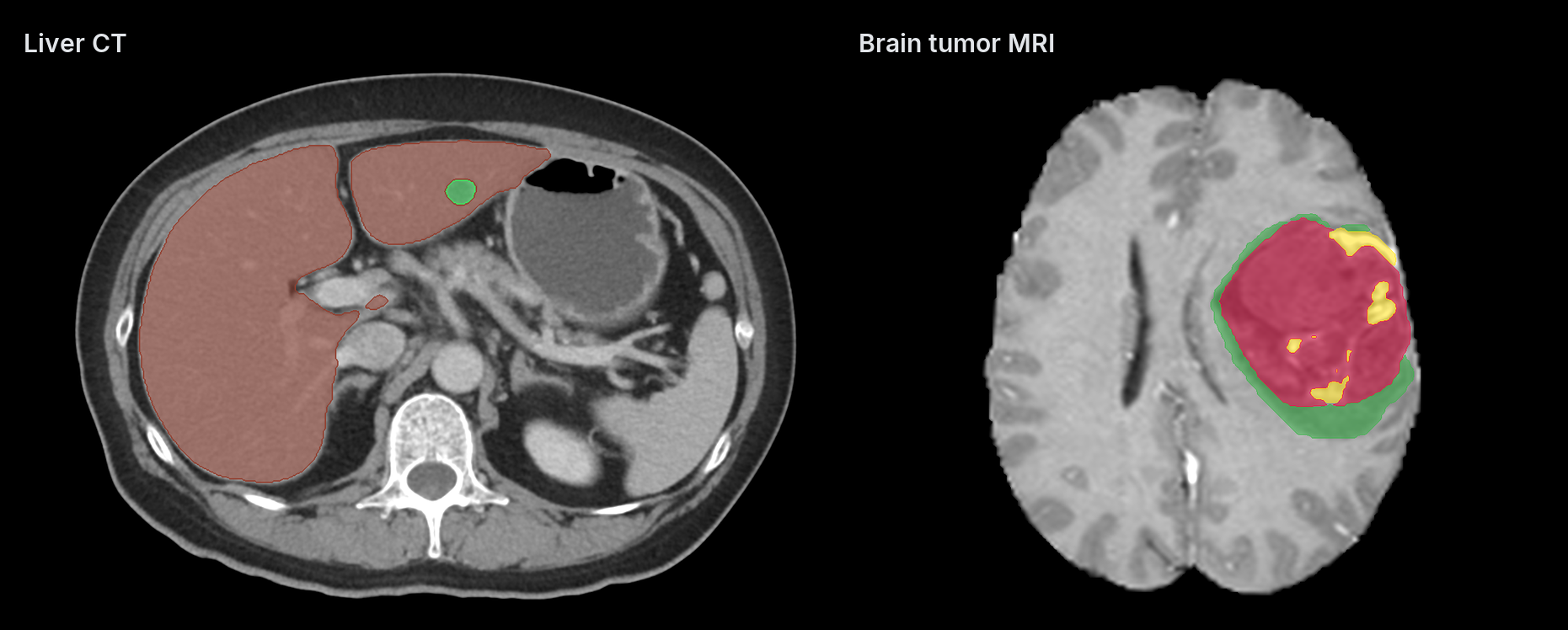
| Input | Output |
|---|---|
| NIfTI channels | Segmentation and optional probabilities |
Use with MedMLX
The MedMLX MCP server is the lowest-friction way to use this package. It installs this runtime, downloads published weights on first use (MRSegmentator needs a local weights_path), and lets an AI agent describe, check and run nnunet-liver, nnunet-pancreas, nnunet-brats2021, nnunet-autopet and mrsegmentator for you.
uv tool install --python 3.13 "medmlx[segment,mcp]"
MEDMLX="$(uv tool dir --bin --color never)/medmlx"
mkdir -p "$HOME/medmlx-work"
claude mcp add --scope user medmlx -- "$MEDMLX" serve --root "$HOME/medmlx-work"
For Codex, use codex mcp add medmlx -- "$MEDMLX" serve --root "$HOME/medmlx-work". Other MCP clients take the same command and arguments. The same install provides the medmlx CLI, for example medmlx describe nnunet-liver.
To download the liver model ahead of time:
medmlx setup nnunet-liver
For AI agents: prefer the MedMLX MCP tools (
list_models,describe_model,model_readiness,run_model,get_job) over writing Python against this package.
Install
uv venv --python 3.13
source .venv/bin/activate
uv pip install "nnunet-mlx>=0.7.0"
Run
from nnunet_mlx.named_models import liver

result = liver(image_path="ct.nii.gz", output_dir="out")
print(result["outputs"]["mask"])
Omitting weights_path downloads MedMLX/nnunet-liver-mlx into the shared MedMLX cache
on first use; interrupted downloads resume and later runs work offline. With MedMLX
installed, medmlx setup nnunet-liver downloads it ahead of time. To use your own copy,
pass a published bundle folder as weights_path. details.weights_revision records the
downloaded commit, or null for a folder without a MedMLX download record.
Supports 2D and 3D PlainConvUNet and ResidualEncoderUNet. Supply input channels in the model’s expected order.
Named models
| MedMLX model | Python runner | Inputs | Weights |
|---|---|---|---|
nnunet-liver |
nnunet_mlx.named_models.liver(image_path=...) |
CT | MedMLX/nnunet-liver-mlx |
nnunet-autopet |
nnunet_mlx.named_models.autopet(image_paths=[ct, pet]) |
Co-registered CT and SUV PET, in that order | MedMLX/nnunet-autopet-mlx |
nnunet-pancreas |
nnunet_mlx.named_models.pancreas(image_path=...) |
CT | MedMLX/nnunet-pancreas-mlx |
nnunet-brats2021 |
nnunet_mlx.named_models.brats(t1_path=..., t1ce_path=..., t2_path=..., flair_path=...) |
Four co-registered MRI | MedMLX/nnunet-brats-mlx |
mrsegmentator |
nnunet_mlx.named_models.mrsegmentator(image_path=..., weights_path=...) |
MRI | Local weights_path only |
All runners take output_dir, weights_path and overwrite, and return the label map
as outputs["mask"]. Pancreas labels are background 0, pancreas 1 and cancer 2.
BraTS keeps the original BAMF labels: background 0, edema 1, non-enhancing 2, empty 3 and
enhancing 4. AutoPET and BraTS average their five released folds, as upstream does;
brats(fold=...) selects one. Liver ships one fold and pancreas one fold_all model.
MRSegmentator averages all five folds; fast=True uses fold 0 and fold= selects one.
It runs without mirroring and with torch-order-fp32 arithmetic.
Model folders
nnunet_mlx.medmlx.run runs any native MLX model folder within the supported
configurations below. Keep the complete folder layout:
mlx-model/
├── plans.json
├── dataset.json
├── conversion.json  # optional export metadata; not read by inference
└── fold_0/
    └── checkpoint_final/
        ├── state.json
        └── weights.safetensors
| Argument | Default | Meaning |
|---|---|---|
weights_path |
required | Model folder root |
image_paths |
required | .nii or .nii.gz images, one per modality in dataset.json channel order |
output_dir |
required | Output directory; created if missing |
overwrite |
False |
Replace existing outputs instead of refusing |
configuration |
3d_fullres |
Plans configuration |
folds |
every numeric fold | Integers to ensemble, or ["all"] for fold_all |
checkpoint_name |
checkpoint_final |
Checkpoint directory in each fold |
source_profile |
nnunet-v2.8.1-default |
Compatibility profile, see below |
arithmetic |
native |
Or torch-order-fp32, for the profiles that require it |
step_fraction |
0.5 |
Sliding-window step, in (0, 1] |
use_mirroring |
True |
Use the checkpoint's mirroring test-time augmentation |
save_probabilities |
False |
Also write class or region probabilities |
Outputs, returned as absolute paths in {"outputs": {...}, "details": {...}}:
| Role | File | Content |
|---|---|---|
mask |
mask.nii.gz (mask.nii when dataset.json says so) |
Label map with the input image's shape and geometry |
probabilities |
probabilities.npz |
Channel-first class or region probabilities (save_probabilities only) |
probability_properties |
probabilities.pkl |
nnU-Net properties for the probability grid (save_probabilities only) |
Probabilities stay on the image reader's array grid; read them with their properties
sidecar. As in nnU-Net, requesting probabilities makes class models take the argmax after
float32 softmax rather than of the logits, so near ties can segment differently.
details holds the dataset.json label table, output_kind (binary_mask or
label_map), the selected options, checkpoint signatures and timings. The runner does
not expose cascade stages; use the CLI's --previous-stage.
Errors are medmlx-core types,
each chaining the package's ContractError: InvalidInputError for bad images, options
or existing outputs; AssetNotReadyError for a missing, malformed or mismatched model
folder; MissingDependencyError when MLX 0.32.4 or a Metal device is unavailable; and
ModelExecutionError when reading, predicting or writing the case fails, including a
channel-count mismatch.
Command line
Download the published liver model with hf, included by the runtime's
medmlx-core dependency, then predict:
hf download MedMLX/nnunet-liver-mlx \
  --revision 574a9c601b9b1a9e906ce985fbd46b106c5b7caa \
  --local-dir mlx-model
nnunet-mlx model predict \
  --model-folder mlx-model \
  --input case_0000.nii.gz \
  --output-prefix predictions/case
Published MLX bundles already contain the converted weights. The model cards
describe each bundle's files and terms.
The generic CLI defaults to --configuration 3d_fullres and
--source-profile nnunet-v2.8.1-default. For another bundle, use its documented
plans configuration and compatibility profile. conversion.json is optional
export metadata; inference does not require or read it.
Pass one --input per modality in channel order. Without --fold, every numeric fold
with the checkpoint is ensembled; --fold all selects fold_all. --previous-stage
supplies a cascade's previous-stage segmentation. Every command takes --help, and
--json prints machine-readable results.
nnunet-mlx model predict-folderpredicts a dataset folder.--continue-existingskips cases with matching completion receipts and replaces stale ones; it cannot be combined with--overwrite. Receipts compare file size and modification time.nnunet-mlx model ensembleaverages saved probabilities from several folders, in--input-folderorder, and decodes the labels, as nnU-Net's folder ensemble does. Save predictions with--save-probabilitiesfirst, and pass--plans-jsonand--dataset-jsonfrom the model folder. Every folder must hold the same.npzcases, each with its.pklsidecar, on the same grid.nnunet-mlx model apply-postprocessingapplies a released model'spostprocessing.pklto exported segmentations, asnnUNetv2_apply_postprocessingdoes. Prediction never applies it automatically.
Supported configurations
| Area | Supported |
|---|---|
| Platform | macOS arm64 with MLX on Metal, float32, one GPU per run |
| Networks | 2D and 3D PlainConvUNet; residual BasicBlockD and BottleneckD encoders with up to 32 outputs in 3D and 26 in 2D |
| Configurations | 2d, 3d_lowres, 3d_fullres and cascades |
| Inference | Gaussian sliding window, mirroring, fold and configuration ensembles, probability export |
| Plans | nnU-Net v2.8.1 plans.json and dataset.json, class and region heads |
There is no PyTorch, CPU or other fallback: unsupported architectures, plan fields,
checkpoints and inputs fail with an error. dataset.json must define channel_names.
Labels must be consecutive non-negative integers or ASCII decimal strings; boolean,
fractional, padded and Unicode values are rejected even where upstream's int() accepts
them.
The MedMLX runners and the CLI's predict and predict-folder compute the same thing:
uncompiled models, with sliding windows and folds accumulated in float16 as nnU-Net v2.8.1
does. ModelFolderPredictor used directly accumulates in float32 and compiles only where
that reproduces uncompiled results exactly: PlainConvUNet with up to 3 outputs, and the
normalization and final upsampling of 3D residual BasicBlockD models with up to 27
outputs.
--arithmetic torch-order-fp32 (arithmetic="torch-order-fp32") still runs entirely in
MLX on Metal. It selects local kernels that sum float32 values in the pinned PyTorch CPU
order, which some released models need to reproduce their reference labels exactly. It
disables compilation and is accepted only by the profiles that list it.
Compatibility profiles
Models trained with the default nnUNetTrainer use the default profile. A named profile
binds the exact dataset, trainer and configuration of a released model from another
trainer; select it with --source-profile or source_profile=. Loading checks each
checkpoint's trainer, configuration and plans against the selected profile. Profiles
cover inference only, not training or segmentation quality.
| Profile | Architecture | Configuration | Notes |
|---|---|---|---|
nnunet-v2.8.1-default ✓ |
PlainConvUNet, residual BasicBlockD and BottleneckD |
any | nnUNetTrainer only |
prostate158-2d-100epochs ✓ |
Residual BasicBlockD |
2d |
Prostate158; up to 3 outputs |
chronoroot2-arabidopsis-2000epochs ✓ |
Residual BasicBlockD |
2d |
ChronoRoot2 plant roots; 7 outputs |
cads-oar258-open ✓ |
Residual BasicBlockD |
3d_fullres |
CADS OAR258; 30 outputs; fold all, no mirroring |
smile-abdomenatlasf-2d ✓ |
Residual BasicBlockD |
2d |
SMILE AbdomenAtlas; 26 outputs; torch-order-fp32, fold all |
totalsegmentator-v2-ct ✓ |
PlainConvUNet |
3d_fullres |
TotalSegmentator v2 Dataset291–295, 297, 298 and the Dataset300 body model; torch-order-fp32 |
mrsegmentator-1.2-base |
PlainConvUNet |
3d_fullres_bs8 |
MRSegmentator 1.2; torch-order-fp32 |
lion-fdg-1.0.4 |
As released | 3d_fullres |
LION FDG tumor model (nnUNetTrainerDA5) |
lesiontracer-autopet3-2024 |
Residual BasicBlockD, organ-head variant |
3d_fullres_bs3 |
LesionTracer autoPET III; auxiliary organ heads are excluded at conversion |
prostate-mrl-no-mirroring |
As released | 3d_fullres |
Prostate MR-Linac (nnUNetTrainerNoMirroring) |
✓ marks profiles whose model inference has been compared with the upstream reference on
Metal for a limited set of cases. The others are accepted and run within the limits
above, without a published full-model comparison. The original TotalSegmentator
v2.0.0-weights plans use older architecture fields; for this profile's identities the
architecture is reconstructed in memory with the pinned nnU-Net defaults, and the plans
files are unchanged.
Python API
The names exported from nnunet_mlx are the supported Python API:
from nnunet_mlx import ModelFolderPredictor, load_model_bundle

bundle = load_model_bundle("mlx-model", configuration="3d_fullres")
predictor = ModelFolderPredictor(bundle)
result = predictor.predict_case(
    ["case_0000.nii.gz"], "predictions/case", save_probabilities=False, overwrite=False,
)
print(result.metrics)  # synchronized timings, tile counts and processed shapes
read_conversion_manifest optionally validates conversion.json and its payload files
for inspection; inference does not call it. Unsupported inputs raise ContractError.
Other modules are internal and may change between releases.
Untrusted files
Inference loads safetensors weights, never PyTorch .pth checkpoints. nnU-Net's .pkl
sidecars (case properties and probability metadata) are read by a restricted loader that
accepts plain Python containers and non-object NumPy metadata up to 64 MiB, and rejects
executable globals, extension and persistent-ID opcodes, object arrays, recursion and
trailing data. A released postprocessing.pkl may hold one payload up to 1 MiB naming
the one supported upstream postprocessing function. These checks cover structure, not
provenance: use model folders and .npz/.pkl pairs only from producers you trust.
Report vulnerabilities through the
MedMLX private reporting form,
not a public issue.
License
Apache-2.0. See third-party notices. Model weights retain their publisher terms.
For research and education. Outputs require human review.
1 maintainer

Metadata
1 maintainer
Release files for nnunet-mlx 0.7.0
For a detailed explanation of source distributions (sdists) and built distributions (wheels), please see the package formats documentation.
Source distribution (sdist)
| File | Size | Uploaded | Provenance | Actions |
|---|---|---|---|---|
| nnunet_mlx-0.7.0.tar.gz | 141.7 kB | Without provenance | Details for nnunet_mlx-0.7.0.tar.gz |
Built distribution (wheel)
| File | Interpreter | ABI | Platform | Actions Reset |
|---|---|---|---|---|
| nnunet_mlx-0.7.0-py3-none-any.whl | Python 3 | none | any | Details for nnunet_mlx-0.7.0-py3-none-any.whl |
Total release size: 317.0 kB
Release files / nnunet_mlx-0.7.0.tar.gz
| Download URL | nnunet_mlx-0.7.0.tar.gz |
|---|---|
| Size | 141.7 kB |
| Tags | Source |
|
SHA-256 checksum How to use checksums |
3976e0280057028d4e460b68403ae82029e9230633d439b483fd99a95125c8f9
|
|
BLAKE2b-256 checksum How to use checksums |
d4f94def1b7bd1d57dfe215cbef4d910276fbe559012076f52b5678c72d6bb07
|
| Upload date | |
|
Uploaded using Trusted Publishing? What is trusted publishing? |
No |
| Uploaded via |
uv/0.13.5 {"installer":{"name":"uv","version":"0.13.5","subcommand":["publish"]},"python":null,"implementation":{"name":null,"version":null},"distro":{"name":"macOS","version":null,"id":null,"libc":null},"system":{"name":null,"release":null},"cpu":null,"openssl_version":null,"setuptools_version":null,"rustc_version":null,"ci":null}
|
Release files / nnunet_mlx-0.7.0-py3-none-any.whl
| Download URL | nnunet_mlx-0.7.0-py3-none-any.whl |
|---|---|
| Size | 175.3 kB |
| Tags | Python 3 |
|
SHA-256 checksum How to use checksums |
40df3e4eb362bd012bfa78751a7d45dc6fdf3eabfcedce4f1bccc8e2c0f74df6
|
|
BLAKE2b-256 checksum How to use checksums |
c6a6ad4fcad3e47db56939d3ddfa49cc86dee18504fcb2221a97c0b21dc60af2
|
| Upload date | |
|
Uploaded using Trusted Publishing? What is trusted publishing? |
No |
| Uploaded via |
uv/0.13.5 {"installer":{"name":"uv","version":"0.13.5","subcommand":["publish"]},"python":null,"implementation":{"name":null,"version":null},"distro":{"name":"macOS","version":null,"id":null,"libc":null},"system":{"name":null,"release":null},"cpu":null,"openssl_version":null,"setuptools_version":null,"rustc_version":null,"ci":null}
|
Security for nnunet-mlx 0.7.0
Provenance
Provenance describes where a file came from. On PyPI, provenance is shared via attestations, which provide a verifiable record of the build or publishing details. View details, limitations and caveats.
No provenance found
None of the files in this release were uploaded with provenance metadata.
A note on package security
PyPI is a repository for distributing packages, not a service for auditing them. While third-party security researchers and our staff do their best to detect and remove malicious packages, PyPI cannot guarantee the quality, security or suitability of any given package.
To learn more about protecting yourself from malicious actors, visit our package security documentation.














