
nodeeditor-qtpy
A node editor framework for Qt. Build interactive graph interfaces out of draggable nodes, connectable sockets and edges, with undo/redo, JSON serialization and support for your own evaluation logic.
The distribution is called nodeeditor-qtpy; the import package is nodeeditor.
The framework itself is binding-agnostic: it talks to Qt through
QtPy, so it runs on PyQt5, PySide2,
PyQt6 and PySide6.
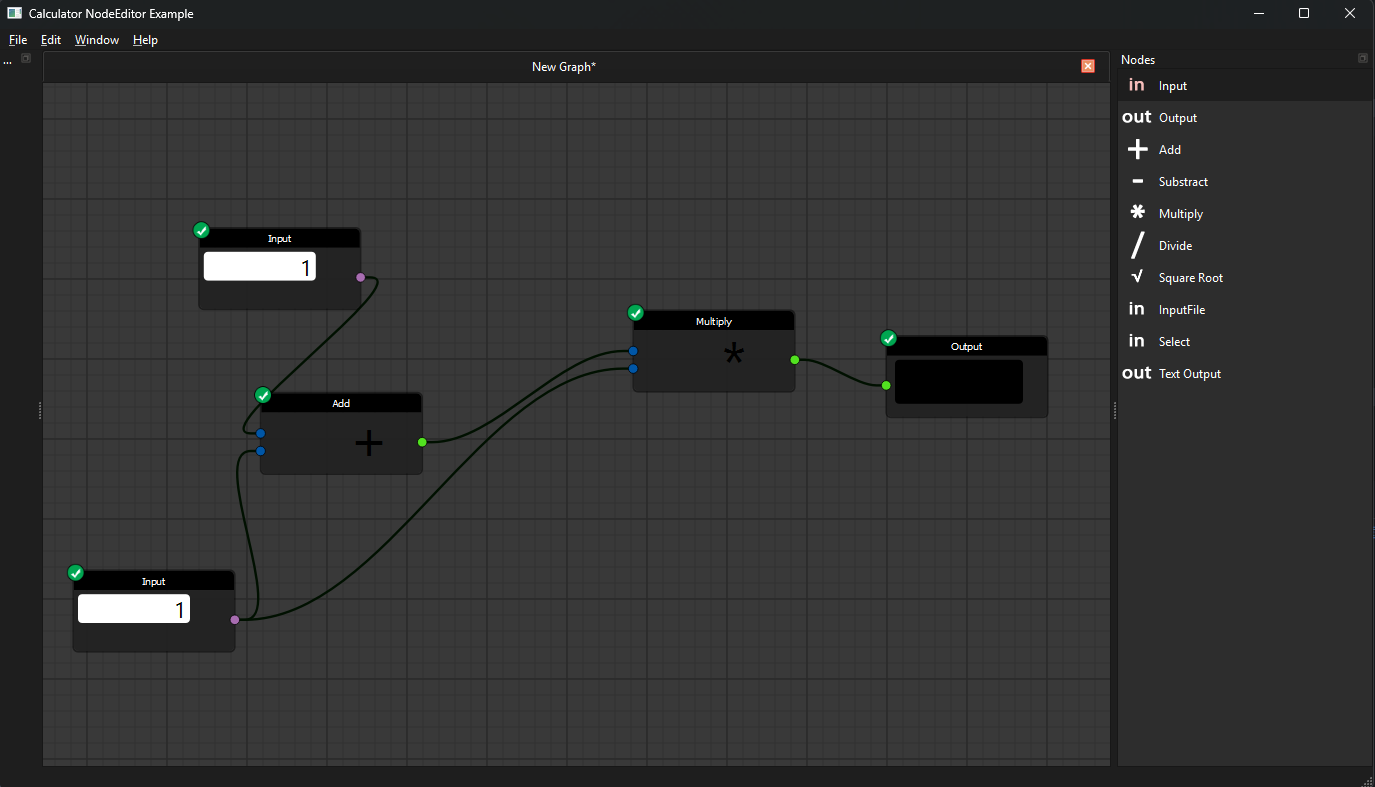
Features
- full framework for customizable nodes, sockets and edges
- undo / redo and serialization into JSON files in a VCS friendly way
- support for implementing evaluation logic
- hovering effects, dragging edges, cutting lines, snapping and more
- node groups, multi-input nodes, custom socket shapes and color schemes
- ready-made examples you can copy from
Requirements
- Python 3.10+
- A Qt binding: PyQt6 or PySide6 (any Qt 5/6 binding QtPy supports works)
Installation
From PyPI, including a Qt binding:
pip install nodeeditor-qtpy[pyqt6]
or, for PySide6:
pip install nodeeditor-qtpy[pyside6]
Without an extra, the package installs no binding and uses whichever
PyQt5/PySide2/PyQt6/PySide6 you already have. When several are installed,
QtPy picks one from the QT_API environment variable.
Directly from source code to get the latest version:
pip install "nodeeditor-qtpy[pyqt6] @ git+https://github.com/AzadKshitij/qtpy-nodeeditor.git"
Or clone the repository:
git clone https://github.com/AzadKshitij/qtpy-nodeeditor.git
Quick start
A node is a Node belonging to a Scene. Give it sockets, then connect an
output socket to an input socket with an Edge:
import sys

from qtpy.QtWidgets import QApplication

from nodeeditor.node_editor_widget import NodeEditorWidget
from nodeeditor.node_node import Node
from nodeeditor.node_edge import Edge

app = QApplication(sys.argv)

editor = NodeEditorWidget()
scene = editor.scene

# a node with one output socket
source = Node(scene, title="Value", outputs=[1], output_text=["out"])

# a node with one input socket
sink = Node(scene, title="Print", inputs=[1], input_text=["in"])

# connect the output of the first node to the input of the second
Edge(scene, source.outputs[0], sink.inputs[0])

editor.show()
sys.exit(app.exec())
NodeEditorWidget creates the Scene for you. Use Scene on its own when
you want to drive the graph without a widget:
from nodeeditor.node_scene import Scene
from nodeeditor.node_node import Node

scene = Scene()
node = Node(scene, title="Value", outputs=[1], output_text=["out"])
The inputs and outputs lists hold socket types, and the matching
input_text / output_text lists hold the labels drawn next to them. Both
Node and Edge register themselves with the scene when created, so there is
nothing to add by hand.
Import names
from nodeeditor import NodeEditorColorScheme, get_socket_shape
from nodeeditor.node_scene import Scene
from nodeeditor.node_node import Node
from nodeeditor.node_edge import Edge
Credits
This project is a fork of the original PyQt Node Editor by Pavel Křupala, which is released under the MIT licence. The original author is credited in LICENCE, and the history of the upstream project is kept in CHANGES.md and HISTORY.rst.
Links
1 maintainer

Metadata
1 maintainer
Release files for nodeeditor-qtpy 0.8.1
For a detailed explanation of source distributions (sdists) and built distributions (wheels), please see the package formats documentation.
Source distribution (sdist)
| File | Size | Uploaded | Provenance | |
|---|---|---|---|---|
| nodeeditor_qtpy-0.8.1.tar.gz | 448.6 kB | With provenance | Details |
Built distribution (wheel)
| File | Interpreter | ABI | Platform | Reset |
|---|---|---|---|---|
| nodeeditor_qtpy-0.8.1-py3-none-any.whl | Python 3 | none | any | Details |
Total release size: 574.0 kB
Release files / nodeeditor_qtpy-0.8.1.tar.gz
| Download URL | nodeeditor_qtpy-0.8.1.tar.gz |
|---|---|
| Size | 448.6 kB |
| Tags | Source |
|
SHA-256 checksum How to use checksums |
b97f5d61e6bb4647697d9e9bab033e5ad5513f6aac4ea1d00a34ac86002d30c5
|
|
BLAKE2b-256 checksum How to use checksums |
a7e4d6446c089da5e7d5485a59746b102c99585d719508d831dd731f87b13a84
|
| Upload date | |
|
Uploaded using Trusted Publishing? What is trusted publishing? |
Yes |
| Uploaded via |
twine/7.0.0 CPython/3.13.16
|
Provenance
Provenance describes where a file came from. On PyPI, provenance is shared via attestations, which provide a verifiable record of the build or publishing details. View details, limitations and caveats.


PyPI Publish Attestation
PyPI verified that this artifact, at this checksum, originated from the publisher listed below.
Signed by GitHub Actions, verified by PyPI on Oct 21, 2026.
Transparency logRelease files / nodeeditor_qtpy-0.8.1-py3-none-any.whl
| Download URL | nodeeditor_qtpy-0.8.1-py3-none-any.whl |
|---|---|
| Size | 125.4 kB |
| Tags | Python 3 |
|
SHA-256 checksum How to use checksums |
be9cea0755def71a4647e6c3632a0497a006804f160b4cc46f22f46949296f33
|
|
BLAKE2b-256 checksum How to use checksums |
685ec3d5c3e94baa6d8f8044cb0ed6aa1aec6297387b8afb9d5ad317b354a1ab
|
| Upload date | |
|
Uploaded using Trusted Publishing? What is trusted publishing? |
Yes |
| Uploaded via |
twine/7.0.0 CPython/3.13.16
|
Provenance
Provenance describes where a file came from. On PyPI, provenance is shared via attestations, which provide a verifiable record of the build or publishing details. View details, limitations and caveats.
PyPI Publish Attestation
PyPI verified that this artifact, at this checksum, originated from the publisher listed below.
Signed by GitHub Actions, verified by PyPI on Oct 21, 2026.
Transparency logSecurity for nodeeditor-qtpy 0.8.1
Provenance
Provenance describes where a file came from. On PyPI, provenance is shared via attestations, which provide a verifiable record of the build or publishing details. View details, limitations and caveats.
Full provenance
All 2 files in this release have been uploaded with provenance metadata.
Attestation for nodeeditor_qtpy-0.8.1.tar.gz
PyPI Publish Attestation
PyPI verified that this artifact, at this checksum, originated from the publisher listed below.
Signed by GitHub Actions, verified by PyPI on Oct 21, 2026.
Transparency logA note on package security
PyPI is a repository for distributing packages, not a service for auditing them. While third-party security researchers and our staff do their best to detect and remove malicious packages, PyPI cannot guarantee the quality, security or suitability of any given package.













