

| Docs |  |
|---|---|
| Tests |   |
| Python |  |
| Version |   |
| License |  |
Nodimo
The main purpose of Nodimo is to transform a dimensional relationship between quantities into a dimensionless one. This is done by grouping dimensional quantities into dimensionless products in such a way that the resulting number of products is always lower than or equal to the starting number of quantities. Therefore, the ensuing dimensionless model is, at the same time, a generalization and simplification of the dimensional model.
Nodimo supports any number of dimensions and quantities. It can be used for applications in science, engineering, economics and finance. The resulting dimensionless relations can be used as the basis for further studies in similarity and model testing.
Notes
-
The use of Nodimo requires basic knowledge of dimensional analysis, specially on choosing the appropriate set of scaling parameters and indentifying established dimensionless groups.
-
It is recommended the use of jupyter notebook for a better displaying of the results.
Installation
Via PyPI, Nodimo and its dependency Sympy is installed by:
pip install nodimo
Alternatively, via Conda:
conda install nodimo --channel rodrigopcastro018
Getting started
Basic example
- Simple pendulum
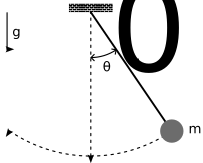
The dimensionless relation between the pendulum's period T and the other quantities presented in the figure above is built and displayed as:
from nodimo import Quantity, Model

T = Quantity('T', mass=0, length=0, time=1, dependent=True)  # period
L = Quantity('L', mass=0, length=1, time=0, scaling=True)    # length
m = Quantity('m', mass=1, length=0, time=0)                  # mass
g = Quantity('g', mass=0, length=1, time=-2, scaling=True)   # gravity
t0 = Quantity('theta_0')                                     # initial angle

model = Model(T, L, m, g, t0)
model.show()
And the result is:
$$\displaystyle \frac{T g^{\frac{1}{2}}}{L^{\frac{1}{2}}} = \Phi{\left(\theta_{0} \right)}$$
For more applications and functionalities, check the documentation.
1 maintainer

Metadata
1 maintainer
Release files for nodimo 2.0.0
For a detailed explanation of source distributions (sdists) and built distributions (wheels), please see the package formats documentation.
Source distribution (sdist)
| File | Size | Uploaded | |
|---|---|---|---|
| nodimo-2.0.0.tar.gz | 36.7 kB | Details |
Built distribution (wheel)
| File | Interpreter | ABI | Platform | Reset |
|---|---|---|---|---|
| nodimo-2.0.0-py3-none-any.whl | Python 3 | none | any | Details |
Total release size: 68.0 kB
Release files / nodimo-2.0.0.tar.gz
| Download URL | nodimo-2.0.0.tar.gz |
|---|---|
| Size | 36.7 kB |
| Tags | Source |
|
SHA-256 checksum How to use checksums |
18d996bccf816b6f45e6769d9c131c084528321b913707eb02b65b5bae6c5e41
|
|
BLAKE2b-256 checksum How to use checksums |
5305c8967a505c3c85259289e94bdb812da7e34310477d46b2af3ebb3f173568
|
| Upload date | |
|
Uploaded using Trusted Publishing? What is trusted publishing? |
No |
| Uploaded via |
twine/5.1.1 CPython/3.12.0
|
Release files / nodimo-2.0.0-py3-none-any.whl
| Download URL | nodimo-2.0.0-py3-none-any.whl |
|---|---|
| Size | 31.3 kB |
| Tags | Python 3 |
|
SHA-256 checksum How to use checksums |
5e8ef4bddb022d6b88162f2a8f9003bb37a88a4939042801eac0a1a865528431
|
|
BLAKE2b-256 checksum How to use checksums |
cdfa882c492e91190a1aafca4aa37ee4052ee8eb4abed57dfdfbbf992787c283
|
| Upload date | |
|
Uploaded using Trusted Publishing? What is trusted publishing? |
No |
| Uploaded via |
twine/5.1.1 CPython/3.12.0
|














