
noisecheck
You test your AI twice with a quiz. First it scored 71. Second it scored 74. Is it really better, or did you just get lucky?
noisecheck reads your eval results and gives you a straight answer: real improvement, real regression, or just noise. It also tells you the smallest change your eval can actually detect, and how many more test items you need when it cannot.
It never runs your evals and never calls any AI. It only does the math, on your files, on your machine, the same way every time.
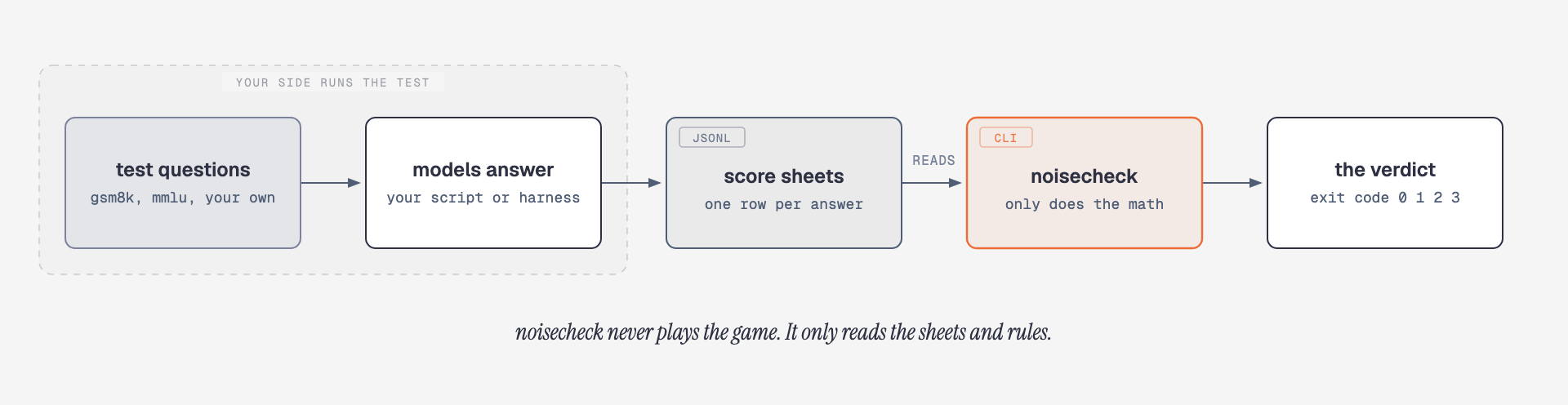
sixty seconds
uvx --from git+https://github.com/y4hyya/noisecheck noisecheck compare baseline.jsonl candidate.jsonl
Your files need one json line per answer:
{"example_id": "q001", "variant": "baseline", "metric": "pass", "value": 1}
Already using promptfoo? Convert its output first:
noisecheck import results.json -o baseline.jsonl --variant my-model
the trap this tool exists for
The repo ships a realistic example: 40 questions asked inside 8 conversations, two versions of an agent. Compare them the usual way and both metrics look like wins:
$ noisecheck compare examples/baseline.jsonl examples/candidate.jsonl

| metric       | verdict     | estimate | interval          | q      | mde     |
| latency_s    | improvement | +0.1165  | [0.1069, 0.127]   | 0.0002 | 0.01387 |
| task_success | improvement | +0.175   | [0.04758, 0.3515] | 0.0391 | 0.1978  |

gate non regression: pass (exit 0)
But questions inside one conversation go wrong together. Tell noisecheck about the conversations and it counts the evidence honestly:
$ noisecheck compare examples/baseline.jsonl examples/candidate.jsonl --cluster conversation_id

| metric       | verdict      | estimate | interval         | q       | mde     |
| latency_s    | improvement  | +0.1165  | [0.1023, 0.1295] | 0.0144  | 0.01569 |
| task_success | underpowered | +0.175   | [0.037, 0.3362]  | 0.06389 | 0.1653  |

task_success: this eval cannot detect differences below 0.1653, about 36 items would
Same data. The latency improvement survives, because it shows up inside every conversation. The task success "win" honestly becomes "cannot tell": 8 conversations are not enough independent evidence, and the tool says how many items would settle it.
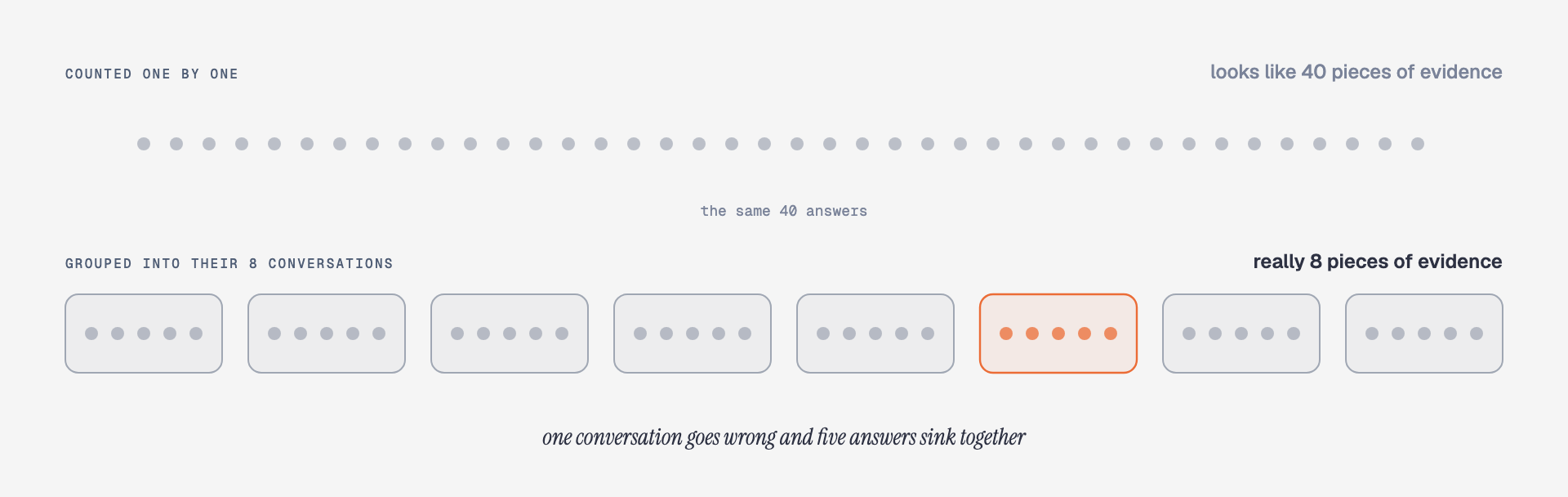
This is not a matter of taste. validation.md simulates a thousand worlds per row where the truth is known: the naive analysis fires up to 32 percent false alarms on clustered data, while noisecheck stays at the promised 5.
who grades the grader
If an AI judges your AI, check the judge before trusting the scores. On 80 real MT Bench battles where expert humans and GPT-4 judged the same model pairs:
$ noisecheck judge agreement examples/mtbench-sample.jsonl --human human --judge gpt4

winner: kappa 0.1513 [-0.02142, 0.3293], raw agreement 62% over 80 pairs
Raw agreement sounds fine at 62 percent. Kappa subtracts the agreement a coin flipping judge would get, and what is left barely clears zero. There are also judge position (does the verdict follow the seat instead of the answer?), judge stability (does the judge change its mind on identical inputs?), and judge scaffold-swap (a promptfoo template to produce the swapped runs).
in your CI
Exit codes are the contract: 0 ship, 1 stop, 2 cannot tell, 3 your files are broken.
- run: noisecheck compare baseline.jsonl candidate.jsonl --min-effect 0.02 --json report.json
Set --min-effect to the smallest difference you actually care about. Use --gate improvement when only proven wins may pass, and --lower-is-better latency_s for metrics where smaller is better. Reports embed the seed, the package version, and the sha256 of both input files, and identical inputs produce byte identical reports.
what noisecheck does not do
- it does not run evals, call models, or need API keys
- no dashboard, no account, nothing leaves your machine
- it does not invent certainty: when the data cannot answer, the verdict is "underpowered" plus the number of items that would fix it
the details
- methods: every statistic, its assumptions, and where it breaks
- validation: the 95 percent promise, measured, including the regimes where it falls short
- case study: the same data giving two opposite answers, and why the most starred eval harness has this exact bug filed against it
Commands: compare, power, floor, import, judge agreement, judge position, judge stability, judge scaffold-swap. Each has --help.
The MT Bench sample comes from lmsys/mt_bench_human_judgments (CC BY 4.0). MIT license.
1 maintainer

Metadata
1 maintainer
Release files for noisecheck 0.1.1
For a detailed explanation of source distributions (sdists) and built distributions (wheels), please see the package formats documentation.
Source distribution (sdist)
| File | Size | Uploaded | Provenance | |
|---|---|---|---|---|
| noisecheck-0.1.1.tar.gz | 56.0 kB | Without provenance | Details |
Built distribution (wheel)
| File | Interpreter | ABI | Platform | Reset |
|---|---|---|---|---|
| noisecheck-0.1.1-py3-none-any.whl | Python 3 | none | any | Details |
Total release size: 91.0 kB
Release files / noisecheck-0.1.1.tar.gz
| Download URL | noisecheck-0.1.1.tar.gz |
|---|---|
| Size | 56.0 kB |
| Tags | Source |
|
SHA-256 checksum How to use checksums |
bae5587f16c4475b18e7fdcfffb19084aaa325fc7e8bf9e8f742c078db29b83e
|
|
BLAKE2b-256 checksum How to use checksums |
8f2ed776da5aa5912957489e4311afb21495626feb4f0ebd61f8fdd9fa2901f6
|
| Upload date | |
|
Uploaded using Trusted Publishing? What is trusted publishing? |
No |
| Uploaded via |
uv/0.11.32 {"installer":{"name":"uv","version":"0.11.32","subcommand":["publish"]},"python":null,"implementation":{"name":null,"version":null},"distro":{"name":"macOS","version":null,"id":null,"libc":null},"system":{"name":null,"release":null},"cpu":null,"openssl_version":null,"setuptools_version":null,"rustc_version":null,"ci":null}
|
Release files / noisecheck-0.1.1-py3-none-any.whl
| Download URL | noisecheck-0.1.1-py3-none-any.whl |
|---|---|
| Size | 35.0 kB |
| Tags | Python 3 |
|
SHA-256 checksum How to use checksums |
6a710a7eccfaa8673e443fb107adfb867e3de059eb40b49d2e277e6d41c4ad4e
|
|
BLAKE2b-256 checksum How to use checksums |
c39b38c303f63300558c209c08961305d1a8b56265f675463a4d63b428878b64
|
| Upload date | |
|
Uploaded using Trusted Publishing? What is trusted publishing? |
No |
| Uploaded via |
uv/0.11.32 {"installer":{"name":"uv","version":"0.11.32","subcommand":["publish"]},"python":null,"implementation":{"name":null,"version":null},"distro":{"name":"macOS","version":null,"id":null,"libc":null},"system":{"name":null,"release":null},"cpu":null,"openssl_version":null,"setuptools_version":null,"rustc_version":null,"ci":null}
|
Security for noisecheck 0.1.1
Provenance
Provenance describes where a file came from. On PyPI, provenance is shared via attestations, which provide a verifiable record of the build or publishing details. View details, limitations and caveats.
No provenance found
None of the files in this release were uploaded with provenance metadata.
A note on package security
PyPI is a repository for distributing packages, not a service for auditing them. While third-party security researchers and our staff do their best to detect and remove malicious packages, PyPI cannot guarantee the quality, security or suitability of any given package.














