
noisemonitor
A python package for sound level data analysis.



Documentation: Usage Guide · API Reference · Migration Guide · Changelog
⚠️ Version 1.1.0: most indicators are now validated against external reference data, and several fixes change computed values. If you upgrade from 1.0.x, read the Changelog first. Code written for versions before 1.0.0 needs the Migration Guide.
Table of Contents
- Key Features
- Installation
- Quick Start
- Core Modules
- Software Testing and Validation
- Citation
- Dependencies
- License
- Disclaimer
- Use of AI tools
Key Features
- Acoustic indicators - Implements standard ($L_{eq}$, $L_{den}$, $L_{90}$, etc.) and research-based noise indicators (HARMONICA, Number of Noise Events, low-frequency criteria from third-octave bands, etc.)
- Flexible data loading - CSV, Excel and TXT files (also compressed), with automatic detection of dates, separators and decimal commas
- Two analysis modes - Summary indicators (discrete values) and profile indicators (time series)
- Multiprocessing support - Fast processing of large datasets
- Easy visualization - Built-in plotting functions with customizable styles
- Data coverage validation - Automated quality checks with configurable thresholds
- Weather integration - [Canada only] Merge and analyze data with Canadian weather station data
- Validated with external data - As of v1.1.0 release, most indicators have been validated against independent datasets and reference implementations (see Software Testing and Validation).
Installation
Using PyPI
pip install noisemonitor
For weather integration (Canada only)
pip install noisemonitor[weather]
If you want to install the latest development version:
pip install git+https://github.com/valerianF/noisemonitor
Using Anaconda
Anaconda users can install using conda-forge:
conda install -c conda-forge noisemonitor
Quick Start
noisemonitor is designed for flexibility and ease of use. All analysis functions accept an optional column parameter, allowing you to specify which data column to analyze (e.g., to work with datasets containing multiple sound level measurements or frequency bands). Most functions return results as pandas DataFrames for easy manipulation.
import noisemonitor as nm

# Load data
df_1m = nm.load(
    'tests/data/internal/test_data_laeq1m.csv',
    datetimeindex=0, # Column index for datetime
    valueindexes=1,  # Column index(es) for sound levels
    header=0,        # Header row index
    sep=','
)

# Compute Lden
lden = nm.summary.lden(df_1m)
lden.head()
| Lden | Lday | Levening | Lnight |
|---|---|---|---|
| 56.1 | 51.75 | 50.09 | 49.22 |
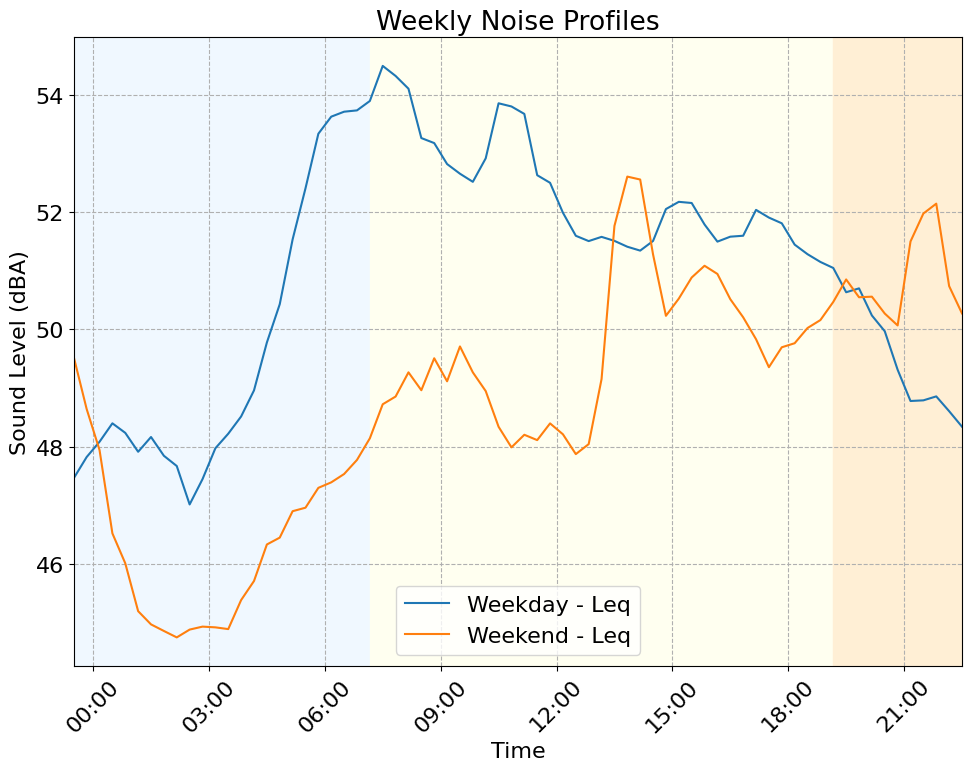
# Compute weekly profiles
weekday_profile = nm.profile.periodic(
    df_1m,
    hour1=23,
    hour2=22,
    day1='monday',
    day2='friday',
    win=3600,    # 1-hour window
    step=1200    # 20-minute step
)

weekend_profile = nm.profile.periodic(
    df_1m,
    hour1=23,
    hour2=22,
    day1='saturday',
    day2='sunday',
    win=3600,
    step=1200
)

# Visualize
nm.display.compare(
    [weekday_profile, weekend_profile],
    ['Weekday', 'Weekend'],
    'Leq',
    fill_background=True,
    title='Weekly Noise Profiles'
)
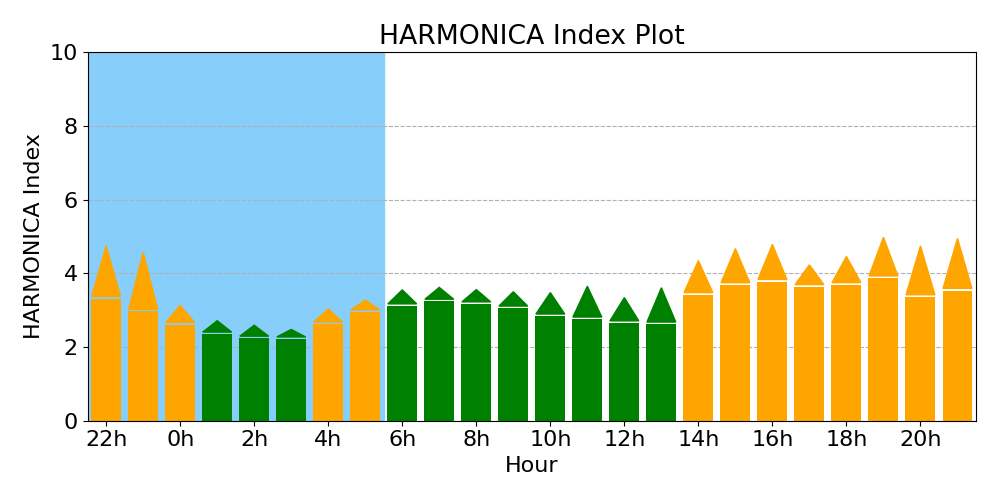
# Load 1 s data and compute HARMONICA indexes (requires data at 1 s or finer)
df_1s = nm.load(
    'tests/data/internal/test_data_laeq1s.csv.xz',
    datetimeindex=0,
    valueindexes=1
)
harmonica = nm.summary.harmonica_periodic(df_1s)
nm.display.harmonica(harmonica) # Visualize
Core Modules
nm.load()
Load data from CSV, Excel, or TXT files (or a list of files) onto a regular time grid, with automatic datetime parsing.
df = nm.load('data.csv', datetimeindex=0, valueindexes=1, header=0, sep=',')
nm.filter
Filter data by datetime, remove outliers, or filter by weather conditions.
df_filtered = nm.filter.extreme_values(df, min_value=30, max_value=100)
nm.summary
Compute discrete sound level indicators: $L_{eq}$, $L_{den}$, HARMONICA, frequency analysis, low-frequency criteria, histograms, etc.
overall_lden = nm.summary.lden(df)
daily_lden = nm.summary.periodic(df, freq='D')
harmonica = nm.summary.harmonica_periodic(df)
# df_freq: one column per frequency band (e.g., one-third-octave band levels)
freq_summary = nm.summary.freq_periodic(df_freq, freq='D')
lowfreq = nm.summary.lf_periodic(df_freq, freq='D', method=['botsford', 'montano'])
nm.profile
Compute time-varying sound level profiles: time series, daily/weekly patterns, number of noise events, etc.
time_series = nm.profile.series(df, win=3600, step=1200)
weekday_profile = nm.profile.periodic(df, hour1=0, hour2=23, day1='monday', day2='friday', win=3600)
nne_profile = nm.profile.nne(df, hour1=0, hour2=24, background_type='L50', exceedance=5)
lowfreq_series = nm.profile.lf_series(df_freq, method='montano', win=3600)
nm.display
Visualize results with line plots, heatmaps, and more.
nm.display.line(time_series, 'Leq', 'L10', 'L90', title='Noise Levels')
nm.display.compare([weekday_profile, weekend_profile], ['Weekdays', 'Weekend'], 'Leq')
nm.display.freq_map(freq_summary['Leq'], title='Frequency Heatmap')
nm.weather (Canada only)
Integrate Environment Canada weather data to analyze weather impact on noise.
stations = nm.weather.weathercan.get_historical_stations(coordinates=[45.5, -73.6], radius=25)
df_weather = await nm.weather.weathercan.merge_weather(df, station_id='702S006',  # climate ID
                                                       wind_speed_flag=18,
                                                       timezone='America/Toronto')  # weather times are LST
contingency = nm.weather.weathercan.contingency_weather_flags(df_weather)
Software Testing and Validation
noisemonitor is tested with pytest on every pull request and push to the main branch. Each indicator has one of three validation statuses:
- External: $L_{eq}$, $L_n$, $L_{den}$, HARMONICA, Number of Noise Events and two low-frequency criteria match reference values computed outside the package (Clark et al., 2021; Bruitparif; Baclet & Rumpler, 2024; Montano & Gushiken, 2023; Generalitat de Catalunya, 2012).
- Derived: weekly and monthly periods, other windows, frequency-band functions, day counts and TNI apply these validated computations and are tested against them.
- Definition only: NPL, roughness indicators and the Botsford low-frequency criterion, for which no published reference values were found, are tested against their definitions.
Other tests check behaviour on edge cases (data gaps, daylight saving time, sub-second data, file formats). See Software testing and external validation in the Usage Guide for the status of each function, the datasets and the tolerances.
Citation
If you use noisemonitor, please consider citing us:
@inproceedings{fraisse2023noisemonitor,
    title={noisemonitor: A Python Package For Sound Level Monitor Analysis},
    author={Fraisse, Valérian},
    booktitle={Acoustics Week in Canada},
    year={2023}
}
Dependencies
Python 3.9 or later, with:
- NumPy (numpy.org), pandas 2.2 or later (pandas.pydata.org) and Matplotlib (matplotlib.org);
- python-calamine and openpyxl, to read Excel files;
- for weather integration only (
noisemonitor[weather]): requests, aiohttp, lxml and python-dateutil.
License
This project is licensed under the Apache License 2.0 - see the LICENSE file for details.
Disclaimer
noisemonitor is an analysis tool: its results have no legal value on their own. Comparing them with noise limits or regulations requires measurements made according to the applicable local standards (location, duration, instrumentation), and an assessment by a qualified acoustician. Decisions to exclude data (e.g., weather filtering) should also be made by a qualified acoustician. The software is provided "as is", without warranty of any kind (see the License).
Use of AI tools
AI coding assistants have been used in the development of noisemonitor since version 1.0.0. Version 1.1.0 was developed with Claude Opus 5.5 (Anthropic), used through Claude Code, for:
- reviewing the code for bugs and inconsistencies;
- drafting code changes, tests and documentation for the fixes and features I specified;
- preparing the validation data and comparing the package's results with the external reference values;
- checking definitions and conventions against the cited literature and standards.
I set the scope, made every choice of definition and convention, and reviewed every change before committing it. The reference values used for validation come from the external sources cited above, not from AI. I remain responsible for the package's content.
1 maintainer

Metadata
1 maintainer
Release files for noisemonitor 1.1.0
For a detailed explanation of source distributions (sdists) and built distributions (wheels), please see the package formats documentation.
Source distribution (sdist)
| File | Size | Uploaded | Provenance | Actions |
|---|---|---|---|---|
| noisemonitor-1.1.0.tar.gz | 107.7 kB | With provenance | Details for noisemonitor-1.1.0.tar.gz |
Built distribution (wheel)
| File | Interpreter | ABI | Platform | Actions Reset |
|---|---|---|---|---|
| noisemonitor-1.1.0-py3-none-any.whl | Python 3 | none | any | Details for noisemonitor-1.1.0-py3-none-any.whl |
Total release size: 166.9 kB
Release files / noisemonitor-1.1.0.tar.gz
| Download URL | noisemonitor-1.1.0.tar.gz |
|---|---|
| Size | 107.7 kB |
| Tags | Source |
|
SHA-256 checksum How to use checksums |
cc34c3e03a8e219289db6ac0088d606b6010b4d9a252b14a8735fcf864a4ed6c
|
|
BLAKE2b-256 checksum How to use checksums |
987ef0010f588f708403e346e2175956b82a09f27504ad0301154171b55af2d3
|
| Upload date | |
|
Uploaded using Trusted Publishing? What is trusted publishing? |
Yes |
| Uploaded via |
twine/7.0.0 CPython/3.13.16
|
Provenance
Provenance describes where a file came from. On PyPI, provenance is shared via attestations, which provide a verifiable record of the build or publishing details. View details, limitations and caveats.


PyPI Publish Attestation
PyPI verified that this artifact, at this checksum, originated from the publisher listed below.
Signed by GitHub Actions, verified by PyPI on Nov 26, 2026.
Transparency logRelease files / noisemonitor-1.1.0-py3-none-any.whl
| Download URL | noisemonitor-1.1.0-py3-none-any.whl |
|---|---|
| Size | 59.2 kB |
| Tags | Python 3 |
|
SHA-256 checksum How to use checksums |
24cbcf6bbf4a6bdfa330fc9473a2a16eac51f442a52deedf339f128d499d914c
|
|
BLAKE2b-256 checksum How to use checksums |
de9b970e921c94b3d2dff8288aab71e39c23abeefa1b2c2989857c4c95a63d06
|
| Upload date | |
|
Uploaded using Trusted Publishing? What is trusted publishing? |
Yes |
| Uploaded via |
twine/7.0.0 CPython/3.13.16
|
Provenance
Provenance describes where a file came from. On PyPI, provenance is shared via attestations, which provide a verifiable record of the build or publishing details. View details, limitations and caveats.
PyPI Publish Attestation
PyPI verified that this artifact, at this checksum, originated from the publisher listed below.
Signed by GitHub Actions, verified by PyPI on Nov 26, 2026.
Transparency logSecurity for noisemonitor 1.1.0
Provenance
Provenance describes where a file came from. On PyPI, provenance is shared via attestations, which provide a verifiable record of the build or publishing details. View details, limitations and caveats.
Full provenance
Both files in this release have been uploaded with provenance metadata.
Attestation for noisemonitor-1.1.0.tar.gz
PyPI Publish Attestation
PyPI verified that this artifact, at this checksum, originated from the publisher listed below.
Signed by GitHub Actions, verified by PyPI on Nov 26, 2026.
Transparency logA note on package security
PyPI is a repository for distributing packages, not a service for auditing them. While third-party security researchers and our staff do their best to detect and remove malicious packages, PyPI cannot guarantee the quality, security or suitability of any given package.
To learn more about protecting yourself from malicious actors, visit our package security documentation.














