



nomhsms

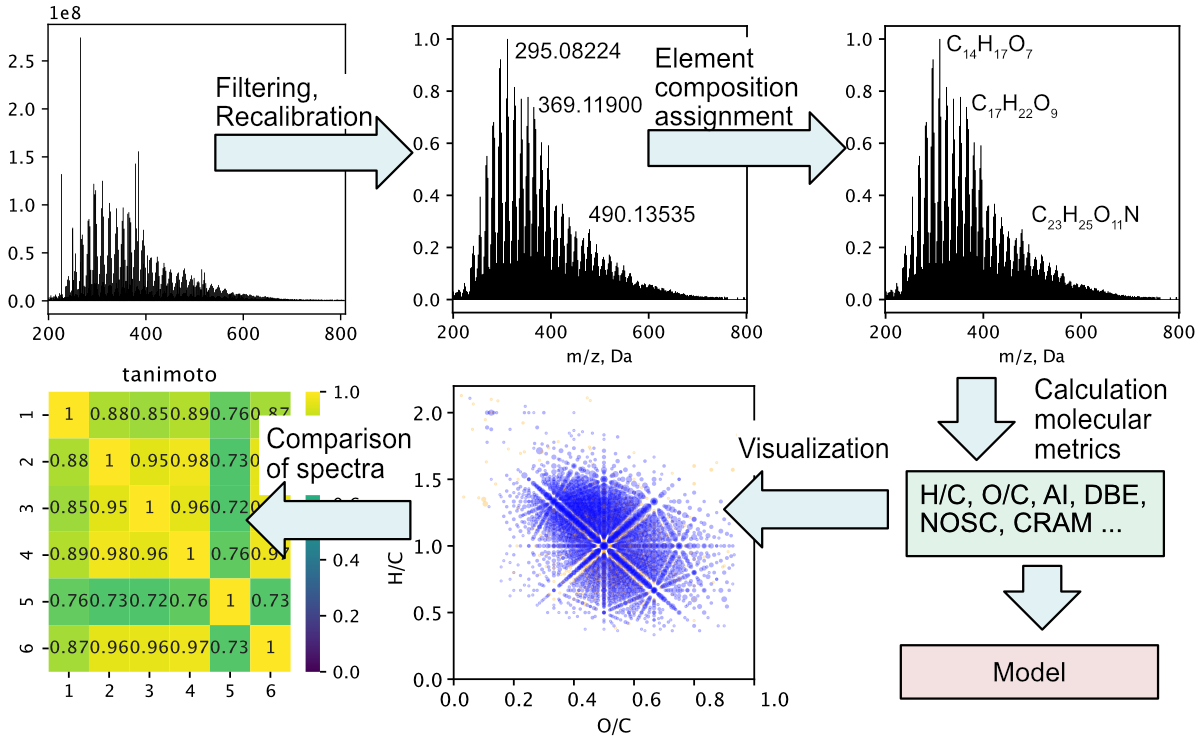
nomhsms is an open-source Python package for processing high resolution mass spectra. The name is an acronym for Natural Organic Matter & Humic Substances Mass Spectrometry, so package designed for analysis natural organic matter (NOM) which are represent such substances as dissolve organic matter (DOM), humic substances, lignin, biochar and other objects of oxidative destruction of natural compounds which are characterized by thousands of signals in the mass spectrum and require special methods for analysis. The package implements a full-fledged workflow for processing, analysis and visualization of mass spectrum. Various algorithms for filtering spectra, recalibrating and assignment of elemental composition to ions are presented. The package implements methods for calculating different molecular descriptors and methods for data visualization. A graphical user interface (GUI) for package has been implemented, which makes this package convenient for a wide range of users.
Main operation:
- Assigning element composition to signal by mass with desirable ranges of elements (include isotopes)
- Fine recalibrate spectrum
- Working with spectra as with sets (intersection, union, etc.)
- Plot spectrum and different kind of scatter and density diagram such as Van Krevelen diagram
- Calculate similarity metrics between spectra
- Calculate molecular descriptors (DBE, AI, NOSC, CRAM and other) for spectra
Documentation
Documentation and examples of usage is placed here. Also, you can explore jupyter notebooks
Install
Requirements:
- Python 3.8 or higher
Install nomhsms and dependences by pip:
pip install nomhsms
Graphical interface
After installation nomhsms you can run GUI by the command:
python -m nomhsms
The GUI is pretty basic and not very flexible but it supports all basic operation.
How to contribute or ask question
If you want to ask question or contribute to the development of nomhsms, have a look at the contribution guidelines.
License
Distributed under license GPLv3
1 maintainer

Metadata
1 maintainer
Release files for nomhsms 0.3.9
For a detailed explanation of source distributions (sdists) and built distributions (wheels), please see the package formats documentation.
Source distribution (sdist)
| File | Size | Uploaded | Provenance | Actions |
|---|---|---|---|---|
| nomhsms-0.3.9.tar.gz | 62.1 kB | Without provenance | Details for nomhsms-0.3.9.tar.gz |
Release files / nomhsms-0.3.9.tar.gz
| Download URL | nomhsms-0.3.9.tar.gz |
|---|---|
| Size | 62.1 kB |
| Tags | Source |
|
SHA-256 checksum How to use checksums |
1c564480c845865ba0c60801b5a5e0dc7f51d887384da0c23ad9fc36412d975e
|
|
BLAKE2b-256 checksum How to use checksums |
e119dcf48734bde9baa7e46eaa4489c28985f4fac594a786f9d1396dcb97bbe2
|
| Upload date | |
|
Uploaded using Trusted Publishing? What is trusted publishing? |
No |
| Uploaded via |
twine/4.0.1 CPython/3.9.12
|
Security for nomhsms 0.3.9
Provenance
Provenance describes where a file came from. On PyPI, provenance is shared via attestations, which provide a verifiable record of the build or publishing details. View details, limitations and caveats.
No provenance found
None of the files in this release were uploaded with provenance metadata.
A note on package security
PyPI is a repository for distributing packages, not a service for auditing them. While third-party security researchers and our staff do their best to detect and remove malicious packages, PyPI cannot guarantee the quality, security or suitability of any given package.
To learn more about protecting yourself from malicious actors, visit our package security documentation.














