

Turn anomaly scores into flags with a false-alarm rate you set.






Documentation · API Reference · Paper
A detector ranks points by how unusual they look but leaves the cutoff to you.
The usual default, flagging the top 10% of scores, is a guess about how many
anomalies there are. nonconform calibrates the scores of your existing detector
against normal data, so the threshold follows from the error rate you can accept.
Works with


The same Isolation Forest on seven benchmark datasets, with and without nonconform:
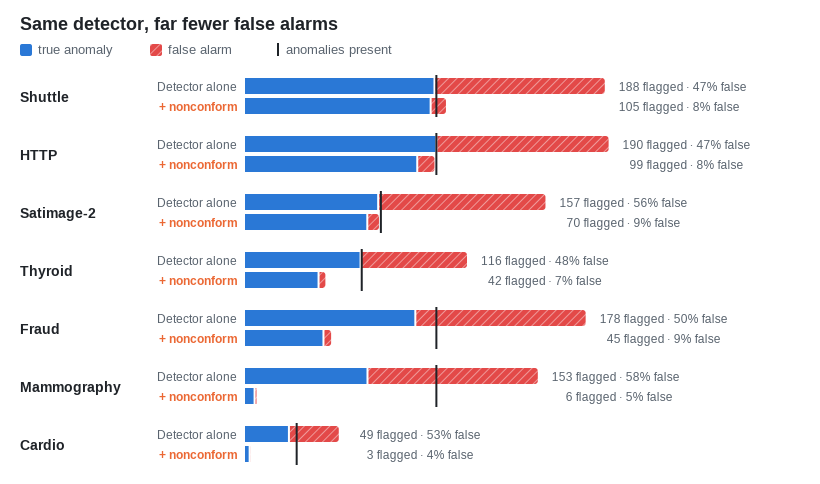
Mean of 20 random splits per benchmark dataset. The average false share stays under the 10% target on every dataset; where the detector barely separates anomalies (Mammography, Cardio), nonconform flags little rather than guess. The baseline trains on every row, nonconform holds some back for calibration. Reproduce with default_thresholds.py.
Installation
nonconform requires Python 3.11 or newer. Both discovery control and
sequential monitoring are included in the core installation.
pip install nonconform
Optional extras
| Extra | Adds |
|---|---|
pyod |
PyOD anomaly detectors |
data |
oddball benchmark datasets and PyArrow support |
fdr |
Streaming FDR procedures from online-fdr |
probabilistic |
KDE-based probabilistic estimation and tuning |
all |
Every optional feature |
Quick start
Wrap a detector, fit it on normal data, and select anomalies at a target false
discovery rate (FDR). The example loads a benchmark dataset, so it needs
pip install "nonconform[data]":
from oddball import Dataset, load
from sklearn.ensemble import IsolationForest

from nonconform import ConformalDetector, Split

# Normal-only training data; a labelled test batch with 10% anomalies
x_train, x_test, y_test = load(Dataset.SHUTTLE, setup=True, seed=0)

alpha = 0.1  # target FDR: on average at most 10% of flags are false
detector = ConformalDetector(
    detector=IsolationForest(random_state=0),
    strategy=Split(n_calib=int(len(x_test) / alpha)),  # see the sizing rule below
    seed=0,
).fit(x_train)

flagged = detector.select(x_test, alpha=alpha)  # Boolean mask
hits = int(y_test[flagged].sum())
print(f"Flagged {flagged.sum()} of {len(x_test)}, {hits} true anomalies")
# Flagged 105 of 1000, 95 true anomalies
The conformal p-values behind the mask stay available in detector.last_result.
Any PyOD model, a recognized scikit-learn estimator, or a
custom detector
works in place of IsolationForest.
Set a score threshold
If the requirement is "flag no more than 5% of normal points", certify a raw-score threshold instead of targeting an FDR:
certificate = detector.fpr_bounds(confidence=0.95)
selected = certificate.select(detector.score_samples(x_test), target_fpr=0.05)
print(f"Certified threshold: {certificate.threshold_for(0.05)}")
With 95% probability over the calibration draw, the threshold flags at most 5% of future normal points. Calibration and future normal scores must be i.i.d.; targets below the certificate's band floor (about 3.85% for 1,000 calibration scores at 95% confidence) give an infinite threshold. See raw-score false-alarm control.
Monitor a stream
A fitted Split detector can start a sequential monitor that raises an alarm when
the data stops looking like the calibration set.
Monitor a stream for change
import numpy as np
from sklearn.ensemble import IsolationForest

from nonconform import ConformalDetector, Split
from nonconform.martingales import AlarmConfig, SimpleJumperMartingale
from nonconform.monitoring import ExchangeabilityMonitor

rng = np.random.default_rng(42)
x_train = rng.normal(size=(1_000, 2))

detector = ConformalDetector(
    detector=IsolationForest(random_state=42),
    strategy=Split(n_calib=0.3),
    seed=42,
).fit(x_train)

alpha = 0.05
monitor = ExchangeabilityMonitor.from_split_detector(
    detector,
    martingale=SimpleJumperMartingale(
        alarm_config=AlarmConfig(restarted_ville_threshold=1 / alpha)
    ),
    seed=42,
)

# Stable observations followed by a distribution shift
x_stream = np.vstack([
    rng.normal(size=(50, 2)),
    rng.normal(loc=3.0, size=(50, 2)),
])

for x_t in x_stream:
    state = monitor.update(x_t)
    if "restarted_ville" in state.triggered_alarms:
        print(f"Change alarm at step {state.evidence_step}")
        break
Under the sequential validity assumptions, the restarted Ville alarm at
1 / alpha bounds the probability of ever raising a false alarm on one stream.
See the sequential monitoring guide.
Choose a workflow
| Goal | Start with |
|---|---|
| Calibrate and select anomalies in a batch | Split and select(...) |
| Set a per-inlier raw-score false-alarm target | fpr_bounds(...) and FPR certificates |
| Aggregate evidence across random splits | DerandomizedSplits and e-BH |
| Monitor a stream for change | Exchangeability martingales |
| Reuse more data for fitting and calibration | CrossValidation or JackknifeBootstrap |
| Account for covariate shift | Weighted conformal inference |
| Calibrate groups with different normal behavior | Group-conditional (Mondrian) p-values |
| Certify realized FDP across p-value thresholds | fdp_bounds(...) and FDP certificates |
| Bring a custom or third-party detector | Detector compatibility |
Coding agents
An agent skill
teaches coding agents to use nonconform without overclaiming. Install it in
Claude Code (/plugin marketplace add OliverHennhoefer/nonconform, then
/plugin install nonconform@nonconform) or Codex
(codex plugin marketplace add OliverHennhoefer/nonconform, then
codex plugin add nonconform@nonconform).
Statistical scope
nonconform calibrates detector scores; it cannot make an unsuitable detector
or a mismatched calibration set valid. Handle spatial or temporal dependence
before relying on exchangeability. Read the guides to
FDR control
and sequential monitoring
before applying a guarantee to a new problem.
Citation
If you use nonconform in academic work, please cite the
accompanying paper:
@inproceedings{Hennhoefer2026,
author = {Hennhöfer, Oliver and Kirsch, Maximilian and Preisach, Christine},
booktitle = {Proceedings of the Fifteenth Symposium on Conformal and Probabilistic Prediction with Applications},
pages = {613--632},
publisher = {PMLR},
title = {{Conformal Anomaly Detection in Python: Moving Beyond Heuristic Thresholds with nonconform}},
url = {https://proceedings.mlr.press/v329/hennhofer26a.html},
year = {2026}
}
Project
Read the documentation, browse
the changelog,
or report a problem in the issue tracker.
Contributions are welcome; start with the
contributing guide.
nonconform is distributed under the
BSD 3-Clause License.

1 maintainer

Metadata
1 maintainer
Release files for nonconform 2.1.0
For a detailed explanation of source distributions (sdists) and built distributions (wheels), please see the package formats documentation.
Source distribution (sdist)
| File | Size | Uploaded | Provenance | Actions |
|---|---|---|---|---|
| nonconform-2.1.0.tar.gz | 113.9 kB | With provenance | Details for nonconform-2.1.0.tar.gz |
Built distribution (wheel)
| File | Interpreter | ABI | Platform | Actions Reset |
|---|---|---|---|---|
| nonconform-2.1.0-py3-none-any.whl | Python 3 | none | any | Details for nonconform-2.1.0-py3-none-any.whl |
Total release size: 233.1 kB
Release files / nonconform-2.1.0.tar.gz
| Download URL | nonconform-2.1.0.tar.gz |
|---|---|
| Size | 113.9 kB |
| Tags | Source |
|
SHA-256 checksum How to use checksums |
5a3875a5913bf21f7e29f1592c666654abb5a27ab00757ad390f8ecf8f3864d1
|
|
BLAKE2b-256 checksum How to use checksums |
b52ab1747bc790c4ea3f49bd70f78258ba6a8f8ffe7ae351351be9221d08daaa
|
| Upload date | |
|
Uploaded using Trusted Publishing? What is trusted publishing? |
Yes |
| Uploaded via |
twine/7.0.0 CPython/3.13.14
|
Provenance
Provenance describes where a file came from. On PyPI, provenance is shared via attestations, which provide a verifiable record of the build or publishing details. View details, limitations and caveats.


PyPI Publish Attestation
PyPI verified that this artifact, at this checksum, originated from the publisher listed below.
Signed by GitHub Actions, verified by PyPI on Nov 20, 2026.
Transparency logRelease files / nonconform-2.1.0-py3-none-any.whl
| Download URL | nonconform-2.1.0-py3-none-any.whl |
|---|---|
| Size | 119.2 kB |
| Tags | Python 3 |
|
SHA-256 checksum How to use checksums |
b90d25ce916af00a7440b08926aae42693dce2d653c5f12deaf77472fce3db95
|
|
BLAKE2b-256 checksum How to use checksums |
c0a2a824365b80f3a3700cc833412ecec4ea98e75dbe5ba8b19112bc8a965674
|
| Upload date | |
|
Uploaded using Trusted Publishing? What is trusted publishing? |
Yes |
| Uploaded via |
twine/7.0.0 CPython/3.13.14
|
Provenance
Provenance describes where a file came from. On PyPI, provenance is shared via attestations, which provide a verifiable record of the build or publishing details. View details, limitations and caveats.
PyPI Publish Attestation
PyPI verified that this artifact, at this checksum, originated from the publisher listed below.
Signed by GitHub Actions, verified by PyPI on Nov 20, 2026.
Transparency logSecurity for nonconform 2.1.0
Provenance
Provenance describes where a file came from. On PyPI, provenance is shared via attestations, which provide a verifiable record of the build or publishing details. View details, limitations and caveats.
Full provenance
Both files in this release have been uploaded with provenance metadata.
Attestation for nonconform-2.1.0.tar.gz
PyPI Publish Attestation
PyPI verified that this artifact, at this checksum, originated from the publisher listed below.
Signed by GitHub Actions, verified by PyPI on Nov 20, 2026.
Transparency logA note on package security
PyPI is a repository for distributing packages, not a service for auditing them. While third-party security researchers and our staff do their best to detect and remove malicious packages, PyPI cannot guarantee the quality, security or suitability of any given package.
To learn more about protecting yourself from malicious actors, visit our package security documentation.














