
Noust 3.1 adds accounts with roles, an audit trail with integrity, management of the server itself (updates, SSH, firewall, disks), fleet-wide views and bulk actions, databases per application, and builds that no longer run as root. See docs/CHANGELOG-3.1.md, and read docs/UPGRADING-3.1.md before upgrading a 3.0 server or a fleet.
WASM is now Noust since 3.0.0: the command is
noust, the paths are/etc/noust,/var/lib/noustand/var/backups/noust, andwasmkeeps working as an alias for the whole 3.x series. Read docs/UPGRADING-3.0.md before upgrading a 2.x server.






Your server, Vercel-grade. No Docker required.
In Orkney and Shetland, a noust is the hollow on the shore where a boat is drawn up and sheltered between voyages. Your server is the noust, and your applications are the boats.
Noust deploys web applications onto a Linux server you own and keeps them running. Point it at a repository and a domain: it builds the application, runs it as a systemd unit behind nginx or Apache, obtains its certificate, and from then on every deploy is a new release that only goes live if it answers, and can be undone in seconds. The same engine is driven from the CLI, a browser console and a JSON API.
What Noust is, and is not
It is
- Your server. A VPS or a bare-metal machine running Ubuntu, Debian, Fedora or openSUSE.
- systemd-native. Every application is a unit you can inspect with
systemctlandjournalctl; every site is a file in/etc/nginxor/etc/apache2. Nothing sits between you and your processes, and there is no daemon with a privileged socket. - A distribution package. Installed with
apt,dnforzypper, or from PyPI. - Atomic deploys with instant rollback. Each deploy builds in its own directory, is activated behind a health check, rolls back by itself when it does not answer, and any release still on disk can be reactivated in seconds. Blue/green activation, opt-in per application, keeps the old version serving until the new one answers.
- Per-application resource limits with cgroups: memory, CPU and tasks.
- Builds without root. Dependencies install and build as an unprivileged account in a systemd sandbox that cannot read the rest of the machine.
- A console and an API over exactly what the CLI does, with accounts and roles, passkeys and two-factor authentication, sudo mode, four-eyes approvals and a tamper-evident audit log.
- The server too: operating-system updates, SSH, the firewall, fail2ban, disks and swap, checked and changed safely from the same console.
It is not
- A cluster or an orchestrator. Each server runs its own applications and manages itself. A central manages several Noust servers from one console and acts on many at once (see The fleet); it does not schedule work across them.
- A container platform. Applications run as ordinary processes. Docker is only needed if you deploy a Docker Compose project, which Noust then runs as a unit.
- An isolation boundary between running applications. They run as the same service account by default; the build sandbox separates builds, not what runs afterwards. Deploy only code you trust, as you would on any server you administer.
- Zero-downtime by default. Activating a release restarts the unit, unless blue/green is turned on for the application. There is no web terminal.
Install
Noust needs root: it writes to /etc, /var and systemd. Run the commands below as root, or
prefix them with sudo. The packages come from the home:Perkybeet repository on the
openSUSE Build Service.
Ubuntu and Debian (recommended)
# Add GPG key
curl -fsSL https://download.opensuse.org/repositories/home:/Perkybeet/xUbuntu_26.04/Release.key | \
  gpg --dearmor | sudo tee /usr/share/keyrings/noust.gpg > /dev/null

# Add repository
echo 'deb [signed-by=/usr/share/keyrings/noust.gpg] https://download.opensuse.org/repositories/home:/Perkybeet/xUbuntu_26.04/ /' | \
  sudo tee /etc/apt/sources.list.d/noust.list

# Install
sudo apt update
sudo apt install noust
Replace xUbuntu_26.04 with your release: xUbuntu_24.04, xUbuntu_22.04, Debian_12 or
Debian_13. A server that already has the WASM repository configured needs no new
repository: it is the same one.
Supported versions:
- Ubuntu 26.04 LTS (Resolute Raccoon, Python 3.14)
- Ubuntu 24.04 LTS (Noble Numbat)
- Ubuntu 22.04 LTS (Jammy Jellyfish)
- Debian 12 (Bookworm) and 13 (Trixie)
Fedora
sudo dnf config-manager --add-repo \
  https://download.opensuse.org/repositories/home:/Perkybeet/Fedora_42/home:Perkybeet.repo
sudo dnf install noust
openSUSE
# Tumbleweed
sudo zypper ar -f \
  https://download.opensuse.org/repositories/home:/Perkybeet/openSUSE_Tumbleweed/ \
  home_Perkybeet
sudo zypper install noust

# Leap 15.6
sudo zypper ar -f \
  https://download.opensuse.org/repositories/home:/Perkybeet/openSUSE_Leap_15.6/ \
  home_Perkybeet
sudo zypper install noust
PyPI
pip install noust            # the CLI
pip install 'noust[web]'     # with the console and the API (passkeys included)
pip install 'noust[all]'     # with the console, the API and the monitor
The packages WASM was published as, wasm (Debian, Ubuntu) and wasm-cli (Fedora,
openSUSE, PyPI), are transitional in 3.x: upgrading one installs noust. See
docs/RENAME.md.
A container, for a central
The image ghcr.io/perkybeet/noust runs a central: the console and the connections to your
servers, and nothing else. It deploys no applications. See The fleet.
docker run -d --name noust --restart unless-stopped \
  -p 8443:8443 -v noust-data:/data \
  --read-only --tmpfs /tmp:size=16m --cap-drop ALL \
  --security-opt no-new-privileges:true \
  ghcr.io/perkybeet/noust:latest
docker logs noust    # the console's sign-in token, once, and the certificate's fingerprint
It serves the console over TLS on 8443 (a self-signed certificate until you mount your own),
answers only the loopback and private address ranges by default, and keeps everything under
/data. packaging/container/compose.yaml is a ready
example, including for a NAS running UGOS Pro. See docs/CENTRAL.md.
From source
git clone https://github.com/Perkybeet/noust.git
cd noust
pip install -e ".[all]"
The console's Python packages (FastAPI, Uvicorn, psutil) are recommended by the Debian
package and suggested by the RPM one. If they are missing, noust web install installs them.
Passkeys need cryptography (python3-cryptography), recommended on Debian and Ubuntu and
suggested by the RPM package.
First deploy
noust setup init                                                   # web server, certbot, git, Node.js, directories
noust create -d shop.example.com -s https://github.com/you/shop.git   # detect, build, run, serve, certificate
noust status shop.example.com                                      # how it is configured, whether it runs
noust update shop.example.com                                      # after a push: a new release behind the health check
noust releases rollback shop.example.com                           # back to the previous release, in seconds
noust create detects the application type, installs and builds it in a new release under
/var/www/apps/shop-example-com/, writes a systemd unit and an nginx site pointing at
current, obtains a Let's Encrypt certificate, and keeps the release only if the
application answers. When the repository has an .env.example, a .env is generated from
it, with random values for secrets. Useful options: --type, --port, --branch, --www,
--webserver apache, --no-ssl, --persist storage, --env-file (its variables are
written into the application's .env, 0600 and loaded by the unit with
EnvironmentFile=; only PORT and NODE_ENV stay inline in the unit, which local users can
read). To change the port later, redeploy with --port rather than editing the .env - the
unit's own PORT would otherwise win over one written there. For a private repository,
create a deploy key with noust setup ssh --generate --show and use the SSH URL, or connect
the GitHub App.
Run noust with a command and --help for its options, or noust -i for an interactive
menu. --dry-run before any command rehearses it without changing anything, and --json
gives machine-readable output where supported.
The console
noust web enable # a systemd service on 127.0.0.1:8080; prints an access token
The console listens on loopback unless you give it TLS, so opening the server's address in a browser will not reach it. Reach it through an SSH tunnel from your own machine; the banner prints the exact line:
ssh -L 8080:127.0.0.1:8080 root@server.example.com # then open http://localhost:8080
noust web enable keeps it running: it writes noust-web.service, which starts at boot and
restarts on failure, and noust web disable removes it. To try it first, noust web start
runs it in the foreground until Ctrl+C, and noust web start -d in the background until
noust web stop or the next reboot. All three take the same options and print the access
token the same way.
To expose it, serve TLS (--host 0.0.0.0 --tls-cert ... --tls-key ..., or --self-signed),
or put it behind a reverse proxy that terminates TLS and declare it with --trusted-proxy.
Binding beyond loopback without TLS is refused unless you pass --insecure-http. A running
console reads the token from disk on every request, so noust web token --new retires the
old one at once, with no restart needed.
The first time, sign in with the access token: the console asks you to create the first account, an administrator (and, recommended, a security officer for someone else). From then on people sign in with their account, a password and an authenticator code, or a passkey, and the access token is emergency access. Destructive actions ask you to confirm it is you (sudo mode) and stay confirmed for 10 minutes.
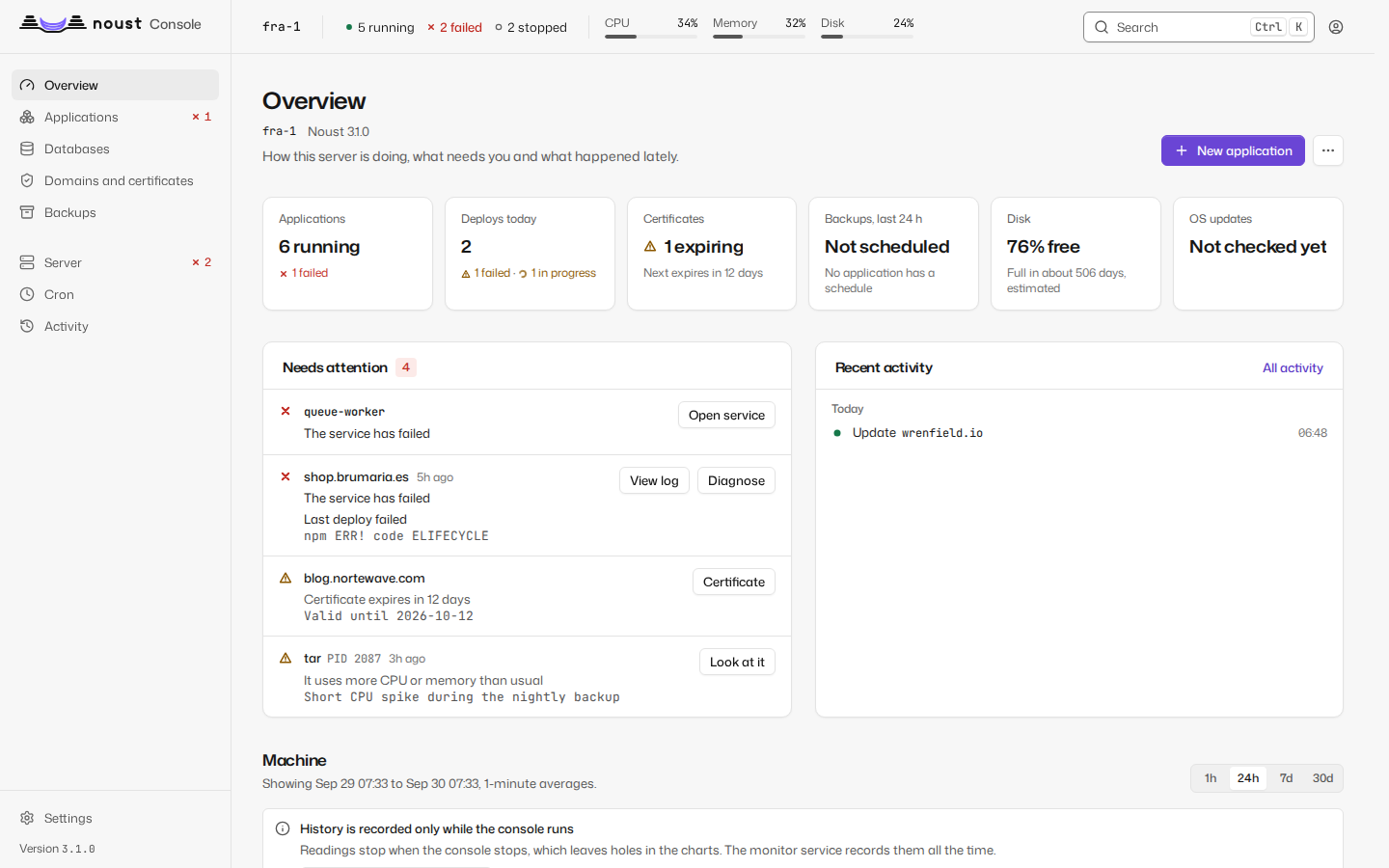
It covers everything the CLI does: an overview of what needs attention; applications with
their deployments, releases, live logs, metrics, environment, database, domains, diagnosis and
settings; databases with a data browser and a SQL console; backups, schedules and remote
destinations; certificates and sites; the server (updates, security, storage, services, logs,
system); cron; an activity timeline; and settings, accounts, approvals, the audit log and
compliance. On a central, fleet-wide views and bulk actions.
The new-application wizard deploys from a repository, a recipe or an exported application.
It speaks English and Spanish, following the browser, switched from the top bar; what
nginx, systemd or certbot print is shown verbatim, as they wrote it. Every page is built from
one design system, docs/DESIGN.md. Keyboard: Ctrl K for
the command palette, g a for applications, / to search, ? for every shortcut. Light,
dark and system themes. Built to WCAG 2.2 AA and tested with axe on every page.
See docs/console.md.
Releases and instant rollback
/var/www/apps/shop-example-com/
  releases/20260925-143012-a1b2c3d/    one build per deploy
  releases/20260924-101500-9f8e7d6/
  current -> releases/20260925-143012-a1b2c3d
  shared/.env                           outside every release
  shared/storage/                       persistent paths, linked into each release
  repo/                                 git cache
- Isolated builds. A deploy fetches and builds in a new directory; the running application sees nothing until activation. Dependencies are copied from the active release instead of reinstalled when the lockfiles have not changed.
- Health-gated activation.
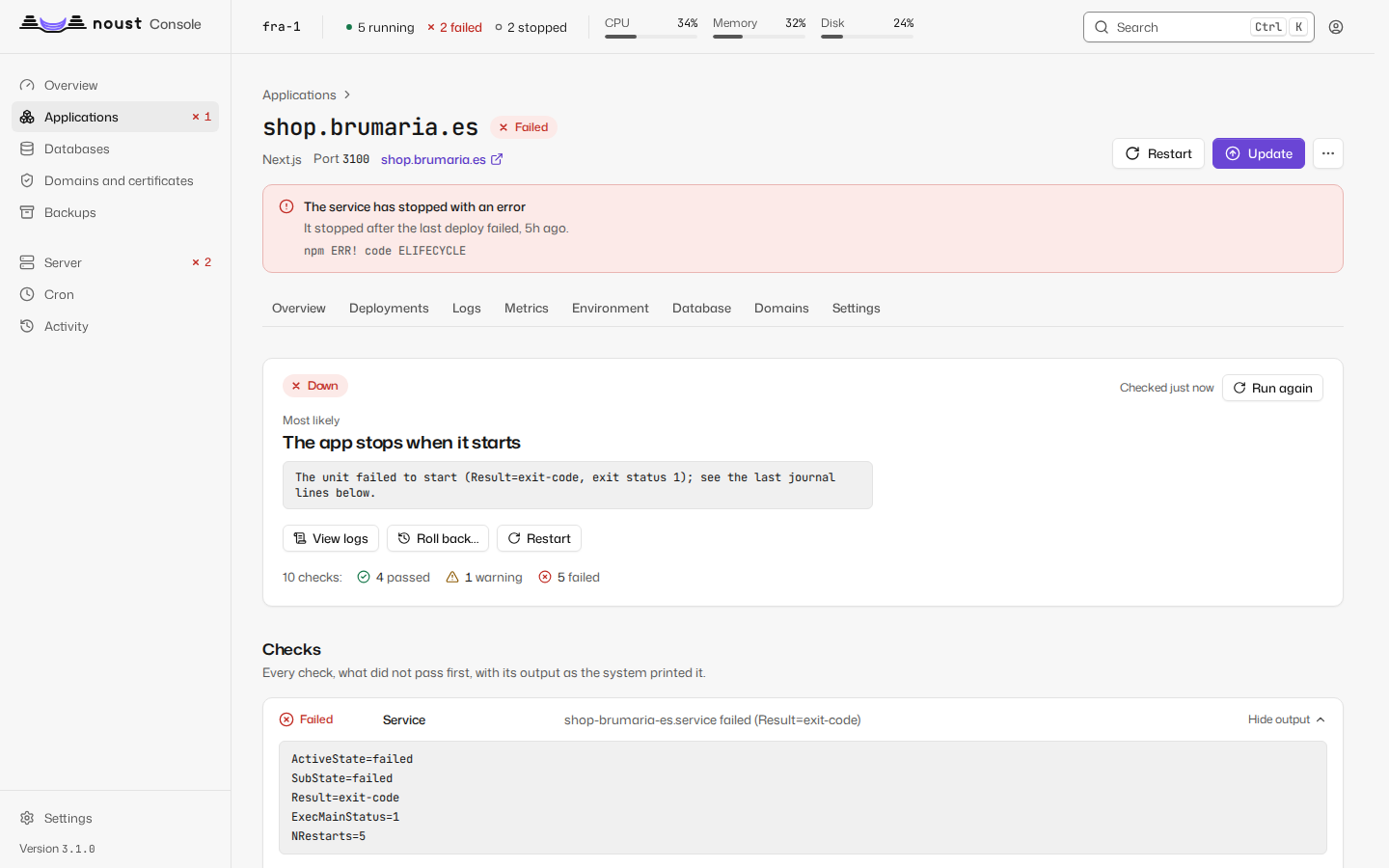
currentis swapped atomically and the unit restarted; the release stays only if the application answers its health check (by default, any status below 500 on its port) within about 30 seconds. The path, accepted statuses and timeout are set per application withnoust app health. - Automatic rollback. If it does not answer, the previous release is put back and the deploy fails with the probe results and the unit's journal, verbatim.
- Instant rollback.
noust releases rollback DOMAIN [RELEASE], the console, orPOST /api/apps/{domain}/releases/{id}/activate: re-point, restart, same health gate.noust update DOMAIN --commit SHArebuilds an exact commit. - Retention. The newest five releases, plus the active one, are kept by default;
noust releases keep DOMAIN Nchanges it. - The branch it deploys.
noust app branch DOMAIN mainpins it: every update builds it and the webhook ignores pushes to other branches.noust update --branch XpinsXwhen it succeeds.
Applications deployed in place (by WASM 1.x, or with --layout inplace) stay in place until
you run noust app migrate DOMAIN (rehearse it first with noust --dry-run app migrate DOMAIN): the live tree becomes the first release, the .env and what the application wrote
for itself move to shared/, and if it does not come up everything is put back. Monorepo and
Docker Compose projects keep deploying in place. See docs/releases.md.
Builds without root
noust app sandbox test shop.example.com      # build the live commit in the sandbox, activate nothing
noust app sandbox enable shop.example.com    # sandboxed from the next deploy on
Installing dependencies and building run in a transient systemd unit as the unprivileged
noust-build account: it can write its release and its own cache, and cannot read Noust's
configuration, the store, root's home or any other application's .env. A self-test proves the
sandbox holds before the first build; where it does not (a container or WSL without mount
namespaces) the build stops rather than running as root. Applications and previews created from
3.1 on build this way; applications from before keep building as root, flagged by noust health, until you test and enable it for each. --network strict also builds without a
network.
Blue/green
noust app zero-downtime shop.example.com on
Opt-in per application. The application runs as two instances of one systemd template unit,
each on its own port and release, behind an nginx upstream. An activation starts the idle
instance on the new release, passes the health gate on its port, moves the upstream with
nginx -t and a reload, and stops the old instance after a drain (10 seconds by default). A
failed gate stops the new instance; the old one never stopped. Only for applications on
releases, with a process, behind nginx; the application must tolerate two copies running
for a few seconds.
Pull request previews
noust preview enable shop.example.com --domain previews.example.com
noust preview list shop.example.com
Every pull request gets pr-<n>-<app>.previews.example.com, deployed on releases with 256 MB
and half a CPU, rebuilt on each push, and removed when the request closes or after seven
days without a push, up to a quota per application. Events come from the application's own
webhook (GitHub, GitLab, Gitea) or from the GitHub App. Pull requests from forks are refused,
and on GitHub so are those of authors who are not the repository's owners, members or
collaborators. A preview runs with the application's environment variables, except those
listed with --exclude-env; its build runs in the sandbox as noust-build and never sees
production secrets.
GitHub
A GitHub App per server, created from the console (Settings > Integrations) with GitHub's
manifest flow: it lives in your account, its private key stays on the server (0600), and
you choose the repositories when you install it. Private repositories clone with one-hour
installation tokens passed through git's environment only, never in a URL, .git/config, a
command line or a log; github:owner/repo works as a source everywhere. Pushes and pull
requests arrive at /hooks/github, and each deployment shows on GitHub as in progress,
success or failure. noust web expose-hooks DOMAIN publishes only /hooks/ of the console
on a domain of its own, so GitHub can reach a console that listens on loopback.
noust github status shows what is connected.
Recipes
noust recipe list
noust recipe show wordpress                         # what it needs, what it creates
noust create --recipe wordpress -d blog.example.com
WordPress (PHP-FPM and MariaDB), Uptime Kuma, Umami (PostgreSQL) and n8n, each with its
source pinned or checked against a published checksum, generated secrets, its database,
persistent paths, a health check and the next steps. Also "From a recipe" in the console's
new-application wizard. Noust installs nothing on its own: noust recipe show lists the
packages a recipe needs.
Moving applications
noust app export shop.example.com -o shop.json        # secrets only with --with-secrets
noust app import shop.json --domain shop.example.org
noust import --from vercel ./shop                     # also: railway, render, heroku
An export is everything that defines an application, as versioned JSON; an import deploys it
through the normal path and applies the rest (domains, health check, retention, secret marks,
cron jobs, backup schedule, previews, blue/green), listing what it could not. noust import --from reads another platform's configuration in a repository and proposes Noust's, with a
warning for each thing that has no equivalent.
Domains, aliases and redirects
noust domain add shop.example.com shop.example.org                    # alias: serves the app too
noust domain add shop.example.com old-shop.example.com --kind redirect # 301 to the primary
noust domain list shop.example.com
noust domain remove shop.example.com shop.example.org
Every name is rendered into the site, tested by the web server before it is reloaded, and,
when the application serves TLS, added to its certificate. noust create --www records
www.<domain> as a redirect. The console checks where each name resolves before you add it.
See docs/domains.md.
Resource limits
noust app limits shop.example.com --memory 512M --cpu 50% --tasks 256 --restart
noust app limits shop.example.com --memory none         # remove one limit
noust app limits shop.example.com                       # show them
The limits become MemoryMax=, CPUQuota= and TasksMax= in the unit (200% is two CPUs).
With --restart, the application must pass the health gate under its new limits or the old
ones are put back. Docker Compose projects set their limits in the compose file.
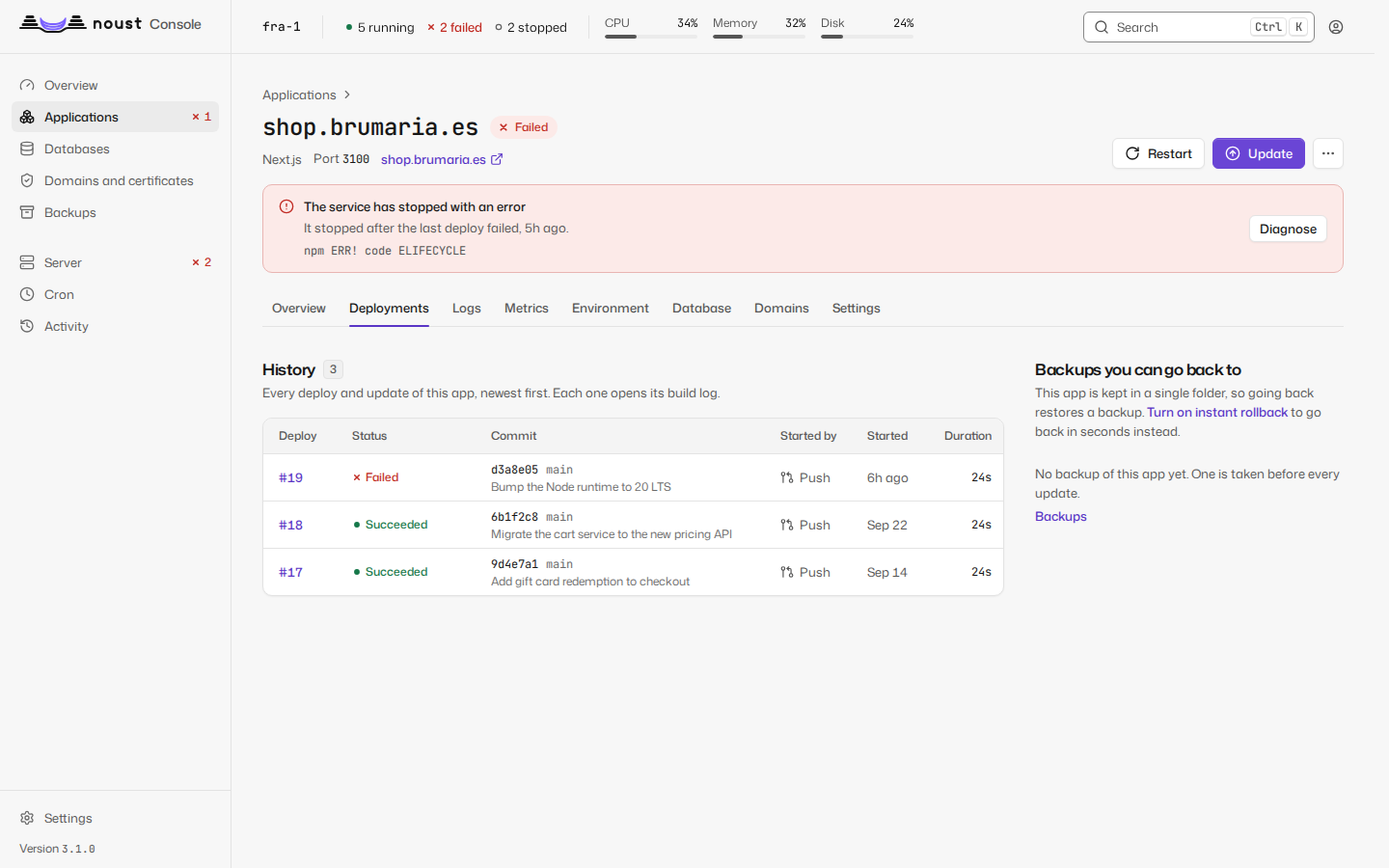
Diagnose
noust diagnose shop.example.com
Explains why an application is down. It checks the unit's state and exit status, whether the
recorded port is listening (and which port the process listens on instead), an HTTP probe
straight to the application and one through nginx, the last journal lines, nginx's error log
for the domain, the certificate, the last deployment, OOM kills in the last week and disk
space, and puts the most likely cause first: "Listening on 3001, Noust routes to 3000",
"Killed by the kernel for running out of memory". Every probe only reads. --json for
scripts; the exit code is 1 when the application is down.
noust health checks the whole server: free disk, the web server, every application,
certificates close to expiry, memory pressure, the hardening checks, the audit trail and the
applications still building as root.
Backups
noust backup create shop.example.com -m "Before the migration" --include-databases
noust backup list shop.example.com
noust backup verify BACKUP_ID
noust backup restore BACKUP_ID
noust backup schedule create shop.example.com --schedule daily --retention-count 7
noust rollback shop.example.com            # restore the latest backup, after a safety backup
A backup is one .tar.gz under /var/backups/noust/<app>/, mode 0600, with a SHA-256
checksum: the application (for one on releases, the active release and shared/), its .env
unless --no-env, and on request its database dumps (--include-databases) and Docker
volumes, so it restores on a server that knows nothing about this one. Schedules are systemd
timers named noust-backup-<app>, and their retention applies only to the backups they
made: manual and safety backups are never removed by a schedule.
Off the server. Remote destinations go through rclone: SFTP, SMB, WebDAV, S3 and compatibles, B2, Google Drive, OneDrive, Dropbox, pCloud and mounted paths, with optional encryption per destination.
noust backup destination add offsite ...        # --help lists the kinds and their options
noust backup destination test offsite
noust backup push BACKUP_ID offsite
noust backup remote-list offsite
noust backup restore --from offsite BACKUP_ID
Each scheduled backup is copied to the schedule's destinations, verified and pruned per destination; each server keeps its own folder, so servers sharing a bucket never remove each other's backups. Keep the key an encrypted destination shows: it is the only way to read its backups on a replacement server.
Databases
noust db install postgresql                             # also: mysql (MariaDB), redis (or Valkey), mongodb
noust db provision shop.example.com -e postgresql       # a database and an account, linked to the app
noust db tables shop -e postgresql                      # browse, read-only
noust db query shop "SELECT count(*) FROM orders" -e postgresql
noust db backup-schedule set shop -e postgresql --schedule daily --keep 7 --to offsite
noust db restore shop dump.pgc -e postgresql --as-new shop_check
noust db connect-info shop -e postgresql                # the SSH tunnel to reach it from your computer
A database belongs to an application: noust db provision creates it with its own account and
writes the connection string into the application's environment, and rotating a password
updates every application that uses it behind the health gate. Each database has a page in the
console with its data, a SQL console with history and saved statements, backups, users and
metrics. Reads are read-only because the database server enforces it: a dedicated role or
account with SELECT and nothing else, in a read-only transaction, so pg_read_file or
LOAD_FILE() are out of reach. Writing SQL or editing a row needs sudo mode. Backups are
policies with a schedule, retention, verification and remote destinations (timers
noust-backup-db-*), and a restore never loses data: --as-new restores beside the database,
and restoring over it takes a safety copy first. Passwords never appear in a command line, and
database ports open beyond the machine are reported (noust db exposure).
Cron
noust cron create nightly-report "/usr/bin/node scripts/report.js" --schedule daily \
  --app shop.example.com --working-directory /var/www/apps/shop-example-com/current
noust cron list
noust cron run nightly-report
noust cron runs nightly-report
Jobs are systemd timers (noust-cron-<name>). A schedule is hourly, daily, weekly,
monthly or any OnCalendar= expression. The command runs without a shell: write
/bin/sh -c "..." when you need pipes or &&. --app associates the job with an
application and makes its directory the default working directory; for an application on
releases, the code is under current/, so name that directory. Runs and their output are
read back from the journal.
Notifications and webhooks
Notifications go to a webhook (JSON, optionally signed), Slack, Discord, Telegram or email,
each written for its channel, on deploys (deploy_started off by default, deploy_success,
deploy_failed, deploy_rolled_back), restores, backups (backup_failed, and
backup_success if you want a heartbeat), cert_expiring, unit_failed, disk_threshold,
reboots, approvals and, on a central, a server unreachable, recovered or with a changed host
key. They come from every deployment: the CLI's, the console's, webhooks' and previews'. A
failure carries the health gate's evidence, and every message names its server
(server.name). Configure
them in the console (Settings > Notifications) or with
noust config set notifications.<key> <value>, and test a channel with
noust notify test slack. They are written in English or Spanish
(notifications.language). Private and loopback destinations are refused unless listed in
notifications.allow_private_hosts.
Deploy on push: in the console (application > Settings > Webhook) or with
POST /api/apps/{domain}/webhook-secret, create a secret, and point a GitHub, Gitea or
GitLab webhook at https://<console>/hooks/deploy/<domain>, which the forge must be able to
reach. Signatures are verified; only pushes to the branch the application deploys update it
(pin one with noust app branch).
noust app webhook show|rotate|disable|deliveries DOMAIN does the same from the terminal: how
far the setup is (public URL, secret, branch, GitHub App), the secret, and every delivery the
forge sent, including the ones that were ignored or had a wrong signature.
API
noust token create ci --scope deploy
curl -H "Authorization: Bearer $TOKEN" https://panel.example.com/api/apps
curl -H "Authorization: Bearer $TOKEN" https://panel.example.com/api/openapi.json
A JSON API under /api. Tokens belong to an account and hold at most its permissions, narrowed
by scope (read, deploy, admin), by a list of permissions or by network. Every route
declares its permission (x-noust-permission in the schema), what needs sudo mode and what
needs a second person's approval. Long operations are jobs
you follow over REST, Server-Sent Events (/events) or WebSockets. Every error has the same
shape: {error, detail, hint, fields, output}, where output is the system tool's own
output. The contract is served as OpenAPI at /api/openapi.json. See
docs/api.md.
Accounts, roles and audit
noust user create alice --role admin --person-ref alice@example.com   # password at a hidden prompt
noust user invite bob --role operator                                   # a one-use code; Bob sets his own
noust audit verify                                                      # the chain is intact
noust ens check                                                         # against Spain's ENS, category MEDIUM
People sign in with their own account, each with one role: viewer (sees, changes nothing),
operator (also restarts, deploys, rolls back, renews, backs up), admin (also creates,
configures, deletes and reads secrets), security (accounts, security settings and the audit
log; deploys nothing) and auditor (reads everything, including the audit log). Every account
has a second factor, an authenticator app or a passkey. One person cannot hold roles that go
against each other without a documented exception. Until the first account exists, the access
token works exactly as before; afterwards it is emergency access.
Every change, from the console, the API or the CLI (--reason says why), is recorded in an audit
log whose lines are chained with an HMAC (noust audit verify) and shipped to journald or a
syslog server as they are written. With approval.enabled, root-equivalent changes (raw units,
cron commands, backup hooks, raw site configuration), SQL that writes, adding servers and role
grants wait for a second person (noust approval). security.profile: ens-medium sets every
value Spain's Esquema Nacional de Seguridad expects for category MEDIUM, and noust ens report
writes the evidence for an auditor. See docs/security.md and
docs/ENS.md.
The server
noust server status                         # updates pending, reboot due, disks, clock, swap
noust server updates apply --security-only  # in its own systemd unit; never reboots by itself
noust server security checks                # hardening checks, each with its fix or exact steps
noust server security ssh harden disable-passwords   # reverts after 120 s unless confirmed from a new login
noust server security firewall status       # the rules against the ports that really answer
noust server reboot --at 04:00
The Server page and noust server look after the machine itself: operating-system updates
(security first, the distribution's automatic updates, services left on replaced libraries,
whether a reboot is due and why), reboots and shutdowns now or scheduled, SSH (the effective
configuration, keys, and fixes that undo themselves unless you confirm from a new login), the
firewall compared with the ports that answer (with a guard that never closes SSH, and a warning
when Docker publishes past it), fail2ban, disks and clean-ups, swap, time, host name, processes
and the journal of any unit. Every change runs as a job with the system's own output, needs sudo
mode and is audited. A finding you decide to keep is accepted with a reason and an end date,
never marked as passed.
The fleet
One Noust, the central, shows and drives several Noust servers from a single console and CLI.
The central can be one more VPS, or a container on a machine at home such as a NAS, reaching
each server over an SSH tunnel it opens outward, so no port has to be opened anywhere. A central
that only manages the fleet (central.role = hub) deploys nothing itself.
noust node key vps1                                                    # on the central
noust fleet authorize --central-key 'ssh-ed25519 AAAA...' --name nas   # on vps1, as root
noust node add vps1 --ssh vps1.example.com --join-code -               # on the central
noust fleet status                                                     # every server it manages
noust fleet certs --expiring 21                                        # certificates of every server
noust node label vps1 env=prod
noust fleet run apps_update --label env=prod --serial 1 --canary vps1  # plan first, then run
Enrollment is inverted: the central never logs in to a server with your credentials. You
authorize it on the server, where you are already root: noust fleet authorize installs
the central's key for noust-tunnel, an account with no home, no shell and no password that
sshd itself restricts to forwarding that server's console port - no terminal, no command, no
other forward - and prints a join code, which you paste into the central (noust node add).
The central pins the server's SSH host key from that code; a change closes the tunnel rather
than being accepted. A server enrolled by 3.0 has the key in root's authorized_keys; move it
with noust node migrate-tunnel.
Each server decides how far any central may go there, and enforces it itself: read, deploy
or admin, plus host access (off by default) for SSH, the firewall, system accounts and
root-equivalent changes (noust fleet access). The central forwards the operator's name and
role, so the server applies its own table for that role within the ceiling and its audit log
names the person, not the central. Anything a server marks as needing confirmation or approval
is asked on the central, and the server refuses the call anyway if the central did not vouch
for it.
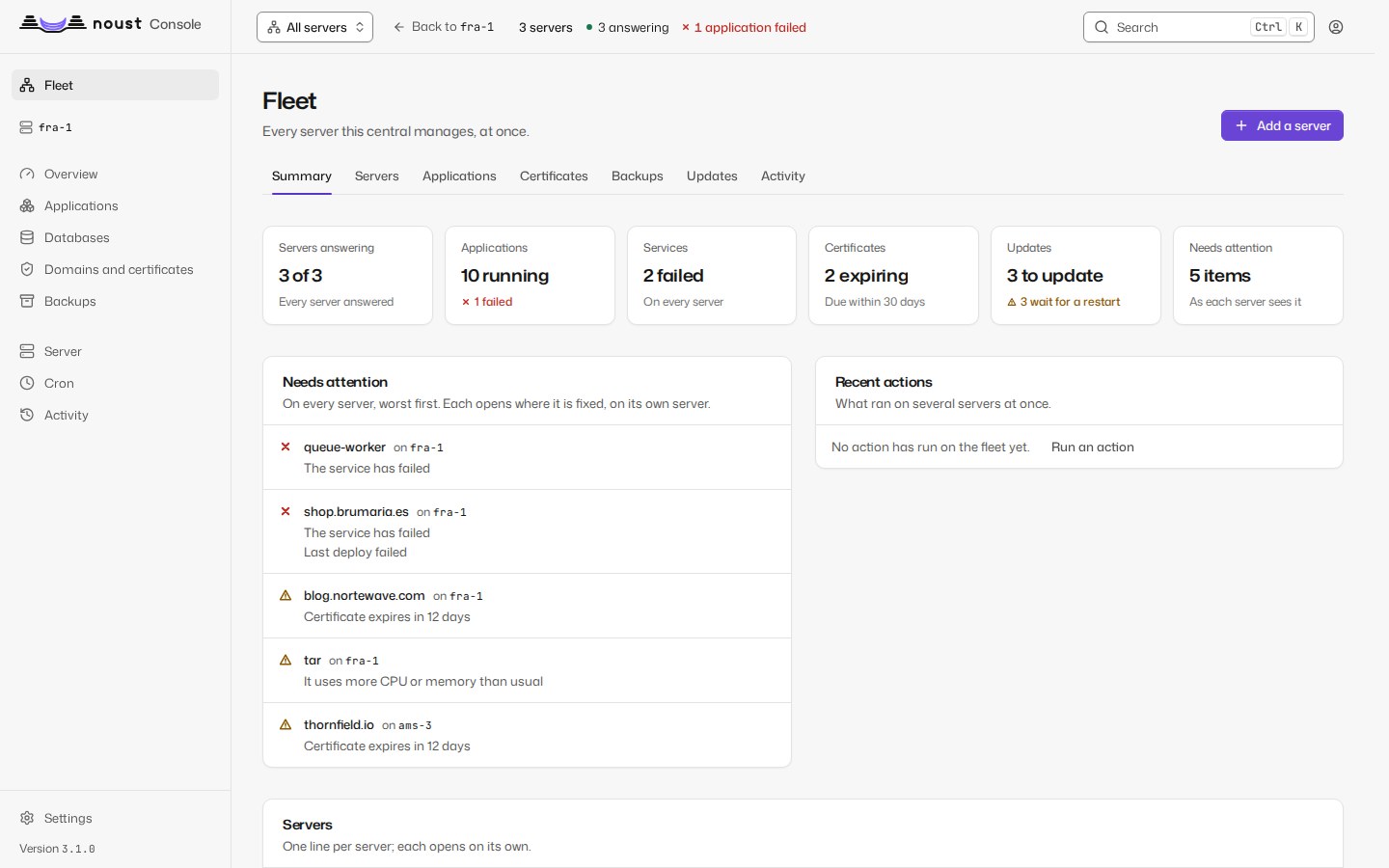
The console has a server selector (every page also exists at /n/<server>/...) and a Fleet page
with fleet-wide views - summary, servers, applications, certificates, backups, updates and
activity, each row linking to its server - and bulk actions: renew certificates, back up and
verify, update or restart applications, update Noust or the operating system, on servers chosen
by name or label, with a plan first, batches, a canary and a retry of what failed. A server that
is down or too old is one row with its reason, never an error for the page. A central with its
secrets sealed shows a lock screen until you unlock it, and noust central backup keeps an
encrypted copy of everything it holds.
See docs/CENTRAL.md for running a central on a NAS or a VPS, the access ceiling, sealing its secrets, backups and troubleshooting.
Security model
- Root, on purpose. Noust administers the machine, so it runs as root. An
adminaccount, the access token and any token holdingroot_equivalentcan make changes that run as root; treat them that way, and turn on approvals if one person should not make them alone. - Roles and permissions at one chokepoint. Every API route declares its permission and one layer enforces it; a route without one is refused.
- Builds without root. Dependencies install and build as
noust-buildin a sandbox, and a build never falls back to root silently. - Processes are started with an argument list, never a shell, always with a timeout, and
secrets travel through the environment or standard input, never the command line. Only one
module may start a process, and the test suite enforces it.
--dry-runruns only commands declared as read-only probes. - The console listens on loopback, and refuses to serve beyond it without TLS.
- Strict Content Security Policy with Trusted Types; no inline scripts or styles; nothing loaded from another origin.
- Sessions are server-side,
HttpOnly,SameSite=Strict, with CSRF tokens; they end after 30 minutes idle and 12 hours in total. Every account has a second factor or a passkey. Five failures lock an account, and an address, for 15 minutes. - Sudo mode: deleting, restoring, revealing secrets, editing units and sites, writing SQL or configuration, server changes and account management need a confirmation from the last 10 minutes.
- Audit log: one closed catalogue of events, chained with an HMAC, retained 365 days and shipped off the machine to journald or syslog.
- Secrets at rest are
0600: configuration,.envfiles, the store, the credentials Noust keeps for itself, backups; TOTP secrets are encrypted.
See docs/security.md, which also says how to report a vulnerability.
Command reference
| Command | Does |
|---|---|
| Applications | |
noust create |
Deploy an application and put it online (also deploy, new; --recipe) |
noust list |
List deployed applications (--json) |
noust status |
Show how an application is configured and whether it runs (--json) |
noust start, stop, restart |
Control an application |
noust update |
Pull, rebuild and redeploy an application |
noust delete |
Delete an application and everything deployed with it |
noust logs |
Show or follow an application's log (-f, --json) |
noust env |
Show, configure, mark or export an application's environment |
noust releases |
List releases, set their retention and roll back to one instantly |
noust app |
Migrate to releases; limits, health check, blue/green, branch, build sandbox, deploy webhook; export and import |
noust domain |
Add, list and remove aliases and redirects |
noust preview |
Pull request previews |
noust recipe |
List and show the ready-made applications |
noust import |
Read another platform's configuration and propose Noust's |
noust diagnose |
Explain why an application is down |
noust rollback |
Restore an application's latest backup |
| Web server and certificates | |
noust site |
Create, enable, disable, show and delete nginx or Apache sites |
noust cert |
Obtain, list, inspect, renew, revoke and delete certificates |
| Services and schedules | |
noust service |
Create and control the systemd services Noust owns |
noust cron |
Run commands on a schedule, as systemd timers |
| Data | |
noust backup |
Create, verify, restore, schedule and send backups off the server |
noust db |
Install engines; databases per application, data, queries, users, backups and their policies |
| The machine | |
noust setup |
Prepare the server (init), check it (doctor), SSH keys, completions |
noust server |
Updates, reboots, storage, swap, time, host name, processes, logs; server security for checks, SSH, firewall, fail2ban and accepted risks |
noust health |
Check the server and report what needs attention |
noust monitor |
Watch processes, resources, units and certificates, record the metrics history, and report |
noust config |
Read, set, upgrade and clean Noust's configuration |
noust store |
Inspect, export and maintain Noust's database |
noust migrate-from-wasm |
Move a server WASM ran onto Noust's names (--dry-run shows the plan) |
| Fleet | |
noust fleet authorize |
Run on a server: let a central manage it, and print the join code |
noust fleet deauthorize |
Run on a server: stop trusting a central, revoke its key and tokens |
noust fleet access |
Run on a server: the most any central may do there |
noust fleet status |
Run on a central: every node it manages, reachability, version, apps |
noust fleet apps, certs, backups, updates, activity |
Run on a central: one view across every node |
noust fleet run, jobs, retry |
Run on a central: an action on several nodes, with a plan, batches and a canary |
noust node |
Run on a central: register, list, show, test, label, rekey, migrate to the tunnel account and remove nodes |
noust central |
Run and look after a central: serve it (run), back it up, seal, unseal, unlock, status |
| Console and access | |
noust web |
Start, stop and inspect the console, or run it as a service; issue its access token |
noust github |
The GitHub App: status, installations, repositories |
noust user |
Accounts and roles: create, invite, set a role, disable, unlock, reset MFA, exceptions |
noust passkey |
List and remove passkeys; reset them when all are lost |
noust token |
Create, list and revoke API tokens |
noust sessions |
List and revoke console sessions |
noust 2fa |
Enrol, confirm, disable or recover the access token's two-factor authentication |
noust approval |
Four-eyes requests: list, show, approve, reject |
noust audit |
Read, verify, export, ship and review the audit log |
noust ens |
Check the server against the ENS profile; evidence report, access reviews, inventory |
noust incident |
Freeze the evidence of an incident and lock the console down |
noust notify |
Send a test notification through a channel |
Global options go before the command: -v (verbose), --dry-run, --json, --no-color,
--reason (why, for the audit log), -i (interactive menu), --changelog, -V (version). Tab completion: noust setup completions. wasm runs the same program throughout 3.x.
Supported application types
| Type | Detected by | Built and run with | Releases |
|---|---|---|---|
nextjs |
next.config.{js,mjs,ts}, or next in package.json |
Install, build, then start or the standalone server |
Yes |
vite |
vite.config.{js,ts,mjs}, or vite in package.json |
Install, build, served as static files; preview when it uses SSR |
Yes |
nodejs |
package.json with Express, Fastify or Koa, a main or a start script |
Install, build if present, then start:prod, start:production or start |
Yes |
python |
requirements.txt, pyproject.toml, setup.py, Pipfile |
A virtual environment (Poetry or Pipenv when locked); Gunicorn, with Uvicorn workers for FastAPI and Starlette; Django's collectstatic |
Yes |
php-fpm |
composer.json with a front controller, or a root index.php |
A PHP-FPM pool per application on its own socket, composer when there is a composer.json, a fastcgi site (nginx only); public/ detected |
Yes |
static |
index.html, and no project manifest |
Served by the web server from public, dist, build, www, html or the root |
Yes |
monorepo |
turbo.json, pnpm workspaces and at least two apps under apps/ |
pnpm; one unit and one subdomain per workspace | In place |
docker-compose |
A compose file (docker-compose.prod.yml first) |
docker compose v2 under a systemd unit, nginx in front of published ports |
In place |
Detection tries the most specific type first: monorepo, Docker Compose, Next.js, PHP, Vite,
Python, Node.js, static. When nothing matches, Noust falls back to Node.js and says so; pass
--type to choose. Node package managers (npm, pnpm, Yarn, Bun) are detected from the
lockfile; --pm npm|pnpm|bun forces one.
Configuration
/etc/noust/config.yaml, mode 0600. Read and change it with the CLI rather than by hand:
noust config show                              # everything in effect, secrets in clear
noust config get deploy.layout                 # one key; secrets print as ***
noust config set ssl.email ops@example.com
noust config upgrade                           # add the options a newer Noust expects
noust config clean                             # remove the settings no version reads any more
Common keys: apps_directory (/var/www/apps), webserver (nginx), service_user
(www-data), ssl.email, deploy.layout (releases for new applications, or inplace),
backup.directory (/var/backups/noust), server.name, security.profile (standard or
ens-medium), auth.*, audit.*, approval.*, notifications.*, monitor.*. Every setting
is documented in docs/CONFIG.md. NOUST_APPS_DIR,
NOUST_WEBSERVER, NOUST_SERVICE_USER and NOUST_SSL_EMAIL override the matching keys (the
WASM_ spellings are still read). The reference configuration is
/usr/share/noust/config.example.yaml.
Files
/var/www/apps/<app>/          applications (see Releases above)
/etc/noust/config.yaml        configuration, 0600 in a 0700 directory
/etc/noust/web-*              console state: signing key, token hash, sessions, 2FA, audit log
/var/lib/noust/noust.db       the store: applications, deployments, jobs, releases, domains
/var/lib/noust/               also build logs, and secrets/ for the credentials Noust keeps
/var/backups/noust/           backup archives
/var/cache/noust/build/<app>/ build caches, owned by the noust-build account
/var/log/noust/               Noust's own log files
/etc/systemd/system/          units: <app>.service, noust-web, noust-monitor, noust-cron-*,
                              noust-backup-*, noust-previews
On a server upgraded from WASM, /etc/wasm, /var/lib/wasm, /var/backups/wasm and
/etc/nginx/wasm-upstreams are symbolic links to their new names. When /var/lib/noust is
not writable the store lives in ~/.local/share/noust/; noust store path prints where it
is.
Requirements
- Operating system: Ubuntu 22.04+, Debian 12+, Fedora 40+, openSUSE Leap 15.6+
- Python: 3.10 to 3.14
- Privileges: root
- Installed by
noust setup initwhen missing: nginx or Apache, certbot, git, Node.js - Per application type:
python3-venvfor Python, PHP-FPM and its extensions for PHP, Docker with the Compose plugin for Compose projects, the engine for databases (noust db install), rclone for remote backup destinations
Documentation
- docs/CHANGELOG-3.1.md: what changed in 3.1
- docs/UPGRADING-3.1.md: upgrading a 3.0 server or fleet to 3.1, and rolling back
- docs/CHANGELOG-3.0.md: what changed in 3.0
- docs/UPGRADING-3.0.md: upgrading a WASM 2.x server to Noust 3.0
- docs/CENTRAL.md: running a central, adding a server, fleet views and bulk actions, sealing its secrets
- docs/CONFIG.md: every setting, and the obsolete ones
- docs/console.md: the console, page by page
- docs/releases.md: the release layout, health gate, rollback, migration
- docs/domains.md: aliases, redirects, certificates, DNS checks
- docs/api.md: authentication, errors, events, WebSockets, endpoints
- docs/security.md: threat model, roles and permissions, controls, reporting vulnerabilities
- docs/ENS.md: Spain's Esquema Nacional de Seguridad, category MEDIUM (in Spanish, with an English summary)
- docs/DESIGN.md: the console's design system
- docs/MONITOR.md: the resource monitor and the metrics history
- docs/UPGRADING-2.0.md: upgrading WASM from 1.6, and between 2.x releases
- Earlier releases, as WASM: 2.3, 2.2, 2.1, 2.0
man noust, andnoust <command> --help
Development
git clone https://github.com/Perkybeet/noust.git
cd noust
python -m venv .venv && source .venv/bin/activate
pip install -e ".[all,dev]"

pytest                          # tests
ruff check src/noust tests      # lint
ruff format src/noust tests     # format
mypy                            # types
The console's source is in panel/ (React, TypeScript, Vite; Node 22). Its build is
committed to src/noust/web/static/, so packaging never runs Node. See
CLAUDE.md for the project's rules and the console workflow.
License
From 2.1.0, Noust (then WASM) is free software under the GNU Affero General Public License, version 3 or later (LICENSE). You may use it for anything, commercially included, study it, change it and share it. If you change Noust and let others use your changed version over a network (a hosted service, say), you must offer them its source under the same licence.
Releases up to 2.0.x were published as WASM under the WASM Non-Commercial Source-Available License 1.0, and stay under it.
Copyright (c) 2024-2026 Yago López Prado. For a licence on other terms (for example to embed Noust in a closed product), write to yago.lopez.adeje@gmail.com.
Acknowledgments
- Certbot - SSL certificate automation
- The open-source community
Support
- Issues: GitHub Issues
- Email: yago.lopez.adeje@gmail.com
Developed by Bitbeet
1 maintainer

Metadata
1 maintainer
Release files for noust 3.1.12
For a detailed explanation of source distributions (sdists) and built distributions (wheels), please see the package formats documentation.
Source distribution (sdist)
| File | Size | Uploaded | |
|---|---|---|---|
| noust-3.1.12.tar.gz | 12.8 MB | Details |
Built distribution (wheel)
| File | Interpreter | ABI | Platform | Reset |
|---|---|---|---|---|
| noust-3.1.12-py3-none-any.whl | Python 3 | none | any | Details |
Total release size: 16.8 MB
Release files / noust-3.1.12.tar.gz
| Download URL | noust-3.1.12.tar.gz |
|---|---|
| Size | 12.8 MB |
| Tags | Source |
|
SHA-256 checksum How to use checksums |
5d9aa3967001db4c29460b13f7da5e5e46f8d4edbdc1e37657d23c570b3c8d7f
|
|
BLAKE2b-256 checksum How to use checksums |
b0e21ea9ac6125b67f62fd7834acd8958abdd26c4814190887105ae305b7215b
|
| Upload date | |
|
Uploaded using Trusted Publishing? What is trusted publishing? |
Yes |
| Uploaded via |
twine/7.0.0 CPython/3.13.14
|
Provenance
Provenance describes where a file came from. On PyPI, provenance is shared via attestations, which provide a verifiable record of the build or publishing details. View details, limitations and caveats.


PyPI Publish Attestation
PyPI verified that this artifact, at this checksum, originated from the publisher listed below.
Signed by GitHub Actions, verified by PyPI on Oct 1, 2026.
Transparency logRelease files / noust-3.1.12-py3-none-any.whl
| Download URL | noust-3.1.12-py3-none-any.whl |
|---|---|
| Size | 4.1 MB |
| Tags | Python 3 |
|
SHA-256 checksum How to use checksums |
451a4f5bad4e802b21c4d641403e71465cbe186c65badef5be6f1cbc726984de
|
|
BLAKE2b-256 checksum How to use checksums |
8e67e3693097da938e4d49407adecaee1833386f8791dcb93d54c6564120b8c0
|
| Upload date | |
|
Uploaded using Trusted Publishing? What is trusted publishing? |
Yes |
| Uploaded via |
twine/7.0.0 CPython/3.13.14
|
Provenance
Provenance describes where a file came from. On PyPI, provenance is shared via attestations, which provide a verifiable record of the build or publishing details. View details, limitations and caveats.
PyPI Publish Attestation
PyPI verified that this artifact, at this checksum, originated from the publisher listed below.
Signed by GitHub Actions, verified by PyPI on Oct 1, 2026.
Transparency log













