
NovaFabric
Replayable, verifiable evidence for AI agent runs.





Website · Documentation · Quick start · Paper · Discussions
NovaFabric is open-source, self-hosted replay and evidence infrastructure for AI agents and agentic systems. It records each execution as a Run Capsule: a portable, secret-scanned directory that you own. Capture needs no changes to your application code. From a capsule you can replay the run, diff it against another run, trace its lineage, and export a signed Evidence Bundle that an auditor can verify without NovaFabric installed.
It runs from a laptop to Docker, Kubernetes and SLURM clusters, online or air-gapped, with no accounts and no telemetry.
▶ Watch the 7-minute demo: capture, seal, verify, and two tamper attempts caught and named.
Why NovaFabric
Observability tells you how a system is behaving right now. NovaFabric answers a different question: can you prove, replay and compare a run weeks or months later? Its unit of value is not a row in someone else's database. It is a folder on your own filesystem that you can archive, share, seal with your own key, and read with no server running.
| Capability | What you get | Maturity |
|---|---|---|
| Zero-code capture | nova capture <command> records OpenAI, Anthropic, MCP and HTTP-client calls; transparent proxies cover non-Python clients |
works today |
| Replay | Five modes, from read-only forensic inspection to mocked re-execution against recorded responses | works today (intervention experimental) |
| Diff and CI gate | Align two runs call by call; --assert-no-regressions fails the build on behavioural change |
works today |
| Lineage | Provenance and blast-radius queries; OpenLineage and W3C PROV export | works today |
| Signed evidence | DSSE-signed seals and a Merkle log (opt-in), plus Evidence Bundles anyone can verify with standard tools | works today |
| Secret scanning | Every capsule is scanned and carries a redaction proof; a capsule without one is invalid | works today |
| Server mode, dashboard, cluster collector | Multi-user REST API, OIDC/RBAC, web dashboard, HPC/Kubernetes collection | experimental |
Quick start
Install
pip install novafabric            # or: uv add novafabric
uv tool install novafabric        # or: pipx install novafabric — CLI only, isolated
NovaFabric requires Python 3.12+. Capture, validate, replay and diff need no extras. To try it without installing anything, open the repository in GitHub Codespaces.
Optional extras
| To… | Install |
|---|---|
Browse runs in a local dashboard (nova serve) |
pip install 'novafabric[serve]' |
Aggregate across runs (nova query) |
pip install 'novafabric[query]' |
| Run multi-user server mode | pip install 'novafabric[server]' |
| Export compliance documents | pip install 'novafabric[compliance]' |
| Sign with Sigstore | pip install 'novafabric[sigstore]' |
Quote the argument: most shells treat [ and ] as glob characters.
nova doctor --check-extras reports which extras are installed and prints the command
for any that are missing.
Capture, inspect, compare
# 1. Capture any command. No code changes.
nova capture python my_agent.py
# ✓ Capsule written: ~/.novafabric/capsules/01HXAY7M5JZ8R7K4P9DPBYK2WX

# 2. Validate it against the capsule schema; a missing redaction proof fails.
nova validate 01HXAY7M5JZ8R7K4P9DPBYK2WX

# 3. Replay it read-only: no network, no subprocess, no API keys.
nova replay 01HXAY7M5JZ8R7K4P9DPBYK2WX --mode forensic

# 4. Capture again and diff the two runs. Gate CI on behavioural change.
nova diff 01HXAY7M5JZ8R7K4P9DPBYK2WX 01HXB3K2T7QW9F0M4ZRC8DNV6P --assert-no-regressions

# 5. Trace lineage.
nova lineage provenance 01HXAY7M5JZ8R7K4P9DPBYK2WX
Capsules are written on success and on failure: a crash is captured evidence, not
lost state. A replay writes a replay result (replay_result.yaml) under
$NOVAFABRIC_HOME/replays/ (default ~/.novafabric/replays/), not a new capsule (only the experimental
intervention mode also writes a counterfactual capsule). To compare behaviour, capture the run again and
diff the two capsules.
What is inside a capsule
~/.novafabric/capsules/01HXAY7M5JZ8R7K4P9DPBYK2WX/
  capsule.yaml          ← run manifest (id, status, timing, refs)
  trace.jsonl           ← execution spans
  model-calls.jsonl     ← LLM API calls (OpenTelemetry GenAI semantic conventions)
  tool-calls.jsonl      ← tool invocations
  assets.jsonl          ← registry assets the run consumed
  lineage.jsonl         ← lineage edges emitted by this run
  env.lock              ← environment snapshot
  redaction-proof.json  ← what the secret scan checked and redacted
  replay.yaml           ← replay policy
  inputs/               ← created empty (not populated by capture today)
  outputs/
    stdout.txt          ← only when the stream is non-empty
    stderr.txt
  .seal/                ← only when NovaSeal is configured (opt-in)
In-process capture with the SDK decorator
from novafabric.sdk.agent import agent

@agent(name="research-agent", version="0.1.0", capsule_dir="capsules/")
def run():
    # OpenAI, Anthropic and httpx calls are captured automatically
    return client.chat.completions.create(...)

run()   # each call writes its own capsules/<run_id>/
Without capsule_dir, the decorator emits OpenTelemetry spans only and writes no capsule.
The Getting Started guide walks through the full path, including signing and the asset registry.
How it works
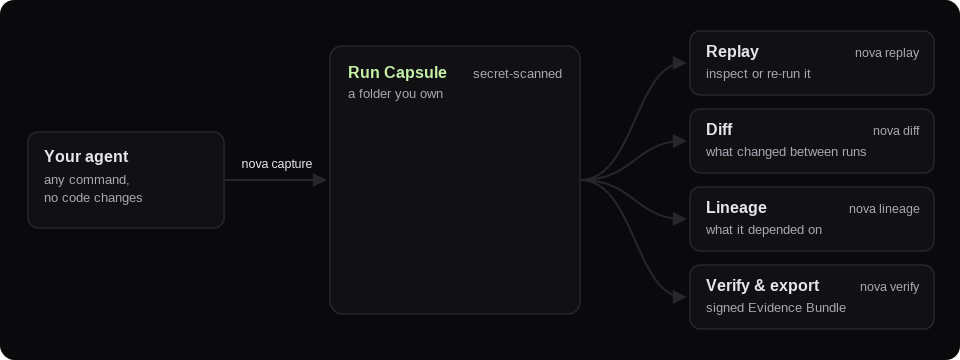
Capture. nova capture injects a loader into the child process that hooks the
OpenAI, Anthropic and MCP SDKs and the httpx, requests, aiohttp and urllib3
clients. It classifies provider traffic (including AWS Bedrock) and records each call
with OpenTelemetry GenAI fields. Hooks for SDKs that are not installed are skipped.
Clients that are not written in Python (Claude Code, Cursor, Node or Go agents) are
captured by two transparent proxies, nova api-proxy and nova mcp-proxy. Third-party
hooks plug in through the novafabric.hooks entry-point group.
Redaction is a precondition. Before a capsule is finalized, NovaFabric
secret-scans the event streams, the manifest, env.lock and every file under inputs/
and outputs/ (18 API-key and token rules; PII masking is a separate opt-in). Detected
values are redacted in place, and a hash-chained redaction-proof.json records what was
checked. The scanner matches known key formats: a capsule is secret-scanned, not
guaranteed secret-free. See what the scan does not catch.
Replay has five explicit, falsifiable modes:
| Mode | What it does | Use for |
|---|---|---|
forensic |
Read-only inspection. No subprocess, no network | Audit, post-incident review |
mocked |
Re-runs a Python workload. Recorded OpenAI and Anthropic replies and MCP tool results are served from the capsule; other tools run live. Fails closed on any unmatched call | CI, regression testing |
semantic |
Scores how similar the recorded responses are. Does not re-execute or call a model | Consistency checks |
exact |
Checks whether the run is eligible for a byte-exact re-run, and why. Does not re-execute | Local, on-premises and compliance runs |
intervention (experimental) |
Mocked replay after substituting one captured model or tool event | Counterfactual root-cause analysis |
NovaFabric does not claim exact replay of remote LLM calls. See the replay support matrix.
Evidence. Sealing is opt-in. Once you configure a signing key, each capsule is
signed (DSSE, ECDSA P-256), entered in a tamper-evident Merkle log, and optionally
timestamped (RFC 3161). nova verify checks it offline. nova export-evidence builds a
signed Evidence Bundle: a ZIP that can be verified with only sha256sum and an Ed25519
verifier, with no NovaFabric runtime required
(what the bundle contains).
Architecture. There are exactly two top-level formats, the Run Capsule and the Evidence Bundle. The capsule is the source of truth; the registry, metadata database and lineage graph are derived, rebuildable indexes. Local mode uses SQLite and never needs a server. Server mode (Postgres) is optional and additive. See the architecture overview.
When to use NovaFabric
Use it to:
- Reproduce a run later, for regression debugging or incident forensics.
- Gate CI on agent behaviour with
nova diff --assert-no-regressions. - Produce portable evidence of what a run did, for governance and audit.
- Capture without code changes, in your own environment, including air-gapped ones.
Look elsewhere if you need:
- A fully managed, hosted observability dashboard with zero operations.
- Real-time, multi-user analytics and alerting as a turnkey product (server mode and the dashboard are experimental).
- A compliance certification. NovaFabric produces evidence that supports compliance workflows; it does not certify anything.
- A frozen on-disk format today. Capsule and bundle formats are frozen at v1.0.
NovaFabric is framework-neutral: it records what LangGraph, AutoGen, CrewAI, DSPy or the OpenAI Agents SDK do, and sits beside inference servers, never in the request path.
How NovaFabric compares
| NovaFabric | Self-hosted observability (Langfuse, Arize Phoenix) | Hosted SaaS (LangSmith, W&B, Helicone) | |
|---|---|---|---|
| Deployment | Self-hosted CLI, server optional, no account | Self-hosted server and database | Managed cloud service |
| Primary artifact | Portable evidence capsule (a folder) | Trace row in a database | Trace row in a vendor cloud |
| Where data lives | On your machine | Your server | Vendor cloud |
| Replay of a run | Five modes | — | — |
| Run-to-run structural diff | Yes | Partial (evals) | Partial (evals) |
| Cryptographic provenance | Yes, opt-in: in-toto DSSE, Sigstore, RFC 3161 | — | — |
| Capture without code changes | Yes: SDK, wire-level, proxy | SDK instrumentation | SDK or proxy |
| Works fully offline | Yes | Self-hosted only | — |
The two categories are complementary. Observability platforms are stronger at live cost and token analytics, alerting and prompt experimentation. NovaFabric emits OpenTelemetry GenAI spans and OpenLineage events, so it can feed an existing stack while keeping portable capsules for replay and audit. See the full comparison, including where NovaFabric loses.
Standards used: OpenTelemetry GenAI · MCP · OpenLineage · in-toto · SLSA · Sigstore · RFC 3161 · JSON Schema 2020-12 · OPA/Rego · W3C PROV · C2PA (experimental). Each claim is listed, with how to check it, in Standards and specifications.
Status
Beta: v0.108.0.
- Usable today: local capture, replay, diff, lineage (SQLite), the trust layer (signing, secret scanning, redaction), the asset registry, policy and approval gates, and the standard evaluation suites.
- Experimental: server mode, the cluster-scale collector, the object capsule store, the dashboard, the at-scale lineage backends, and the feature cohorts shipped since v0.59.
The Run Capsule and Evidence Bundle formats are not frozen until the v1.0 schema freeze; changes until then are additive. The Roadmap gives per-feature maturity labels, and the Changelog and release notes record what shipped when.
FAQ
Does NovaFabric send my data anywhere? No. Data stays on your machine in local mode, or on your own server in server mode. There are no accounts and no telemetry, and the core features work fully offline.
Do I have to change my code?
No. nova capture <command> wraps any command. Non-Python clients are captured through
nova api-proxy and nova mcp-proxy.
Is it free? Yes. NovaFabric is licensed under Apache-2.0, with no paid tier and no hosted service required.
Is it production-ready? The local toolkit is beta and usable today. Server mode, the dashboard and the cluster components are experimental. See Status.
More answers, covering evaluation, troubleshooting and trust, are in the FAQ.
Documentation
| If you want to… | Read |
|---|---|
| Get started | Getting Started · Concepts · Tutorials |
| Look up a command or API | CLI reference · Python API · REST API |
| Evaluate NovaFabric for a team | For platform teams · Support policy · Security policy |
| Run it in production | Operator guide · Server deployment · Air-gapped install |
| Make research reproducible | For researchers · Benchmarks |
| Support audit and compliance work | Assurance cases · Trust surfaces · Standards |
| Understand the design | Architecture · Architecture decisions |
| Capture CI jobs | GitHub Action |
| Write or speak about the project | Press kit |
Contributing
Contributions are welcome. CONTRIBUTING.md takes you from clone to pull request, and every good first issue names the files involved and a definition of done.
git clone https://github.com/MSKazemi/novafabric.git && cd novafabric
uv sync --all-extras          # all extras are required for the full test suite
make test-fast                # parallel, no Docker required
make lint typecheck check-links
A devcontainer is included for Codespaces and VS Code.
- Translations. The documentation is currently available in English only. Translations are credited exactly like code; the translation guide explains what to translate, and issue #73 coordinates languages.
- Design changes follow the RFC process.
- Coding agents should read AGENTS.md.
- Questions and show-and-tell go to GitHub Discussions.
See also: Governance · Contributors · Adopters · Support.
If NovaFabric is useful to you, a ⭐ helps others find it.
Citation
If you use NovaFabric in research or tooling, please cite the paper,
arXiv:2609.12582. Citation metadata is in
CITATION.cff.
@misc{seyedkazemi2026novafabric,
  author        = {Seyedkazemi Ardebili, Mohsen},
  title         = {{NovaFabric}: Tamper-Evident, Replayable Evidence for Autonomous {AI} Agent Runs},
  year          = {2026},
  eprint        = {2609.12582},
  archivePrefix = {arXiv},
  primaryClass  = {cs.CR},
  url           = {https://arxiv.org/abs/2609.12582}
}
To cite a specific software release:
@software{novafabric,
  author  = {Seyedkazemi Ardebili, Mohsen},
  title   = {{NovaFabric}: replayable, verifiable execution evidence for {AI} agents},
  url     = {https://github.com/MSKazemi/novafabric},
  version = {0.108.0},
  license = {Apache-2.0}
}
License
NovaFabric is licensed under the Apache License 2.0.
Created and maintained by Mohsen Seyedkazemi Ardebili, AI Platform & Agentic Systems Engineer and independent consultant.
Legal notice and responsible use
The materials in this repository are made available without warranties to the extent permitted by applicable law. Please read the Disclaimer and Responsible-Use Notice before relying on or deploying them. This notice does not change any existing software license or limit rights that cannot legally be waived.
Operational safety and limitations
Before connecting accounts, running automation, relying on consequential outputs, or using production systems, review project-specific safety risks and pre-deployment checks. The checklist describes precautions to verify, not a certification that the software currently enforces every safeguard.
1 maintainer

Metadata
1 maintainer
Release files for novafabric 0.108.0
For a detailed explanation of source distributions (sdists) and built distributions (wheels), please see the package formats documentation.
Source distribution (sdist)
| File | Size | Uploaded | Provenance | Actions |
|---|---|---|---|---|
| novafabric-0.108.0.tar.gz | 10.6 MB | With provenance | Details for novafabric-0.108.0.tar.gz |
Built distribution (wheel)
| File | Interpreter | ABI | Platform | Actions Reset |
|---|---|---|---|---|
| novafabric-0.108.0-py3-none-any.whl | Python 3 | none | any | Details for novafabric-0.108.0-py3-none-any.whl |
Total release size: 15.5 MB
Release files / novafabric-0.108.0.tar.gz
| Download URL | novafabric-0.108.0.tar.gz |
|---|---|
| Size | 10.6 MB |
| Tags | Source |
|
SHA-256 checksum How to use checksums |
58cf548961cee03af69d86f57dc578d4351a153624897da7fd5a5042b1495aec
|
|
BLAKE2b-256 checksum How to use checksums |
00599d7a510cf35205c0581019d89b3216d7317d352bf69fd307648842bafd0d
|
| Upload date | |
|
Uploaded using Trusted Publishing? What is trusted publishing? |
Yes |
| Uploaded via |
twine/7.0.0 CPython/3.13.16
|
Provenance
Provenance describes where a file came from. On PyPI, provenance is shared via attestations, which provide a verifiable record of the build or publishing details. View details, limitations and caveats.


PyPI Publish Attestation
PyPI verified that this artifact, at this checksum, originated from the publisher listed below.
Signed by GitHub Actions, verified by PyPI on Oct 25, 2026.
Transparency logRelease files / novafabric-0.108.0-py3-none-any.whl
| Download URL | novafabric-0.108.0-py3-none-any.whl |
|---|---|
| Size | 5.0 MB |
| Tags | Python 3 |
|
SHA-256 checksum How to use checksums |
a9f30db8ff3e186377660c03d6a8c0a8dd0a16807fa238789148388406ac9303
|
|
BLAKE2b-256 checksum How to use checksums |
c7f27fd55451c4fcc807ab707a8f42a2a3808e34472c0198a18424774c92783c
|
| Upload date | |
|
Uploaded using Trusted Publishing? What is trusted publishing? |
Yes |
| Uploaded via |
twine/7.0.0 CPython/3.13.16
|
Provenance
Provenance describes where a file came from. On PyPI, provenance is shared via attestations, which provide a verifiable record of the build or publishing details. View details, limitations and caveats.
PyPI Publish Attestation
PyPI verified that this artifact, at this checksum, originated from the publisher listed below.
Signed by GitHub Actions, verified by PyPI on Oct 25, 2026.
Transparency logSecurity for novafabric 0.108.0
Provenance
Provenance describes where a file came from. On PyPI, provenance is shared via attestations, which provide a verifiable record of the build or publishing details. View details, limitations and caveats.
Full provenance
Both files in this release have been uploaded with provenance metadata.
Attestation for novafabric-0.108.0.tar.gz
PyPI Publish Attestation
PyPI verified that this artifact, at this checksum, originated from the publisher listed below.
Signed by GitHub Actions, verified by PyPI on Oct 25, 2026.
Transparency logA note on package security
PyPI is a repository for distributing packages, not a service for auditing them. While third-party security researchers and our staff do their best to detect and remove malicious packages, PyPI cannot guarantee the quality, security or suitability of any given package.
To learn more about protecting yourself from malicious actors, visit our package security documentation.














