


Compile once. Search forever.
An LLM reads your documents a single time and compiles them into a plain lexical index. Every query after that is pure BM25: one millisecond, zero cost, fully local. No embedding model. No vector database. No GPU.
Performance · Quickstart · How to use · Evaluation · Cost · How it works
Performance
No embeddings. No GPU. On BEIR scifact, it still matches a four-billion-parameter embedder.
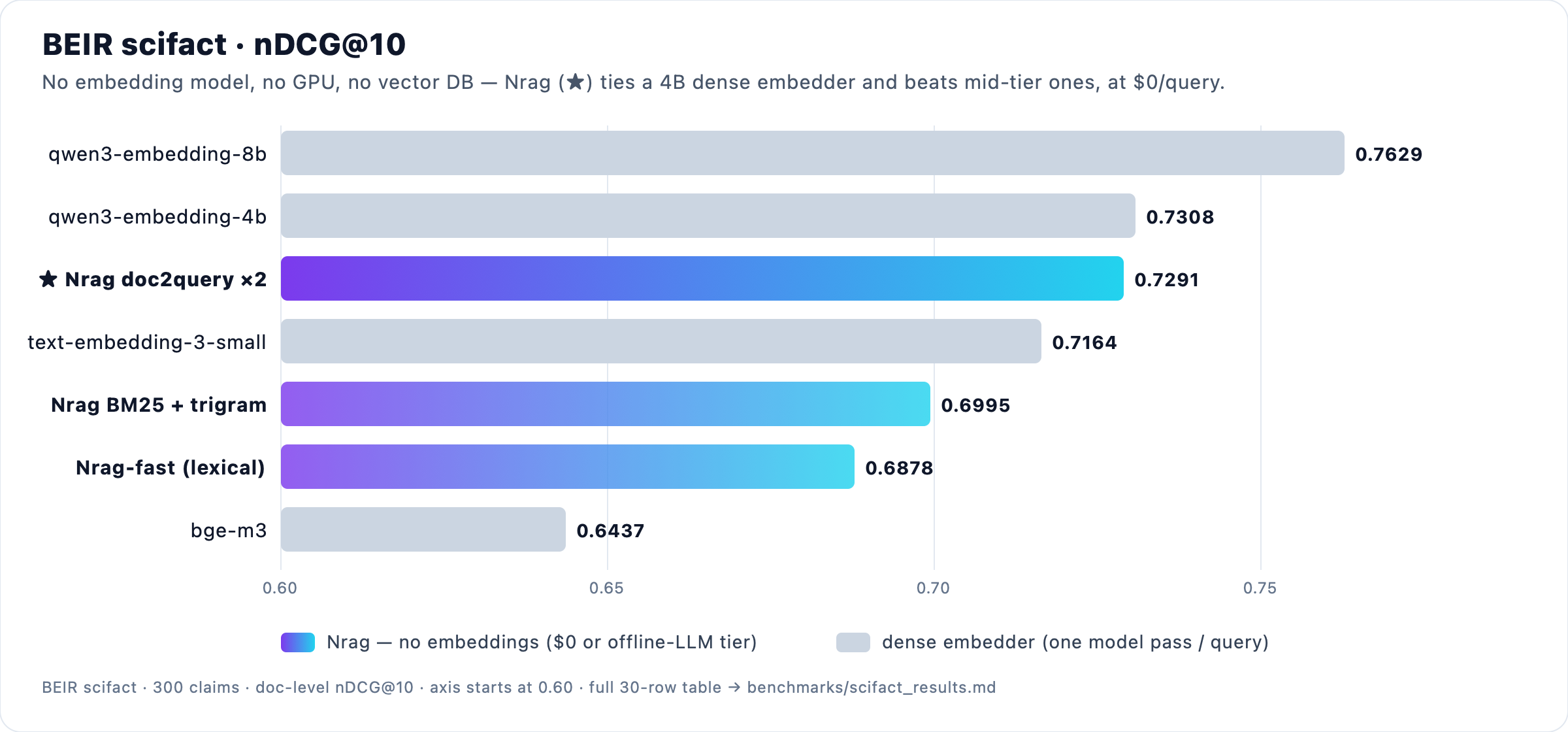
Nrag doc2query×2 scores 0.7291 nDCG@10 and 0.7042 MRR, with no embeddings, no GPU, and no vector database. It ties qwen3-embedding-4b and wins on MRR. It clears text-embedding-3-small and bge-m3 outright. Every score here costs $0 per query. Only the 8B embedder finishes ahead. All 30 rows and the ablations live in benchmarks/scifact_results.md.
Where embeddings break
Reasoning-heavy retrieval does not reward similarity. The top model on MTEB scores 59. On BRIGHT, it scores 18.3. This is the ground Compiled Retrieval is built for.
| nDCG@10 (avg) | BM25 zero-shot | off-the-shelf dense | BM25 + GPT-4 CoT | LATTICE (emb-free SOTA) |
|---|---|---|---|---|
| 14.3 | 18.3 ⬇ | 27.0 | 46.7 |
The target is plain. Beat off-the-shelf dense at $0 per query, and close on reasoning systems while holding one millisecond.
Quickstart
pip install nrag
from nrag import Nrag

rag = Nrag(preset="fast")                      # pure lexical, no LLM, no setup, no models
rag.add_texts(["Dijkstra finds shortest paths.", "Tomato soup needs basil."])
print(rag.search("shortest path", k=1)[0].text)
# -> Dijkstra finds shortest paths.
Nothing to download. No Java, no GPU, no database. An LLM is optional. Plug one in when you want compiled enrichment and grounded answers. Everything works without one.
How to use
1 · Pure lexical (no LLM)
from nrag import Nrag, Document

rag = Nrag(preset="fast", path="./idx")             # on-disk; omit path for in-memory
rag.add("docs/")                                    # a dir, file, glob, texts, or Documents
rag.add("report.pdf")                               # needs nrag[pdf]
rag.add_texts(["first passage", "second passage"])
rag.add([Document(doc_id="d1", text="...", source="d1.md", metadata={"team": "billing"})])

for h in rag.search("how do refunds work?", k=5):
    print(f"{h.score:.3f}  {h.source}\n   {h.text[:100]}")

for h in rag.search_docs("how do refunds work?", k=3):   # one hit per *document*
    print(f"{h.score:.3f}  {h.chunk.doc_id}")
rag.close()
The lexical core is benchmark-tuned: v0.1.4 defaults clear the published Anserini BM25
anchor on BEIR scifact, nfcorpus, and fiqa at $0 query cost — grids and reproduction
commands in benchmarks/lexical_tuning_v014.md.
2 · Plug in any LLM
One method: complete. Bring the built-in OpenAI-compatible adapter, wrap a function, or bring nothing.
from nrag.llm import OpenAICompatLLM, CallableLLM

# Any OpenAI-compatible endpoint: OpenAI, Ollama, vLLM, llama.cpp, LM Studio, Together, Groq...
llm = OpenAICompatLLM(base_url="http://localhost:11434/v1/", model="llama3.2", api_key="ollama")

# ...or wrap any callable (called with just the prompt string by default)
llm = CallableLLM(lambda prompt: my_model(prompt))

# ...or no LLM at all; pure lexical retrieval still works
3 · Presets
| Preset | LLM | What runs | For |
|---|---|---|---|
fast |
no | pure lexical (BM25 + trigrams + title) | sub-10 ms retrieval, no LLM |
quality (default) |
✔ | + contextual indexing (offline) + query expansion + grounded answers | best general RAG |
compiled |
✔ | + the index-time compiler (CSC) + the adaptive router | reasoning corpora, $0 queries |
Override any field: Nrag(preset="compiled", consensus_k=5, engine="sqlite").
4 · Compiled Retrieval
Retrieval intelligence is a compile-time problem, not a serve-time problem.
One offline pass per chunk, cached forever. It writes plain text into the search index, never into the text you cite:
| Pillar | What the compiler adds | Prior art |
|---|---|---|
| blurb | a chunk-specific context sentence | Anthropic Contextual Retrieval, 2024 |
| questions | the queries this chunk answers | doc2query / docTTTTTquery |
| propositions | atomic, decontextualized facts | Dense X, EMNLP 2024 |
| reasoning | multi-hop bridges not lexically present | the BRIGHT-winning signal, precomputed |
Consensus Sparse Compilation (CSC). Sample the compiler k times. A term's weight is how often it agrees with itself. Terms that recur are real, so they get promoted. Terms that appear once are hallucinations, so they get dropped. No training, no labels. Literal terms like IDs and error codes keep a floor weight, so exact match never breaks.
llm = OpenAICompatLLM(base_url="...", model="...", api_key="...")

rag = Nrag(llm=llm, preset="compiled", path="./idx")
rag.compile("docs/")                                # offline, cached by content-hash
print(rag.query("does this scale to a billion rows?").answer)

rag = Nrag.open("./idx")                             # reopen with NO llm, it still serves
The router. The only LLM call at query time, and it rarely fires. The first pass is one millisecond and free. Only when confidence runs low does Nrag spend a call to expand and re-search. Short, precise queries are left untouched, which sidesteps the expansion trap that hurts strong retrievers.
rag.search("how can I get my money back?", k=5)
print(rag.last_route)   # RouterDecision(escalate=..., reason='no_hits'|'low_margin'|'confident', ...)
5 · Persistent, incremental, portable
rag = Nrag.open("./idx", llm=llm)
rag.sync("docs/")                     # re-index only changed files; drop deleted ones
rag.remove("d1")                      # delete one document
Compile once, serve anywhere. The index is a plain lexical artifact. Bundle it, ship it to an air-gapped machine, serve it with no model and no network:
nrag export --index ./idx --out ship.nrag.tgz      # portable bundle (drops the LLM cache)
nrag import ship.nrag.tgz --index ./served         # unpack on the target machine
nrag query  "how do refunds work?" --index ./served   # $0, ~1 ms, no model, no network
Or host the compiler. Clients send documents and get back a ready-to-serve bundle. The embedding model never exists, so it never leaves your walls. (nrag serve is a development tool — no auth or TLS yet; keep it on localhost or a trusted network.)
nrag serve --base-url http://localhost:11434/v1/ --model llama3.2 # POST /compile, GET /bundle/<job>
6 · Answers, citations, streaming
res = rag.query("How do refunds work?", k=8)
print(res.answer)                        # grounded answer (None if no LLM)
for c in res.citations:
    print(c.marker, c.source, f"{c.score:.3f}")
for tok in rag.query_stream("How do refunds work?"):
    print(tok, end="")
7 · Drop into LangChain / LlamaIndex
from nrag.integrations import to_langchain_retriever, to_llamaindex_retriever
lc = to_langchain_retriever(rag, k=5)      # a LangChain BaseRetriever
li = to_llamaindex_retriever(rag, k=5)     # a LlamaIndex BaseRetriever
8 · Command line
nrag compile ./docs --index ./idx --base-url http://localhost:11434/v1/ --model llama3.2
nrag query  "how do refunds work?" --index ./idx
nrag stats  --index ./idx
nrag tco    --queries-per-month 5000000 --months 36    # cost model (below)
Evaluation
Nrag measures itself honestly. Every benchmark is labelled by cost per query, so a free lexical system is never quietly scored against one that runs a model on every search.
The metrics module (pure-Python, no deps)
nrag.eval.ir_metrics implements the standard IR metrics with zero dependencies: ndcg@k, recall@k, precision@k, hit@k, mrr, map.
from nrag.eval import evaluate_run

qrels = {"q1": {"docA": 1, "docC": 1}}                    # ground-truth relevance
run   = {"q1": {"docA": 9.1, "docB": 4.2, "docC": 2.0}}  # your system's doc -> score
print(evaluate_run(qrels, run, metrics=("ndcg@10", "recall@10", "mrr")))
# {'ndcg@10': 0.92, 'recall@10': 1.0, 'mrr': 1.0}
Score Nrag on your own labelled queries:
rag = Nrag(preset="fast"); rag.add("corpus/")
run = {}
for qid, text in my_queries.items():
    scores = {}
    for h in rag.search(text, k=100):
        did = h.chunk_id.split("::", 1)[0]                 # chunk -> parent doc
        scores[did] = max(scores.get(did, -1e9), h.score)  # max-pool chunks
    run[qid] = scores
print(evaluate_run(my_qrels, run, ("ndcg@10", "recall@100", "mrr")))
BEIR & BRIGHT runners
Install the extra (pip install "nrag[eval]"), then build a fresh index and score it:
from nrag.eval import run_beir, run_bright, run_bright_all

# BEIR: breadth / parity, scored against the published BM25 anchor
print(run_beir(lambda: Nrag(preset="fast"), dataset="scifact", split="test"))

# BRIGHT: the reasoning-intensive hero benchmark (needs an LLM for the compiled preset)
print(run_bright(lambda: Nrag(llm=llm, preset="compiled"), subset="biology"))
results = run_bright_all(lambda: Nrag(llm=llm, preset="compiled"))   # all 12 subsets
Two things the benchmarks proved.
- Expanding the query hurts. LLM query2doc costs 0.015 nDCG. Classic RM3 costs up to 0.19. So Nrag enriches the document, never the query, and the router only expands when a search comes back weak.
- Enriching the document wins. Let the LLM write, at index time, the questions each passage answers. Queries stay pure BM25. It is the best embedding-free result on the board, and it is free at query time.
Live compiled-retrieval benchmark
python benchmarks/csc_eval.py baseline                      # pure-lexical, free
OPENROUTER_API_KEY=... python benchmarks/csc_eval.py smoke   # compile a few docs; print bundle + weights
OPENROUTER_API_KEY=... python benchmarks/csc_eval.py compiled --index ./idx_csc --k 3
Reproducing
pip install "nrag[eval]"
export NRAG_LLM_BASE_URL=... NRAG_LLM_MODEL=... NRAG_LLM_API_KEY=...   # any OpenAI-compatible endpoint
python -m pytest -m "not eval and not live_llm"   # deterministic suite (a few tests skip without nrag[bm25s])
Cost
Quality is half the story. The other half is the bill. Nrag pays for intelligence once, at compile time. An embedding stack pays on every query, forever, plus the RAM to keep its vectors resident.
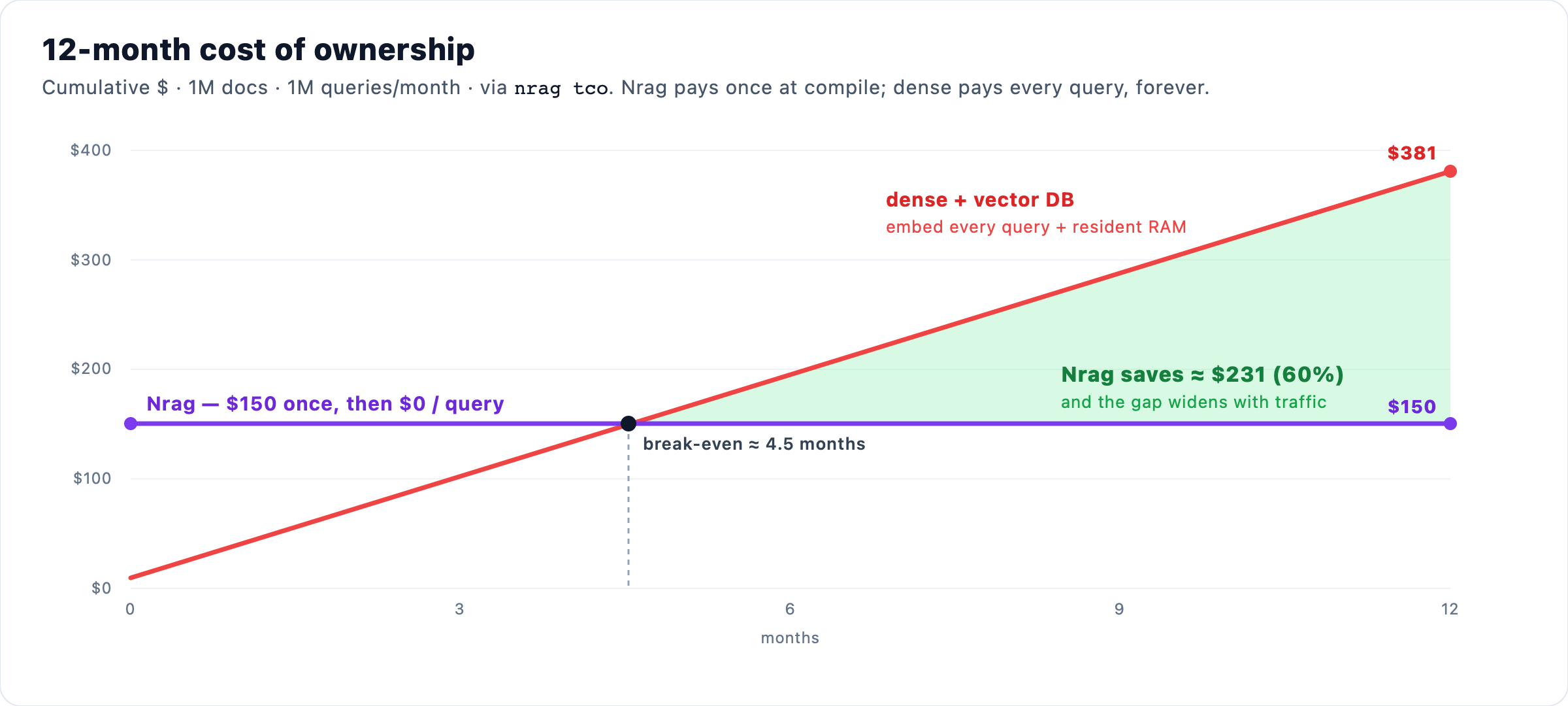
nrag tco --docs 1000000 --queries-per-month 5000000 --months 36
from nrag.tco import TCOInputs, compute_tco, format_report
print(format_report(TCOInputs(), compute_tco(TCOInputs())))
Every rate is yours to change. Put in your own numbers and read your own break-even.
How it works
flowchart LR
  D[docs] -->|offline compile · cached| C{{Compiler · CSC}}
  C --> A[Leg A<br/>BM25 + trigrams<br/>over enriched text]
  C --> B[Leg B<br/>consensus sparse<br/>term weights]
  Q([query]) --> R{Adaptive router}
  R -->|confident · ~1 ms · $0| F[RRF / convex fusion]
  R -.->|weak · 1 LLM call| E[expand + re-search]
  E --> F
  A --> F
  B --> F
  F --> H[ranked hits<br/>+ citations]
- Structure-aware chunking with span-exact offsets. The enriched
indexed_textyou search stays separate from theraw_textyou cite. - Two sparse legs, fused by RRF or a convex combination. Hybrid's complementarity, with no dense leg.
- An offline compiler with a content-hash cache, so re-indexing is free, and a cost guard.
- An adaptive router that spends an LLM call only when the cheap path is unsure.
Engines
Swap the search backend. Nothing else changes.
| Engine | Install | Notes |
|---|---|---|
tantivy (default) |
core | fast, persistent, multi-field scoring |
sqlite |
core | FTS5, zero extra deps, portable single file |
bm25s |
nrag[bm25s] |
in-memory, pure-NumPy, fast batch |
rag = Nrag(preset="fast", engine="sqlite", path="./idx")
Install extras
pip install nrag                # core: tantivy + stemmer + http client. No models, ever.
pip install "nrag[openai]"      # openai SDK + tiktoken (exact token counts)
pip install "nrag[bm25s]"       # in-memory bm25s engine
pip install "nrag[pdf]"         # PDF text loader (HTML/Markdown handled built-in)
pip install "nrag[eval]"        # ranx / pytrec_eval / BEIR / RAGAS / datasets
Design guarantees
- Works with no LLM. Pure lexical retrieval always runs. LLM features switch off by construction when no model is supplied.
- All model cost is offline. Enrichment happens once at index time and is cached. The only query-time call is the gated router.
- Portable and explainable. Scores are deterministic. The serving index is a plain directory you can archive and ship.
License
MIT.
1 maintainer

Metadata
1 maintainer
Release files for nrag 0.1.4
For a detailed explanation of source distributions (sdists) and built distributions (wheels), please see the package formats documentation.
Source distribution (sdist)
| File | Size | Uploaded | Provenance | Actions |
|---|---|---|---|---|
| nrag-0.1.4.tar.gz | 68.0 kB | With provenance | Details for nrag-0.1.4.tar.gz |
Built distribution (wheel)
| File | Interpreter | ABI | Platform | Actions Reset |
|---|---|---|---|---|
| nrag-0.1.4-py3-none-any.whl | Python 3 | none | any | Details for nrag-0.1.4-py3-none-any.whl |
Total release size: 158.1 kB
Release files / nrag-0.1.4.tar.gz
| Download URL | nrag-0.1.4.tar.gz |
|---|---|
| Size | 68.0 kB |
| Tags | Source |
|
SHA-256 checksum How to use checksums |
1dd09fdb2e20ef8db01e3c5fe5e7ca76b53b2a40cf6bf537eb7e1ba50fc1fef6
|
|
BLAKE2b-256 checksum How to use checksums |
77c9b0ff8e37bec7d63f577a221f71be37610a516510f177bb630a75fa8a1eac
|
| Upload date | |
|
Uploaded using Trusted Publishing? What is trusted publishing? |
Yes |
| Uploaded via |
twine/7.0.0 CPython/3.13.14
|
Provenance
Provenance describes where a file came from. On PyPI, provenance is shared via attestations, which provide a verifiable record of the build or publishing details. View details, limitations and caveats.


PyPI Publish Attestation
PyPI verified that this artifact, at this checksum, originated from the publisher listed below.
Signed by GitHub Actions, verified by PyPI on Aug 8, 2026.
Transparency logRelease files / nrag-0.1.4-py3-none-any.whl
| Download URL | nrag-0.1.4-py3-none-any.whl |
|---|---|
| Size | 90.1 kB |
| Tags | Python 3 |
|
SHA-256 checksum How to use checksums |
d90fde9f0135de101b8f7cd7ba4fccf3e7317099d3c457fed60a2a3db570d6ff
|
|
BLAKE2b-256 checksum How to use checksums |
9e2efa5ae2643ac45e7894c89ff594c6e12db4cc39c160494ed98e9c385d30b7
|
| Upload date | |
|
Uploaded using Trusted Publishing? What is trusted publishing? |
Yes |
| Uploaded via |
twine/7.0.0 CPython/3.13.14
|
Provenance
Provenance describes where a file came from. On PyPI, provenance is shared via attestations, which provide a verifiable record of the build or publishing details. View details, limitations and caveats.
PyPI Publish Attestation
PyPI verified that this artifact, at this checksum, originated from the publisher listed below.
Signed by GitHub Actions, verified by PyPI on Aug 8, 2026.
Transparency logSecurity for nrag 0.1.4
Provenance
Provenance describes where a file came from. On PyPI, provenance is shared via attestations, which provide a verifiable record of the build or publishing details. View details, limitations and caveats.
Full provenance
All 2 files in this release have been uploaded with provenance metadata.
Attestation for nrag-0.1.4.tar.gz
PyPI Publish Attestation
PyPI verified that this artifact, at this checksum, originated from the publisher listed below.
Signed by GitHub Actions, verified by PyPI on Aug 8, 2026.
Transparency logA note on package security
PyPI is a repository for distributing packages, not a service for auditing them. While third-party security researchers and our staff do their best to detect and remove malicious packages, PyPI cannot guarantee the quality, security or suitability of any given package.
To learn more about protecting yourself from malicious actors, visit our package security documentation.














