

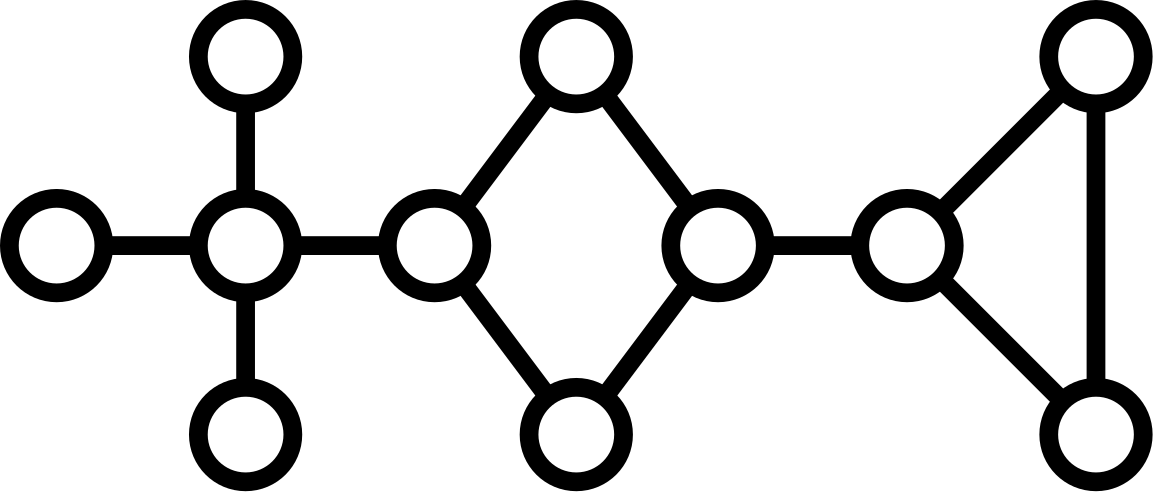
NSPPK
Neighbourhood Subgraph Pairwise Pathway Kernel (NSPPK) turns labeled NetworkX graphs into fixed-width feature vectors for graph-level prediction, node-level analysis, and scikit-learn workflows.
Read the documentation · Getting started · API reference
Install
NSPPK requires Python 3.10 or newer. Install the latest release from PyPI:
python -m pip install nsppk
Your first graph features
Pass NSPPK a list of simple, undirected networkx.Graph objects. Each graph becomes one sample. Node and edge labels can be any hashable values; a missing label is treated as 0.
import networkx as nx
from nsppk import NSPPK


def make_graph(node_labels):
    graph = nx.Graph()
    graph.add_nodes_from(
        (node_id, {"label": label})
        for node_id, label in enumerate(node_labels)
    )
    graph.add_edges_from(
        (u, v, {"label": "bond"})
        for u, v in [(0, 1), (1, 2)]
    )
    return graph


graphs = [
    make_graph(["C", "O", "C"]),
    make_graph(["C", "N", "C"]),
    make_graph(["O", "C", "O"]),
]

encoder = NSPPK(nbits=8, dense=False, parallel=False)
X = encoder.fit_transform(graphs)
print(X.shape)  # (3, 256): one row per graph
With nbits=8 and no continuous node attributes, this example produces 256 structural features per graph. dense=False returns a SciPy sparse matrix; the default dense=True returns a NumPy array. For the default discrete-label setup, you can also call encoder.transform(graphs) directly.
Choose what you need
- Graph features:
NSPPKreturns one feature row per graph, as shown above. - Node features:
NodeNSPPKreturns one node-by-feature matrix per graph. Rows follow each graph’sgraph.nodes()iteration order. - Edge features:
EdgeNSPPKreturns one edge-by-feature matrix per graph. Rows follow each graph’sgraph.edges()iteration order; each edge’s structural row sums the feature rows of its two endpoints. - Prediction:
NSPPKClassifierandNSPPKRegressorwrap graph vectorization with a scikit-learn estimator.
See the getting-started guide for runnable examples of node features and prediction, and the API reference for parameters and output details.
Read graphs from files
The core install supports NetworkX graphs. Optional input formats require extra dependencies:
- SMILES and SDF:
python -m pip install rdkit - PyTorch Geometric files: install PyTorch for your platform, then
python -m pip install torch_geometric. See the PyTorch installation guide and PyG installation guide for compatible platform and accelerator commands.
See graph loading and streaming for supported formats and examples. These optional packages are not installed with NSPPK.
Documentation and examples
- Getting started
- API and output reference
- Graph loading and streaming
- Node attributes
- Hashing procedure
- Node and feature importance
- Development and releases
- Changelog
Runnable notebooks are in notebooks/: Demo.ipynb covers graph features, Importance Demo.ipynb covers explanations, and Streaming Benchmark.ipynb covers loading and streaming. Other notebooks benchmark molecular graphs and supervised learning; some require optional packages. See IO.md for reader requirements.
Develop from a checkout
From the repository root, install NSPPK in editable mode:
python -m pip install -e ".[docs]"
Citation
The repository’s Zenodo DOI is 10.5281/zenodo.14261713.
1 maintainer

Metadata
1 maintainer
Release files for nsppk 2.0.0
For a detailed explanation of source distributions (sdists) and built distributions (wheels), please see the package formats documentation.
Source distribution (sdist)
| File | Size | Uploaded | Provenance | Actions |
|---|---|---|---|---|
| nsppk-2.0.0.tar.gz | 39.0 kB | With provenance | Details for nsppk-2.0.0.tar.gz |
Built distribution (wheel)
| File | Interpreter | ABI | Platform | Actions Reset |
|---|---|---|---|---|
| nsppk-2.0.0-py3-none-any.whl | Python 3 | none | any | Details for nsppk-2.0.0-py3-none-any.whl |
Total release size: 70.7 kB
Release files / nsppk-2.0.0.tar.gz
| Download URL | nsppk-2.0.0.tar.gz |
|---|---|
| Size | 39.0 kB |
| Tags | Source |
|
SHA-256 checksum How to use checksums |
634474cb0c55cd6802043df96d68ffe7f37c6ebc3b1052d9021ac1476a8b3d9d
|
|
BLAKE2b-256 checksum How to use checksums |
41243131d4e841fad26e5f90df21ea48658cd9852f85723abfeeacc563acbd7f
|
| Upload date | |
|
Uploaded using Trusted Publishing? What is trusted publishing? |
Yes |
| Uploaded via |
twine/7.0.0 CPython/3.13.16
|
Provenance
Provenance describes where a file came from. On PyPI, provenance is shared via attestations, which provide a verifiable record of the build or publishing details. View details, limitations and caveats.


PyPI Publish Attestation
PyPI verified that this artifact, at this checksum, originated from the publisher listed below.
Signed by GitHub Actions, verified by PyPI on Nov 22, 2026.
Transparency logRelease files / nsppk-2.0.0-py3-none-any.whl
| Download URL | nsppk-2.0.0-py3-none-any.whl |
|---|---|
| Size | 31.7 kB |
| Tags | Python 3 |
|
SHA-256 checksum How to use checksums |
4b4b2468731a27ab1af17077bcac9a270b7dc15f30fd6c4c08ac464092b8051b
|
|
BLAKE2b-256 checksum How to use checksums |
2cb0dd6ff065819ad6f32b5ce4bc007abed2e1d30daa6f8a078d57b31271efd7
|
| Upload date | |
|
Uploaded using Trusted Publishing? What is trusted publishing? |
Yes |
| Uploaded via |
twine/7.0.0 CPython/3.13.16
|
Provenance
Provenance describes where a file came from. On PyPI, provenance is shared via attestations, which provide a verifiable record of the build or publishing details. View details, limitations and caveats.
PyPI Publish Attestation
PyPI verified that this artifact, at this checksum, originated from the publisher listed below.
Signed by GitHub Actions, verified by PyPI on Nov 22, 2026.
Transparency logSecurity for nsppk 2.0.0
Provenance
Provenance describes where a file came from. On PyPI, provenance is shared via attestations, which provide a verifiable record of the build or publishing details. View details, limitations and caveats.
Full provenance
Both files in this release have been uploaded with provenance metadata.
Attestation for nsppk-2.0.0.tar.gz
PyPI Publish Attestation
PyPI verified that this artifact, at this checksum, originated from the publisher listed below.
Signed by GitHub Actions, verified by PyPI on Nov 22, 2026.
Transparency logA note on package security
PyPI is a repository for distributing packages, not a service for auditing them. While third-party security researchers and our staff do their best to detect and remove malicious packages, PyPI cannot guarantee the quality, security or suitability of any given package.
To learn more about protecting yourself from malicious actors, visit our package security documentation.














