
nuke-di





English · Русский · 简体中文 · Español · Português (Brasil) · 日本語 · Polski
The simplest dependency injection for async Python projects.
Dependencies are declared with plain type hints. nuke-di builds the dependency tree,
creates every client once and drives its async lifecycle: connect() on startup and
disconnect() on shutdown. Every client starts as soon as its own dependencies have
connected, concurrently with every other client that is ready.
On top of that, one decorator turns an async function into a process with command-line arguments, and FastAPI, Litestar and FastStream handlers take clients by type hint the same way.
It was extracted from the DI layer of a production Python microservice framework and has no runtime dependencies.
- Installation · Quick start · Principles · Performance
- Examples: a job with command-line arguments · FastAPI
- Documentation
Installation
pip install nuke-di
Requires Python 3.11+.
Quick start
import asyncio

from nuke_di import DI, Client


class Database(Client):
    async def connect(self) -> None:
        print("database: connected")

    async def disconnect(self) -> None:
        print("database: disconnected")

    async def fetch_user(self, user_id: int) -> str:
        return f"user-{user_id}"


class UserService(Client):
    def __init__(self, db: Database) -> None:
        self._db = db

    async def greet(self, user_id: int) -> str:
        return f"Hello, {await self._db.fetch_user(user_id)}!"


async def handler(user_id: int, users: UserService) -> str:
    return await users.greet(user_id)


async def main() -> None:
    injected = DI.inject(handler)  # resolves UserService -> Database

    async with DI:  # connect() every client, disconnect() on exit
        print(await injected(42))


asyncio.run(main())
database: connected
Hello, user-42!
database: disconnected
What happened:
DI.inject(handler)read the type hints ofhandler, found the clientUserService, saw that it needs aDatabasein its__init__and built both.user_id: intis not a client, so it stays a regular argument.async with DIcalledconnect()on every client it built, dependencies first.injected(42)calledhandler(42, users=<UserService>).- Leaving the
async withblock calleddisconnect()in reverse order.
Principles
- A dependency is a class. A subclass of
Clientwith a type-hinted__init__and asyncconnect()/disconnect()is the whole model: no providers, no modules, no registration, no scopes to configure. A third-party object becomes a dependency by wrapping it in such a class. - Type hints are the wiring. A client asks for its dependencies in
__init__, a function in its signature. Nothing else names them, so renaming or adding a dependency is an ordinary refactoring. - Concurrent startup, ordered shutdown. A client connects as soon as its own dependencies have,
concurrently with every other client that is ready, so a slow client holds back only the clients that
need it. They disconnect in reverse, and a failing
disconnect()does not stop the others. - Fail fast. A tree that cannot be built fails before anything connects, naming the argument and
the path to it, and
mypywith the plugin reports the same error before the process starts. A client that cannot connect stops the application once the connected ones are disconnected. There are no retries: restarting is the orchestrator's job. - Tests replace, they do not rewire.
mock()andoverride()put a fake in place of a client for one test; the code under test does not change. - No runtime dependencies. The core uses only the standard library; the framework integrations are extras.
How a startup goes, on the example of the
Clients guide: Consumer needs
only Kafka, so it does not wait for the slow Postgres, and the startup takes as long as its longest chain of
dependencies.

Performance
benchmarks/compare.py runs the same trees of clients through dishka, wireup, dependency-injector and
injector, each registering the same classes its own way: a cold container with the root resolved, on
classes new to the process, the root again, and one FastAPI request through each library's integration:
$ uv run python benchmarks/compare.py --size 100 --summary
nuke-di 1.11.1 · CPython 3.11.7 · macOS-26.6.2-arm64-arm-64bit · commit 6c2ae10 · N = 100 · 20 repeats
nuke-di 1.11.1 · dishka 1.10.1 · wireup 2.12.1 · dependency-injector 4.49.1 · injector 0.24.0

| Lower is better                                          | nuke-di        | dishka          | wireup          | dependency-injector | injector        |
|----------------------------------------------------------|---------------:|----------------:|----------------:|--------------------:|----------------:|
| Cold start: a container and a tree of 100 clients        | **541 µs**     | 12.9 ms (23.8×) | 20.0 ms (37.0×) | 1.05 ms (1.9×)      | 1.34 ms (2.5×)  |
| Cold start: the same 100 clients with string annotations | 1.27 ms (1.2×) | 13.7 ms (12.6×) | 21.4 ms (19.6×) | **1.09 ms**         | 1.47 ms (1.3×)  |
| A cached root                                            | 94.1 ns (2.5×) | 261 ns (7.1×)   | 92.6 ns (2.5×)  | **37.0 ns**         | 1.18 µs (31.9×) |
| A FastAPI request with a client                          | **103 µs**     | 107 µs (1.0×)   | 206 µs (2.0×)   | 221 µs (2.2×)       | —               |
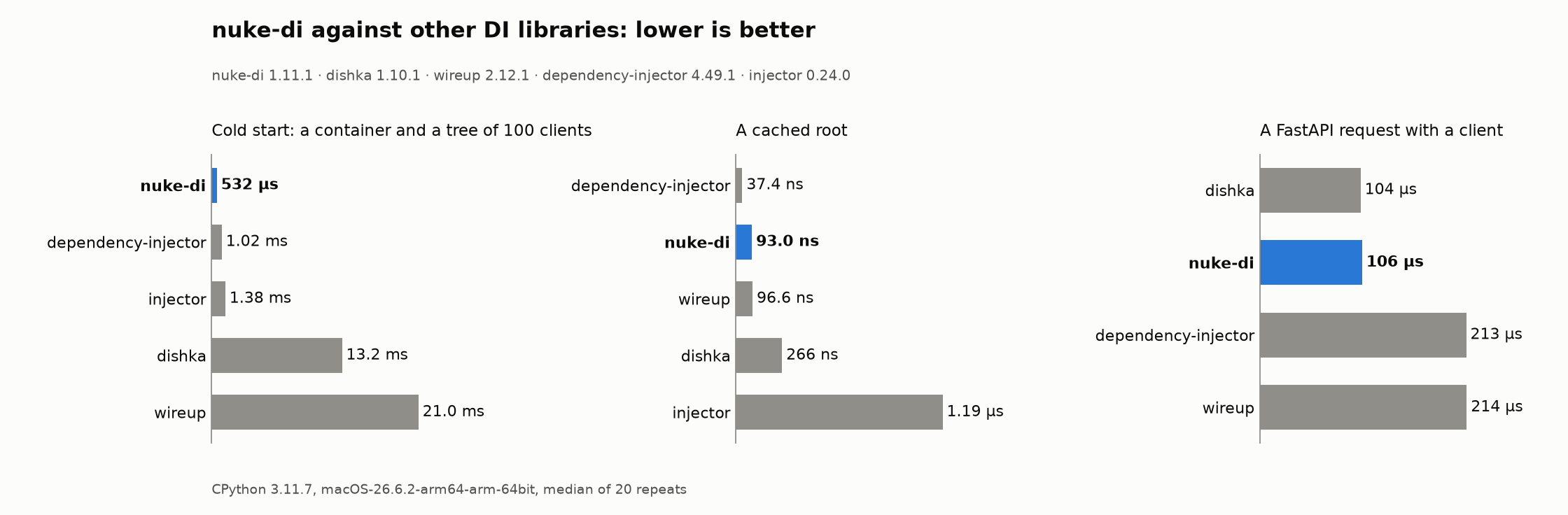
So, is nuke-di the fastest? At building a tree with real type hints and at a FastAPI request, yes:
dependency-injector and injector take 2–2.5 times as long for the tree, dishka and wireup 24–37 times as
long, for validating the graph when the container is created, and wireup and dependency-injector twice as
long per request. With string annotations dependency-injector, which reads no annotation, is ahead by a fifth.
On a cached root nuke-di is level with wireup, and the Cython get() of dependency-injector wins by about
50 ns, a difference no application notices.
On its own, resolve() costs 3.5–6.3 µs per client, so a tree of 1000 clients is built in under 5.5 ms,
and connect() adds 13–18 µs per client. docs/benchmarks.md explains every
scenario, records the baseline on Python 3.11–3.14 and has the whole comparison with its method.
A job with command-line arguments
One decorator turns an async function into the main program of a process. Clients are injected, and every other annotated argument becomes a command-line option, typed and validated:
# sync.py
import datetime
import enum
from typing import Annotated

from nuke_di import Client, Option, job


class Postgres(Client):
    async def connect(self) -> None:
        print("postgres: connected")

    async def disconnect(self) -> None:
        print("postgres: disconnected")

    async def upsert(self, table: str, rows: list[str]) -> None:
        print(f"postgres: upserted {len(rows)} rows into {table}")


class Warehouse(Client):
    async def changes(self, table: str, day: datetime.date) -> list[str]:
        return [f"{table}:{day}:{n}" for n in range(3)]


class Mode(enum.Enum):
    INCREMENTAL = "incremental"
    FULL = "full"


@job
async def sync(
    pg: Postgres,
    warehouse: Warehouse,
    day: Annotated[datetime.date, Option(help="Day to copy, YYYY-MM-DD", short="d")],
    tables: Annotated[
        list[str] | None, Option(help="Table to copy, repeat for several; all by default", short="t")
    ] = None,
    mode: Mode = Mode.INCREMENTAL,
    dry_run: Annotated[bool, Option(help="Read the changes, write nothing")] = False,
) -> None:
    """Copy one day of changes from the warehouse into Postgres."""
    print(f"sync: {mode.name} copy of {day}")
    for table in tables or ["users", "orders"]:
        rows = await warehouse.changes(table, day)
        if dry_run:
            print(f"sync: would upsert {len(rows)} rows into {table}")
        else:
            await pg.upsert(table, rows)
No main(), no asyncio.run(), no argparse: the decorator resolves and connects the clients, parses
the command line, runs the function and exits with a meaningful code:
$ python sync.py --day 2026-10-01
postgres: connected
sync: INCREMENTAL copy of 2026-10-01
postgres: upserted 3 rows into users
postgres: upserted 3 rows into orders
postgres: disconnected

$ python sync.py -d 2026-10-01 -t users --mode FULL --dry-run
postgres: connected
sync: FULL copy of 2026-10-01
sync: would upsert 3 rows into users
postgres: disconnected
--help is generated from the signature and the docstring (Python 3.13+ prints -d, --day DAY instead of
-d DAY, --day DAY):
$ python sync.py --help
usage: sync.py [-h] -d DAY [-t TABLES] [--mode {INCREMENTAL,FULL}]
               [--dry-run | --no-dry-run]

Copy one day of changes from the warehouse into Postgres.

options:
  -h, --help            show this help message and exit
  -d DAY, --day DAY     Day to copy, YYYY-MM-DD
  -t TABLES, --tables TABLES
                        Table to copy, repeat for several; all by default
  --mode {INCREMENTAL,FULL}
                        (default: INCREMENTAL)
  --dry-run, --no-dry-run
                        Read the changes, write nothing (default: False)
A wrong command line is rejected before any client is connected, with exit code 2:
$ python sync.py -d 2026-10-01 --mode full
usage: sync.py [-h] -d DAY [-t TABLES] [--mode {INCREMENTAL,FULL}]
               [--dry-run | --no-dry-run]
sync.py: error: argument --mode: invalid choice: 'full' (choose from INCREMENTAL, FULL)
Run sync.sync failed: argument --mode: invalid choice: 'full' (choose from INCREMENTAL, FULL)
$ echo $?
2
@worker does the same for a process that runs until SIGTERM, with a graceful shutdown. Both are
described in Workers and jobs.
FastAPI
A path operation takes a client by its type hint, with no Depends and no inject() per handler.
app/clients.py holds the Database and UserService classes of the Quick start, without its
main():
pip install "nuke-di[fastapi]"
# app/api.py
from typing import Annotated

from fastapi import Depends, FastAPI, Header

from app.clients import Database, UserService
from nuke_di.fastapi import setup

app = FastAPI()
setup(app)  # before the routes: clients connect on startup, disconnect on shutdown


@app.get("/users/{user_id}")
async def get_user(user_id: int, users: UserService) -> str:
    return await users.greet(user_id)


async def current_user(x_user_id: Annotated[int, Header()], db: Database) -> str:
    return await db.fetch_user(x_user_id)


@app.get("/me")
async def me(user: Annotated[str, Depends(current_user)]) -> str:
    return user
$ uvicorn app.api:app
INFO:     Started server process [55625]
INFO:     Waiting for application startup.
database: connected
INFO:     Application startup complete.
INFO:     Uvicorn running on http://127.0.0.1:8000 (Press CTRL+C to quit)
INFO:     127.0.0.1:51602 - "GET /users/42 HTTP/1.1" 200 OK
INFO:     127.0.0.1:51604 - "GET /me HTTP/1.1" 200 OK
^C
INFO:     Shutting down
INFO:     Waiting for application shutdown.
database: disconnected
INFO:     Application shutdown complete.
INFO:     Finished server process [55625]
$ curl localhost:8000/users/42
"Hello, user-42!"
$ curl localhost:8000/me -H "X-User-Id: 7"
"user-7"
The clients connect on startup and disconnect on shutdown, and a dependency such as current_user takes
clients the same way. Importing the app builds nothing, so a test replaces a client before TestClient
starts it:
# tests/test_api.py
from fastapi.testclient import TestClient

from app.api import app
from app.clients import Database
from nuke_di import DI


class FakeDatabase(Database):
    async def fetch_user(self, user_id: int) -> str:
        return "alice"


def test_get_user() -> None:
    with DI.override(Database, FakeDatabase()), TestClient(app) as client:
        assert client.get("/users/1").json() == "Hello, alice!"
        assert client.get("/me", headers={"X-User-Id": "7"}).json() == "alice"
$ pytest -q tests/test_api.py
.                                                                        [100%]
1 passed in 0.23s
Routers, websockets and the app's own lifespan are covered in FastAPI; Litestar and FastStream work the same way.
Documentation
- Clients:
ClientandNotSingletonClient, the lifecycle, dataclass clients, connect order, startup timings, the dependency graph, connect and resolution errors - The container:
Dependenciesand the globalDI,resolve(),inject(),mock(),override() - Workers and jobs:
@joband@worker, command-line parameters,Shutdown, the grace period, background tasks, exit codes, hooks, Kubernetes - Frameworks: FastAPI, Litestar,
FastStream, and
writing an integration for another framework with
nuke_di.integration - Testing:
mock(),override(), the pytest fixtures, checking the wiring - Configuration: timeouts, concurrency and the grace period
- Errors: every exception and when it is raised
- Examples: 21 runnable scenarios, from a one-off script and a queue worker to FastAPI, Litestar, FastStream, Starlette and a whole service, each with its output and tests
- Benchmarks: every scenario, the baseline on Python 3.11–3.14 and the comparison with other libraries
- Development: the checks, coverage and releases
License
1 maintainer

Metadata
1 maintainer
Release files for nuke-di 1.14.0
For a detailed explanation of source distributions (sdists) and built distributions (wheels), please see the package formats documentation.
Source distribution (sdist)
| File | Size | Uploaded | |
|---|---|---|---|
| nuke_di-1.14.0.tar.gz | 394.2 kB | Details |
Built distribution (wheel)
| File | Interpreter | ABI | Platform | Reset |
|---|---|---|---|---|
| nuke_di-1.14.0-py3-none-any.whl | Python 3 | none | any | Details |
Total release size: 449.9 kB
Release files / nuke_di-1.14.0.tar.gz
| Download URL | nuke_di-1.14.0.tar.gz |
|---|---|
| Size | 394.2 kB |
| Tags | Source |
|
SHA-256 checksum How to use checksums |
a8228d3916d99e6b9862d12babe1dd7604171a5104d6a475e4677e4ecf759273
|
|
BLAKE2b-256 checksum How to use checksums |
4debacc3ebb232c735c11715e5df85654b8aafa8620a85fb7a7e8013baf9417e
|
| Upload date | |
|
Uploaded using Trusted Publishing? What is trusted publishing? |
Yes |
| Uploaded via |
twine/7.0.0 CPython/3.13.14
|
Provenance
Provenance describes where a file came from. On PyPI, provenance is shared via attestations, which provide a verifiable record of the build or publishing details. View details, limitations and caveats.


PyPI Publish Attestation
PyPI verified that this artifact, at this checksum, originated from the publisher listed below.
Signed by GitHub Actions, verified by PyPI on Oct 9, 2026.
Transparency logRelease files / nuke_di-1.14.0-py3-none-any.whl
| Download URL | nuke_di-1.14.0-py3-none-any.whl |
|---|---|
| Size | 55.7 kB |
| Tags | Python 3 |
|
SHA-256 checksum How to use checksums |
f6be90920a4c7fce1c08fef8f4d6ed550493bf9922f894a9f1a9b8f010a2405b
|
|
BLAKE2b-256 checksum How to use checksums |
667d1e054512a9c5a00da44847e2ca6aecb143ba887a40e7e8fbb716c33e874c
|
| Upload date | |
|
Uploaded using Trusted Publishing? What is trusted publishing? |
Yes |
| Uploaded via |
twine/7.0.0 CPython/3.13.14
|
Provenance
Provenance describes where a file came from. On PyPI, provenance is shared via attestations, which provide a verifiable record of the build or publishing details. View details, limitations and caveats.
PyPI Publish Attestation
PyPI verified that this artifact, at this checksum, originated from the publisher listed below.
Signed by GitHub Actions, verified by PyPI on Oct 9, 2026.
Transparency log













