
numODEsolver


A lightweight Python package for solving first- and second-order ordinary differential equations (ODEs) numerically, using Euler-type methods or the classical fourth-order Runge–Kutta method (RK4).
Methods
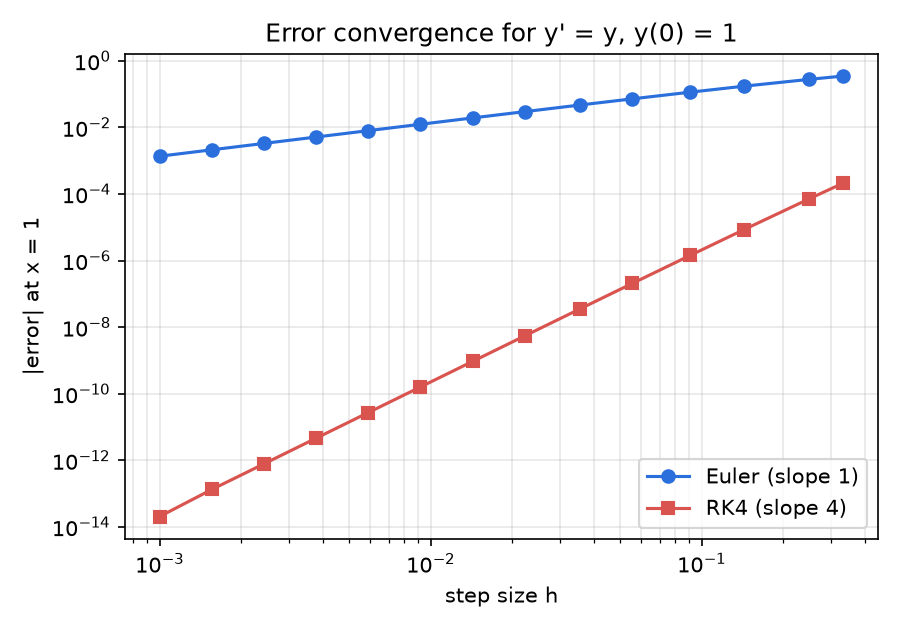
| Solver | ODE | Method | Global error |
|---|---|---|---|
euler_1order |
y' = f(x, y) | Explicit Euler | ∝ h |
rk4_1order |
y' = f(x, y) | Classical RK4 | ∝ h⁴ |
euler_2order |
y'' = f(x, y, y') | Semi-implicit Euler (Euler–Cromer) | ∝ h |
rk4_2order |
y'' = f(x, y, y') | Classical RK4 | ∝ h⁴ |
Halving the step size h reduces the error roughly by a factor of 2 for Euler and by a factor of 16 for RK4.
euler_2order updates y' first and then uses the new y' to update y. This keeps the energy of oscillating systems (e.g. y'' = −y) bounded, while the plain explicit Euler method lets it grow without limit.
The second-order solvers rewrite y'' = f(x, y, y') as a system of two first-order ODEs, y' = v and v' = f(x, y, v), and advance y and v together.
Installation
pip install numODEsolver
Requires Python 3.8 or newer. The dependencies NumPy, SciPy and asteval are installed automatically.
Usage
First-order ODE
Solve y' = y with y(0) = 1 (exact solution: y = eˣ):
import numODEsolver as ns
import matplotlib.pyplot as plt  # optional, only for plotting

solver = ns.Solver()
f = solver.get_function("y")  # right-hand side of y' = y
values = solver.rk4_1order(f, x0=0, y0=1, n=10000, bound=10)

print(solver.get_value(values, val=10, dec=5))  # y(10) ≈ e^10 = 22026.46579

plt.plot(values[:, 0], values[:, 1])
plt.show()
Second-order ODE
Solve y'' = y' + y with y(0) = 1 and y'(0) = 1:
import numODEsolver as ns

solver = ns.Solver()
f = solver.get_function("y'+y")  # right-hand side of y'' = y' + y; use y' for the first derivative
values = solver.rk4_2order(f, x0=0, y0=1, dy0=1, n=10000, bound=5)

print(solver.get_value(values, val=3, dec=2))  # y(3) ≈ 92.86
euler_2order takes the same arguments.
Parameters
| Parameter | Meaning |
|---|---|
x0, y0 |
Initial point and initial value |
dy0 |
Initial value of y' (second-order solvers only) |
n |
Number of steps (step size h = (bound − x0) / n) |
bound |
End of the integration interval, must be greater than x0 |
val, dec |
x-value to evaluate and number of decimal places (get_value) |
Return value
Every solver returns a NumPy array with one row per step:
- first-order solvers: columns
[x, y] - second-order solvers: columns
[x, y, y']
get_value interpolates y between the steps with a cubic spline. val must lie between x0 and bound.
How Functions Are Parsed
get_function turns a string such as "y'+y" into a callable function:
- The string is converted to lower case and every
y'is replaced by a variabledy. - The expression is evaluated with asteval as
lambda x, y, dy=0: <expression>. - If the expression contains
y', the function is marked as second-order.
Allowed are the variables x, y and y', normal Python operators (+ - * / **) and the NumPy math functions and constants without a prefix, e.g. sin, cos, exp, log, sqrt, abs, pi:
solver.get_function("sin(x) - y**2")
solver.get_function("-0.5*y' - 4*y")
asteval does not allow imports or access to Python internals (like __import__), and numODEsolver also removes asteval's open(), so expressions cannot read files. This makes it much safer than Python's eval, but it is not a complete sandbox, so do not pass untrusted input.
An expression that cannot be parsed raises a ValueError. Passing a function with y' to a first-order solver also raises a ValueError.
Known Limitations
- Fixed step size only (no adaptive step-size control)
- Explicit methods: stiff ODEs may require very small step sizes
- Integration only forwards (
boundmust be greater thanx0) - Only single equations, no systems of several ODEs and no third or higher order
get_valueneeds at least 4 points (n >= 3) for the cubic interpolation- Functions are evaluated through asteval, which is slower than plain Python; very large
ncan take a while
Contributing
Bug reports and suggestions are welcome. Please open an issue.
Author
Lukas Filipon, B.Sc. Physics student at KIT
1 maintainer

Metadata
1 maintainer
Release files for numODEsolver 3.1
For a detailed explanation of source distributions (sdists) and built distributions (wheels), please see the package formats documentation.
Source distribution (sdist)
| File | Size | Uploaded | Provenance | Actions |
|---|---|---|---|---|
| numodesolver-3.1.tar.gz | 5.6 kB | Without provenance | Details for numodesolver-3.1.tar.gz |
Built distribution (wheel)
| File | Interpreter | ABI | Platform | Actions Reset |
|---|---|---|---|---|
| numodesolver-3.1-py3-none-any.whl | Python 3 | none | any | Details for numodesolver-3.1-py3-none-any.whl |
Total release size: 11.5 kB
Release files / numodesolver-3.1.tar.gz
| Download URL | numodesolver-3.1.tar.gz |
|---|---|
| Size | 5.6 kB |
| Tags | Source |
|
SHA-256 checksum How to use checksums |
a2e3cc3675678f9ac7c35df0017ceca60ae8a655166670a2583cb5770901f977
|
|
BLAKE2b-256 checksum How to use checksums |
bb31237527d11247c5c6746c7b7177deb047ef4ca007d11a72e891e74bc633d8
|
| Upload date | |
|
Uploaded using Trusted Publishing? What is trusted publishing? |
No |
| Uploaded via |
twine/7.0.0 CPython/3.12.6
|
Release files / numodesolver-3.1-py3-none-any.whl
| Download URL | numodesolver-3.1-py3-none-any.whl |
|---|---|
| Size | 5.9 kB |
| Tags | Python 3 |
|
SHA-256 checksum How to use checksums |
78309d6aa73442894938bc17cebf5b1d5f0714cb1352ac987aa9cde31270c941
|
|
BLAKE2b-256 checksum How to use checksums |
f69f2e1e7d4bd848be9fd7fc1ae10eba484a98701ac10e0b0110b52b3ec49e92
|
| Upload date | |
|
Uploaded using Trusted Publishing? What is trusted publishing? |
No |
| Uploaded via |
twine/7.0.0 CPython/3.12.6
|
Security for numODEsolver 3.1
Provenance
Provenance describes where a file came from. On PyPI, provenance is shared via attestations, which provide a verifiable record of the build or publishing details. View details, limitations and caveats.
No provenance found
None of the files in this release were uploaded with provenance metadata.
A note on package security
PyPI is a repository for distributing packages, not a service for auditing them. While third-party security researchers and our staff do their best to detect and remove malicious packages, PyPI cannot guarantee the quality, security or suitability of any given package.
To learn more about protecting yourself from malicious actors, visit our package security documentation.














