
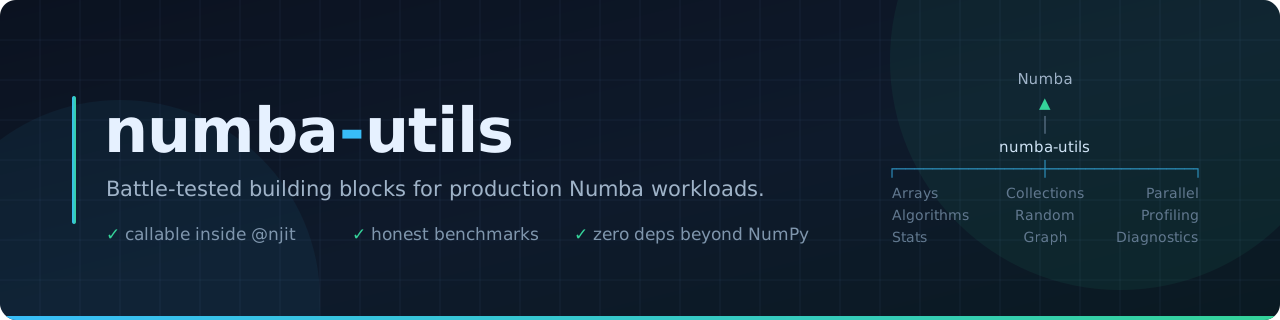
Battle-tested building blocks for production Numba workloads.





✓ Zero dependencies beyond NumPy + Numba · ✓ Callable inside
@njit · ✓ Honest benchmarks · ✓ Diagnostics
                    Numba
                      ▲
                      │
                 numba-utils
      ┌───────────────┼───────────────┐
   Arrays        Collections       Parallel
   Algorithms    Random            Profiling
   Decorators    Graph             Diagnostics
   Stats         Testing
from numba import njit
from numba_utils import topk

@njit
def winners(scores):
    return topk(scores, 10)     # O(n), no full sort — runs in nopython mode
from numba import njit
from numba_utils import PriorityQueue, SparseSet

@njit
def simulate(n_events):
    events = PriorityQueue(n_events)    # constructed in nopython mode
    active = SparseSet(100_000)         # O(1) add/discard/contains/clear
    ...
from numba_utils import compare

compare(numpy_impl, njit_impl, args=(values,))
# 31x on a fused kernel — JIT compilation excluded automatically
And the part that almost no library ships — diagnostics for compiled code:
>>> from numba_utils import diagnostics
>>> diagnostics.check(fn)
⚠ cache=True may crash when loaded across processes (farms, network FS)
  → NUMBA_UTILS_CACHE=0 in the environment, before the first import
⚠ fastmath=True relaxes IEEE 754 — not for exact/reproducible results
Install
pip install numba-utils
Zero build steps: NumPy and Numba are the only dependencies, and Numba brings its own LLVM-based compiler.
Why this exists
After enough numerical projects — long-running Monte Carlo engines, solvers, simulation farms — you realize you've rewritten the same binary search, the same typed collections, the same sampling algorithms and the same benchmarking helpers again. And debugged the same Numba production surprises again.
numba-utils ships more than code. It ships the production knowledge that usually stays trapped inside numerical projects — as kernels with the pitfalls engineered around, as diagnostics, and as documentation. It does not compete with Numba: it builds on top of it.
Why not...
- heapq /
collections? They can't be called from nopython mode. The containers here are jitclasses usable inside@njit. - NumPy? Many helpers are built to run inside compiled kernels, where NumPy calls can't reach. Where NumPy is faster (bandwidth-bound sweeps, its SIMD sort), BENCHMARKS.md says so.
- SciPy? A heavy dependency that isn't njit-callable; this stays at NumPy + Numba and works in the compiled path.
- Numba itself? Numba is a compiler. numba-utils is a standard library on top of it.
Design principles
- Performance First — nothing ships without a benchmarked justification.
- No Hidden Magic — thin, readable layers over Numba; nothing rewrites your code.
- Numba Compatible — everything callable from your own
@njitcode, no hacks. - Minimal APIs —
topk(arr, 10), not twenty keyword parameters. - Benchmark Honesty — losses are published next to the wins.
The identity behind these: docs/philosophy.md.
Modules
Core — decorators, arrays, algorithms, stats (logsumexp,
softmax, weighted_quantile) ·
Performance — parallel (complete operations, not prange wrappers;
bit-exact chunked_reduce), profiling (JIT excluded by default),
diagnostics ·
Data structures — collections (dtype-generic factories), graph
(BFS/DFS, toposort, Dijkstra, UnionFind over CSR), random (including
the stateless counter-based Philox RNG, bit-identical to
np.random.Philox) ·
Developer tools — testing (reference validation + stochastic
asserts), config
Full API: docs/modules.md · Runnable code: examples/
Benchmark honesty
Every algorithm states whether it is faster, similar but more ergonomic, or slower but solving a problem unavailable elsewhere. BENCHMARKS.md contains losing rows on purpose: they tell you when NOT to use a function. Backed in-repo by reproducible benchmarks/, 300+ reference-validated tests (why there's no coverage badge), and CI running all of it. Trade-off records: docs/design/.
Used in
Patterns extracted from real workloads: Monte Carlo equity engines, game-theory solvers (CFR), quantitative research, scientific simulations, optimization loops.
Works with cachau
Result caching composes cleanly on top of numba-utils: the decorator
aliases return real Numba dispatchers, so
cachau fingerprints them — including
the options the aliases inject (fastmath, parallel) and global
configure() / NUMBA_UTILS_* overrides. @cache goes outermost:
from numba_utils.decorators import njit_fast
from cachau import cache

@cache(persist=True, max_memory="2GB")
@njit_fast
def simulate(values, iterations):
    ...
A cachau HIT skips execution entirely; a MISS still benefits from
cache=True's compiled-code cache. Flipping a semantic option
(fastmath, parallel, dev-mode boundscheck) changes the cache
identity, so stale results are never served across semantics. Verified
by cachau's
integration suite.
Status
All three roadmap phases are shipped (see ROADMAP.md); what comes next is user-driven — open an issue.
- Phase 1 (0.1.x) — decorators, profiling, diagnostics, arrays, algorithms, random, collections, parallel, testing; PyPI release
- Phase 2 (0.2.0) — dtype-generic collections,
stable_argsort,lexsort, thegraph/module (BFS/DFS, toposort, Dijkstra, UnionFind over CSR) and thestats/module (logsumexp,softmax,weighted_quantile) - Phase 3 (0.3.0) — Monte Carlo primitives from the first
real-user feedback: counter-based Philox RNG (bit-identical to
np.random.Philox), partial Fisher–Yates sampling,combination_table, bit-exact serial/parallelchunked_reduce, stochastic assertions - 0.3.1–0.3.3 — four rounds of adversarial audit absorbed, each fixed and released the same day it was reported: memory-safety hardening, contract corrections, ~150 attack vectors (CHANGELOG.md)
- Phase 4 (0.4.0) — contributions from a production CFR solver:
disjoint_rank_aggregate(reach-weighted all-pairs comparison with exact set-disjointness by inclusion–exclusion), the certification primitives (mutation_screams,assert_within_se, the reach² guard), and documented parallel patterns (Hogwild, factorized aggregation) - 0.4.1–0.4.2 — the 0.4.0 audit verdict and the low-priority
backlog, retired: certification primitives that could certify
silently-dead checks fixed, the flagship's key-domain envelope
made true (combinadic subset encoding: a 52-card deck fits at
every K ≤ 12),
ContentHashLocatorfor stale-cache-proof deploys, and profiling that no longer measures its own timer (batched sampling, interleaved comparison)
Development
python -m venv .venv
.venv/Scripts/pip install -e .[dev]
.venv/Scripts/python -m pytest
Contributions follow GUIDELINES.md — benchmarks are mandatory, honesty is policy.
1 maintainer

Download files
Download the file for your platform. If you're not sure which to choose, learn more about installing packages.
Source Distribution
Built Distribution
Filter files by name, interpreter, ABI, and platform.
If you're not sure about the file name format, learn more about wheel file names.
Copy a direct link to the current filters
File details
Details for the file numba_utils-0.4.3.tar.gz.
File metadata
- Download URL: numba_utils-0.4.3.tar.gz
- Upload date:
- Size: 106.0 kB
- Tags: Source
- Uploaded using Trusted Publishing? No
- Uploaded via:
twine/6.2.0 CPython/3.13.3
File hashes
| Algorithm | Hash digest | |
|---|---|---|
| SHA256 |
a92aeba59f79c46195f103aa20b83bdda8a58cdfbbc37b41b89e6d1e9550bc8b
|
|
| MD5 |
f503c7378b7f5f751c143b13e6aa421c
|
|
| BLAKE2b-256 |
819ba9f200b462a70c1457c3a8679d745123b6e4e8c63587e283f5b864e3d00a
|
File details
Details for the file numba_utils-0.4.3-py3-none-any.whl.
File metadata
- Download URL: numba_utils-0.4.3-py3-none-any.whl
- Upload date:
- Size: 91.9 kB
- Tags: Python 3
- Uploaded using Trusted Publishing? No
- Uploaded via:
twine/6.2.0 CPython/3.13.3
File hashes
| Algorithm | Hash digest | |
|---|---|---|
| SHA256 |
82fad5ad495fd98c235ddbf5a5f7d4801d37fa9f9bdee879692a655bd3df3943
|
|
| MD5 |
9ec0e67bb15ca49c8fea1b1f390c3b65
|
|
| BLAKE2b-256 |
902220775ae18498bd7265b52ff76aa802a6b5a7c12ef5f03da425eac1b6d495
|














