
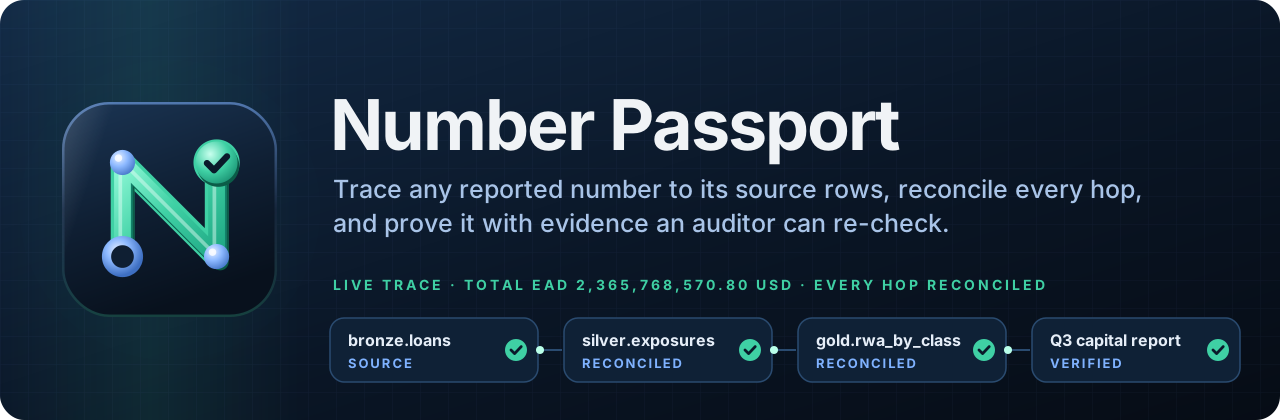





A regulator asks: "Where does the 1,088,769,797.07 of risk-weighted assets on page 4 come from?" Today a team spends days reading SQL, dbt models and Spark jobs and running ad-hoc queries. Number Passport answers in under a minute:
$ passport trace total_rwa
Total risk-weighted assets (USD): GAPS FOUND
  hop  0 gap          report: Total risk-weighted assets (USD)       1088769797.07  unexplained 3100000.00
           ! CRITICAL: the report shows 1,088,769,797.07 but gold.rwa_by_class totals 1,085,669,797.07
             (difference 3,100,000.00): a manual adjustment or a report built from another source
  hop  1 reconciled   gold.rwa_by_class        SUM(rwa_usd)          1085669797.07
           - inner join ref.risk_weights AS rw            0 rows            0.00  models/dbt/gold/rwa_by_class.sql:19
  hop  2 reconciled   silver.exposures         SUM(ead_usd)          2365768570.80
           - dedup ROW_NUMBER() OVER (PARTITION BY ...)   30 rows   -34697141.71  models/sql/silver_exposures.sql:8
           - inner join bronze.fx_rates AS fx            15 rows            0.00  models/sql/silver_exposures.sql:18
           - filter l.status <> 'CLOSED'                120 rows  -153180711.57  models/sql/silver_exposures.sql:20
           - filter l.amount > 0                          8 rows     6999452.32  models/sql/silver_exposures.sql:21
  hop  3 reconciled   silver.collateral_adj    SUM(collateral_usd)    238633695.10
           - filter (haircut < 1)                         6 rows            0.00  jobs/collateral_adjust.py:14
  hop  5 source       bronze.loans             SUM(amount)          49965607732.58
  ...
51 read-only queries · evidence pack: passports/total_rwa-20261103T101500Z
It found the 3.1M manual adjustment that is in the report but not in the warehouse, and it says, to the cent and to the line of code, what every filter, join and dedup did on the way.
What it does
For one number, Number Passport:
-
Builds the lineage from code, not from names. It reads:
- SQL scripts and stored procedures:
CREATE TABLE/VIEW AS,INSERT ... SELECT(with column lists, several inserts into one table),SELECT INTO,MERGE, temp tables, andDELETE/UPDATErun after a load; procedure bodies in SQL Server, PostgreSQL, Snowflake, BigQuery and Oracle; - dbt models (source files or
manifest.json); - PySpark jobs, translated step by step to SQL (including
unionandunionByName); - SAS programs:
PROC SQL, DATA steps,PROC SORT,PROC MEANS/SUMMARY,PROC APPEND; - Informatica PowerCenter mappings from repository XML exports;
- views that live only in the warehouse, read from the database catalog;
- Airflow DAGs, to tag each model with its DAG and task.
Column-level lineage follows the measure through every hop.
- SQL scripts and stored procedures:
-
Reconciles every hop. For each table on the path it compares:
- the value the table holds now;
- the value its code would produce if re-run now (a mismatch is flagged as
table_code_mismatch); - the effect of each row-removing step (WHERE conditions, inner joins,
QUALIFY/dedup,DISTINCT,HAVING), measured by turning all of them off and back on one at a time, so the step effects add up exactly to the difference between input and output; - rows lost to inner joins, with their value in the source currency;
- join fan-out (duplicate join keys that silently multiply money).
-
Checks data quality on each table: row counts, NULL measures, duplicate keys (from config or inferred from the dedup in the code) and freshness against the report's as-of time.
-
Compares the report itself (a CSV cell) with the warehouse, and flags any difference as a CRITICAL gap.
-
Writes an evidence pack:
passport.html(one self-contained page with the lineage diagram, hop cards and findings),passport.json,replay.sql(every query it ran) andMANIFEST.sha256. -
Re-checks a pack later with
passport verify: file integrity, whether any pipeline code changed since, and whether every query still returns the same result.
Sums and counts are traced hop by hop. Averages and ratios (capital ratios, coverage, RWA density) are traced as their two additive parts, each with its own evidence, and the figure is re-derived from the two reconciled totals and checked against the report at the report's precision.
Statuses are strict: verified, gaps_found, partially_verified (some hops could not be checked) and
lineage_only (offline). A residual above tolerance is never rounded away.
Try it in two minutes
git clone https://github.com/sagarkonkanagaon-netizenk/number-passport
cd number-passport
pip install -e ".[mcp]"
python examples/bank/build.py              # sample bank: bronze -> silver -> gold -> Q3 capital report
cd examples/bank
passport doctor                             # checks every connection point
passport trace total_rwa                    # gaps_found: the 3.1M manual adjustment
passport trace total_ead                    # verified
passport trace corporate_rwa                # verified, with a WHERE filter
passport verify passports/<pack>            # re-check the pack
python build.py --late-data && passport trace total_rwa   # late rows: table_code_mismatch on silver
The sample pipeline mixes all four code types: a SQL model with a QUALIFY dedup and an FX join, a dbt
gold model, a PySpark collateral job (run by real Spark when pyspark and Java are installed) and an Airflow
DAG.
Connecting to your data: three levels
You never need to give it more than read access, and you can start with no access at all.
| Level | What it needs | What you get |
|---|---|---|
| 1. Code only | The pipeline repo | Lineage with file:line, DAG and task, every filter and join (--offline, status lineage_only). |
| 2. Read-only login | A database role with SELECT only |
Full reconciliation and quality checks. Only aggregates leave the database. |
| 3. Extracts | CSV or Parquet files, one folder per schema | Full reconciliation with no database connection at all (files:///path). |
Supported connection URLs:
connection:
  url: duckdb:///warehouse/bank.duckdb      # opened read_only
  url: files:///exports                      # exports/<schema>/<table>.csv|parquet
  url: postgresql://reader@db/risk           # pip install "number-passport[postgres]"; session forced READ ONLY
  url: snowflake://...                       # pip install "number-passport[sqlalchemy]" + the driver
Use ${PASSPORT_DB_URL:-default} in passport.yml to keep credentials out of the file.
Commands
| Command | What it does |
|---|---|
passport init |
Write a starter passport.yml. |
passport doctor |
Check config, code paths, parsing, cycles, connection, read-only access, privacy guard, replay of every model in the warehouse dialect, metrics and report cells. |
passport metrics |
List configured metrics. |
passport lineage <table> |
Code-only lineage for a table. |
passport trace <metric> |
Trace and write an evidence pack. Ad hoc: --table --column --agg --where. |
passport trace ... --strict |
Exit code 2 when gaps are found, for CI gates before a filing. |
passport trace ... --json |
Machine-readable digest. |
passport verify <pack> |
Re-check a pack (--offline for integrity and code drift only). |
passport mcp |
Run the MCP server (stdio, or --http for streamable HTTP). |
Use it from an AI assistant
Number Passport ships an MCP server and an agent skill (skills/number-passport/SKILL.md). The skill tells
the assistant how to run the method and how to talk about results honestly; the server does the work.
Claude Code plugin (installs both; needs uv). Inside Claude Code:
/plugin marketplace add sagarkonkanagaon-netizenk/number-passport
/plugin install number-passport@number-passport
Then run Claude Code in the folder that holds passport.yml. Or set it up by hand:
claude mcp add number-passport -- passport mcp --project /path/to/project
cp -r skills/number-passport ~/.claude/skills/number-passport
For Claude Desktop, Cursor and other MCP clients:
{
  "mcpServers": {
    "number-passport": {
      "command": "passport",
      "args": ["mcp", "--project", "/path/to/project"],
      "env": { "PASSPORT_DB_URL": "postgresql://reader@db.internal/risk" }
    }
  }
}
Tools: passport_doctor, list_metrics, show_lineage, trace_number, verify_passport. All are
read-only except trace_number, which writes the evidence pack to disk.
Security model
- Read-only, enforced twice. Connectors open DuckDB with
read_only=Trueand put Postgres sessions inREAD ONLYmode with a rollback after every query.passport doctortries a write and fails if it works. - Aggregates only. Every query passes a privacy guard before it runs: one
SELECT, aggregate-only outputs, no DDL or DML, no table functions or file readers (read_csv,COPY,ATTACH...), at most 50 result rows. Grouping by a column is only allowed for columns the data owner lists underprivacy.safe_dimensionswithprivacy.mode: allow_dimensions. - Every query is logged with its purpose and a SHA-256 of the result, inside the evidence pack.
- Nothing is sent anywhere. The engine has no network calls of its own. When used through MCP, the assistant only sees the digest of totals, counts and code locations.
- The HTTP MCP transport has no authentication of its own: run it behind your own authenticating proxy.
The full threat model, guard rules and a reviewer summary are in docs/security.md.
Documentation
| Guide | For |
|---|---|
| How it works | Everyone: the method, a worked example, statuses and every finding code. |
| Configuration reference | Data engineers: passport.yml, connections, metrics and privacy modes. |
| Security and privacy model | Security, data protection and model risk reviewers. |
| Architecture | Contributors: modules, design decisions and how to extend. |
| FAQ | Comparisons with lineage and data-diff tools, regulations, limits. |
| Releasing | Maintainers: the automated PyPI and GitHub release pipeline. |
Configuration
See examples/bank/passport.yml for a complete, commented example: code paths,
connection, privacy, tolerance, as-of time, per-table keys and freshness limits, and metrics with their report
cell.
Limitations
- Sums and counts are traced hop by hop; averages and ratios through their two additive parts. Medians, percentiles and distinct counts are not additive and cannot be reconciled this way.
- dbt Jinja beyond
ref,sourceandconfig(macros, loops) marks the modelopaque; usedbt compileand pointcode.dbt.manifestattarget/manifest.jsonto trace compiled SQL. - The PySpark translator covers the DataFrame API used in ETL (select, filter, withColumn, join, union,
groupBy, agg, drop, dedup, renames,
spark.sqlstrings). UDFs, RDDs and dynamic code are markedopaquewith their upstream tables, so lineage continues but that hop is not reconciled. The same holds for SASRETAIN,DOloops, arrays and macro logic, Informatica Java or Normalizer transformations and$$parameters, andMERGEupserts, whose result depends on rows already in the table. - Dynamic SQL (
EXECof a string,EXECUTE IMMEDIATE) cannot be read statically. It is listed under parse issues, not silently skipped. IFbranches inside procedures are assumed to have run; each one is noted on the hop.dropDuplicatesandPROC SORT NODUPKEYkeep an arbitrary or input-order row; the translation keeps the first by key and the pack notes it.- Informatica session-level overrides (SQL or table name set in the workflow, not the mapping) are not read.
Development
pip install -e ".[dev]" pyspark
ruff check . && ruff format --check . && mypy src
pytest                                      # Postgres tests run when NP_TEST_POSTGRES_URL is set
CI runs lint, types and the full suite on Python 3.10 to 3.13, against a real PostgreSQL service and a real local Spark.
Contributing
Contributions are welcome. Please read CONTRIBUTING.md and the Code of Conduct. Report security issues privately as described in SECURITY.md. For help, see SUPPORT.md. Changes are listed in CHANGELOG.md.
License
Copyright 2026 Sagar Konkanagaon. Licensed under the Apache License, Version 2.0; see NOTICE. You may use, modify and distribute it, including commercially, under the terms of that license.
1 maintainer

Metadata
1 maintainer
Release files for number-passport 0.2.0
For a detailed explanation of source distributions (sdists) and built distributions (wheels), please see the package formats documentation.
Source distribution (sdist)
| File | Size | Uploaded | Provenance | Actions |
|---|---|---|---|---|
| number_passport-0.2.0.tar.gz | 515.2 kB | With provenance | Details for number_passport-0.2.0.tar.gz |
Built distribution (wheel)
| File | Interpreter | ABI | Platform | Actions Reset |
|---|---|---|---|---|
| number_passport-0.2.0-py3-none-any.whl | Python 3 | none | any | Details for number_passport-0.2.0-py3-none-any.whl |
Total release size: 618.6 kB
Release files / number_passport-0.2.0.tar.gz
| Download URL | number_passport-0.2.0.tar.gz |
|---|---|
| Size | 515.2 kB |
| Tags | Source |
|
SHA-256 checksum How to use checksums |
fe97a2e1ac0e4dd2acd3f22504ab63729dd6130bf88ad677bef56313df62afbd
|
|
BLAKE2b-256 checksum How to use checksums |
d692c9b5884bff84c9b9d717a8234d9f267d1be421c0d19ddba1c3ecd86a5686
|
| Upload date | |
|
Uploaded using Trusted Publishing? What is trusted publishing? |
Yes |
| Uploaded via |
twine/7.0.0 CPython/3.13.16
|
Provenance
Provenance describes where a file came from. On PyPI, provenance is shared via attestations, which provide a verifiable record of the build or publishing details. View details, limitations and caveats.


PyPI Publish Attestation
PyPI verified that this artifact, at this checksum, originated from the publisher listed below.
Signed by GitHub Actions, verified by PyPI on Nov 3, 2026.
Transparency logRelease files / number_passport-0.2.0-py3-none-any.whl
| Download URL | number_passport-0.2.0-py3-none-any.whl |
|---|---|
| Size | 103.4 kB |
| Tags | Python 3 |
|
SHA-256 checksum How to use checksums |
e2e75ce75b6ac3e406305491a191bb0d3d7886ba924a89b50234984fc4f6d167
|
|
BLAKE2b-256 checksum How to use checksums |
46df119d28b9b9e7f22181238a855a5b78c057ff0d228ab4a05c0f20eb40947f
|
| Upload date | |
|
Uploaded using Trusted Publishing? What is trusted publishing? |
Yes |
| Uploaded via |
twine/7.0.0 CPython/3.13.16
|
Provenance
Provenance describes where a file came from. On PyPI, provenance is shared via attestations, which provide a verifiable record of the build or publishing details. View details, limitations and caveats.
PyPI Publish Attestation
PyPI verified that this artifact, at this checksum, originated from the publisher listed below.
Signed by GitHub Actions, verified by PyPI on Nov 3, 2026.
Transparency logSecurity for number-passport 0.2.0
Provenance
Provenance describes where a file came from. On PyPI, provenance is shared via attestations, which provide a verifiable record of the build or publishing details. View details, limitations and caveats.
Full provenance
Both files in this release have been uploaded with provenance metadata.
Attestation for number_passport-0.2.0.tar.gz
PyPI Publish Attestation
PyPI verified that this artifact, at this checksum, originated from the publisher listed below.
Signed by GitHub Actions, verified by PyPI on Nov 3, 2026.
Transparency logA note on package security
PyPI is a repository for distributing packages, not a service for auditing them. While third-party security researchers and our staff do their best to detect and remove malicious packages, PyPI cannot guarantee the quality, security or suitability of any given package.
To learn more about protecting yourself from malicious actors, visit our package security documentation.














