
numga

Geometric algebra with extensors in NumPy, JAX, PyTorch and WebGPU.
Extensors generalize matrices and tensors from vectors to multivectors, and from the inner and tensor products to every product of geometric algebra.
Gravitational waves  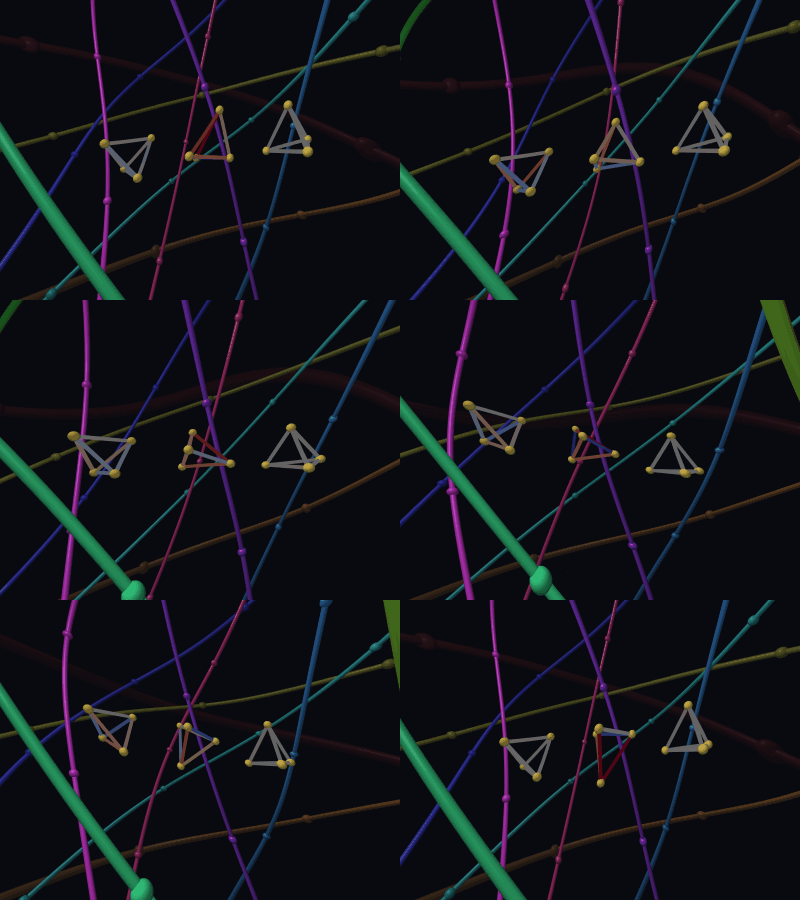 | Snowflake thermodynamics  |
Scenegraph and camera optics 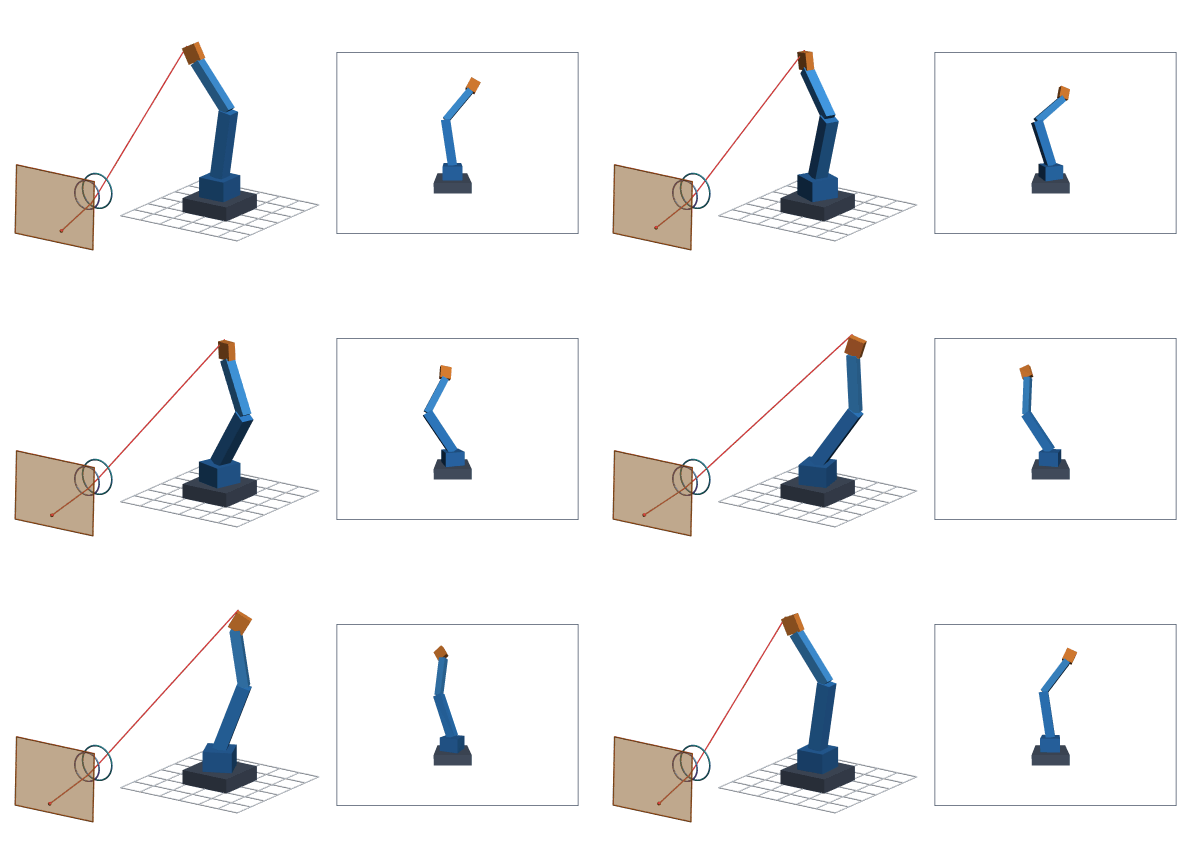 | Spin reversal by rolling contact 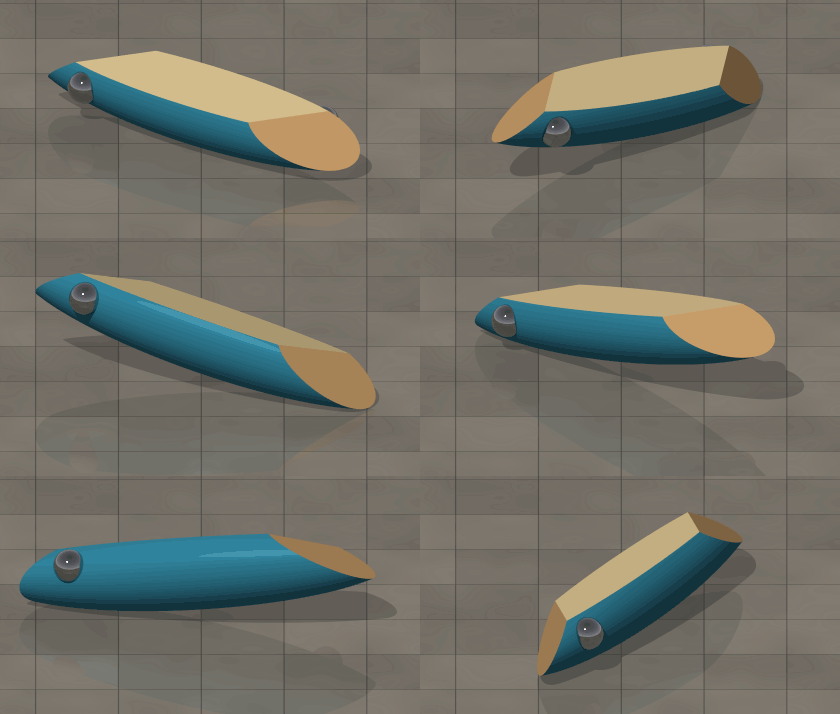 |
Summing cones into splats 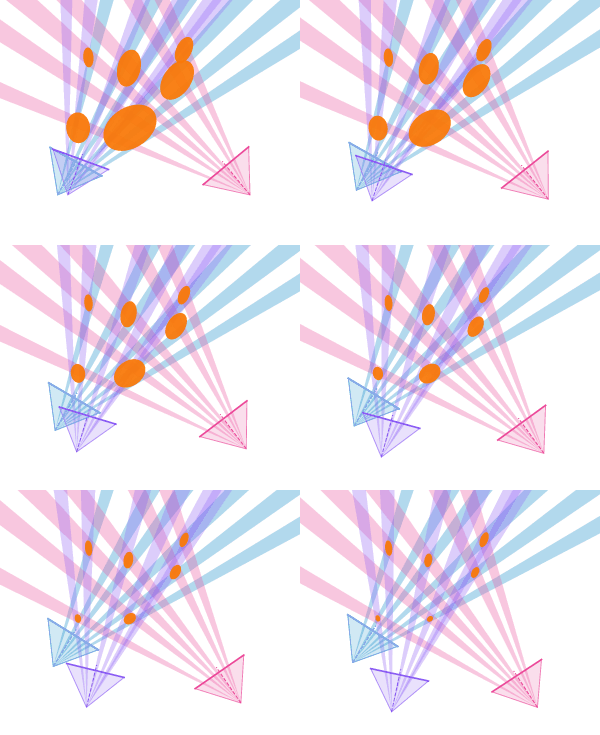 | Quantized vortices in a Bose–Einstein condensate 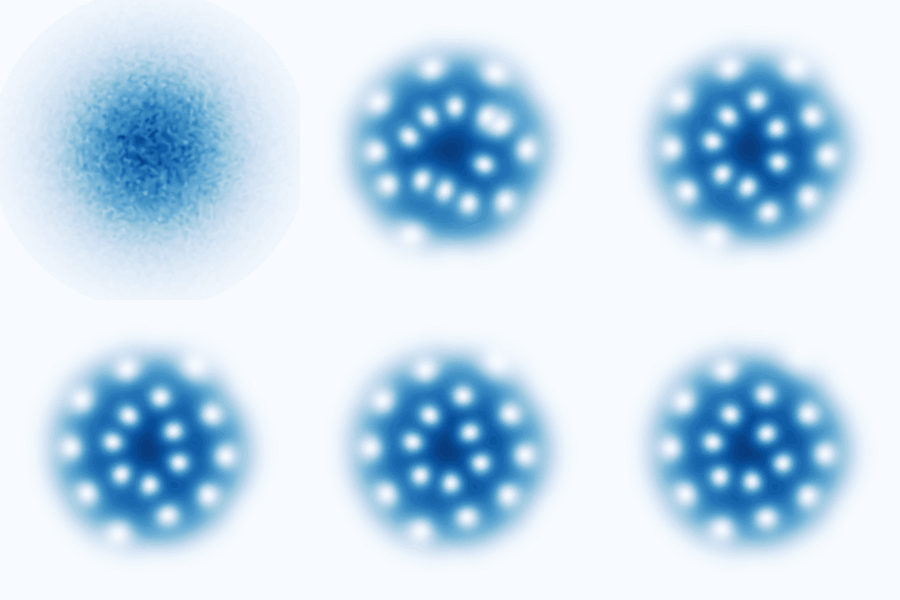 |
Explore live: a rotating black hole · a gravitational wave
Extensors
An introduction to extensors, and a gallery of what they do: from a robot arm and its camera to a snowflake, a dynamo and a closed universe, each example a picture and the few lines of extensor code that compute it.
A short example of the extensor syntax: building unary maps and bilinear forms, and solving for the vibration modes of four point masses on springs:
points = mv.point([[0, 0, 0], [1, 0, 0], [0, 1, 0], [0, 0, 1]])   # four unit masses
inertia = (points & points.commutator(Bivector)).sum(axis=0)   # Antibivector <- Bivector

springs = points[:, None] & points[None, :]                    # [points, points] Antibivector: a line through each pair
stiffness = (springs * (springs & Bivector)).sum(axis=(0, 1)) / 2   # Antibivector <- Bivector
# the vibration modes, between two bilinear energy forms
values, modes = (Bivector & stiffness).eigh(Bivector & inertia)
The full example: vibration modes
Documentation
- Tutorials: step-by-step primers on geometric algebra and extensors.
- Guides and reference: extensor syntax, orientation, fields, simplicial topologies, WebGPU shaders and rendering, conventions and internals.
- Examples: over 200 runnable notebooks across geometry, estimation, surfaces, mechanics, fluids, optics, electromagnetism, relativity, quantum physics and thermodynamics.
Articles
Conceptual articles on extensors, orientation, the regressive product, complementarity, discrete differential geometric algebra and coupled thermodynamics, and how extensors relate to linear algebra, tensors and forms.
Install and run
Install from PyPI:
pip install numga
To install numga with the examples package from GitHub and run an example:
pip install "numga[examples] @ https://github.com/EelcoHoogendoorn/numga/archive/HEAD.tar.gz"
python -m examples.mechanics.modes.scenarios
1 maintainer

Metadata
1 maintainer
Release files for numga 2.0.0
For a detailed explanation of source distributions (sdists) and built distributions (wheels), please see the package formats documentation.
Source distribution (sdist)
| File | Size | Uploaded | Provenance | Actions |
|---|---|---|---|---|
| numga-2.0.0.tar.gz | 241.7 kB | With provenance | Details for numga-2.0.0.tar.gz |
Built distribution (wheel)
| File | Interpreter | ABI | Platform | Actions Reset |
|---|---|---|---|---|
| numga-2.0.0-py3-none-any.whl | Python 3 | none | any | Details for numga-2.0.0-py3-none-any.whl |
Total release size: 527.2 kB
Release files / numga-2.0.0.tar.gz
| Download URL | numga-2.0.0.tar.gz |
|---|---|
| Size | 241.7 kB |
| Tags | Source |
|
SHA-256 checksum How to use checksums |
7e875560af5e0f33beafba8b6ec5c88858c1b5d7979550e1a9acd60eedfc744d
|
|
BLAKE2b-256 checksum How to use checksums |
515257f35b5b6d267b2912f0aa42edbb3a20842c896797efcdbcd2efa5d75a80
|
| Upload date | |
|
Uploaded using Trusted Publishing? What is trusted publishing? |
Yes |
| Uploaded via |
twine/7.0.0 CPython/3.13.16
|
Provenance
Provenance describes where a file came from. On PyPI, provenance is shared via attestations, which provide a verifiable record of the build or publishing details. View details, limitations and caveats.


PyPI Publish Attestation
PyPI verified that this artifact, at this checksum, originated from the publisher listed below.
Signed by GitHub Actions, verified by PyPI on Nov 16, 2026.
Transparency logRelease files / numga-2.0.0-py3-none-any.whl
| Download URL | numga-2.0.0-py3-none-any.whl |
|---|---|
| Size | 285.5 kB |
| Tags | Python 3 |
|
SHA-256 checksum How to use checksums |
d16b7c3546a1f2fd18e5f60bdb3a2a43bfaa1c1f9128b0386a5b78addf9c256f
|
|
BLAKE2b-256 checksum How to use checksums |
01e7fcc7cba5013571bd77cbd2e5105ff9c2fba93d65126e61d42eb26d60e44a
|
| Upload date | |
|
Uploaded using Trusted Publishing? What is trusted publishing? |
Yes |
| Uploaded via |
twine/7.0.0 CPython/3.13.16
|
Provenance
Provenance describes where a file came from. On PyPI, provenance is shared via attestations, which provide a verifiable record of the build or publishing details. View details, limitations and caveats.
PyPI Publish Attestation
PyPI verified that this artifact, at this checksum, originated from the publisher listed below.
Signed by GitHub Actions, verified by PyPI on Nov 16, 2026.
Transparency logSecurity for numga 2.0.0
Provenance
Provenance describes where a file came from. On PyPI, provenance is shared via attestations, which provide a verifiable record of the build or publishing details. View details, limitations and caveats.
Full provenance
Both files in this release have been uploaded with provenance metadata.
Attestation for numga-2.0.0.tar.gz
PyPI Publish Attestation
PyPI verified that this artifact, at this checksum, originated from the publisher listed below.
Signed by GitHub Actions, verified by PyPI on Nov 16, 2026.
Transparency logA note on package security
PyPI is a repository for distributing packages, not a service for auditing them. While third-party security researchers and our staff do their best to detect and remove malicious packages, PyPI cannot guarantee the quality, security or suitability of any given package.
To learn more about protecting yourself from malicious actors, visit our package security documentation.













