
This release is a pre-release and may not be stable for production use.
nvflops
The New Version of the Free-style machine-Learning Open Platform System
Key concepts
- All results from participants are recorded with mandatory metadata, such as parents, creator, creator's role.
- Blobs of results (the large binary information) are stored in S3 or other dedicate blob storage space. Their addresses (bucket and object in S3 use case) are stored in the mandatory metadata.
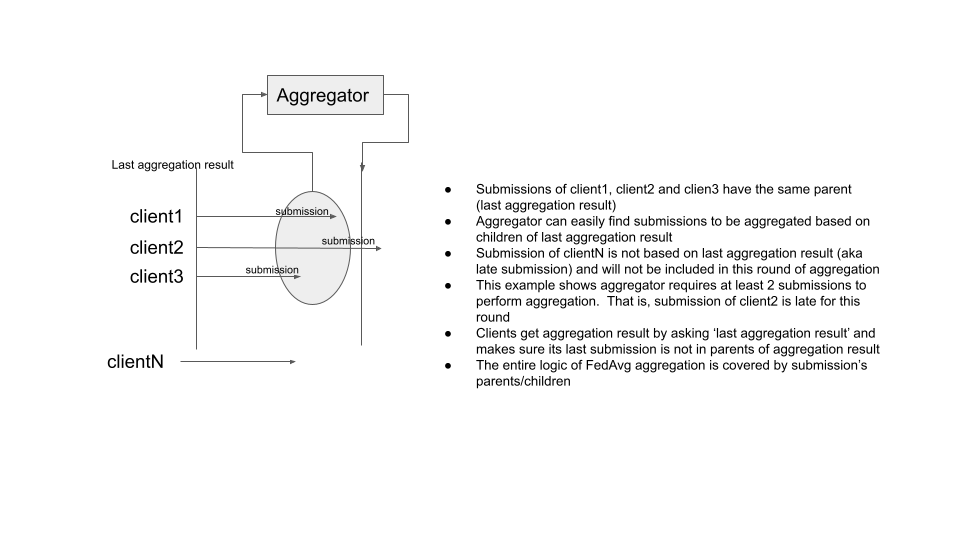
- Parents and children are many-to-many relationship. That is, one result can have multiple parents (aggregation operation). One parents can have multiple results (client's local training).
- Results can include additional metadata (custom_field) as flat dictionary. Search can perform against those custom_field.
Aggregation style operation as shown in this graph.
Package requirements
In current implementation, vflops requires a blob storage space and only S3 is supported. Full S3 authentication with AWS IAM credential will be implemented in the future. For local development and test, you can install [minio][https://min.io/download#/linux). Minio Python package is required, but it should be easy to replace it with boto3.
The backend database can be any SQL database supported by SQLAlchemy. However, you will need to setup your own database management system.
Installation
We plan to have nvflops wheel package available on PyPi. You can choose to install via source codes.
pip install -e .
in nvflops folder (same level as setup.py)
1 maintainer

Metadata
1 maintainer
Release files for nvflops 0.0.1.dev2
For a detailed explanation of source distributions (sdists) and built distributions (wheels), please see the package formats documentation.
Built distribution (wheel)
| File | Interpreter | ABI | Platform | Reset |
|---|---|---|---|---|
| nvflops-0.0.1.dev2-py3-none-any.whl | Python 3 | none | any | Details |
Release files / nvflops-0.0.1.dev2-py3-none-any.whl
| Download URL | nvflops-0.0.1.dev2-py3-none-any.whl |
|---|---|
| Size | 15.0 kB |
| Tags | Python 3 |
|
SHA-256 checksum How to use checksums |
fbad873f625c4e8b43915b894ccadde5bb626210502dae674a9a87e9a86403bf
|
|
BLAKE2b-256 checksum How to use checksums |
f72d36c20fd595a8cfe1c98eeb8074238d1caab38f6de220c6348955c70a1850
|
| Upload date | |
|
Uploaded using Trusted Publishing? What is trusted publishing? |
No |
| Uploaded via |
twine/3.8.0 pkginfo/1.8.2 readme-renderer/34.0 requests/2.27.1 requests-toolbelt/0.9.1 urllib3/1.26.9 tqdm/4.63.1 importlib-metadata/4.11.3 keyring/23.5.0 rfc3986/2.0.0 colorama/0.4.4 CPython/3.8.10
|
Security for nvflops 0.0.1.dev2
Provenance
Provenance describes where a file came from. On PyPI, provenance is shared via attestations, which provide a verifiable record of the build or publishing details. View details, limitations and caveats.
No provenance found
None of the files in this release were uploaded with provenance metadata.
A note on package security
PyPI is a repository for distributing packages, not a service for auditing them. While third-party security researchers and our staff do their best to detect and remove malicious packages, PyPI cannot guarantee the quality, security or suitability of any given package.
To learn more about protecting yourself from malicious actors, visit our package security documentation.














