
SSD1306 Library
oled.set_rotation(1) # Rotation can be 0, 1, 2, or 3 corresponding to 0, 90, 180, 270 degrees
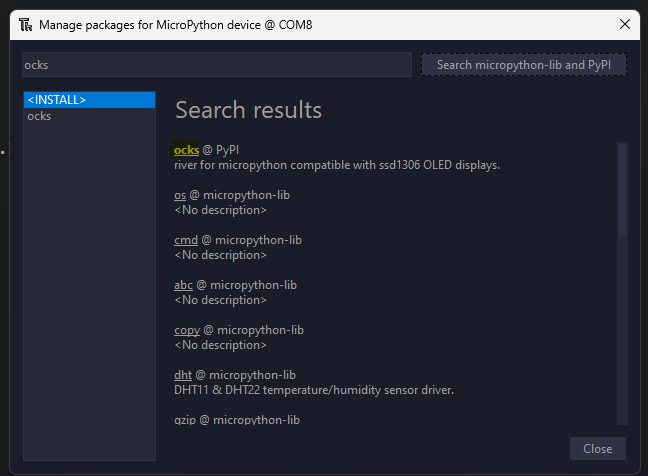
This repository contains a modified version of the micropython-ssd1306 library with the main objective of simplifying the installation process. This project has removed support for SPI and retains only the I2C functionality from the original library. All credits and acknowledgments go to the original author.
The focus of this repository is to prepare the library for uploading to PyPI and renaming it before the upload.
Test for the DUALMCU board:
import machine

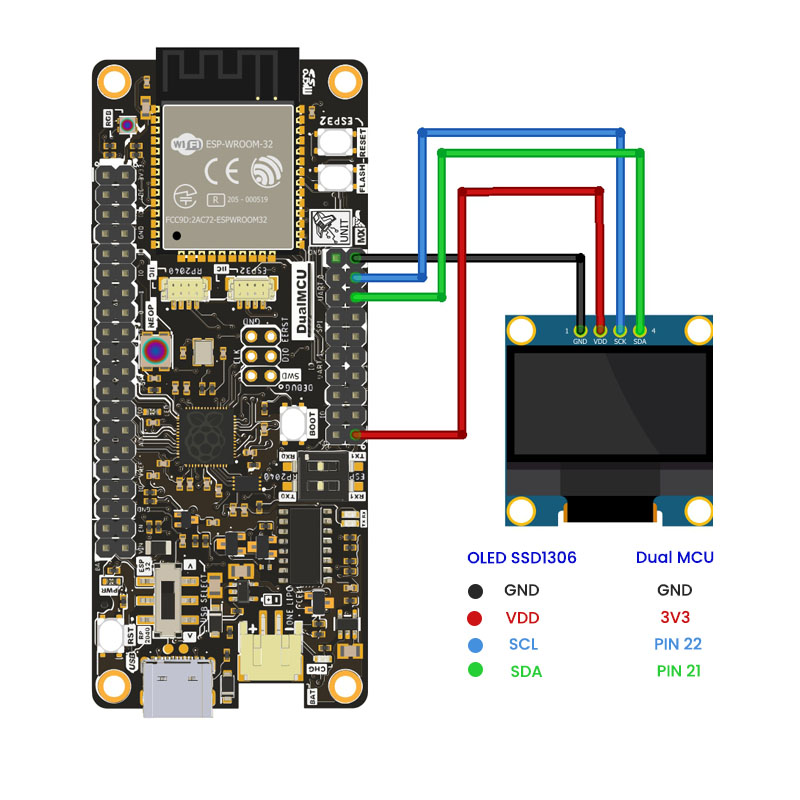
i2c = machine.I2C(0, sda=machine.Pin(21), scl=machine.Pin(22))

print(i2c.scan())
The next diagram illustrates the communication between one of the two microcontrollers and the ability to display a default text on the OLED screen.
Code example
'''
    Unit Electronics 2023
           (o_
    (o_    //\
    (/)_   V_/_
    tested code mark
    version: 0.0.1
    revision: 0.0.1

'''

import machine
from ocks import SSD1306_I2C

i2c = machine.I2C(0,sda=machine.Pin(21), scl=machine.Pin(22))

oled = SSD1306_I2C(128, 32, i2c)

oled.fill(1)
oled.show()

oled.fill(0)
oled.show()
oled.text('UNIT', 50, 10)
oled.text('ELECTRONICS', 25, 20)

oled.show()
1 maintainer

Metadata
1 maintainer
Release files for ocks 0.6
For a detailed explanation of source distributions (sdists) and built distributions (wheels), please see the package formats documentation.
Built distribution (wheel)
| File | Interpreter | ABI | Platform | Reset |
|---|---|---|---|---|
| ocks-0.6-py3-none-any.whl | Python 3 | none | any | Details |
Release files / ocks-0.6-py3-none-any.whl
| Download URL | ocks-0.6-py3-none-any.whl |
|---|---|
| Size | 4.4 kB |
| Tags | Python 3 |
|
SHA-256 checksum How to use checksums |
00be8df811b4abaa1e3c428722b2b68e1ce586ddd80b384b5ddf910681b5e49d
|
|
BLAKE2b-256 checksum How to use checksums |
30ebf80b62bf6d90c215fff4e813c3d7ab04508d36421be5562e1322eb2354c9
|
| Upload date | |
|
Uploaded using Trusted Publishing? What is trusted publishing? |
No |
| Uploaded via |
twine/5.0.0 CPython/3.11.9
|
Security for ocks 0.6
Provenance
Provenance describes where a file came from. On PyPI, provenance is shared via attestations, which provide a verifiable record of the build or publishing details. View details, limitations and caveats.
No provenance found
None of the files in this release were uploaded with provenance metadata.
A note on package security
PyPI is a repository for distributing packages, not a service for auditing them. While third-party security researchers and our staff do their best to detect and remove malicious packages, PyPI cannot guarantee the quality, security or suitability of any given package.
To learn more about protecting yourself from malicious actors, visit our package security documentation.














