
Odin monitor
Experimental release!
Odin provides lightweight progress reporting for long-running computations. Monitor running programs — progress bars, warnings, errors — from a browser or terminal, with almost no extra code. Start a server, add two lines to your code, and watch it from anywhere your laptop can connect.
Odin works with Python, C++, and shell scripts.
Here is a minimalistic example for how to add a progressbar to a Python script:
from odin import track

for item in track(my_list, label="processing"):
    do_work(item)
Features
- Minimal API — wrapping an existing loop takes one line
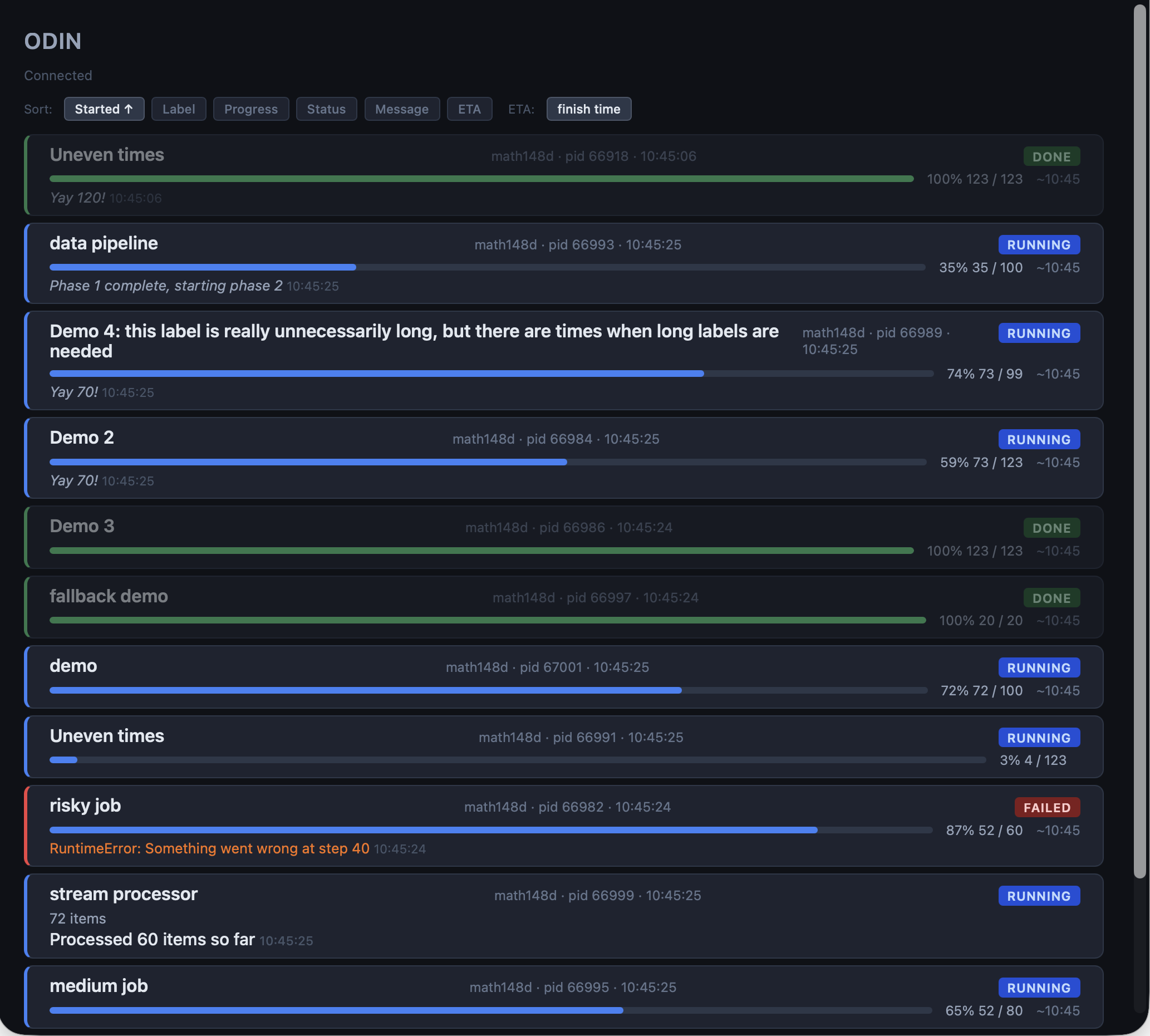
- Live browser dashboard — auto-updating, no page refreshes. See example below!
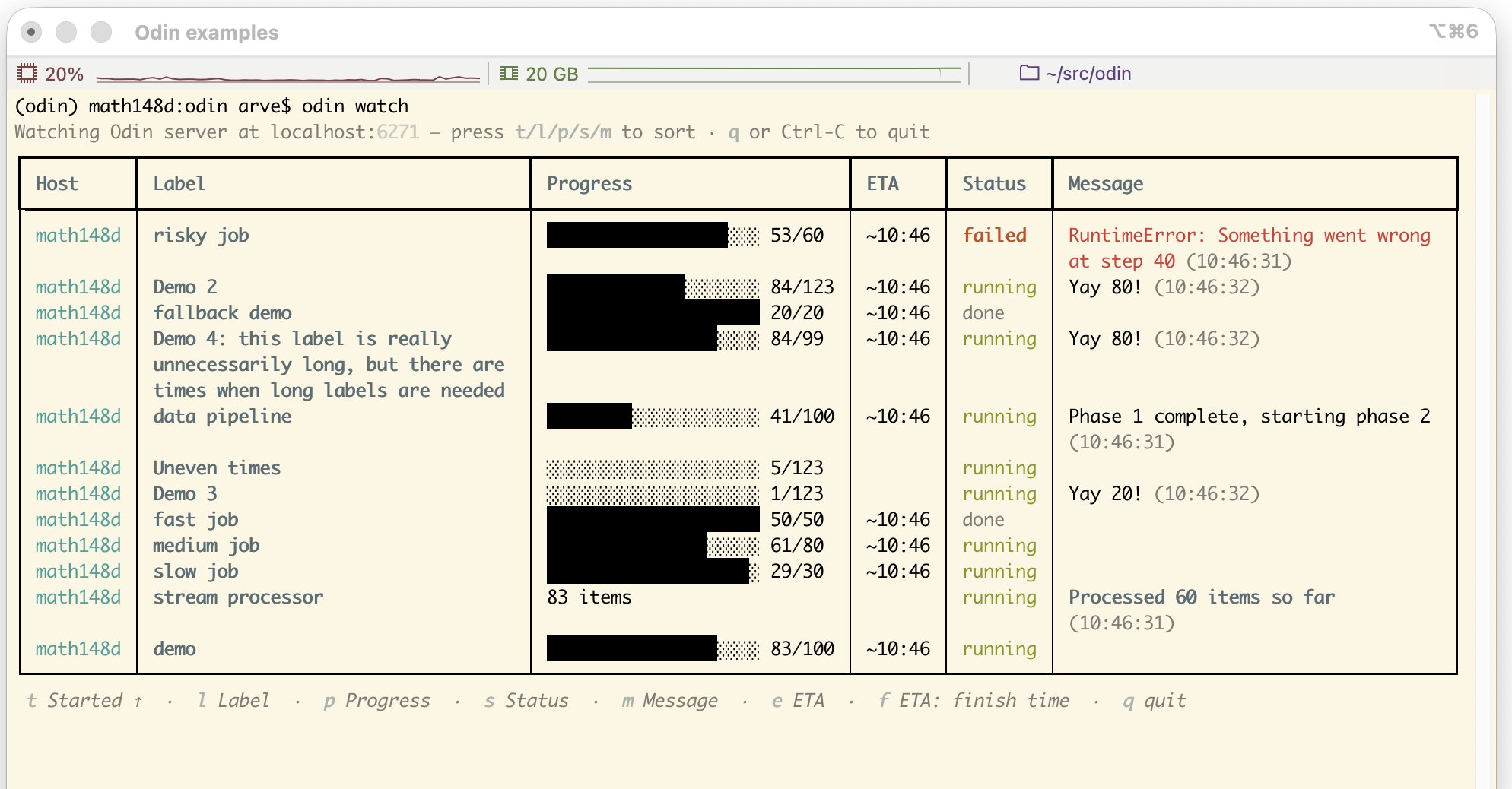
- Live terminal dashboard —
odin watchfor a rich live table in your terminal. Good to have when your jobs are on a remote server. See example below! - Multi-language — Python and C++ reporter libraries; shell one-liners via the
odinCLI - Graceful fallback — if no server is running, output goes to stderr (or your logger); your code keeps working
- ETA estimation — time-remaining shown once enough data has accumulated
- Integrates with Python logging — pass a
logger=argument and Odin uses it as the fallback - Process death detection — reporters that crash or are killed are automatically marked as died
Installation
The odin package that provides server, terminal-based dashboard, and module for progress reporting in Python programs
is typically installed like this (from pypi.org):
pip install odin-monitor
The package requires Python 3.10+. The package installs as odin — use from odin import ... in your code.
For progress reporting in C++ code you download cpp/odin.hpp from this repository to your project – this is a header-only dependency and no further installation is required.
Quickstart
1. Start the server
odin serve
Open http://localhost:6271 in a browser. Or run odin watch in a second terminal for a terminal view.
2. Report from Python
Wrap any iterable with track():
from odin import track

for item in track(my_list, label="training"):
    process(item)
Or use Reporter directly for more control:
from odin import Reporter

r = Reporter("simulation", total=1000)
for i in range(1000):
    run_step(i)
    r.progress(i + 1)
    if something_odd:
        r.warning("Step took longer than expected")
r.done()
Use it as a context manager and exceptions are reported automatically:
with Reporter("risky job", total=100) as r:
    for i in range(100):
        r.progress(i + 1)
        do_work(i)          # if this raises, the error is reported before propagating
3. Stop the server
odin stop
C++ usage
Copy cpp/odin.hpp from the repository into your project — no build system changes needed beyond adding the include path.
#include "odin.hpp"
#include <vector>

int main() {
    // Wrap a container — progress reported automatically
    std::vector<double> data = load_data();
    for (auto& item : odin::track(data, "processing")) {
        process(item);
    }

    // Or use Reporter directly
    odin::Reporter r("simulation", 1000);
    for (int i = 0; i < 1000; ++i) {
        run_step(i);
        r.progress(i + 1);
        if (something_odd) r.warning("Step took too long");
    }
    r.done(); // optional — destructor calls it automatically
}
Compile with C++17 and pthreads:
g++ -std=c++17 -pthread -I/path/to/odin/cpp myprogram.cpp -o myprogram
Exceptions thrown inside odin::track() are automatically reported as errors before propagating.
Shell usage
Report progress from shell scripts using the odin CLI:
odin progress "pipeline" 0 5

for step in 1 2 3 4 5; do
    do_work "$step"
    odin progress "pipeline" "$step" 5
done

odin info    "pipeline" "All steps complete"
odin warning "pipeline" "Disk usage above 80%"
odin error   "pipeline" "Input file missing"
Each odin call connects, sends one message, and exits. If no server is running the commands are silent no-ops.
Snakemake integration
Pipe a running Snakemake workflow's output through odin snakemake to report its
progress without changing the workflow itself:
snakemake 2>&1 | odin snakemake
odin snakemake echoes every line straight through to the terminal (so the
normal Snakemake output is unaffected), while parsing lines like "15 of 30 steps (50%) done" into progress updates and known Snakemake failure markers
(Error in rule ...:, WorkflowError:, etc.) into error reports. Use
--label to give it a custom session name, e.g. odin snakemake --label my-pipeline. See examples/snakemake/ for a runnable demo workflow.
Integration with Python logging
Pass a standard logging.Logger and Odin uses it as the fallback when no server is running. Users who don't know about Odin get normal log output; users with a server running get the full dashboard.
import logging
from odin import Reporter, track

log = logging.getLogger(__name__)

r = Reporter("job", total=100, logger=log)
# or
for item in track(data, label="job", logger=log):
    process(item)
Message types
| Method | Meaning |
|---|---|
r.progress(value) |
Update progress (0 … total) |
r.info(message) |
Informational note |
r.warning(message) |
Something unexpected but non-fatal |
r.error(message) |
An error occurred |
r.done() |
Job finished cleanly (optional — the server also detects clean exit) |
Server options
odin serve [--retention SECONDS]
--retention controls how long finished or died sessions remain visible before being removed (default: 30 seconds). Use 0 to keep them until the server restarts.
For remote access from another machine, use an SSH tunnel:
# on the viewing machine:
ssh -L 6271:localhost:6271 user@compute-server
# then open http://localhost:6271
How it works
Reporters connect to a Unix socket (~/.odin) on startup and hold the connection open. The server keeps only the latest state for each reporter and pushes updates to connected viewers over WebSocket. When a reporter's connection drops without a done message, the server marks it as died.
Because the server is single-threaded asyncio and each reporter has its own connection, there are no race conditions — multiple reporters writing simultaneously is safe by design.
The wire protocol is documented in PROTOCOL.md. It is simple enough to implement a reporter in any language in an afternoon.
Publishing / distribution
Python — install from PyPI:
pip install odin-monitor
C++ — the library is a single header file. Copy it directly:
wget https://raw.githubusercontent.com/arvestad/odin/main/cpp/odin.hpp
Or add the repo as a git submodule:
git submodule add https://github.com/arvestad/odin deps/odin
# then add -Ideps/odin/cpp to your compiler flags
License
MIT
Dashboard examples
The following dashboards show concurrent execution of Python scripts in the examples folder.
Browser dashboard (http://localhost:6271):
Terminal dashboard (odin watch):
1 maintainer

Metadata
1 maintainer
Release files for odin-monitor 1.2
For a detailed explanation of source distributions (sdists) and built distributions (wheels), please see the package formats documentation.
Source distribution (sdist)
| File | Size | Uploaded | |
|---|---|---|---|
| odin_monitor-1.2.tar.gz | 709.4 kB | Details |
Built distribution (wheel)
| File | Interpreter | ABI | Platform | Reset |
|---|---|---|---|---|
| odin_monitor-1.2-py3-none-any.whl | Python 3 | none | any | Details |
Total release size: 729.9 kB
Release files / odin_monitor-1.2.tar.gz
| Download URL | odin_monitor-1.2.tar.gz |
|---|---|
| Size | 709.4 kB |
| Tags | Source |
|
SHA-256 checksum How to use checksums |
f1cc6d9aa268f920737940603b4ed155462f8d0cbd630c685e5efe8121763a9c
|
|
BLAKE2b-256 checksum How to use checksums |
b7c75be68a57afd7830ec199eef559b1a1da7ff039bf040fe484773228aad6e6
|
| Upload date | |
|
Uploaded using Trusted Publishing? What is trusted publishing? |
Yes |
| Uploaded via |
twine/7.0.0 CPython/3.13.14
|
Provenance
Provenance describes where a file came from. On PyPI, provenance is shared via attestations, which provide a verifiable record of the build or publishing details. View details, limitations and caveats.


PyPI Publish Attestation
PyPI verified that this artifact, at this checksum, originated from the publisher listed below.
Signed by GitHub Actions, verified by PyPI on Aug 13, 2026.
Transparency logRelease files / odin_monitor-1.2-py3-none-any.whl
| Download URL | odin_monitor-1.2-py3-none-any.whl |
|---|---|
| Size | 20.5 kB |
| Tags | Python 3 |
|
SHA-256 checksum How to use checksums |
ca0a85608a174d70b1806a9c18f2a3fce1e1582a04fa34ef00193659eccb11d6
|
|
BLAKE2b-256 checksum How to use checksums |
0e5d4b64752ab0bc40fed71f0444b00e6e055cc0a849a63608a202f540c57e8a
|
| Upload date | |
|
Uploaded using Trusted Publishing? What is trusted publishing? |
Yes |
| Uploaded via |
twine/7.0.0 CPython/3.13.14
|
Provenance
Provenance describes where a file came from. On PyPI, provenance is shared via attestations, which provide a verifiable record of the build or publishing details. View details, limitations and caveats.
PyPI Publish Attestation
PyPI verified that this artifact, at this checksum, originated from the publisher listed below.
Signed by GitHub Actions, verified by PyPI on Aug 13, 2026.
Transparency log













