

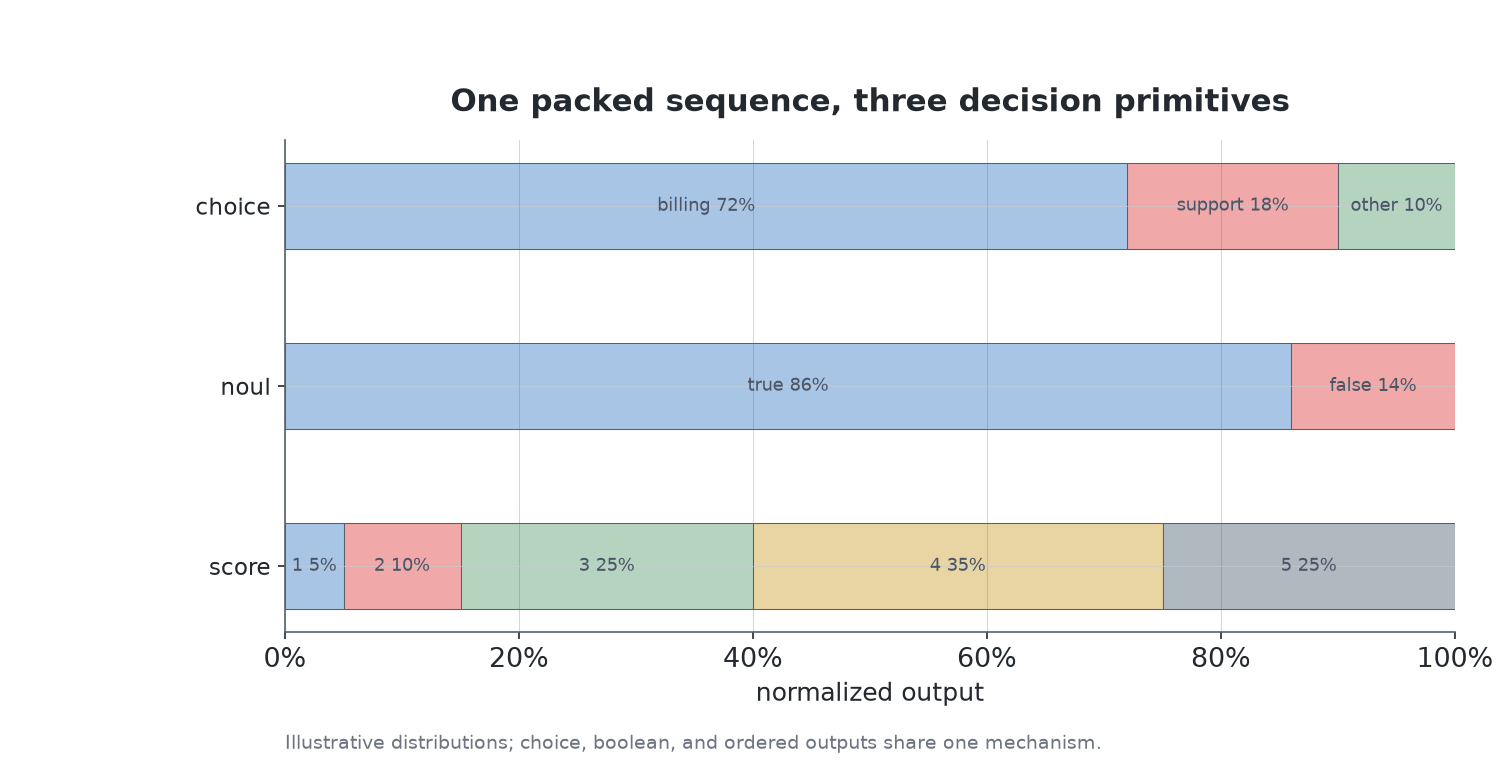
OEV is a small (184M params) neural decision engine. Instead of generating text, it scores answer options directly. The state, the question, and every option are packed into one sequence. One forward pass returns a calibrated probability distribution.
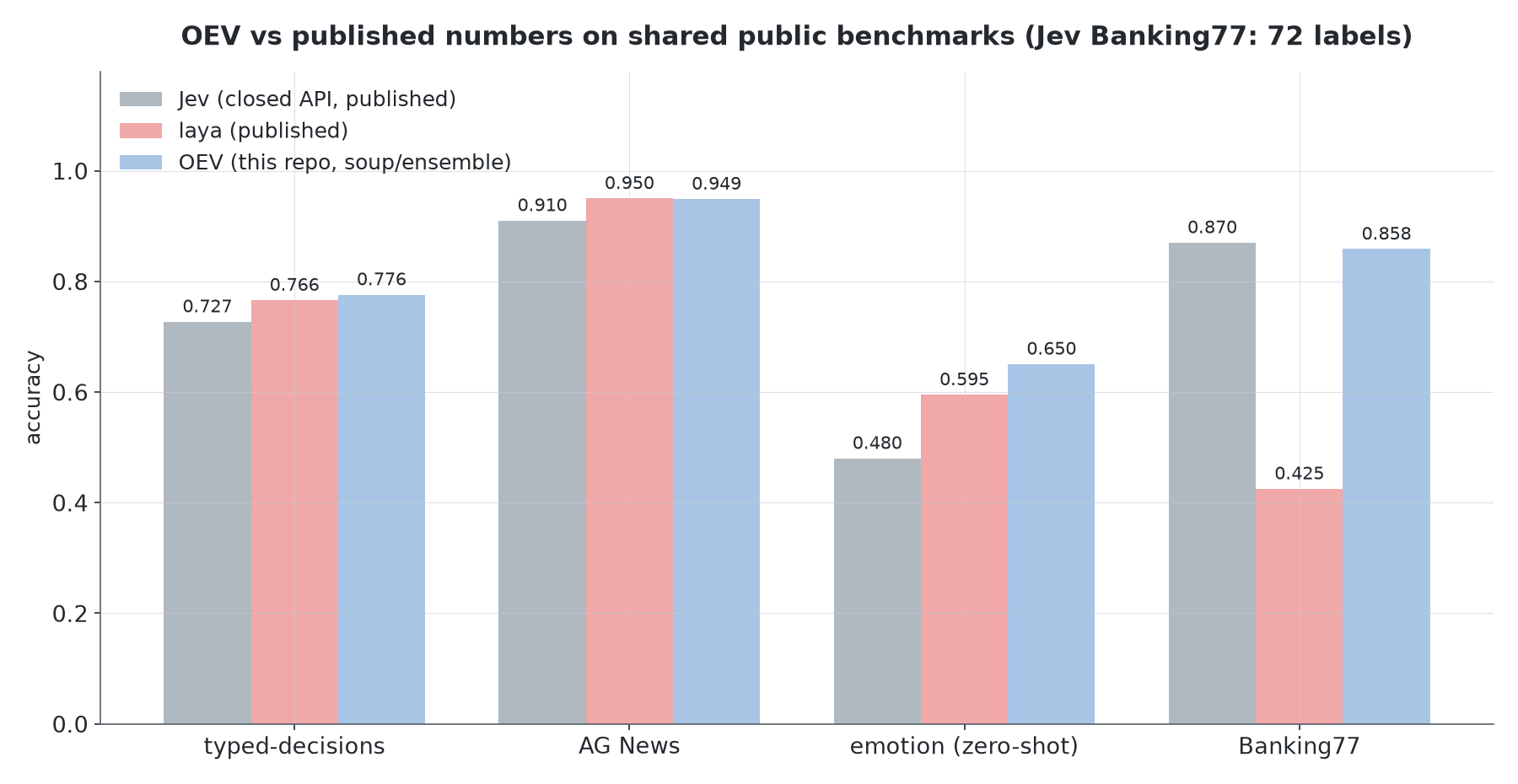
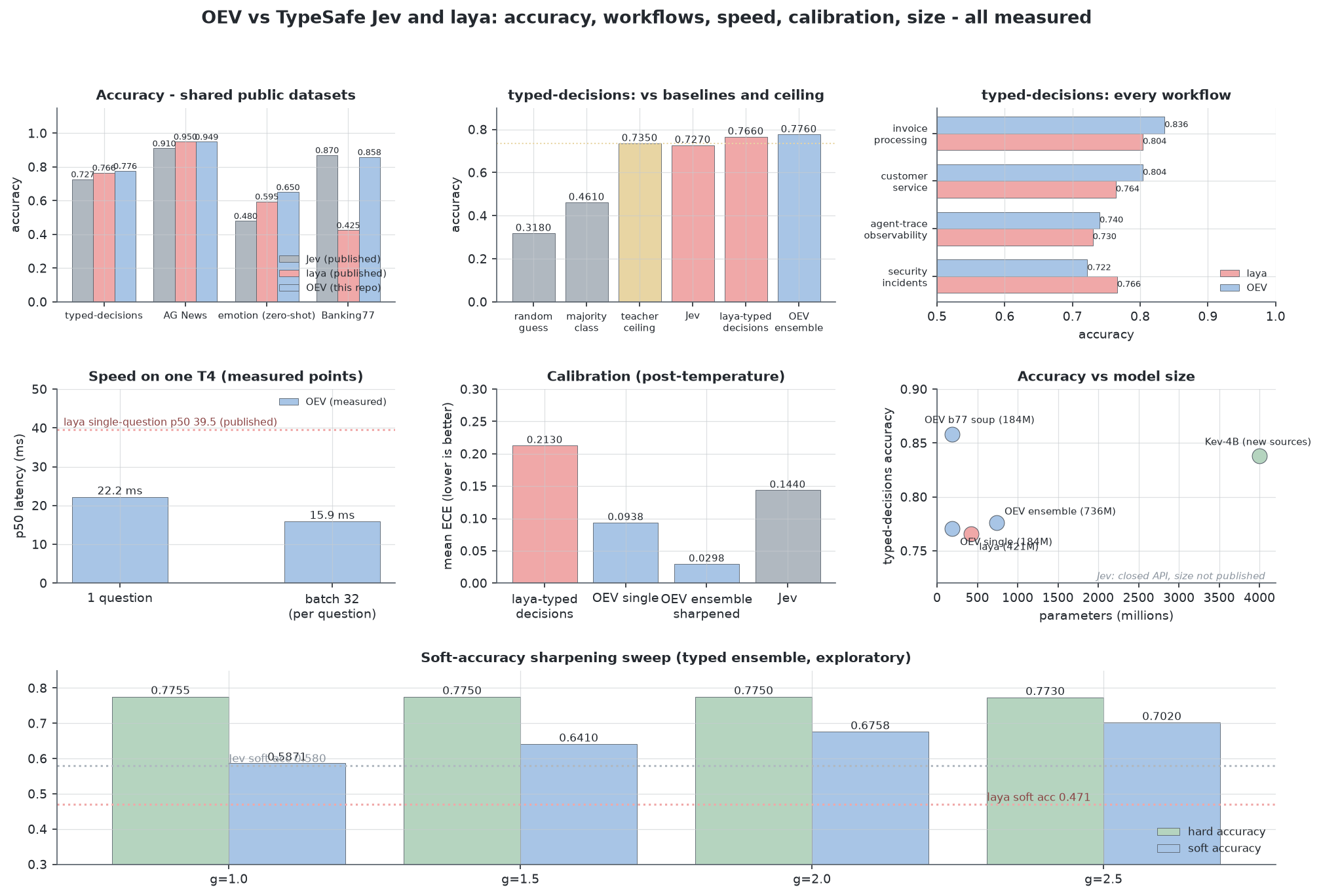
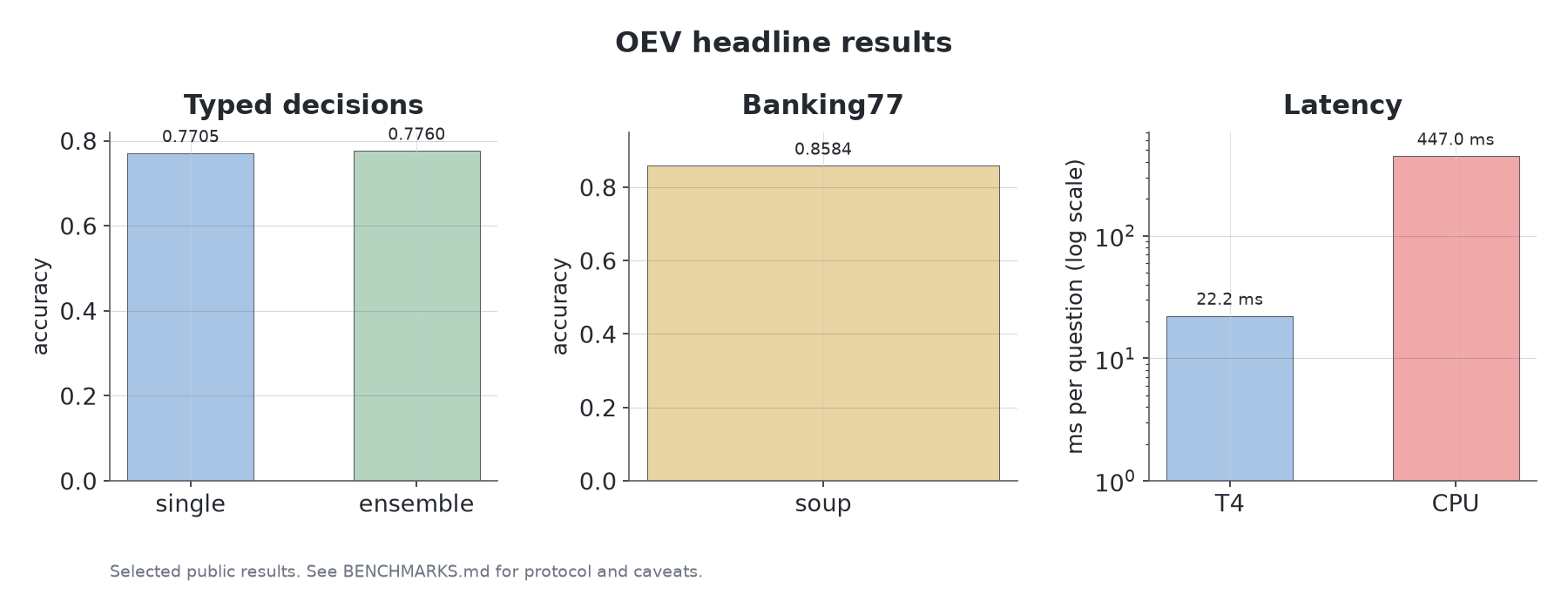
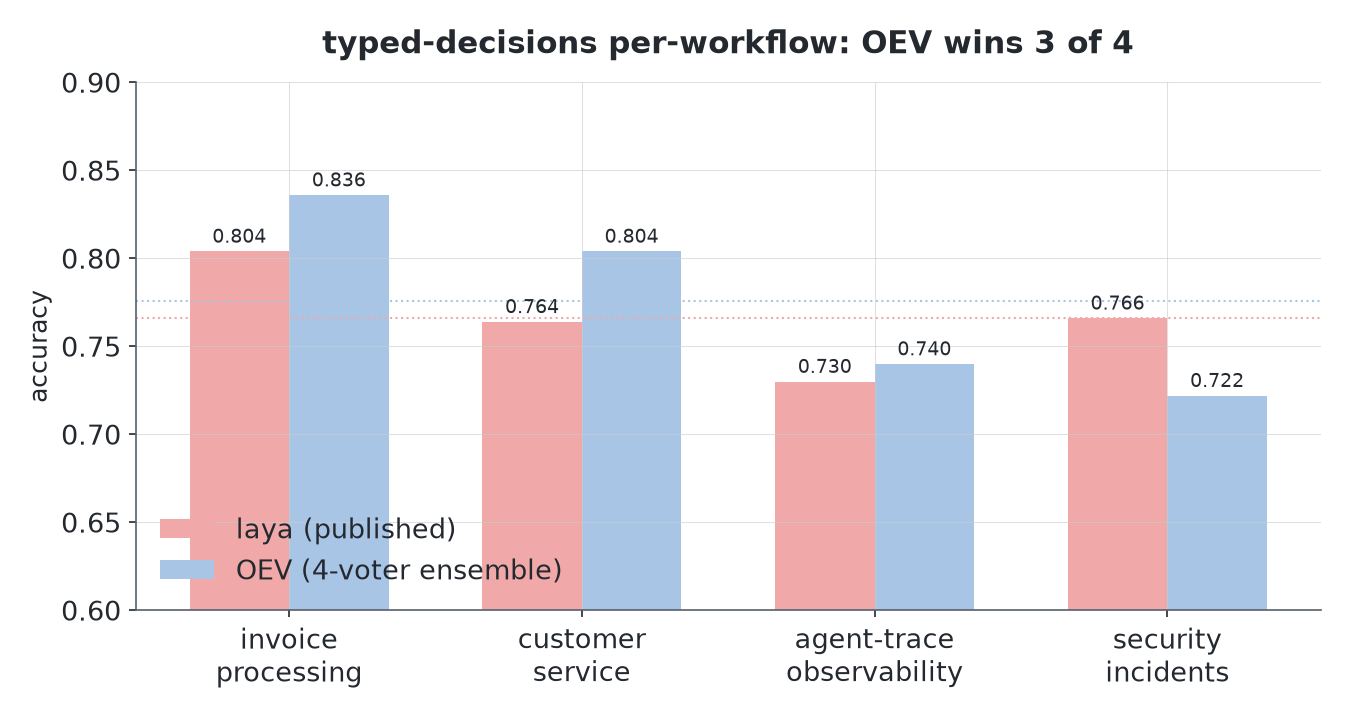
The single 184M model scores 0.7705 on typed-decisions, slightly above laya's published 0.766 from a 421M checkpoint. An ensemble of four 184M checkpoints reaches 0.7760, the highest reported result, and a single Banking77 soup checkpoint reaches 0.8584 (best ECE 0.0595 from the 3-checkpoint ensemble). Jev leads only on Banking77 (0.870).






At a glance
| claim | result |
|---|---|
| best accuracy | 0.7705 single model, 0.7760 ensemble - typed-decisions (laya 0.766 from 421M) |
| high-cardinality | 0.8584 Banking77, one soup checkpoint (ECE 0.0595 best ensemble; laya 0.425) |
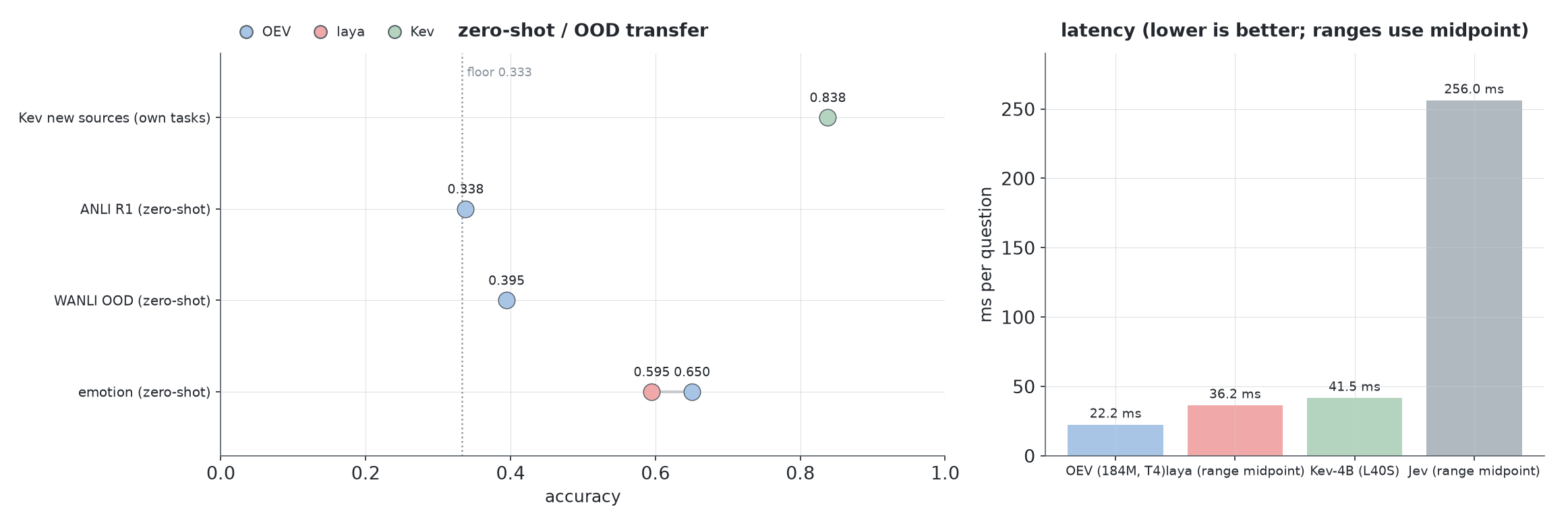
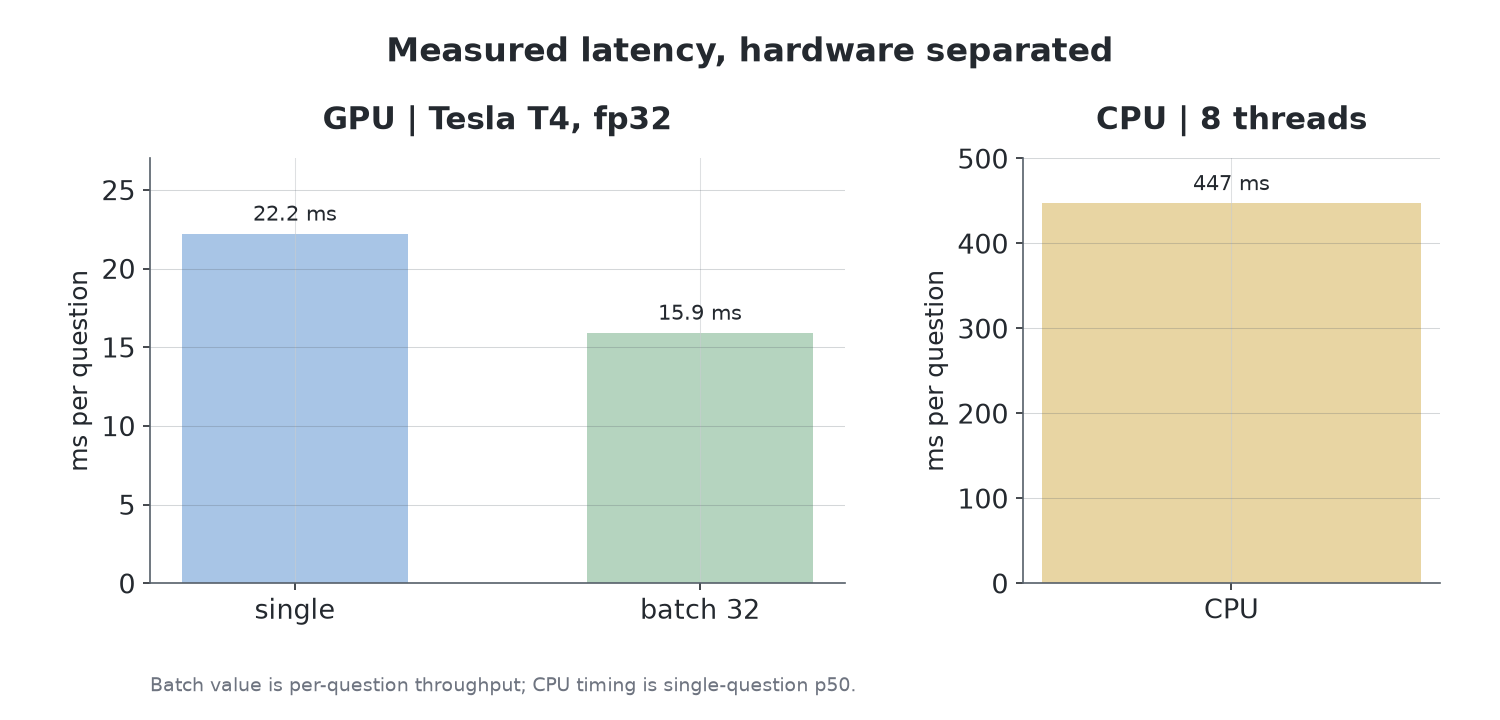
| speed | 22.2 ms single question (laya 32.8-39.5 ms published range) |
| size | 184M params, 0.44x laya |
| weights & checkpoints | Apache 2.0 - huggingface.co/divyanshudhruv/oev-typed |
22.2 msper question on aT4(GPU);447 msp50 on CPU (8 threads, 184M soup checkpoint)0.8584on 77-labelBanking77from a single soup checkpoint (the 3-checkpoint ensemble still holds best ECE0.0595): each option is embedded as its own anchor with full tokens, so accuracy scales with label count (gap to Jev 1.16 pts)184Mparams,Apache 2.0weights- Kev (0.8B / 4B) publishes no in-domain numbers on these datasets, so it is not in the tables; see BENCHMARKS.md for the like-for-like comparison plan
Architecture
flowchart LR
    subgraph input["Input"]
        direction TB
        S["state<br/>text or JSON"]
        Q["questions<br/>choice, noul, score"]
    end

    P["packer<br/>state + questions + anchors<br/>one packed sequence"]

    subgraph pass["One forward pass, 22 ms on T4"]
        direction TB
        E["encoder<br/>DeBERTa-v3-base, 184M<br/>or the from-scratch char model"]
        H["shared linear head<br/>scores every anchor"]
    end

    D["softmax per question<br/>calibrated distribution"]
    O["outputs<br/>choice / noul / score"]

    S --> P
    Q --> P
    P --> E
    E --> H
    H --> D
    D --> O
Vertical layout
flowchart TB
    subgraph input["Input"]
        direction TB
        S["state<br/>text or JSON"]
        Q["questions<br/>choice, noul, score"]
    end

    P["packer<br/>state + questions + anchors<br/>one packed sequence"]

    subgraph pass["One forward pass, 22 ms on T4"]
        direction TB
        E["encoder<br/>DeBERTa-v3-base, 184M<br/>or the from-scratch char model"]
        H["shared linear head<br/>scores every anchor"]
    end

    D["softmax per question<br/>calibrated distribution"]
    O["outputs<br/>choice / noul / score"]

    S --> P
    Q --> P
    P --> E
    E --> H
    H --> D
    D --> O
- One anchor mechanism covers all three primitives - options, yes/no pairs, and score levels are each embedded as anchors in one packed sequence
- No text generation - nothing to parse, nothing to hallucinate
- New question types need no new heads - new options are just new anchors
Benchmarks: OEV vs the published field
Fine-tuned on each benchmark's train split, following the same protocol as Laya's published runs. Selected results and evaluation notes are in BENCHMARKS.md.
| benchmark | OEV | laya | Jev | note |
|---|---|---|---|---|
| typed-decisions | 0.7760 | 0.766 | 0.727 | highest reported (ensemble); single model 0.7705 |
| Banking77 | 0.8584 | 0.425 | 0.870 | 2x laya; gap to Jev 1.16 pts |
| AG News | 0.9489 | 0.950 | 0.910 | label-noise ceiling (~0.95) |
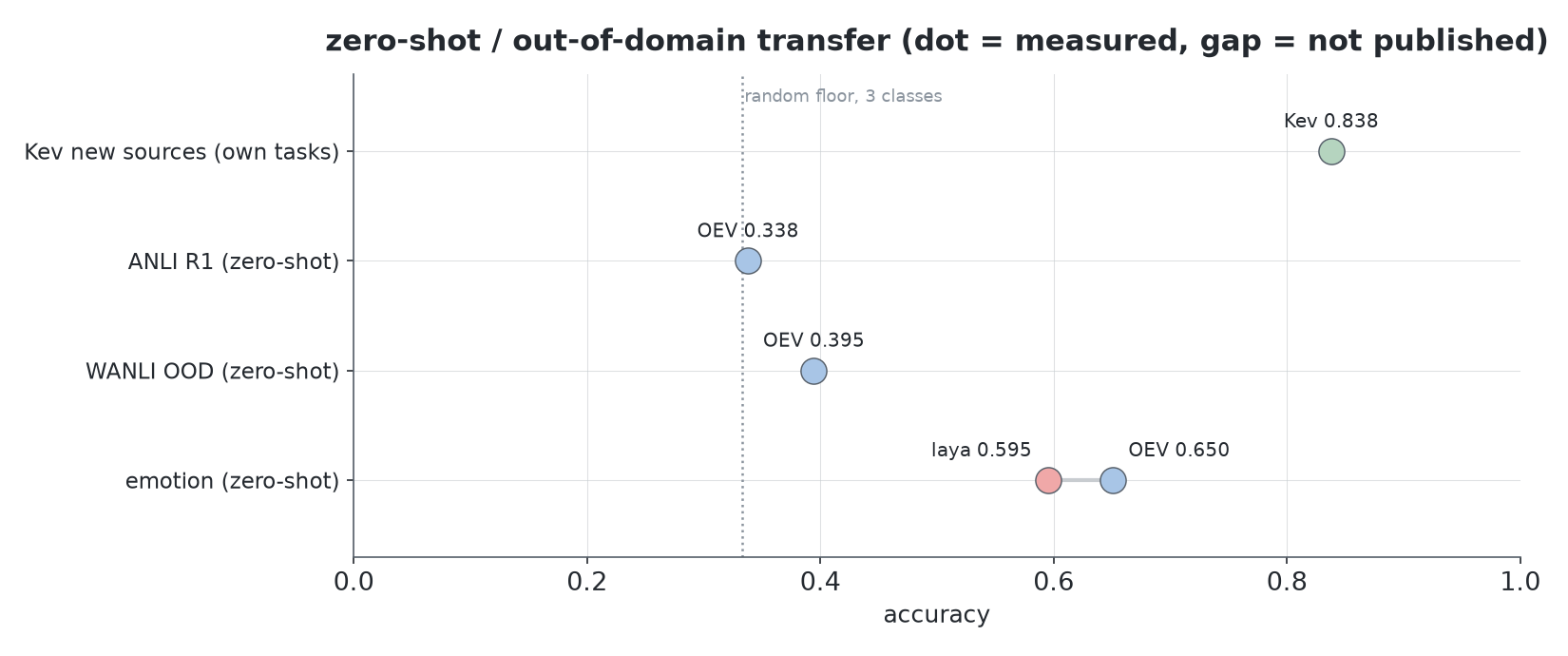
| DAIR Emotion | 0.9300 (fine-tuned) | 0.595 | 0.480 | zero-shot: OEV student 0.6505 beats laya's 0.595 head-to-head |
Quickstart
pip install oev          # from PyPI
# or from source:
pip install -e .
Optional extras:
pip install -e ".[dev]"- pytestpip install -e ".[data]"- dataset converterspip install -e ".[backbone]"- DeBERTa fine-tuningpip install -e ".[serve]"- FastAPI server (oev-serve)pip install -e ".[app]"- Gradio Space dependencies
from oev.infer import OEV

agent = OEV("checkpoints_td5/oev-tiny.pt", device="cpu")

result = agent.decide("We were charged twice for the same order.", {
    "department": {"type": "choice", "options": ["billing", "technical", "sales", "other"],
                   "instructions": "Which department should handle this?"},
    "refund_requested": {"type": "noul"},
    "severity": {"type": "score", "levels": [1, 2, 3, 4, 5]},
})
{
  "department": {
    "choice": "billing",
    "probabilities": {
      "billing": 0.94,
      "technical": 0.04,
      "sales": 0.01,
      "other": 0.01
    },
    "confidence": 0.94
  },
  "refund_requested": 0.91,
  "severity": {
    "value": 3,
    "probabilities": { "1": 0.02, "2": 0.08, "3": 0.61, "4": 0.22, "5": 0.07 }
  }
}
Confidence gating - automate when confident, escalate when not:
from oev.presets import triage_questions, gate

for name, payload, confident in gate(result, threshold=0.85):
    automate(name, payload) if confident else escalate_to_human(name)
HTTP server (native + Jev-compatible /v1/systemone endpoint - TypeSafe clients work by changing baseUrl):
pip install -e ".[serve]"
oev-serve --checkpoint checkpoints_td5/oev-tiny.pt --port 8000
curl -X POST localhost:8000/decide -H "Content-Type: application/json" \
  -d '{"state": "My payment failed twice", "questions": {"urgency": {"type": "score", "levels": [1, 2, 3]}}}'
Docker:
docker compose up # checkpoint at ./checkpoints/oev-tiny.pt
Training
python -m oev.convert_typed

python -m oev.train --backbone microsoft/deberta-v3-base --epochs 4 --batch-size 8 --max-len 768 --data-dir data/typed --out checkpoints_td5

python -m oev.rlcd --checkpoint checkpoints_td5/oev-tiny.pt --data-dir data/typed --epochs 2 --batch-size 8 --out checkpoints_rlcd

python -m oev.ensemble --ckpts checkpoints_td5/oev-tiny.pt,checkpoints_rlcd/oev-tiny.pt,checkpoints_rlcd_soup/oev-tiny.pt,checkpoints_rlcd_seed1/oev-tiny.pt --data-dir data/typed

python -m pytest -q
train_colab.ipynb runs the entire pipeline end to end. Evaluation rules and selected limitations are in BENCHMARKS.md.
Limitations
- every benchmark number is from a checkpoint fine-tuned on that benchmark's train split (the
0.9300emotion figure included). Zero-shot emotion is a separate win: the shipped distilled student (0.6505, both models zero-shot) against laya's0.595, up from the round-1 starting point of0.4265 - ANLI remains near chance (
0.3380for the round-1 student), while the WANLI specialist reaches0.5645; the NLI result is split-dependent, not uniformly at chance - pure-mimicry distillation transfers breadth, not depth. The round-1 student hit emotion
0.6875(+26 pts zero-shot) but lost typed skill (0.5385). Adding gold-CE loss (round 2) collapsed to uniform, a documented negative result. Round 2b (pure-KL, balanced domains) rescued it: typed0.6480, emotion0.6505, b770.7964, probes all PASS - the headline ensemble result is an average of four checkpoints; the best single model is
0.7705 - CPU inference is roughly
20xslower than the T4 (447 msp50, 8 threads) - all headline timings are GPU - the b77 headline includes a 3-checkpoint probability ensemble and a single-file soup checkpoint at
0.8584;0.8403is a historical warm-start re-tune, not the current best single artifact - English only
Roadmap
- round 3 distillation: 6 teachers, 5 domains including NLI
- 4-member Banking77 ensemble: the live shot past
0.8584 - round 4: one file near specialist numbers everywhere
- INT8 / ONNX CPU deployment (export + quantization scripts in
scripts/, bench pending) - multi-question shared-state encoding (one pass, many questions)
- robustness: reduce mild overconfidence on out-of-distribution inputs
- non-English checkpoints (the interface is language-agnostic; the weights are not yet)
Full list: ROADMAP.md.
Credits
The interface and benchmark protocol follow Laya, Kev and the System One model category introduced by TypeSafe's Jev. Their published numbers are quoted here for comparison and remain their measurements.
1 maintainer

Release files for oev 0.2.0
For a detailed explanation of source distributions (sdists) and built distributions (wheels), please see the package formats documentation.
Source distribution (sdist)
| File | Size | Uploaded | |
|---|---|---|---|
| oev-0.2.0.tar.gz | 61.7 kB | Details |
Built distribution (wheel)
| File | Interpreter | ABI | Platform | Reset |
|---|---|---|---|---|
| oev-0.2.0-py3-none-any.whl | Python 3 | none | any | Details |
Total release size: 118.3 kB
Release files / oev-0.2.0.tar.gz
| Download URL | oev-0.2.0.tar.gz |
|---|---|
| Size | 61.7 kB |
| Tags | Source |
|
SHA-256 checksum How to use checksums |
792825c379dacab1904ccdc3367c81ac88d7ecceacbdd8a441fc5504b79b4eb9
|
|
BLAKE2b-256 checksum How to use checksums |
d11d9d5900a4fa042380e1984a19ad3be2c505e53a4dec1925cfc0ef6449cdc1
|
| Upload date | |
|
Uploaded using Trusted Publishing? What is trusted publishing? |
Yes |
| Uploaded via |
twine/7.0.0 CPython/3.13.14
|
Provenance
Provenance describes where a file came from. On PyPI, provenance is shared via attestations, which provide a verifiable record of the build or publishing details. View details, limitations and caveats.


PyPI Publish Attestation
PyPI verified that this artifact, at this checksum, originated from the publisher listed below.
Signed by GitHub Actions, verified by PyPI on Sep 25, 2026.
Transparency logRelease files / oev-0.2.0-py3-none-any.whl
| Download URL | oev-0.2.0-py3-none-any.whl |
|---|---|
| Size | 56.6 kB |
| Tags | Python 3 |
|
SHA-256 checksum How to use checksums |
422a55d9f0e10535fc00f205487a7897e01e99d48c275936bd12480912468d1f
|
|
BLAKE2b-256 checksum How to use checksums |
7db63980a08dd1f7ee845e866ec7ff14abcfbb42d6a22814e068696d4b42ddb3
|
| Upload date | |
|
Uploaded using Trusted Publishing? What is trusted publishing? |
Yes |
| Uploaded via |
twine/7.0.0 CPython/3.13.14
|
Provenance
Provenance describes where a file came from. On PyPI, provenance is shared via attestations, which provide a verifiable record of the build or publishing details. View details, limitations and caveats.
PyPI Publish Attestation
PyPI verified that this artifact, at this checksum, originated from the publisher listed below.
Signed by GitHub Actions, verified by PyPI on Sep 25, 2026.
Transparency log













