
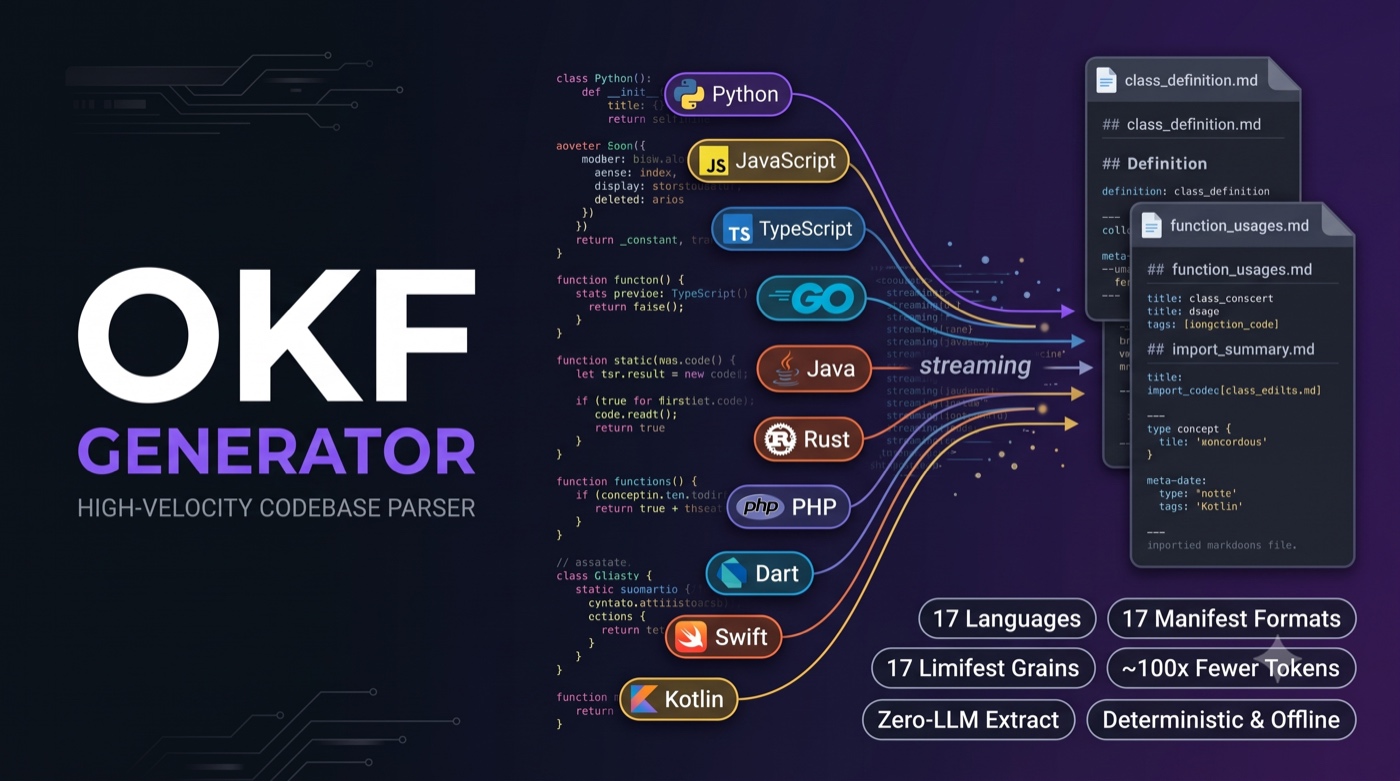








OKF Generator
The knowledge layer for AI coding agents
Scan any codebase into structured, agent-ready knowledge — 18 languages, ~100x fewer tokens than reading whole files, zero LLM required.
Quick Start · Why OKF? · Features · Agents · vs RAG · FAQ
Visual Hook & Demos
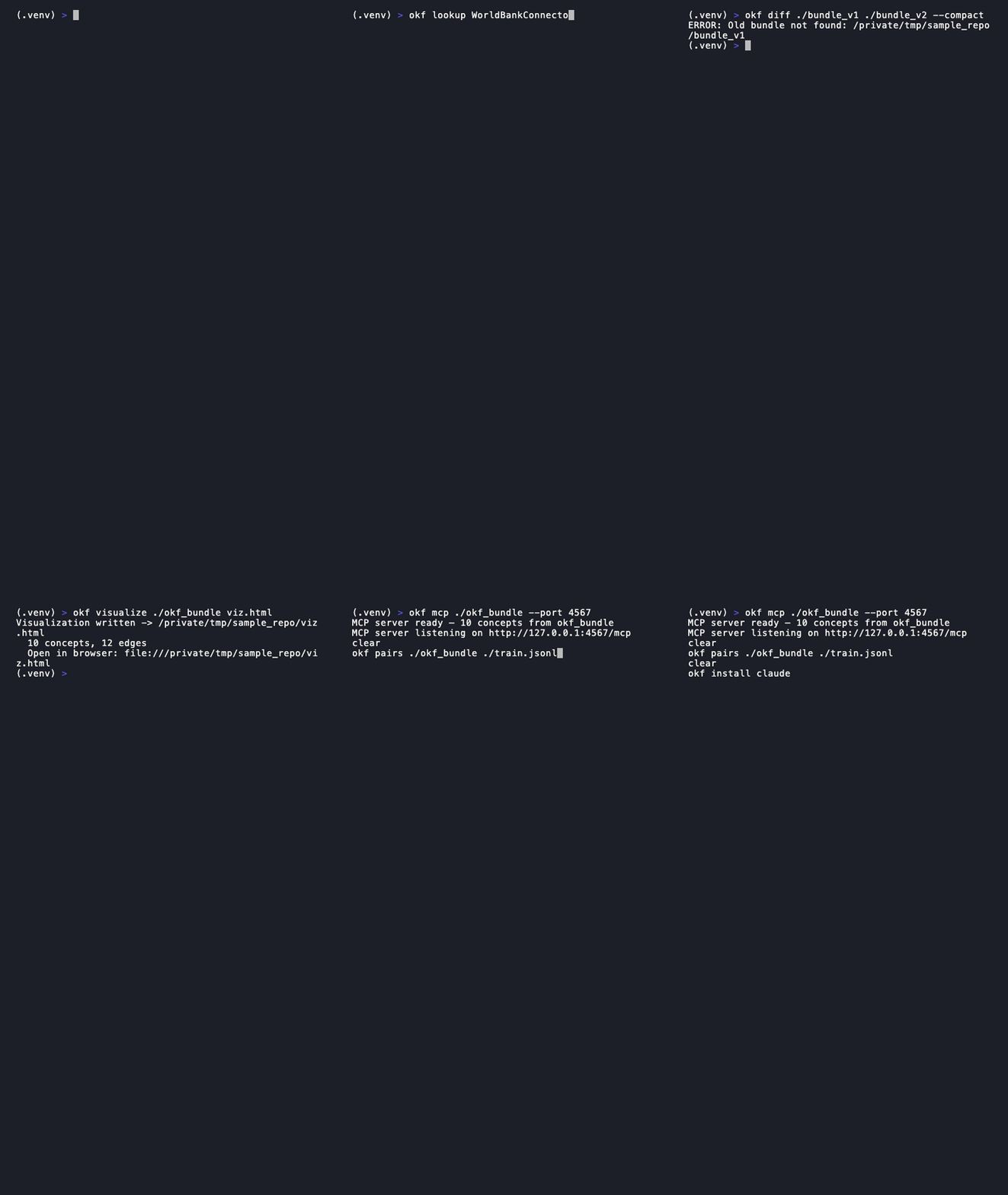
okf generate → okf lookup → okf diff → okf visualize → okf mcp → okf pairs
Live Viz Graph · Interactive Dev Container · Render App Demo
The Why
AI agents waste tokens re-reading code
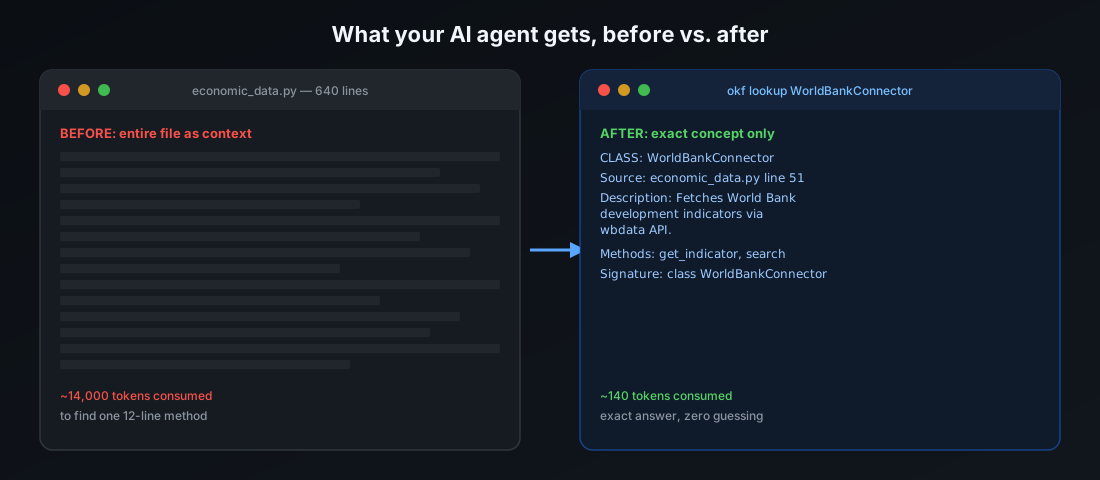
Every context reset forces agents to re-read entire files to find one function signature. A 600-line file costs 14,000 tokens — just to find one class. Cloud models with 200K windows mask this cost; local SLMs on a MacBook run out of memory immediately.
Vector databases (RAG) don't solve this — they shred code into arbitrary chunks, losing syntax structure, import pathways, and call relationships.
The OKF Edge: deterministic AST extraction
Instead of chunking text, okf-generator uses tree-sitter AST parsers to create a mathematical map of your codebase. Every function, class, module, and dependency becomes a structured node with typed edges (calls, called-by, imports, depends-on).
The result: an average lookup drops from 45,000 tokens → 1,200 tokens — a ~97.3% reduction.
# Before touching any file, get the exact concept card
okf lookup WorldBankConnector
CLASS: WorldBankConnector
Source      : StockAI/RnD/python/connectors/economic_data.py  line 51
Description : Fetches World Bank development indicators via wbdata API.
Methods     : get_indicator, search
Signature   : class WorldBankConnector
Calls       : [wbdata.get_indicator, pandas.DataFrame]
Called-by   : [DataPipeline.fetch_economic]
No re-reading the file. No guessing. No LLM call required.
Core Features
| Capability | What it means |
|---|---|
| 18 languages | Native AST extraction for Python, JS/TS, Go, Rust, Java, C++, Swift, Kotlin, Ruby, C/C++/C#, SQL, PHP, Dart, Scala, Julia, YAML — one parser file per language, add a new one in minutes |
| 20 manifest formats | Automatic cross-indexing of package.json, Cargo.toml, Dockerfile, go.mod, requirements.txt, Gemfile, pyproject.toml, and 13 more |
| Deterministic & offline | Core extraction is 100% offline — zero LLM calls, zero API keys, zero vector infrastructure. Same output every run |
| Cross-reference linker | Resolves imports → dependency edges and function calls → caller/callee across all languages. Multi-hop reasoning without grep |
| LSP call-graph enrichment | Optional LSP pass (okf enrich --lsp) uses local language servers for compiler-accurate caller/callee resolution — 4 servers mapped (pyright ✅, gopls, rust-analyzer, typescript-language-server), zero token cost |
| Interactive visualization | Self-contained D3.js HTML dashboard — force-directed graph, search, filter, dark/light theme, no server required |
| Token efficiency | ~140 tokens per concept lookup vs 14,000+ reading whole files. Local SLMs become viable for enterprise-scale codebases |
| 4 enrichment tiers | Optional LLM layer: base (descriptions), deep (examples + side effects), security (risk audit), full (all + semantic links). Runs at generate time or standalone |
| Multi-provider routing | Route cheap work to local llama.cpp, security audits to Claude — one config file |
| Incremental updates | okf update re-scans only changed files — SHA256 manifest tracks mtime + content hashes, edge-diff detects cascade changes, writes only dirty concepts. 8 writes for a 1-file edit in a 68-concept bundle |
| Bundle diff & impact | okf diff --impact shows exactly what changed between runs — which deps affect which modules |
| Training data export | okf pairs converts any bundle into JSONL fine-tuning pairs (codegen, QA, doc, summarize, crosslink) |
How it works
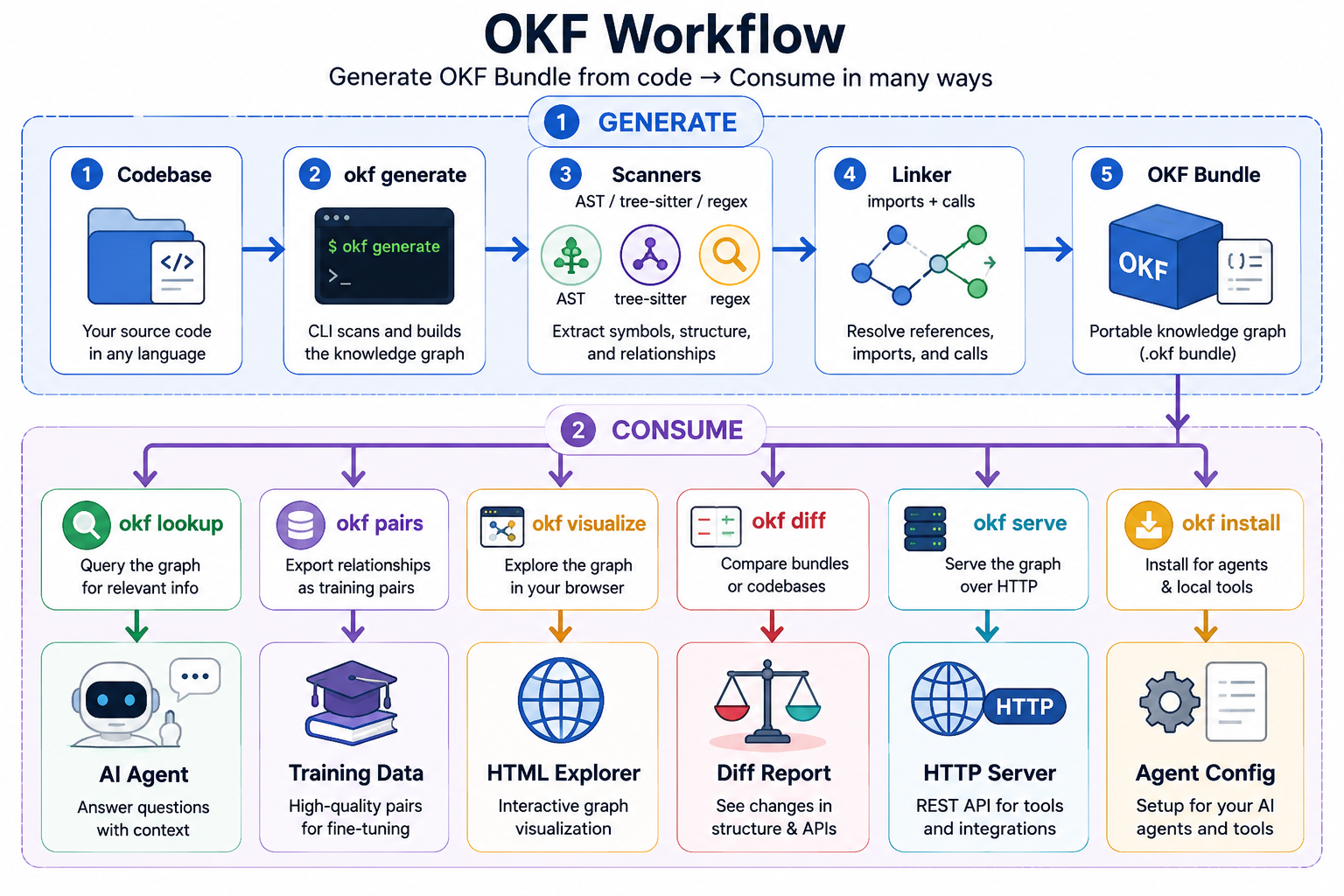
1. Scan  → tree-sitter AST parsers extract functions, classes, modules (17 langs)
2. Link  → cross-reference linker resolves imports→deps, calls→callees
3. Write → OKF v0.2 bundle: structured markdown, mirrors your source tree
4. Update → incremental: SHA256 manifest detects changes, re-parses only dirty files, re-links, edge-diffs, writes only dirty concepts
5. Use   → lookup, ask, diff, visualize, mcp, dashboard — 19 commands
6. Enrich → optional LSP pass (deterministic call-graph refinement) + optional LLM layer: 4 modes, multi-provider routing
Core extraction is fully deterministic and offline. Enrichment is optional, resumable, works with any AI provider. LSP enrichment requires language server binaries on $PATH.
Full language table with per-parser details: docs/languages-and-manifests.md
Supported languages (18)
Python · JavaScript · TypeScript · Go · Java · Rust · Swift · Kotlin · PHP · Dart · Scala · Julia · Ruby · C · C++ · C# · SQL · YAML
Each language lives in its own file under okf/parsers/. Add a new one in minutes — one file + one registry entry.
Domain Classification
Use --domains crossplane to re-classify YAML concepts using data-driven rules. Built-in rules for Crossplane (XRD, Composition, Claim, ProviderConfig, ManagedResource). Custom domains via --domain-rules ./my-rules.yaml. See docs/domain-classification.md.
Manifest formats (20)
requirements.txt · pyproject.toml · package.json · Cargo.toml · Cargo.lock · yarn.lock · pnpm-lock.yaml · go.mod · go.sum · poetry.lock · composer.json · pom.xml · Gemfile · build.gradle / .kts · Package.swift · Dockerfile / Containerfile · docker-compose.yml · mix.exs · project.clj · package.swift
What a bundle looks like
okf_bundle/
├── SUMMARY.md                    ← agent's bird's-eye view
├── index.md                      ← root navigation
├── _dependencies/                ← deps by ecosystem (pip, npm, cargo…)
└── my_project/
    └── connectors/
        ├── index.md              ← lists all concepts in folder
        ├── economic_data.md      ← Module concept
        └── economic_data/
            ├── WorldBankConnector.md   ← Class (signature, methods, calls)
            ├── get_indicator.md        ← Function (params, returns)
            └── search.md               ← Function
Each file follows the OKF v0.2 dialect (extended from Google's OKF v0.1) with structured YAML frontmatter — agents parse it deterministically, no guessing.
Quick Start
Install in 30 seconds
# Via pip
pip install okf-generator

# Or one-liner (macOS / Linux)
curl -fsSL https://raw.githubusercontent.com/UmairBaig8/okf-generator/main/scripts/install.sh | bash
Generate your first bundle
okf generate ./my_project ./okf_bundle
That's it — no API key, no vector DB, no config required.
Incremental updates (fast)
After the first generate, use okf update to re-scan only changed files:
okf update ./my_project ./okf_bundle          # incremental (default)
okf update ./my_project ./okf_bundle --force  # full re-scan
okf update ./my_project ./okf_bundle --watch  # continuous watcher mode
A SHA256 manifest tracks file state. Only changed files are re-parsed; edge-diff detects cascade changes; only dirty concepts are written.
Look up any concept
okf lookup WorldBankConnector

# Filter by type
okf lookup --type Function

# Filter by ecosystem
okf lookup --tag ecosystem:pip

# JSON output for programmatic use
okf lookup --json WorldBankConnector

# Fuzzy / camelCase search
okf lookup repo          # finds UserRepository
Visualize as interactive HTML
okf visualize ./okf_bundle viz.html
# Open viz.html in any browser
Launch the live dashboard
okf dashboard ./okf_bundle --open
Opens a 3-panel FastAPI web UI at http://127.0.0.1:8700 with search, detail inspection, and force-directed graphs.
Agent Integration
One command per agent
okf install writes the exact rules, instructions, and commands each agent needs. No manual configuration.
# Install for all detected agents at once
okf install all

# Or pick specific agents
okf install claude      # Claude Code skill (auto-triggers on "index my codebase")
okf install cursor      # Cursor rules (.cursorrules)
okf install copilot     # GitHub Copilot instructions
okf install windsurf    # Windsurf rules
okf install cline       # Cline rules
okf install opencode    # OpenCode /lookup command
okf install mcp         # Register MCP server (OpenCode + Claude Desktop)
MCP server (11 tools)
Start an offline-first MCP server that exposes your knowledge bundle to any MCP client:
okf mcp ./okf_bundle --port 4567
Tools: lookup, get_concept, find_callers, find_callees, list_by_file, list_dependencies, bundle_info, list_by_type, search_by_tag, get_related, get_manifest_source.
Connect from Cursor, Cline, Claude Desktop, or any MCP-compatible IDE.
Quick agent context
Add to your agent instructions:
This project has an OKF knowledge bundle at ./okf_bundle/.
- Use `okf lookup <Name>` for full concept context.
- Use `okf lookup --type <Type>` to filter by type.
- Read `SUMMARY.md` for the full knowledge map.
Comparison
okf-generator vs RAG / vector search
| Capability | okf-generator | RAG / Vector Search |
|---|---|---|
| Retrieval | ✓ Precise AST lookup (exact symbols) | ~ Approximate (chunk similarity) |
| Token cost per lookup | ✓ ~140 tokens | ~ Varies by chunk strategy |
| Cross-reference edges | ✓ Calls / called-by / imports | ✗ Not supported |
| Privacy | ✓ 100% offline, no data leaves | ✗ Needs embeddings API (data may egress) |
| Search speed | ✓ ~3-4ms (indexed) | ~ 200-500ms (embed + search) |
| Dependency manifest parsing | ✓ 20 formats automatically | ✗ Not designed for this |
| CI/CD integration | ✓ Built-in GitHub Action + impact diff | ✗ Custom pipeline required |
| Training data export | ✓ Built-in JSONL pairs | ✗ Not a feature |
| Context compression | ✓ ~97% reduction (45K→1.2K tokens) | ~ Varies by chunk strategy |
| Setup | ✓ pip install + 1 command | ⚠ Vector DB + embedding pipeline |
Full comparison with Sourcegraph, Graphify/CodeSee, and dep-graph tools: docs/comparison.md
Enterprise & CI/CD
Built-in GitHub Action
A pre-built workflow (.github/workflows/okf-bundle.yml) auto-generates the bundle on every push/PR to main, caches previous bundles per branch, diffs with --impact, and posts a PR comment showing which dependency changes affect which code:
# .github/workflows/okf-bundle.yml
name: OKF Bundle
on:
  push: { branches: [main] }
  pull_request: { branches: [main] }
jobs:
  generate:
    runs-on: ubuntu-latest
    steps:
      - uses: actions/checkout@v4
      - run: pip install okf-generator
      - run: okf generate . okf_bundle
      - run: okf diff .okf_bundle_prev okf_bundle --impact
      - uses: actions/github-script@v7  # post/update PR comment
Fine-tuning data export
Convert your bundle into JSONL training pairs for fine-tuning private local SLMs:
# 5 pair types: codegen, qa, doc, summarize, crosslink
okf pairs ./okf_bundle ./train.jsonl
Docker image
docker pull ghcr.io/umairbaig8/okf-generator/okf-generator:latest
docker run ghcr.io/umairbaig8/okf-generator/okf-generator --help
Pre-commit hook
Auto-regenerates the bundle when source files change — no stale knowledge graphs:
# .pre-commit-config.yaml
repos:
  - repo: local
    hooks:
      - id: okf-generate
        name: okf generate
        entry: okf generate
        language: system
        pass_filenames: false
CI/CD guide + copy-paste workflow template: docs/user-guide/ci-cd.md
CLI Reference
okf --help              Show available commands
okf <command> --help    Show options for a specific command
okf --version           Show version
| Command | Usage | Description |
|---|---|---|
generate |
okf generate [src] [out] [--enrich] |
Scan codebase (auto-detects project root) |
update |
okf update [src] [out] [--force] [--watch] |
Incremental re-scan of changed files |
lookup |
okf lookup <query> |
Instant exact-symbol concept retrieval |
ask |
okf ask <question> |
AI-powered Q&A about your codebase |
enrich |
okf enrich <bundle> [--mode] |
LLM-enhance an existing bundle |
lsp |
okf lsp [bundle] |
LSP call-graph enrichment pass |
diff |
okf diff <old> <new> [--impact] |
Compare two bundles, show dependency impact |
visualize |
okf visualize <bundle> [out.html] |
Generate interactive D3 graph |
mcp |
okf mcp <bundle> [--port] |
Start MCP server with 11 tools |
dashboard |
okf dashboard <bundle> [--port] |
Launch FastAPI live bundle browser |
serve |
okf serve [dir] [--port] |
Browse bundle via local HTTP server |
pairs |
okf pairs <bundle> [output.jsonl] |
Export fine-tuning training pairs |
install |
okf install [agent] |
Write agent integration rules/configs |
init |
okf init [dir] |
Interactive wizard for bundle setup |
summarize |
okf summarize <bundle> |
Regenerate SUMMARY.md for agents |
domains |
okf domains |
List available domain classification rule sets |
config |
okf config [key=value] |
Read/write .okfconfig settings |
migrate |
okf migrate <bundle> |
Migrate v0.1 bundles to v0.2 |
agent |
okf agent [--bundle] |
Interactive REPL over the bundle |
plugin |
okf plugin [list|install|uninstall] |
Manage external parser plugins |
Full CLI reference: docs/cli-reference.md
FAQ
Does this require an API key or internet connection?
No. Core extraction (okf generate) is fully offline and deterministic — no LLM call is made unless you explicitly enable --enrich. All 18 language parsers use tree-sitter (or stdlib equivalent) and work completely air-gapped.
How is this different from RAG / vector search?
RAG retrieves chunks by semantic similarity, which is approximate and can miss exact symbols. okf lookup is exact: it indexes real functions, classes, modules, and dependencies by name and resolves to the precise concept, with zero embedding/vector infrastructure required. Same result every run.
Does my proprietary code leave my local environment? Never. Core extraction runs 100% offline on your local CPU. No code or metadata is sent to any third-party cloud. Optional LLM enrichment can be enabled manually and works with self-hosted models or private enterprise APIs.
Does this work on monorepos or very large codebases?
Yes — scanning is linear in file count. Scope okf generate to a subdirectory if you only need part of the codebase indexed. Multi-bundle support visualizes cross-project edges.
Can I use this without any LLM at all, ever?
Yes. okf generate + okf lookup form a complete zero-LLM workflow. LLM enrichment and training-pair synthesis are optional layers on top — you can get full value without ever providing an API key.
Is the bundle safe to commit to git? Yes — that's the intended workflow. Bundles are plain Markdown with YAML frontmatter — they diff cleanly, version alongside the code they describe, and can be reviewed in any code review tool.
Contributing
git clone https://github.com/UmairBaig8/okf-generator
cd okf-generator
pip install -e ".[dev]"
pytest tests/ -q
415+ tests passing. See CONTRIBUTING.md for full guidelines.
License
MIT — Copyright © 2026 Umair Baig
okf-generator produces OKF v0.2 bundles — an extended dialect of the Open Knowledge Format (OKF) v0.1 by Google. Our v0.2 adds schema version, concept identity, language, status, and typed relationships to every concept file. Not affiliated with Google.
1 maintainer

Metadata
1 maintainer
Release files for okf-generator 0.1.53
For a detailed explanation of source distributions (sdists) and built distributions (wheels), please see the package formats documentation.
Source distribution (sdist)
| File | Size | Uploaded | |
|---|---|---|---|
| okf_generator-0.1.53.tar.gz | 3.1 MB | Details |
Built distribution (wheel)
| File | Interpreter | ABI | Platform | Reset |
|---|---|---|---|---|
| okf_generator-0.1.53-py3-none-any.whl | Python 3 | none | any | Details |
Total release size: 6.0 MB
Release files / okf_generator-0.1.53.tar.gz
| Download URL | okf_generator-0.1.53.tar.gz |
|---|---|
| Size | 3.1 MB |
| Tags | Source |
|
SHA-256 checksum How to use checksums |
51791ebcca9e5222e442bc1031137d392281a247ab3d782609199173a632fd5f
|
|
BLAKE2b-256 checksum How to use checksums |
f775d9e872b624e82033b628c4d3846df29fbf3d7b524e826df77057697f79d5
|
| Upload date | |
|
Uploaded using Trusted Publishing? What is trusted publishing? |
Yes |
| Uploaded via |
twine/7.0.0 CPython/3.13.14
|
Provenance
Provenance describes where a file came from. On PyPI, provenance is shared via attestations, which provide a verifiable record of the build or publishing details. View details, limitations and caveats.


PyPI Publish Attestation
PyPI verified that this artifact, at this checksum, originated from the publisher listed below.
Signed by GitHub Actions, verified by PyPI on Aug 1, 2026.
Transparency logRelease files / okf_generator-0.1.53-py3-none-any.whl
| Download URL | okf_generator-0.1.53-py3-none-any.whl |
|---|---|
| Size | 3.0 MB |
| Tags | Python 3 |
|
SHA-256 checksum How to use checksums |
5e2a7fefb6ded543fac05a3f6eb9df0b7a90defde4fb8d393fdfef797048775e
|
|
BLAKE2b-256 checksum How to use checksums |
95d2b78e90222e4265ea0bb6b0b0ed0d7851eefca1fa52769fcd9e8738dc4e9b
|
| Upload date | |
|
Uploaded using Trusted Publishing? What is trusted publishing? |
Yes |
| Uploaded via |
twine/7.0.0 CPython/3.13.14
|
Provenance
Provenance describes where a file came from. On PyPI, provenance is shared via attestations, which provide a verifiable record of the build or publishing details. View details, limitations and caveats.
PyPI Publish Attestation
PyPI verified that this artifact, at this checksum, originated from the publisher listed below.
Signed by GitHub Actions, verified by PyPI on Aug 1, 2026.
Transparency log













