This release is a pre-release and may not be stable for production use.
omnibias-graph
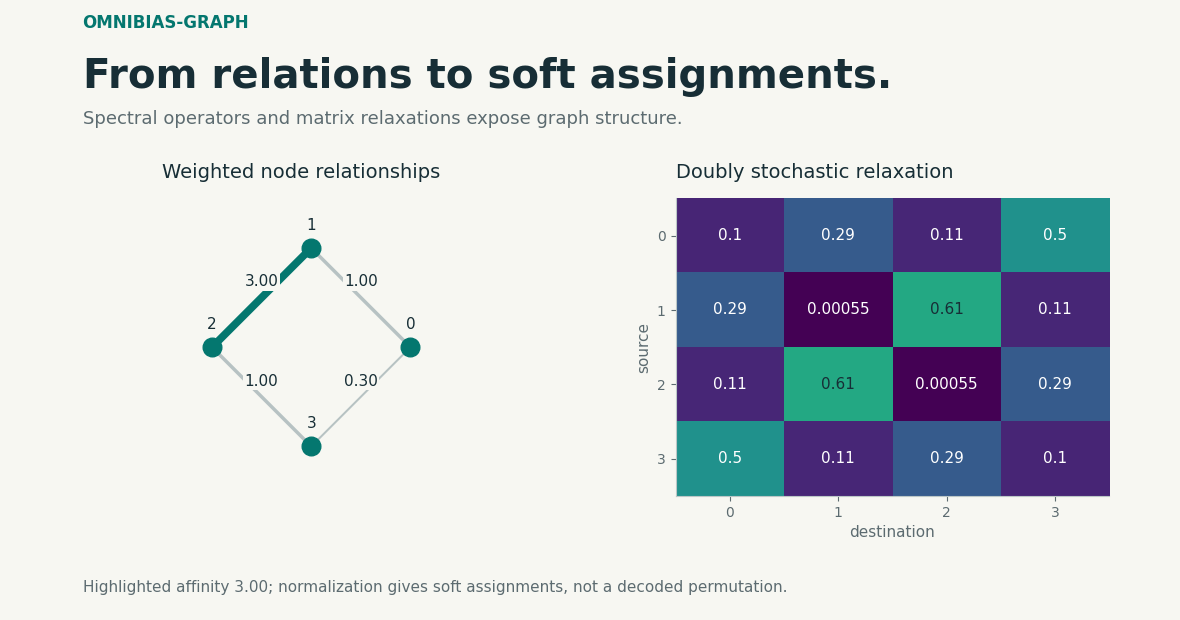
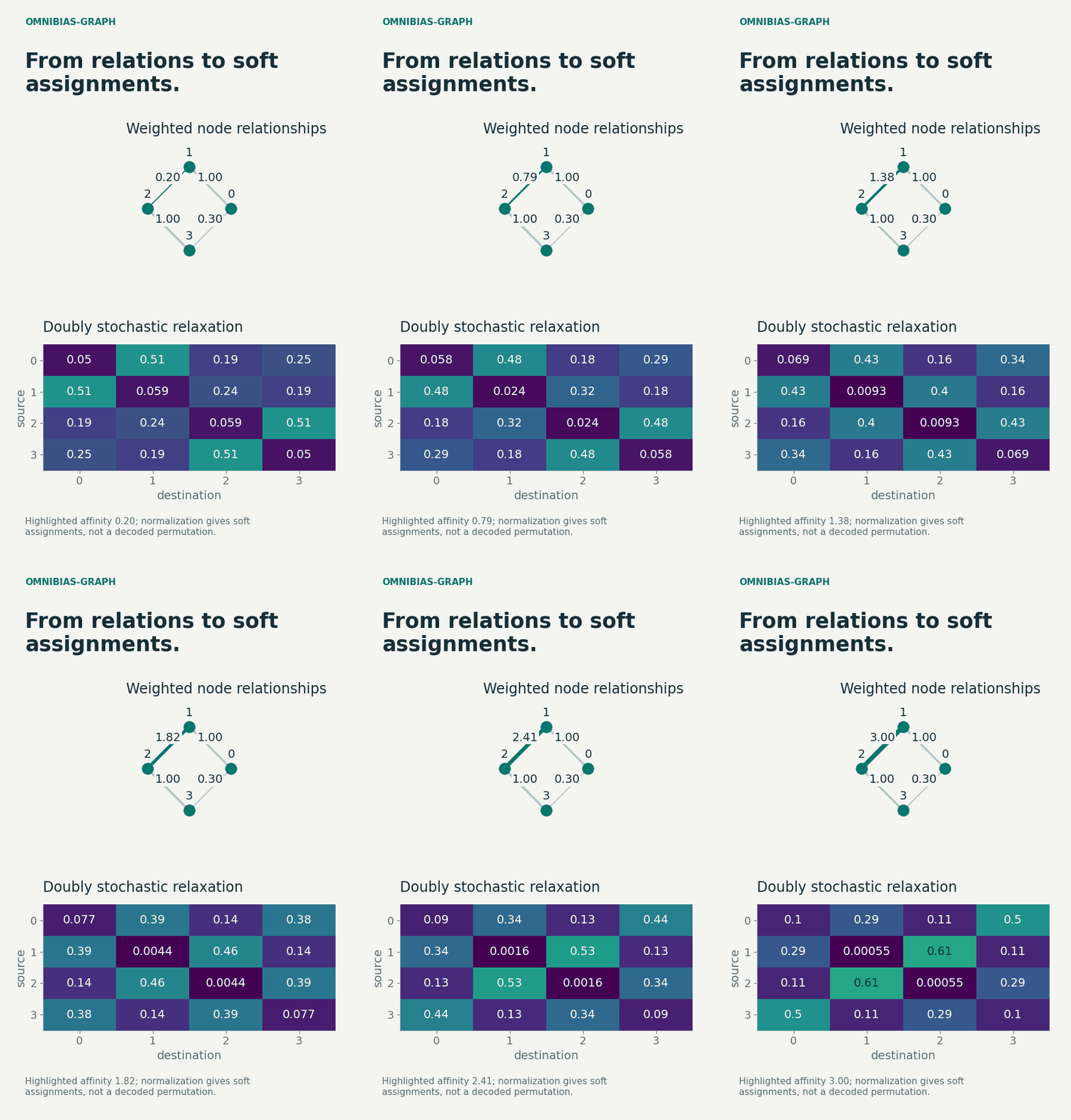
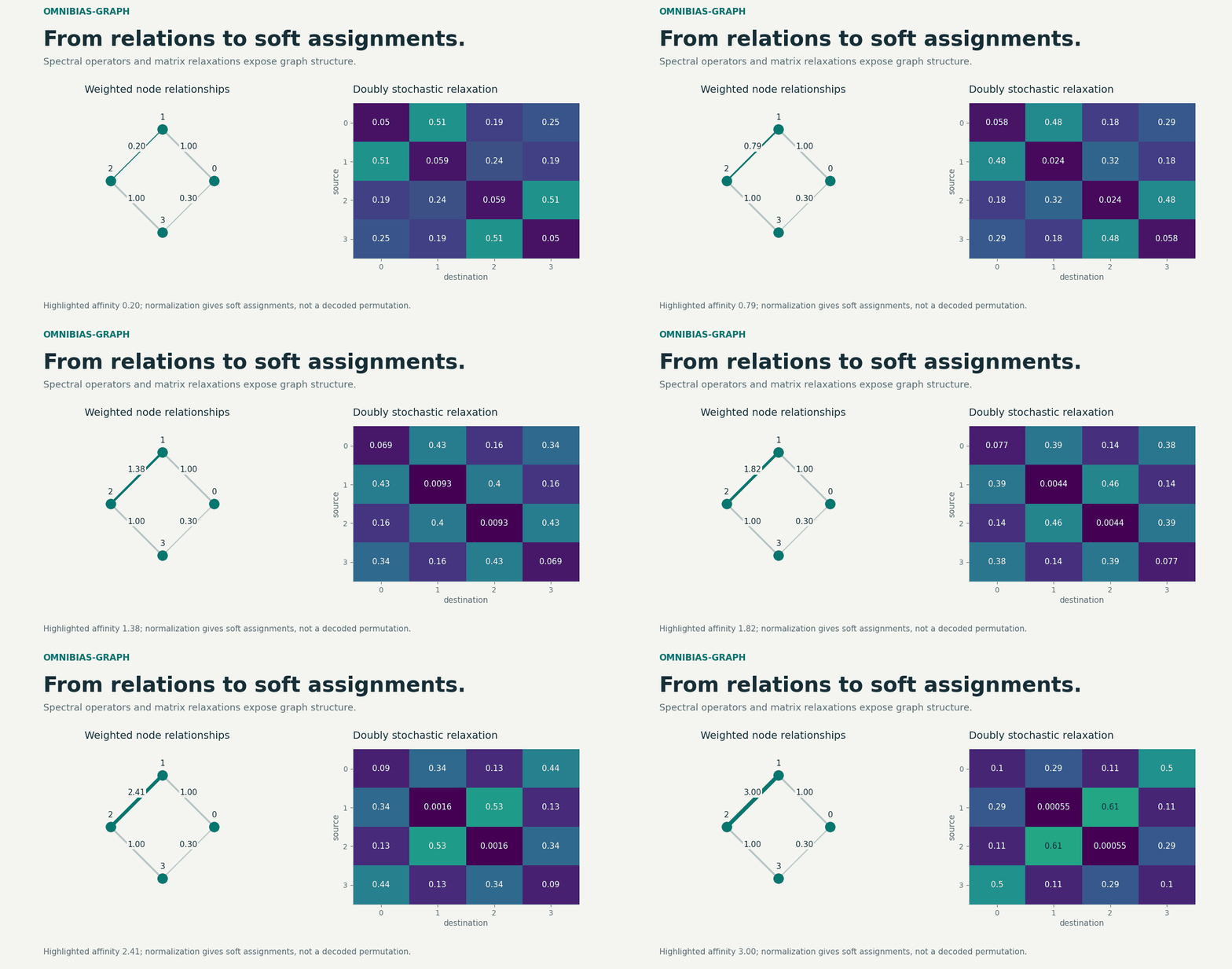
From relations to soft assignments. Spectral operators and matrix relaxations expose graph structure.
Static poster · Narrow-screen animation · How this visual is computed
An affinity or cost matrix enters; spectral graph operators, embeddings, soft orderings or assignment matrices leave. Graph-aware models can compose these outputs with trainable features while respecting each relaxation’s constraints.
The animation uses computed outputs to explain this package. Frame transitions are illustrative unless a training step is explicitly identified; it is not a performance comparison.
API reference · Source · Tests · Talk to Derivon
The mathematical connection
Temperature-like sharpening controls selected soft assignment and sorting operators. Ties and finite iteration residuals must remain visible when interpreting a hardened result. Spectral Laplacians are a separate graph-calculus operation, not automatically a temperature limit. Bias collapse is consumed only where a differentiated model explicitly uses the shared derivative tower.
Run this README
The examples use omnibias-graph[torch] on Python >=3.10. Their installed-wheel
profile selects runtime features, not an editable workspace. Install the prepared
prerelease from PyPI:
python -m pip install --pre "omnibias-graph[torch]==0.1.0a2"
For local development before publication, build and test the coordinated wheelhouse using the release guide. The package's wheel profile executes the examples below outside the source checkout.
Existing published consumers may need historical primitive versions; see the compatibility policy.
Why this package exists
Graph Laplacians describe connectivity and diffusion; smooth assignment matrices provide a route from discrete matching choices to trainable scores. Graph puts these reusable operations in one primitive so application packages can focus on their objective and decoding policy.
What you can build
- Laplacians, spectral embeddings and heat-kernel operations.
- Sinkhorn normalization, soft sorting and soft top-k.
- Torch and JAX realizations plus arrangement-related operators.
Use spectral operators for geometry-aware representations and smooth relaxations when a downstream loss must influence assignment scores. Combinatorial applications, routing workflows and shape models live in consumers. A matrix relaxation is a component of those products rather than a complete optimizer.
A working example
import torch
from omnibias.graph.torch.ops import graph_laplacian, sinkhorn_normalize

adjacency = torch.tensor([[0., 1., 0.], [1., 0., 1.], [0., 1., 0.]])
L = graph_laplacian(adjacency)
assert torch.allclose(L.sum(dim=1), torch.zeros(3))
scores = torch.eye(3, requires_grad=True)
assignment = sinkhorn_normalize(scores, n_iters=30)
(assignment * torch.arange(9).reshape(3, 3)).sum().backward()
assert scores.grad is not None
Choose the right contract
Repeated eigenvalues can make eigenvector gradients ambiguous. Sinkhorn uses a finite iteration budget, so row and column constraints need tolerances. A doubly stochastic matrix is not a permutation until decoded, and a low-temperature choice still needs handling of ties and numerical range.
Explore and validate
The API guide contains the generated module/export inventory. Use it to find the focused implementation rather than guessing a symbol from another package. The capability map connects the primitives to larger scientific workflows.
From the main repository, run the package’s regression suite:
uv run pytest packages/omnibias-graph/tests -q
License
AGPL-3.0-or-later or commercial. See LICENSE and the licensing policy. Comply with the AGPL terms or obtain a signed commercial grant; commercial use alone does not require payment. Commercial terms describe the alternative. Previously distributed Apache editions, where applicable, retain their original grants.
1 maintainer

Metadata
1 maintainer
Release files for omnibias-graph 0.1.0a2
For a detailed explanation of source distributions (sdists) and built distributions (wheels), please see the package formats documentation.
Source distribution (sdist)
| File | Size | Uploaded | |
|---|---|---|---|
| omnibias_graph-0.1.0a2.tar.gz | 35.8 kB | Details |
Built distribution (wheel)
| File | Interpreter | ABI | Platform | Reset |
|---|---|---|---|---|
| omnibias_graph-0.1.0a2-py3-none-any.whl | Python 3 | none | any | Details |
Total release size: 69.1 kB
Release files / omnibias_graph-0.1.0a2.tar.gz
| Download URL | omnibias_graph-0.1.0a2.tar.gz |
|---|---|
| Size | 35.8 kB |
| Tags | Source |
|
SHA-256 checksum How to use checksums |
d37557a7b1fdfee5b2cd6c9febc47295ad05cf3bf072b72d6d368da42f4f3fe5
|
|
BLAKE2b-256 checksum How to use checksums |
d362ff5df5f6cbc44299847465237d25d25b751f34db691fdcc9ec02247cc1b1
|
| Upload date | |
|
Uploaded using Trusted Publishing? What is trusted publishing? |
Yes |
| Uploaded via |
twine/6.1.0 CPython/3.12.9
|
Provenance
Provenance describes where a file came from. On PyPI, provenance is shared via attestations, which provide a verifiable record of the build or publishing details. View details, limitations and caveats.


PyPI Publish Attestation
PyPI verified that this artifact, at this checksum, originated from the publisher listed below.
Signed by GitHub Actions, verified by PyPI on Oct 4, 2026.
Transparency logRelease files / omnibias_graph-0.1.0a2-py3-none-any.whl
| Download URL | omnibias_graph-0.1.0a2-py3-none-any.whl |
|---|---|
| Size | 33.3 kB |
| Tags | Python 3 |
|
SHA-256 checksum How to use checksums |
6a5e93b6fc2814cbb91062de45f63d5d4bcac4f915b4a8a9b17a0317c6a52e43
|
|
BLAKE2b-256 checksum How to use checksums |
88e8d0f2e8935d4407acbbc10c93da948a7dccb950cf359e2ad51bb32977b782
|
| Upload date | |
|
Uploaded using Trusted Publishing? What is trusted publishing? |
Yes |
| Uploaded via |
twine/6.1.0 CPython/3.12.9
|
Provenance
Provenance describes where a file came from. On PyPI, provenance is shared via attestations, which provide a verifiable record of the build or publishing details. View details, limitations and caveats.
PyPI Publish Attestation
PyPI verified that this artifact, at this checksum, originated from the publisher listed below.
Signed by GitHub Actions, verified by PyPI on Oct 4, 2026.
Transparency log