This release is a pre-release and may not be stable for production use.
omnibias-partition
Learn where each expert applies. Regions, memberships and expert outputs form one trainable composition.
Static poster · Narrow-screen animation · How this visual is computed
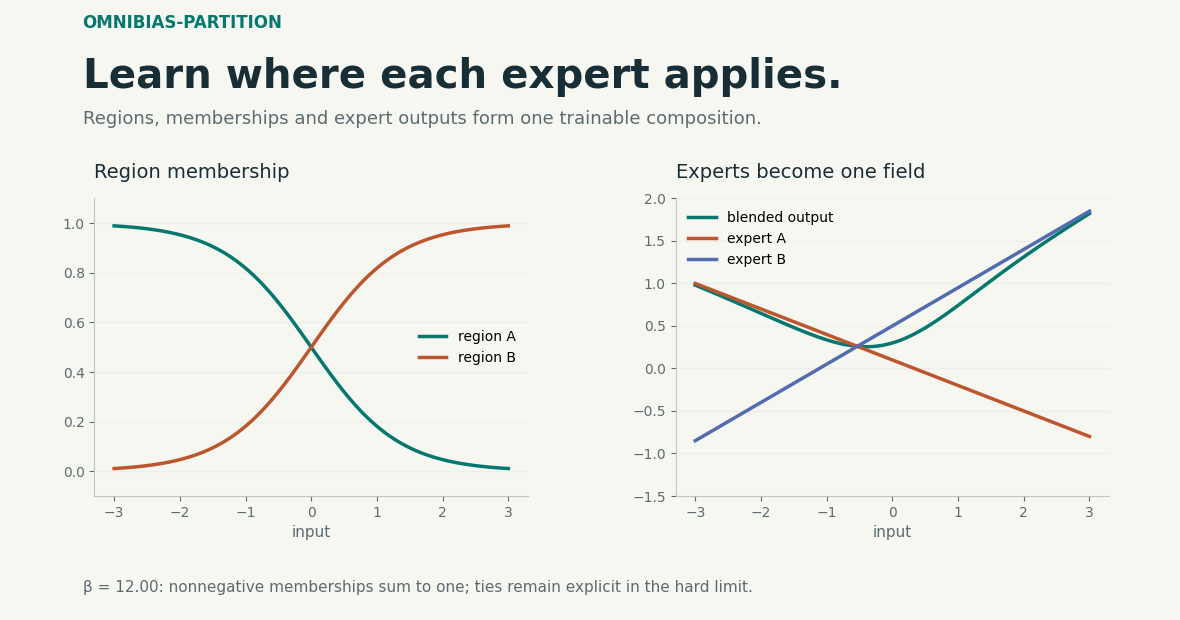
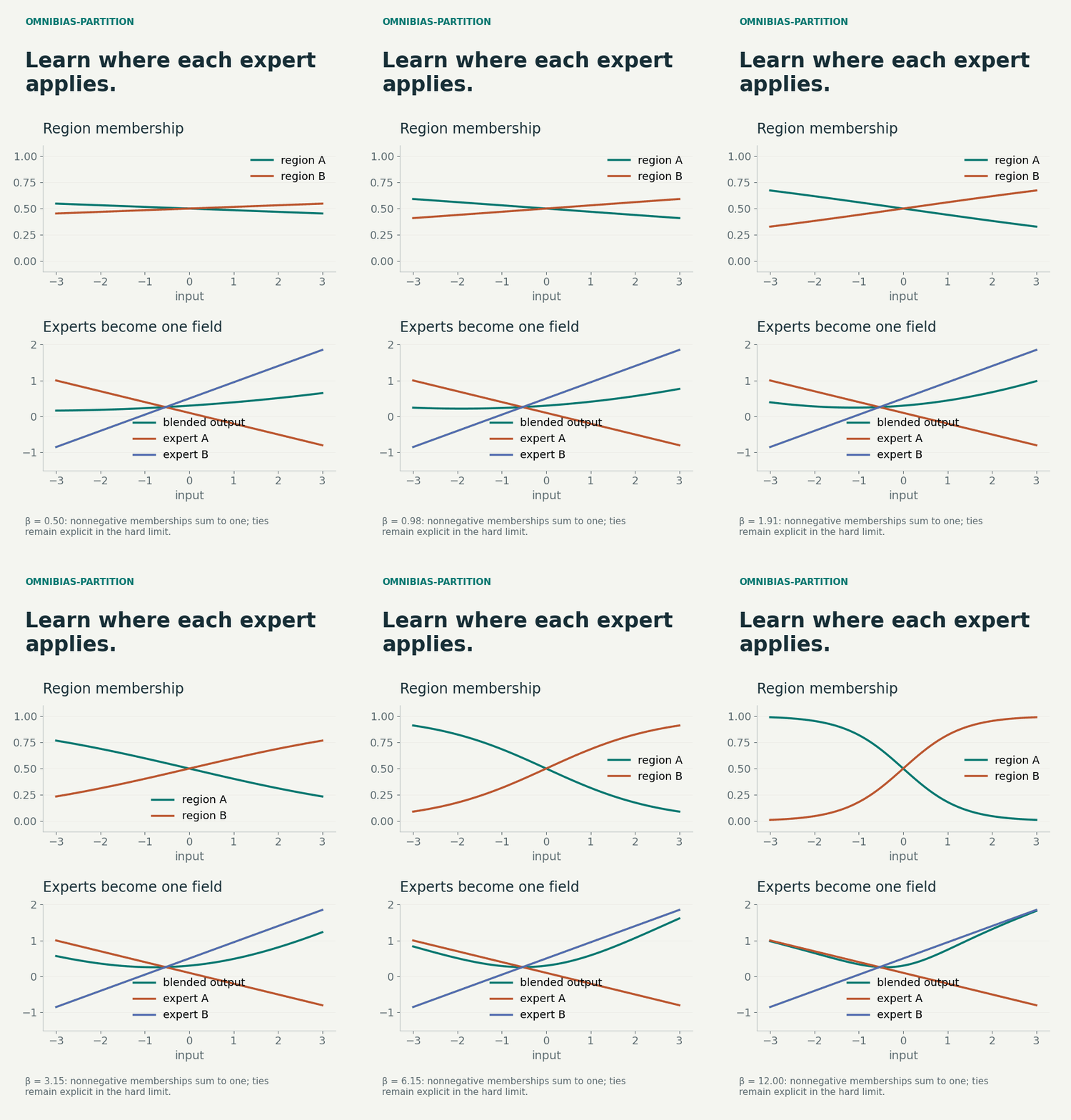
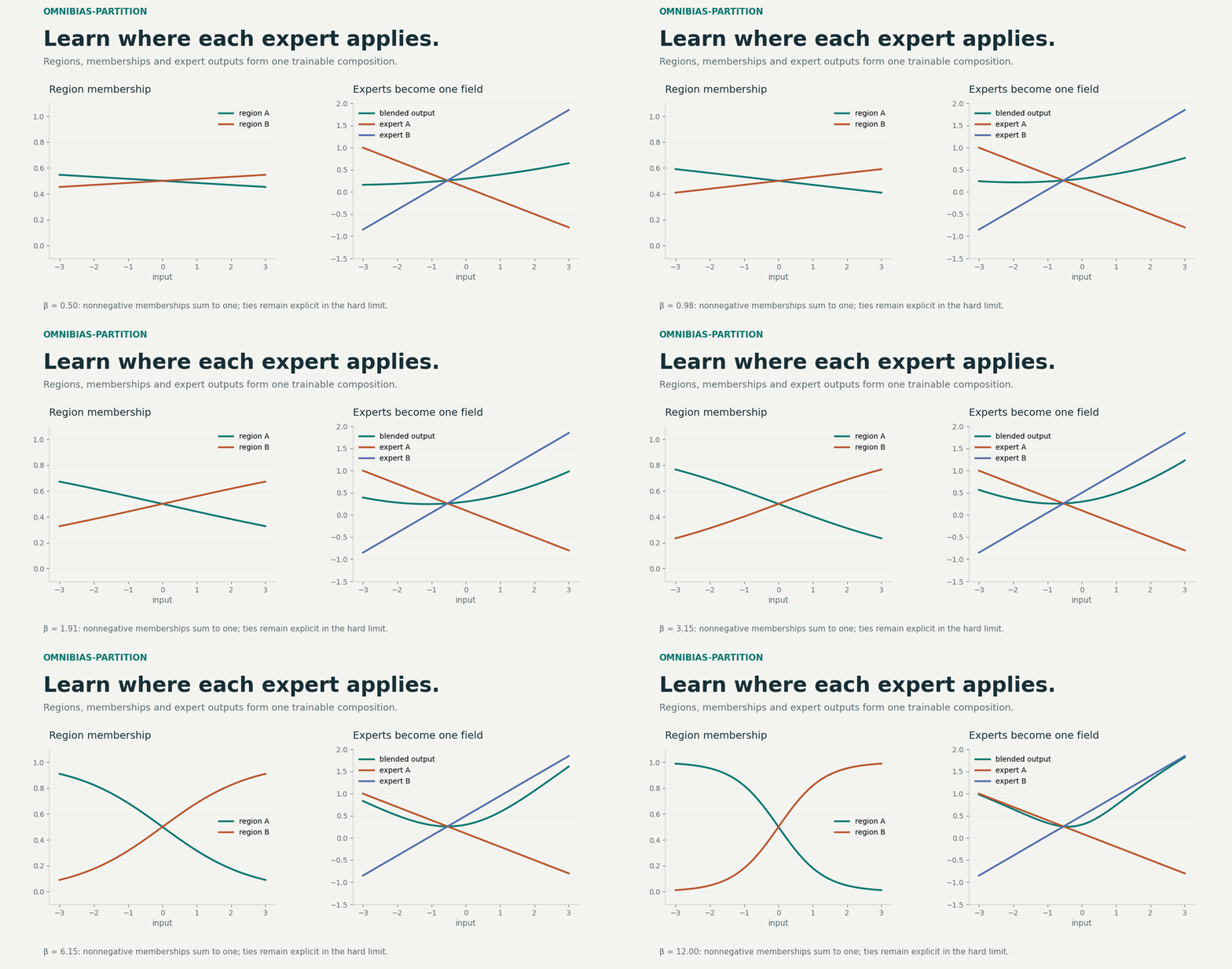
Coordinates, oblique gate parameters and regional experts enter; nonnegative region weights and blended outputs leave. Gradients can update splits and expert parameters together, making region choice part of the learned model.
The animation uses computed outputs to explain this package. Frame transitions are illustrative unless a training step is explicitly identified; it is not a performance comparison.
API reference · Source · Tests · Talk to Derivon
The mathematical connection
Temperature collapse is the central mechanism: sigmoid gates sharpen as β grows. Away from split boundaries they approach hard routing; on a boundary the sigmoid remains one half, so tie conventions matter. Bias-collapse derivative kernels support the smooth experts and gates. A finite-temperature mixture is differentiable; an exact hard if/else discontinuity is not.
Run this README
The examples use omnibias-partition on Python >=3.10. Their installed-wheel
profile selects runtime features, not an editable workspace. Install the prepared
prerelease from PyPI:
python -m pip install --pre "omnibias-partition==0.1.0a2"
For local development before publication, build and test the coordinated wheelhouse using the release guide. The package's wheel profile executes the examples below outside the source checkout.
Existing published consumers may need historical primitive versions; see the compatibility policy.
Why this package exists
Hard routing makes it difficult to learn where one expert should stop and another should begin. A soft partition assigns nonnegative weights that sum to one, so regional outputs can be blended while learning thresholds and features. Increasing inverse temperature sharpens the decision after or during training.
What you can build
- Oblique, axis and sparse split configurations.
- NumPy reference weights with Torch, JAX and Keras realizations.
- Regional composition, hard assignments, readable rules and scoped gap certificates.
Build mixtures of regional physics models, trainable soft trees or piecewise surrogates. This is a routing primitive: stagewise boosting and complete tabular training pipelines live in consumers. The certified add-on supplies integrations for Apache PINN and geometry users who explicitly choose the advanced engines.
A working example
import numpy as np
from omnibias.partition import PartitionConfig, init_params, partition_weights

params = init_params(PartitionConfig(n_features=1, depth=1), rng=0)
x = np.linspace(-2, 2, 9)[:, None]
weights = partition_weights(params, x, beta=3.0)
experts = np.concatenate([x**2, 1 + x], axis=1)
prediction = (weights * experts).sum(axis=1)
assert np.allclose(weights.sum(axis=1), 1.0)
assert prediction.shape == (9,)
Choose the right contract
Finite-temperature routing is differentiable; exact hard if/else is not made smooth by renaming it. At a split boundary a sigmoid gate stays at one half, and hard assignments need a tie policy. A depth-d binary partition has 2**d regions, so deeper routing has a real representation cost.
Explore and validate
The API guide contains the generated module/export inventory. Use it to find the focused implementation rather than guessing a symbol from another package. The capability map connects the primitives to larger scientific workflows.
From the main repository, run the package’s regression suite:
uv run pytest packages/omnibias-partition/tests -q
License
AGPL-3.0-or-later or commercial. See LICENSE and the licensing policy. Comply with the AGPL terms or obtain a signed commercial grant; commercial use alone does not require payment. Commercial terms describe the alternative. Previously distributed Apache editions, where applicable, retain their original grants.
1 maintainer

Metadata
1 maintainer
Release files for omnibias-partition 0.1.0a2
For a detailed explanation of source distributions (sdists) and built distributions (wheels), please see the package formats documentation.
Source distribution (sdist)
| File | Size | Uploaded | Provenance | Actions |
|---|---|---|---|---|
| omnibias_partition-0.1.0a2.tar.gz | 39.3 kB | With provenance | Details for omnibias_partition-0.1.0a2.tar.gz |
Built distribution (wheel)
| File | Interpreter | ABI | Platform | Actions Reset |
|---|---|---|---|---|
| omnibias_partition-0.1.0a2-py3-none-any.whl | Python 3 | none | any | Details for omnibias_partition-0.1.0a2-py3-none-any.whl |
Total release size: 82.6 kB
Release files / omnibias_partition-0.1.0a2.tar.gz
| Download URL | omnibias_partition-0.1.0a2.tar.gz |
|---|---|
| Size | 39.3 kB |
| Tags | Source |
|
SHA-256 checksum How to use checksums |
6481f24b3ca07f8e7c7370d552e85084cd59aad6b68606293f17517f47dd3a41
|
|
BLAKE2b-256 checksum How to use checksums |
8369526b6f8485f82028ad66a1165393714f8c3d19c756100878451b1805c986
|
| Upload date | |
|
Uploaded using Trusted Publishing? What is trusted publishing? |
Yes |
| Uploaded via |
twine/6.1.0 CPython/3.12.9
|
Provenance
Provenance describes where a file came from. On PyPI, provenance is shared via attestations, which provide a verifiable record of the build or publishing details. View details, limitations and caveats.


PyPI Publish Attestation
PyPI verified that this artifact, at this checksum, originated from the publisher listed below.
Signed by GitHub Actions, verified by PyPI on Oct 4, 2026.
Transparency logRelease files / omnibias_partition-0.1.0a2-py3-none-any.whl
| Download URL | omnibias_partition-0.1.0a2-py3-none-any.whl |
|---|---|
| Size | 43.2 kB |
| Tags | Python 3 |
|
SHA-256 checksum How to use checksums |
dcd7ad806a78671f5d65a6ce87006ad7a2cf72244e2a9d400479cb66f55bc6e3
|
|
BLAKE2b-256 checksum How to use checksums |
d0d2536fe0f58ed355552059d3c414f83d111b0204a151037612abb78d10f612
|
| Upload date | |
|
Uploaded using Trusted Publishing? What is trusted publishing? |
Yes |
| Uploaded via |
twine/6.1.0 CPython/3.12.9
|
Provenance
Provenance describes where a file came from. On PyPI, provenance is shared via attestations, which provide a verifiable record of the build or publishing details. View details, limitations and caveats.
PyPI Publish Attestation
PyPI verified that this artifact, at this checksum, originated from the publisher listed below.
Signed by GitHub Actions, verified by PyPI on Oct 4, 2026.
Transparency logSecurity for omnibias-partition 0.1.0a2
Provenance
Provenance describes where a file came from. On PyPI, provenance is shared via attestations, which provide a verifiable record of the build or publishing details. View details, limitations and caveats.
Full provenance
Both files in this release have been uploaded with provenance metadata.
Attestation for omnibias_partition-0.1.0a2.tar.gz
PyPI Publish Attestation
PyPI verified that this artifact, at this checksum, originated from the publisher listed below.
Signed by GitHub Actions, verified by PyPI on Oct 4, 2026.
Transparency logA note on package security
PyPI is a repository for distributing packages, not a service for auditing them. While third-party security researchers and our staff do their best to detect and remove malicious packages, PyPI cannot guarantee the quality, security or suitability of any given package.
To learn more about protecting yourself from malicious actors, visit our package security documentation.