This release is a pre-release and may not be stable for production use.
omnibias-qcalculus
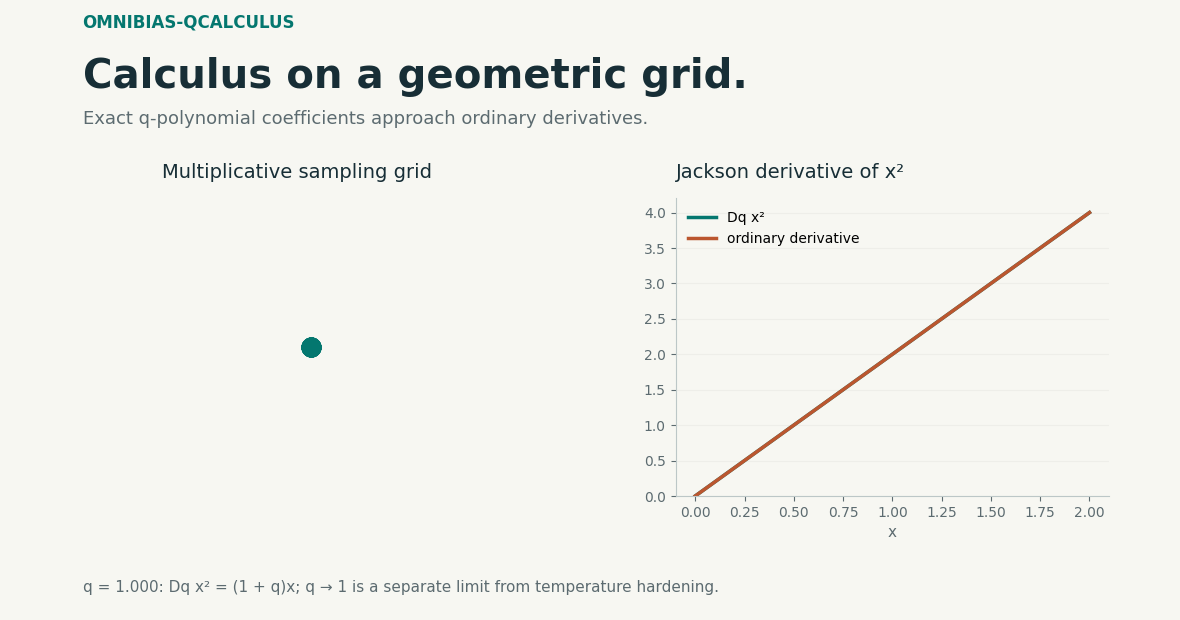
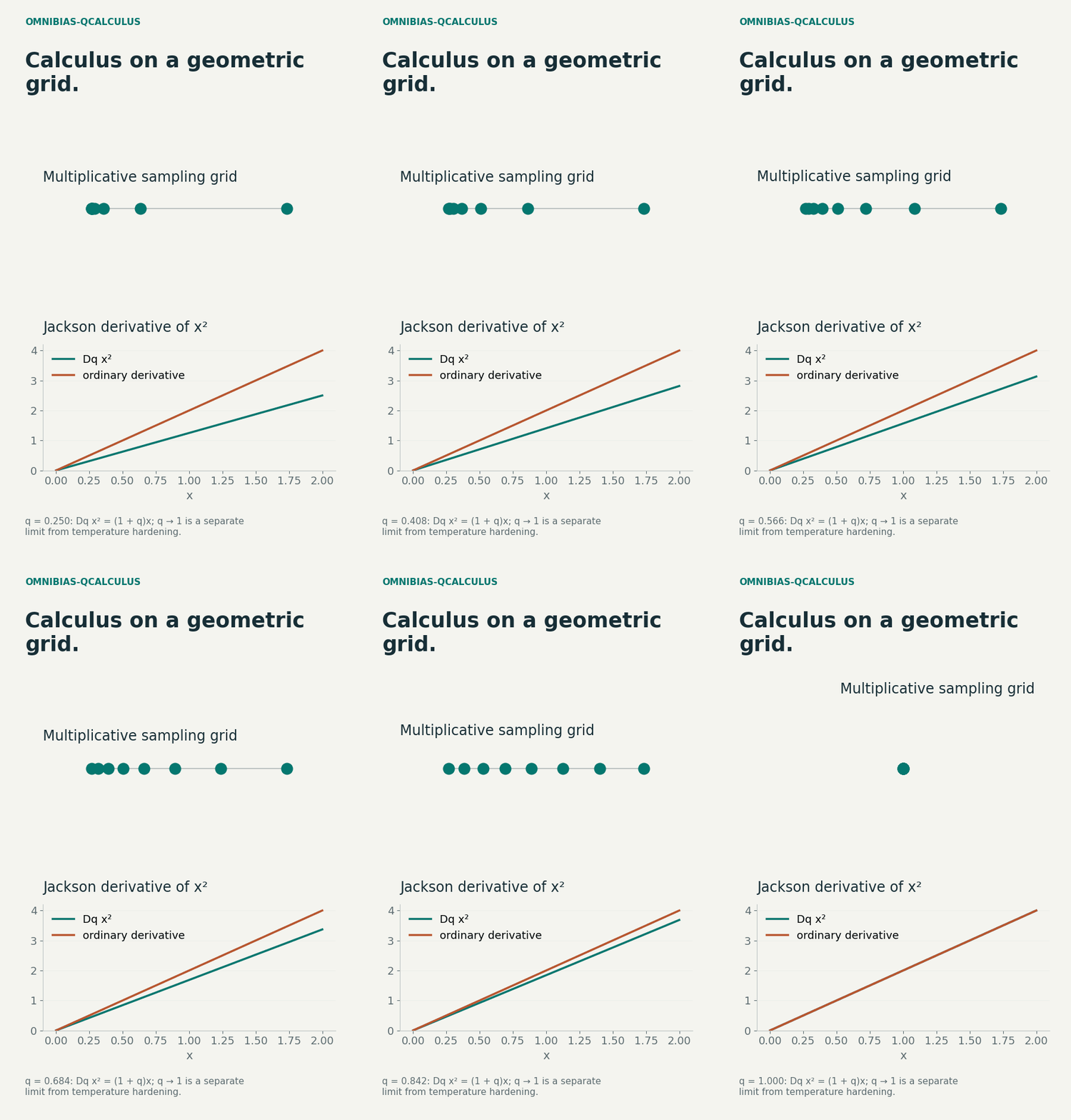
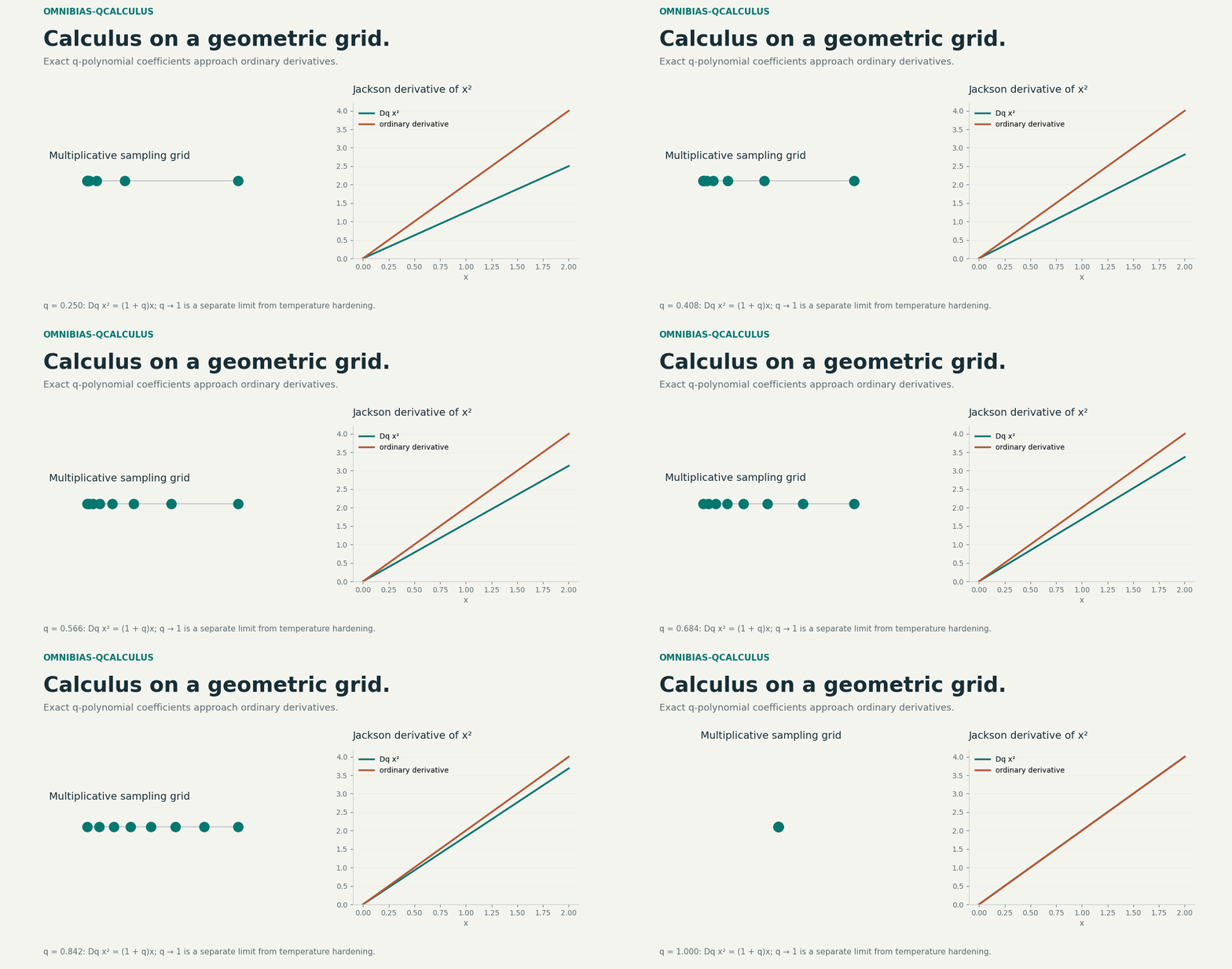
Calculus on a geometric grid. Exact q-polynomial coefficients approach ordinary derivatives.
Static poster · Narrow-screen animation · How this visual is computed
A q-parameter and algebraic coefficients enter; q-numbers, Jackson derivatives and q-integrals leave. Multiplicative sampling supports calculations on a geometric grid, distinct from an additive finite-difference stencil.
The animation uses computed outputs to explain this package. Frame transitions are illustrative unless a training step is explicitly identified; it is not a performance comparison.
API reference · Source · Tests · Talk to Derivon
The mathematical connection
The defining limit here is q → 1, which recovers ordinary calculus. It is distinct from both bias collapse (normalized nearby shifts) and temperature collapse (sharpening soft alternatives). Neither founding mechanism should be substituted for the q-calculus operator definition or its domain restrictions.
Run this README
The examples use omnibias-qcalculus on Python >=3.10. Their installed-wheel
profile selects runtime features, not an editable workspace. Install the prepared
prerelease from PyPI:
python -m pip install --pre "omnibias-qcalculus==0.1.0a2"
For local development before publication, build and test the coordinated wheelhouse using the release guide. The package's wheel profile executes the examples below outside the source checkout.
Existing published consumers may need historical primitive versions; see the compatibility policy.
Why this package exists
Some discrete and multiplicative-scale problems are expressed more naturally by q-differences than by ordinary shifts. Qcalculus exposes that deformation explicitly and connects it to the ordinary derivative as q approaches one. Exact polynomial operations make the relation easy to inspect without numerical differencing.
What you can build
- q-brackets, factorials, binomials and polynomial transforms.
- Jackson derivatives and antiderivatives.
- q-exponential families, series bounds and optional tensor realizations.
Use qcalculus for multiplicative sampling, q-series experiments and time-scale or symbolic consumers that need this register. Its q→1 limit is a separate mechanism from bias collapse and temperature hardening. Select the register that represents the mathematical problem rather than treating the parameters as interchangeable temperatures.
A working example
from fractions import Fraction
from omnibias.qcalculus import q_derivative_poly

# Coefficients are ordered from constant term upward: f(x) = x**2.
assert q_derivative_poly([0, 0, 1], Fraction(1, 2)) == (Fraction(0), Fraction(3, 2))
assert q_derivative_poly([0, 0, 1], Fraction(1)) == (Fraction(0), Fraction(2))
Choose the right contract
Numeric series require a supported q-domain and truncation/convergence controls. Near q=1, a direct quotient may be poorly conditioned; prefer the explicit limit or polynomial path where available. Exact rational coefficients do not make arbitrary floating-point series evaluations exact.
Explore and validate
The API guide contains the generated module/export inventory. Use it to find the focused implementation rather than guessing a symbol from another package. The capability map connects the primitives to larger scientific workflows.
From the main repository, run the package’s regression suite:
uv run pytest packages/omnibias-qcalculus/tests -q
License
Apache-2.0. See LICENSE and the licensing policy.
1 maintainer

Metadata
1 maintainer
Release files for omnibias-qcalculus 0.1.0a2
For a detailed explanation of source distributions (sdists) and built distributions (wheels), please see the package formats documentation.
Source distribution (sdist)
| File | Size | Uploaded | |
|---|---|---|---|
| omnibias_qcalculus-0.1.0a2.tar.gz | 32.5 kB | Details |
Built distribution (wheel)
| File | Interpreter | ABI | Platform | Reset |
|---|---|---|---|---|
| omnibias_qcalculus-0.1.0a2-py3-none-any.whl | Python 3 | none | any | Details |
Total release size: 63.5 kB
Release files / omnibias_qcalculus-0.1.0a2.tar.gz
| Download URL | omnibias_qcalculus-0.1.0a2.tar.gz |
|---|---|
| Size | 32.5 kB |
| Tags | Source |
|
SHA-256 checksum How to use checksums |
c0eb8d12f807a613f261801f4d9439e6e82f471f05f891a668c8188d1f79d632
|
|
BLAKE2b-256 checksum How to use checksums |
09a7829f37202a9929c07800df3604b3ac3b9c830a681af5d23a2564e93294b9
|
| Upload date | |
|
Uploaded using Trusted Publishing? What is trusted publishing? |
Yes |
| Uploaded via |
twine/6.1.0 CPython/3.12.9
|
Provenance
Provenance describes where a file came from. On PyPI, provenance is shared via attestations, which provide a verifiable record of the build or publishing details. View details, limitations and caveats.


PyPI Publish Attestation
PyPI verified that this artifact, at this checksum, originated from the publisher listed below.
Signed by GitHub Actions, verified by PyPI on Oct 4, 2026.
Transparency logRelease files / omnibias_qcalculus-0.1.0a2-py3-none-any.whl
| Download URL | omnibias_qcalculus-0.1.0a2-py3-none-any.whl |
|---|---|
| Size | 31.0 kB |
| Tags | Python 3 |
|
SHA-256 checksum How to use checksums |
aedf61b9f51a85bc0e692f10c24a6cdd0fca23b4a176488a4e64d937dd36b9ce
|
|
BLAKE2b-256 checksum How to use checksums |
08eb3af6db5dfd6172c276a33b649b94019952862dc5daeb3b1d4b6c36fa709a
|
| Upload date | |
|
Uploaded using Trusted Publishing? What is trusted publishing? |
Yes |
| Uploaded via |
twine/6.1.0 CPython/3.12.9
|
Provenance
Provenance describes where a file came from. On PyPI, provenance is shared via attestations, which provide a verifiable record of the build or publishing details. View details, limitations and caveats.
PyPI Publish Attestation
PyPI verified that this artifact, at this checksum, originated from the publisher listed below.
Signed by GitHub Actions, verified by PyPI on Oct 4, 2026.
Transparency log