This release is a pre-release and may not be stable for production use.
omnibias-torch
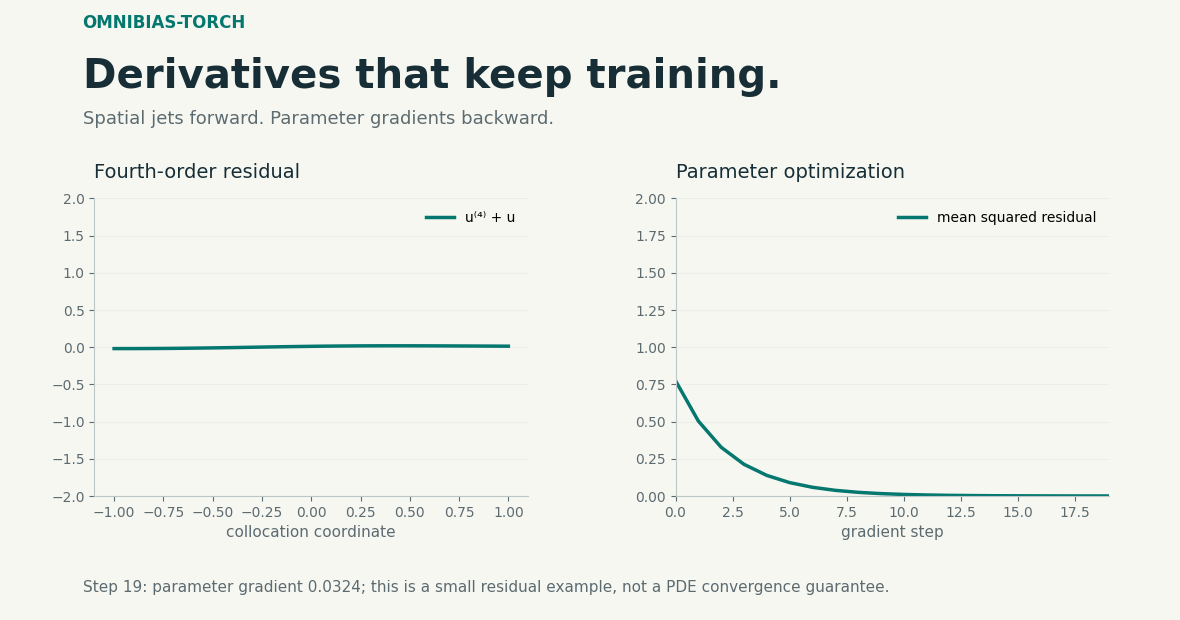
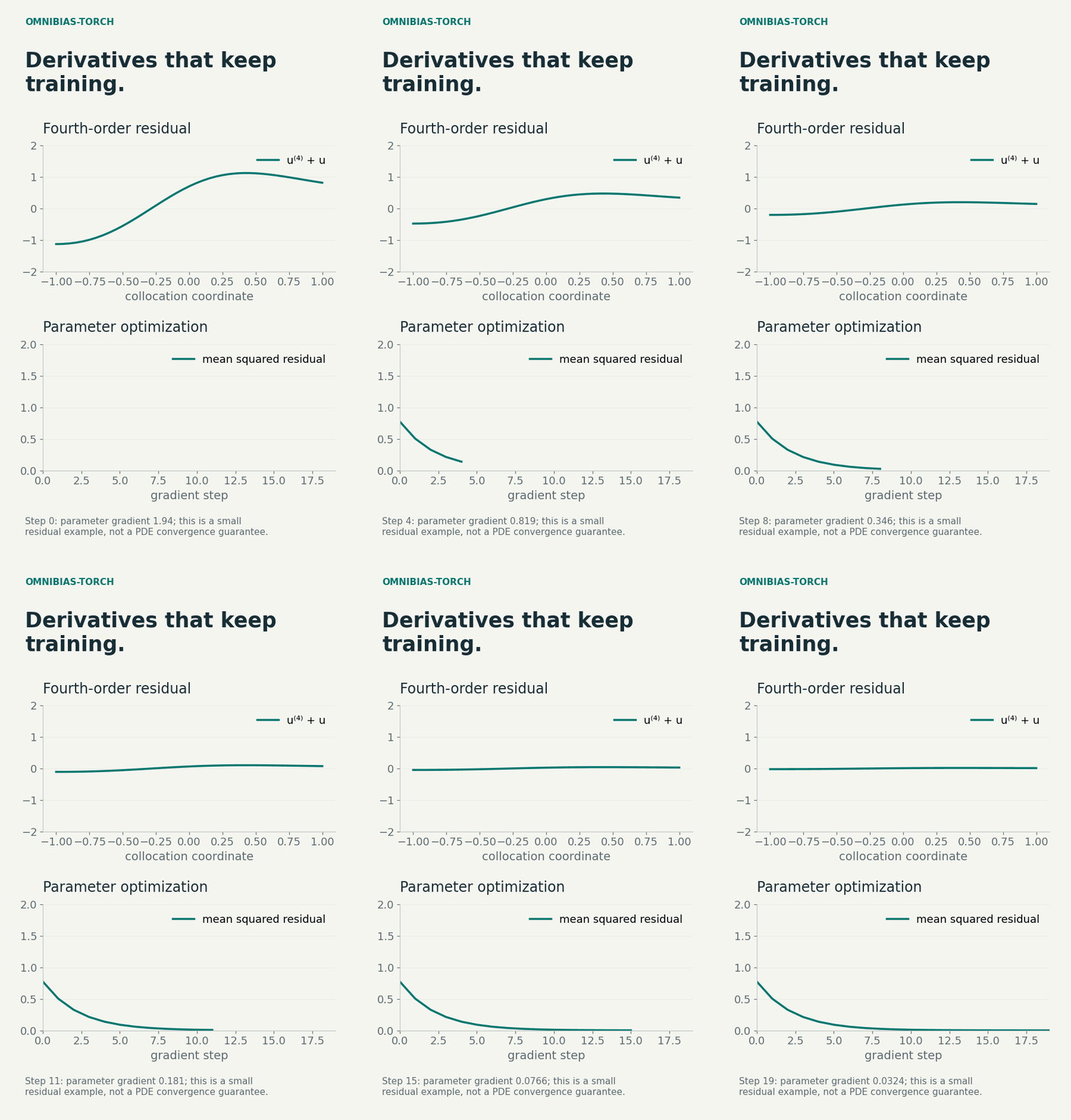
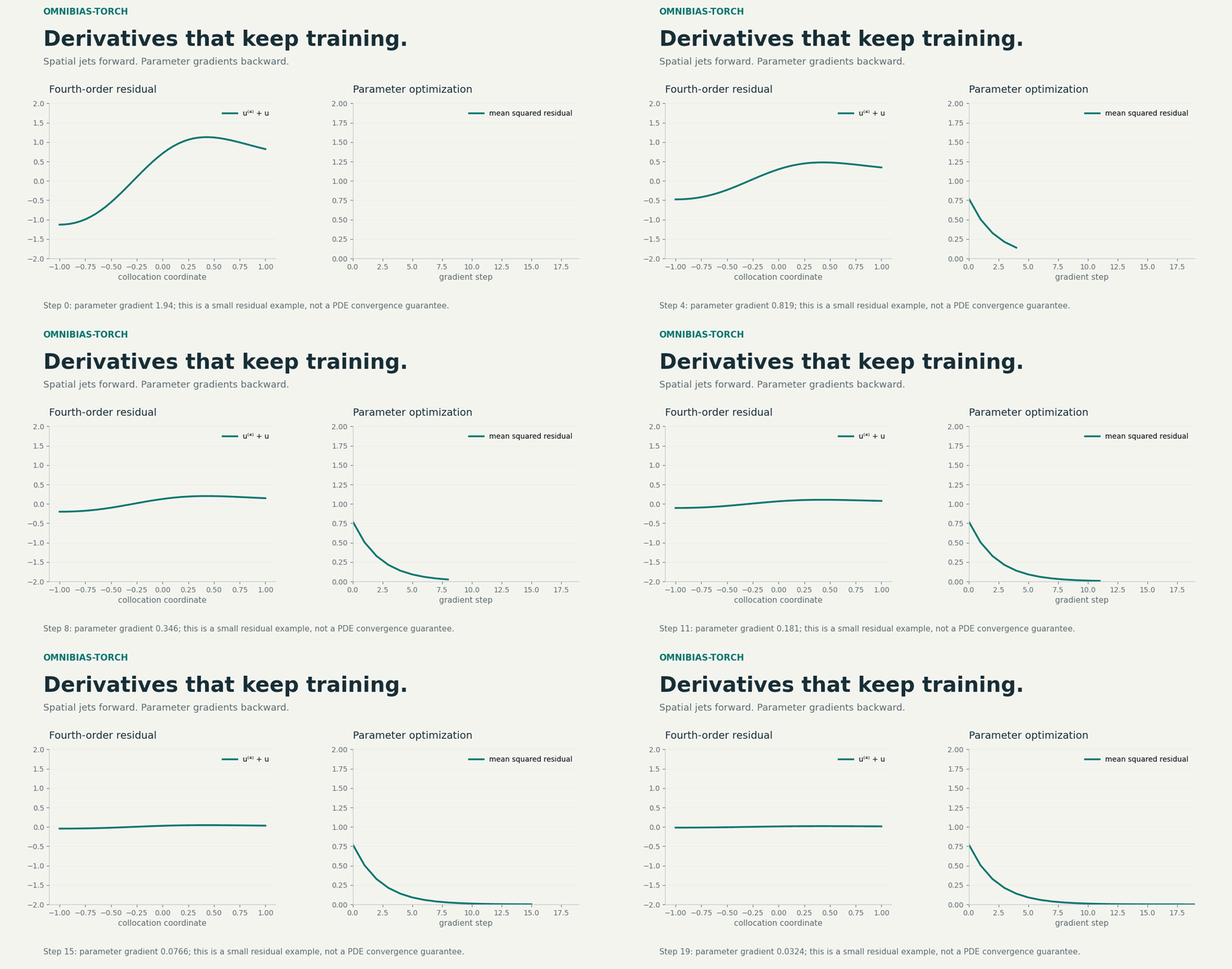
Derivatives that keep training. Spatial jets forward. Parameter gradients backward.
Static poster · Narrow-screen animation · How this visual is computed
Torch tensors and supported network layers enter; activation derivatives, directional jets and specialized contractions leave as tensors still connected to model parameters. Use this backend to train a high-order residual without constructing a nested spatial backward graph.
The animation uses computed outputs to explain this package. Frame transitions are illustrative unless a training step is explicitly identified; it is not a performance comparison.
API reference · Source · Tests · Talk to Derivon
The mathematical connection
Bias collapse becomes an analytic tensor kernel here: evaluate the shared activation polynomial, then propagate normalized Taylor coefficients through layers. Parameter autograd remains available through that calculation. Temperature collapse is realized by separate soft-gate primitives; this backend provides their trainable arithmetic rather than a tree-learning algorithm.
Run this README
The examples use omnibias-torch on Python >=3.10. Their installed-wheel
profile selects runtime features, not an editable workspace. Install the prepared
prerelease from PyPI:
python -m pip install --pre "omnibias-torch==0.5.0rc1"
For local development before publication, build and test the coordinated wheelhouse using the release guide. The package's wheel profile executes the examples below outside the source checkout.
Existing published consumers may need historical primitive versions; see the compatibility policy.
Why this package exists
A fourth-order residual can require more derivative work than evaluating the network itself. Instead of recursively asking spatial autograd for another gradient, carry Taylor coefficients through supported layers. The result remains a tensor expression, so ordinary parameter autograd can optimize the residual.
What you can build
- Direct activation derivatives and composable directional Taylor jets.
- Mixed partials for coupled PDE residuals and direct Laplacian contractions when the full Hessian is unnecessary.
- Trainable operator layers, reusable architectures and residual-optimizer interfaces.
Use directional jets for a few directions, mixed jets when you need the complete selected order, and specialized Laplacians for trace-like operators. These are different algorithms with different output sizes. Choose the operator your residual consumes before choosing a general Hessian implementation.
A working example
import torch
from omnibias.torch.jet import mlp_jet, jet_to_tower

w = torch.tensor([[0.5], [-0.3]], dtype=torch.float64, requires_grad=True)
layers = [(w, torch.tensor([0.1, 0.2]), "tanh"),
          (torch.tensor([[0.6, -0.4]], dtype=torch.float64), None, None)]
x = torch.tensor([0.3], dtype=torch.float64)
tower = jet_to_tower(mlp_jet(x, torch.ones_like(x), layers, order=4))
residual = tower[4] + tower[0]  # an illustrative fourth-order operator
residual.square().mean().backward()
assert w.grad is not None and torch.isfinite(w.grad).all()
Choose the right contract
Jet row k stores the derivative divided by k!. Convert with jet_to_tower at derivative-facing boundaries. Mixed coefficients use multi-index factorials. Shared algebra gives comparable mathematics, not universal bit identity across devices. Dense mixed jets still grow combinatorially; no fixed dimension ceiling means no hard-coded cap, not constant memory.
Explore and validate
The API guide contains the generated module/export inventory. Use it to find the focused implementation rather than guessing a symbol from another package. The capability map connects the primitives to larger scientific workflows.
From the main repository, run the package’s regression suite:
uv run pytest packages/omnibias-torch/tests -q
License
Apache-2.0. See LICENSE and the licensing policy.
1 maintainer

Metadata
1 maintainer
Release files for omnibias-torch 0.5.0rc1
For a detailed explanation of source distributions (sdists) and built distributions (wheels), please see the package formats documentation.
Source distribution (sdist)
| File | Size | Uploaded | Provenance | Actions |
|---|---|---|---|---|
| omnibias_torch-0.5.0rc1.tar.gz | 236.5 kB | With provenance | Details for omnibias_torch-0.5.0rc1.tar.gz |
Built distribution (wheel)
| File | Interpreter | ABI | Platform | Actions Reset |
|---|---|---|---|---|
| omnibias_torch-0.5.0rc1-py3-none-any.whl | Python 3 | none | any | Details for omnibias_torch-0.5.0rc1-py3-none-any.whl |
Total release size: 432.6 kB
Release files / omnibias_torch-0.5.0rc1.tar.gz
| Download URL | omnibias_torch-0.5.0rc1.tar.gz |
|---|---|
| Size | 236.5 kB |
| Tags | Source |
|
SHA-256 checksum How to use checksums |
dfe80ab69c448fe9c389553d707e20a47bc35f4059374f007c3fe28ea932649c
|
|
BLAKE2b-256 checksum How to use checksums |
b2d5d8437f00ab6acc1c23d1739a1e789f682b918af5be5b6ec38dc63a29320a
|
| Upload date | |
|
Uploaded using Trusted Publishing? What is trusted publishing? |
Yes |
| Uploaded via |
twine/6.1.0 CPython/3.12.9
|
Provenance
Provenance describes where a file came from. On PyPI, provenance is shared via attestations, which provide a verifiable record of the build or publishing details. View details, limitations and caveats.


PyPI Publish Attestation
PyPI verified that this artifact, at this checksum, originated from the publisher listed below.
Signed by GitHub Actions, verified by PyPI on Oct 4, 2026.
Transparency logRelease files / omnibias_torch-0.5.0rc1-py3-none-any.whl
| Download URL | omnibias_torch-0.5.0rc1-py3-none-any.whl |
|---|---|
| Size | 196.1 kB |
| Tags | Python 3 |
|
SHA-256 checksum How to use checksums |
11d5be56a8b166a542ee6dfe00ab778dc4b3782ef5153221720c41627af50c11
|
|
BLAKE2b-256 checksum How to use checksums |
a3c06043356af68e3ff6c2582ab82525d5af4c6a2f7f6523c4465cc15a532512
|
| Upload date | |
|
Uploaded using Trusted Publishing? What is trusted publishing? |
Yes |
| Uploaded via |
twine/6.1.0 CPython/3.12.9
|
Provenance
Provenance describes where a file came from. On PyPI, provenance is shared via attestations, which provide a verifiable record of the build or publishing details. View details, limitations and caveats.
PyPI Publish Attestation
PyPI verified that this artifact, at this checksum, originated from the publisher listed below.
Signed by GitHub Actions, verified by PyPI on Oct 4, 2026.
Transparency logSecurity for omnibias-torch 0.5.0rc1
Provenance
Provenance describes where a file came from. On PyPI, provenance is shared via attestations, which provide a verifiable record of the build or publishing details. View details, limitations and caveats.
Full provenance
Both files in this release have been uploaded with provenance metadata.
Attestation for omnibias_torch-0.5.0rc1.tar.gz
PyPI Publish Attestation
PyPI verified that this artifact, at this checksum, originated from the publisher listed below.
Signed by GitHub Actions, verified by PyPI on Oct 4, 2026.
Transparency logA note on package security
PyPI is a repository for distributing packages, not a service for auditing them. While third-party security researchers and our staff do their best to detect and remove malicious packages, PyPI cannot guarantee the quality, security or suitability of any given package.
To learn more about protecting yourself from malicious actors, visit our package security documentation.