
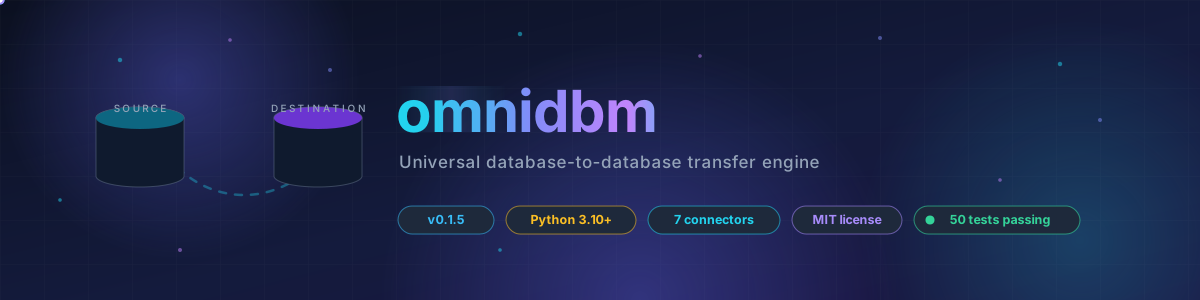






omnidbm moves data between any supported database and any other. MongoDB, PostgreSQL, MySQL, SQLite, Redis, CSV, JSONL — pick a source, pick a destination, transfer. One package, one CLI, one lossless data bus.
Features
- Any-to-any transfers — every connector speaks both directions; no source/destination pairing limits
- Lossless type bus — datetimes, ObjectIds, Binary, and Decimals survive round trips via JSON-safe type tags
- Zero hardcoding — everything is configured per-run with CLI flags; nothing is baked in
- Automatic schema — PostgreSQL, MySQL, and SQLite destinations are created and typed for you
- Interactive wizard — guided setup for every supported database
- Preflight checks —
doctorverifies connectivity before you start - Battle-tested basics — batch size, per-table limits, filters, drop-first, conflict policies, dry runs, index copy
Install
pip install omnidbm

pip install "omnidbm[mysql]"   # MySQL support
pip install "omnidbm[redis]"   # Redis support
pip install "omnidbm[all]"     # everything
Requires Python 3.10+. MongoDB (pymongo) and PostgreSQL (psycopg) drivers are included; MySQL and Redis drivers are optional extras.
Quick start
# Transfer every table, schema included
omnidbm transfer -s mongodb://user:pass@host:27017/db -d postgresql://user:pass@host:5432/db

# Selective: specific tables, bigger batches, wipe the destination first
omnidbm transfer -s mongodb://... -d postgresql://... -t users,orders --batch-size 2000 --drop-first

# Dry run: count only, no writes
omnidbm transfer -s csv://./data -d mongodb://... --dry-run

# Guided interactive setup
omnidbm wizard

# Inspect a source before moving anything
omnidbm inspect mongodb://user:pass@host:27017/db --sample 3

# Connectivity preflight
omnidbm doctor mongodb://... postgresql://...
Options
| Flag | Description |
|---|---|
-s, --source |
Source URI |
-d, --dest |
Destination URI |
-t, --tables |
Comma-separated tables (default: all) |
--batch-size |
Documents per batch (default 1000) |
--drop-first |
Drop destination table before transferring |
--dry-run |
Count documents only, no writes |
--limit |
Max documents per table |
--filter |
Source-side JSON filter, e.g. {"status":"active"} |
--conflict |
skip (default), overwrite, or error |
--copy-indexes |
Copy indexes (MongoDB only) |
--copy-options |
Copy collection options (MongoDB only) |
URI schemes
| Scheme | Example |
|---|---|
| MongoDB | mongodb://user:pass@host:27017/db · mongodb+srv://... |
| PostgreSQL | postgresql://user:pass@host:5432/db |
| MySQL | mysql://user:pass@host:3306/db |
| SQLite | sqlite://C:/path/db.sqlite · sqlite://:memory: |
| Redis | redis://user:pass@host:6379/0 |
| CSV | csv://C:/path/file.csv · csv://C:/data/ (directory = multiple tables) |
| JSONL | jsonl://C:/path/out.jsonl · jsonl://C:/data/ |
Redis treats key prefixes (split on :) as tables; (all) targets every key. Documents use the shape {"_key", "_value", "_ttl"} and support strings, hashes, lists, and sets.
Python API
from omnidbm import transfer, TransferConfig, ConnectorConfig, TableSpec

config = TransferConfig(
    source=ConnectorConfig(uri="mongodb://user:pass@host:27017/db"),
    dest=ConnectorConfig(uri="postgresql://user:pass@host:5432/db"),
    tables=[TableSpec(source="users", dest="users")],
    drop_first=True,
)
results = transfer(config)
Custom connectors
Subclass BaseConnector, implement connect, list_tables, read_stream, write_stream, and close, then register:
from omnidbm.core.connector import BaseConnector, register


@register("myproto")
class MyConnector(BaseConnector): ...
How the type bus works
Every document is normalized to JSON-safe values on the wire, tagged so nothing is lost in transit:
| Type | Tag |
|---|---|
| datetime | {"$omni:datetime": "2026-08-17T12:00:00+00:00"} |
| ObjectId | {"$omni:objectid": "507f1f77bcf86cd799439011"} |
| Binary | {"$omni:binary": "<base64>"} |
| Decimal | {"$omni:decimal": "99.95"} |
Development
git clone https://github.com/Notookk/Omnidbm
pip install -e ".[dev]"

pytest          # run the test suite
ruff check .    # lint
ruff format .   # format
Roadmap
- Resumable transfers with checkpoints
- Saved config profiles
- Parallel table transfers
- Incremental / delta sync
License
MIT — see LICENSE.
1 maintainer

Release files for omnidbm 0.1.2
For a detailed explanation of source distributions (sdists) and built distributions (wheels), please see the package formats documentation.
Source distribution (sdist)
| File | Size | Uploaded | |
|---|---|---|---|
| omnidbm-0.1.2.tar.gz | 23.9 kB | Details |
Built distribution (wheel)
| File | Interpreter | ABI | Platform | Reset |
|---|---|---|---|---|
| omnidbm-0.1.2-py3-none-any.whl | Python 3 | none | any | Details |
Total release size: 50.9 kB
Release files / omnidbm-0.1.2.tar.gz
| Download URL | omnidbm-0.1.2.tar.gz |
|---|---|
| Size | 23.9 kB |
| Tags | Source |
|
SHA-256 checksum How to use checksums |
dc29b340d217ffdb47f94d94295287bb3cf320d1609e1d54c582e53f35015a6d
|
|
BLAKE2b-256 checksum How to use checksums |
c91dbc4b308a2bad48896ad342784b4c50a57b2724eecb1819945928b50c66ba
|
| Upload date | |
|
Uploaded using Trusted Publishing? What is trusted publishing? |
Yes |
| Uploaded via |
twine/7.0.0 CPython/3.13.14
|
Provenance
Provenance describes where a file came from. On PyPI, provenance is shared via attestations, which provide a verifiable record of the build or publishing details. View details, limitations and caveats.


PyPI Publish Attestation
PyPI verified that this artifact, at this checksum, originated from the publisher listed below.
Signed by GitHub Actions, verified by PyPI on Aug 17, 2026.
Transparency logRelease files / omnidbm-0.1.2-py3-none-any.whl
| Download URL | omnidbm-0.1.2-py3-none-any.whl |
|---|---|
| Size | 27.0 kB |
| Tags | Python 3 |
|
SHA-256 checksum How to use checksums |
638456f29f9066656ffa9ecfa53494a29cfad766ffb06a5e9cecbf5872756f2b
|
|
BLAKE2b-256 checksum How to use checksums |
611da974aacf5cd6cce5846944ea03850e8102282b1cd2d3e15d301a04969cb4
|
| Upload date | |
|
Uploaded using Trusted Publishing? What is trusted publishing? |
Yes |
| Uploaded via |
twine/7.0.0 CPython/3.13.14
|
Provenance
Provenance describes where a file came from. On PyPI, provenance is shared via attestations, which provide a verifiable record of the build or publishing details. View details, limitations and caveats.
PyPI Publish Attestation
PyPI verified that this artifact, at this checksum, originated from the publisher listed below.
Signed by GitHub Actions, verified by PyPI on Aug 17, 2026.
Transparency log













