
onepass
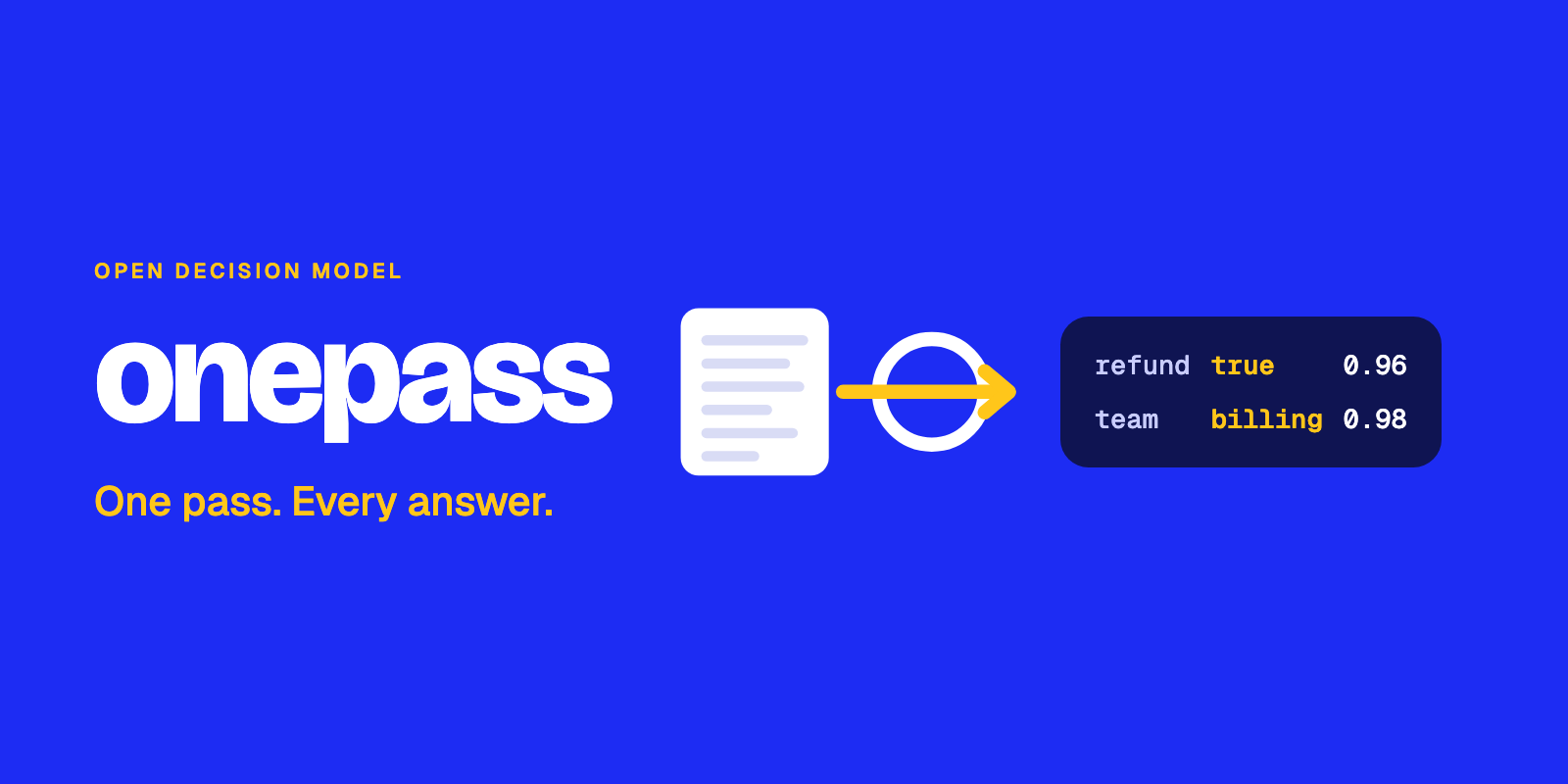
A tiny open decision model. You give it a piece of text (the "state") and typed questions: yes/no, choose one option, or pick a level on a scale. It returns a probability for every possible answer, for all questions at once, from a single forward pass. It generates no tokens, so the output can never be malformed.
The model is Qwen3-0.6B (or Qwen3-1.7B) with a LoRA adapter, trained on open datasets. It was never trained on the benchmark it is scored on.
All models are in the onepass collection on Hugging Face:
| Size | transformers | GGUF (llama.cpp) | LoRA adapter |
|---|---|---|---|
| 0.6B | onepass-qwen3-0.6b | onepass-qwen3-0.6b-GGUF | onepass-qwen3-0.6b-lora |
| 1.7B | onepass-qwen3-1.7b | onepass-qwen3-1.7b-GGUF | onepass-qwen3-1.7b-lora |
What it does
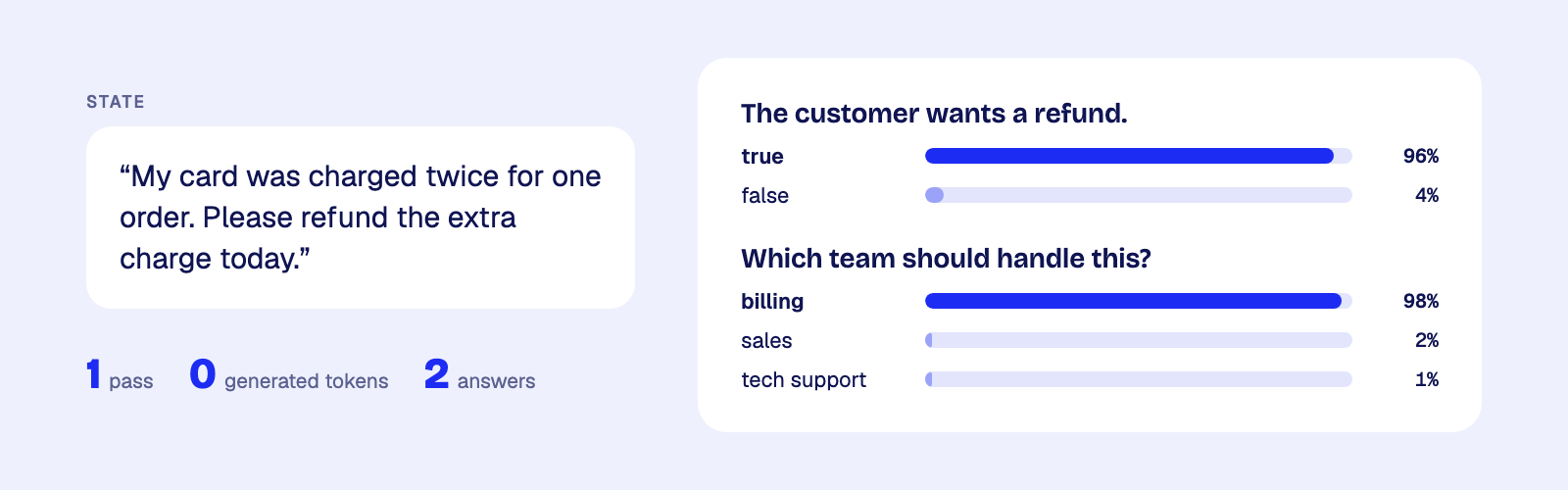
The probabilities above are the real output of the 8-bit 0.6B model for this message. Every question gets a probability for each of its options, read from one forward pass.
Results
Scored on the 400-case test split of LocalLLaMA/typed-decisions (2,000 decisions), with the formulas from the benchmark's own scoring script. Accuracy: higher is better. KL from gold, Brier and ECE: lower is better.
| Model | Accuracy | KL from gold | Brier | ECE |
|---|---|---|---|---|
| Qwen3-0.6B, no fine-tuning | 0.311 | 0.888 | 0.428 | 0.306 |
| Qwen3-1.7B, no fine-tuning | 0.278 | 1.914 | 0.812 | 0.611 |
| Label frequencies from the benchmark's train split (ignores the input) | 0.481 | 0.327 | 0.181 | 0.036 |
| onepass 0.6B | 0.601 | 0.270 | 0.154 | 0.049 |
| onepass 1.7B | 0.646 | 0.236 | 0.129 | 0.076 |
The 8-bit file (639 MB for the 0.6B) gives almost the same answers as the 16-bit one. Results by question type, four held-out human-labelled sets, every file size, and what happens when the model writes its answers instead: docs/results.md.
How it got here
Today onepass 1.7B scores 0.646 on the benchmark's 400 test cases, and the 0.6B scores 0.601. A baseline that ignores the input scores 0.481. The best small general model on the leaderboard (under 1B, never trained on the benchmark) scored 0.531, by the leaderboard's own number.
My first full model lost to that baseline. I trained it for about 5 hours on a MacBook Pro (M3 Pro), on 16 human-labelled datasets. It scored 0.429.
Even getting that far was slow. The laptop ran out of memory because gradient
checkpointing was silently off: from_pretrained returns a model in eval mode. One
line, model.train(), fixed it. When the battery got low, macOS slowed the run about
four times. On Kaggle, asking for an L4 GPU silently gave me a CPU (PyTorch printed
2.11.0+cpu), and the free 2×T4 queue held my run for over 2 hours.
I had trained it on the wrong kind of text. The data was plain sentences: tweets, reviews, questions about passages. The benchmark is business records written as JSON: agent traces, invoices, security alerts, support threads.
The benchmark ships its own training split: 1,200 cases of exactly that kind. I did not train on it, so the score stays honestly zero-shot.
Instead I went looking. I found about 20 public datasets in the same typed-question format. I checked each one for its license, who made the labels, and overlap with the benchmark: exact matches, any shared 10-word run, identical questions. Most were dropped, for unclear licenses or for labels written by closed models whose terms may forbid training on them. Three passed: n4ze3m/typed-decisions-synth (MIT), decisionmodels/sn92-specialists (CC BY 4.0) and tasksource/procedural-typed-decisions (Apache-2.0). In generated data the right answer was listed first 51% of the time, so I shuffle the options.
Then I trained again on Kaggle's two free T4 GPUs, with the human data plus those three sets: 68,061 texts and 138,928 questions. The 0.6B took 4.5 hours and the 1.7B took 8.8, side by side. They scored 0.601 and 0.646.
It is not solved. On SummEval, a held-out set about summary quality, training took the 0.6B from 0.504 down to 0.265. It answers "good" almost every time where experts said "excellent".
Quick start
With uv and nothing else installed, download the 8-bit 0.6B model and start the local server and demo page:
uvx --from huggingface_hub hf download samadpls/onepass-qwen3-0.6b-GGUF onepass-qwen3-0.6b-Q8_0.gguf --local-dir .
uvx --from "onepassai[serve]" onepass-serve onepass-qwen3-0.6b-Q8_0.gguf
Or run the web app from this repo:
uv run --extra serve --with streamlit --with huggingface_hub streamlit run demo/streamlit_app.py
The HTTP API, the Python API, the 1.7B model, and a copy-paste version that needs only
transformers: docs/usage.md.
How it works
- One slot per question. The prompt lists the state, then each question with
its options as letters (A, B, C ...), each followed by
Answer:. The model's scores for the option letters at that position become the answer probabilities. - No answer leaks into the next question. A fixed placeholder follows every slot, so each answer depends only on the state and the questions so far.
- Trained on probabilities. Where a dataset has several human raters, the training target is the share of raters who chose each answer, not a single label.
- One decode call at run time. The whole prompt goes into one llama.cpp batch, with scores read only at the answer positions.
The data, how it was cleaned, and the training setup: docs/training.md.
Docs
| Page | What's in it |
|---|---|
| docs/results.md | Full benchmark results, held-out sets, GGUF sizes, generation baseline |
| docs/usage.md | Server, HTTP API, Python, demo app, using it with only transformers |
| docs/training.md | Prompt layout, data sources, cleaning, LoRA training, calibration |
Credit
Built by Abdul Samad (samadpls.com, abdulsamadsid1@gmail.com). Licensed under Apache-2.0.
1 maintainer

Metadata
1 maintainer
Release files for onepassai 0.1.0
For a detailed explanation of source distributions (sdists) and built distributions (wheels), please see the package formats documentation.
Source distribution (sdist)
| File | Size | Uploaded | Provenance | Actions |
|---|---|---|---|---|
| onepassai-0.1.0.tar.gz | 25.9 kB | Without provenance | Details for onepassai-0.1.0.tar.gz |
Built distribution (wheel)
| File | Interpreter | ABI | Platform | Actions Reset |
|---|---|---|---|---|
| onepassai-0.1.0-py3-none-any.whl | Python 3 | none | any | Details for onepassai-0.1.0-py3-none-any.whl |
Total release size: 56.1 kB
Release files / onepassai-0.1.0.tar.gz
| Download URL | onepassai-0.1.0.tar.gz |
|---|---|
| Size | 25.9 kB |
| Tags | Source |
|
SHA-256 checksum How to use checksums |
514388fde3e0a04844db24d363be23d988366c81a92a2ffc0c91cf841a90902c
|
|
BLAKE2b-256 checksum How to use checksums |
75dc625c61d72b39cb1604867894640ff1dcfc1e58b893a2b68f94fa3f7b49fa
|
| Upload date | |
|
Uploaded using Trusted Publishing? What is trusted publishing? |
No |
| Uploaded via |
uv/0.12.2 {"installer":{"name":"uv","version":"0.12.2","subcommand":["publish"]},"python":null,"implementation":{"name":null,"version":null},"distro":{"name":"macOS","version":null,"id":null,"libc":null},"system":{"name":null,"release":null},"cpu":null,"openssl_version":null,"setuptools_version":null,"rustc_version":null,"ci":null}
|
Release files / onepassai-0.1.0-py3-none-any.whl
| Download URL | onepassai-0.1.0-py3-none-any.whl |
|---|---|
| Size | 30.2 kB |
| Tags | Python 3 |
|
SHA-256 checksum How to use checksums |
96d5d63687f5a703d4a6ecd7a52fb7c01f93d351b724709e7ae3905f8a326ea6
|
|
BLAKE2b-256 checksum How to use checksums |
9fdadc9035a9a15084aea43027ee3eda4c8dc71781a152a2361650ed44e9ab57
|
| Upload date | |
|
Uploaded using Trusted Publishing? What is trusted publishing? |
No |
| Uploaded via |
uv/0.12.2 {"installer":{"name":"uv","version":"0.12.2","subcommand":["publish"]},"python":null,"implementation":{"name":null,"version":null},"distro":{"name":"macOS","version":null,"id":null,"libc":null},"system":{"name":null,"release":null},"cpu":null,"openssl_version":null,"setuptools_version":null,"rustc_version":null,"ci":null}
|
Security for onepassai 0.1.0
Provenance
Provenance describes where a file came from. On PyPI, provenance is shared via attestations, which provide a verifiable record of the build or publishing details. View details, limitations and caveats.
No provenance found
None of the files in this release were uploaded with provenance metadata.
A note on package security
PyPI is a repository for distributing packages, not a service for auditing them. While third-party security researchers and our staff do their best to detect and remove malicious packages, PyPI cannot guarantee the quality, security or suitability of any given package.
To learn more about protecting yourself from malicious actors, visit our package security documentation.














