
OntologyToAPI
This python package is an ontology-driven API generator designed for backend development by transforming structured domain knowledge, different data sources and implemented business models into fully functional APIs. The tool accepts ontologies specified in Turtle (.ttl), Resource Description Framework (.rdf) and Web Ontology Language (.owl).

- A full documentation on how to extend your own ontologies using the OntologyToAPI framework is still in development, but you can check a small sample and docs at https://github.com/JCGCosta/OntologyToAPI/wiki
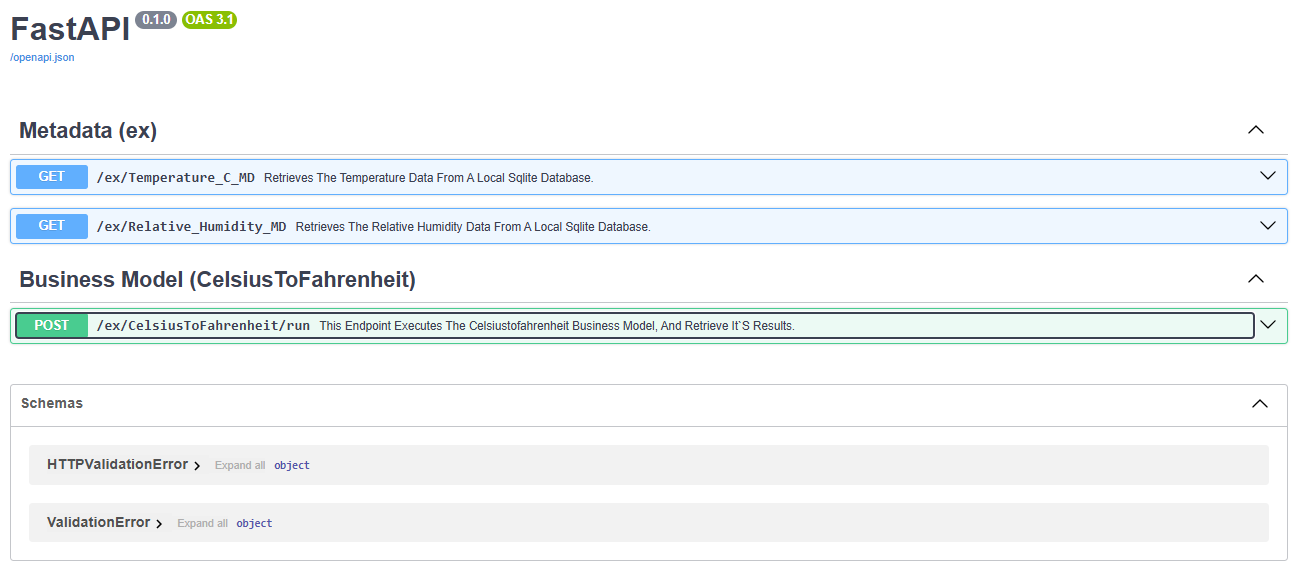
Expected Results from a simple ontology specification
Supported communication technologies are (Currently):
Stateful Connections
- "SOCKET" - For Socket connections using asyncio streams
Stateless Connections
- "API" - For REST APIs using requests driver
- "MYSQL" - For MySQL Databases using aiomysql driver
- "SQLITE" - For SQLite Databases using aiosqlite driver
- "POSTGRESQL" - For PostgreSQL Databases using asyncpg driver
- "MONGODB" - For MongoDB Databases using motor driver
- "UNQLITE" - For UnQLite Databases using unqlite+asyncio driver
Next Steps:
Next steps involve extending the support for new communication technologies.
- "FILE" - For File operations using aiofiles driver
- "WEBSOCKET" - For WebSocket connections using websockets driver
- "MQTT" - For MQTT connections using asyncio-mqtt driver
- "REDIS" - For Redis Databases using aioredis driver
- "CASSANDRA" - For Cassandra Databases using cassandra-driver with asyncio support
Change Log
VERSION="0.0.25" LAST_UPDATE="13/07/2026"
- Changed the default name of an output schema to the concatenation of the BM name + _OutputSchema, to simplify debugging in docs.
- Added support to multi file uploads by adding "List[UploadFile]" or "list[UploadFile]" in the parameter type in the BM ontology, the solution required a workaround because of an inference problems with the swagger ui and the OAS 3.0 (Ref. https://github.com/fastapi/fastapi/pull/15069 and https://github.com/fastapi/fastapi/discussions/14975).
1 maintainer

Metadata
1 maintainer
Release files for ontologytoapi 0.0.25
For a detailed explanation of source distributions (sdists) and built distributions (wheels), please see the package formats documentation.
Source distribution (sdist)
| File | Size | Uploaded | Provenance | Actions |
|---|---|---|---|---|
| ontologytoapi-0.0.25.tar.gz | 14.2 kB | Without provenance | Details for ontologytoapi-0.0.25.tar.gz |
Built distribution (wheel)
| File | Interpreter | ABI | Platform | Actions Reset |
|---|---|---|---|---|
| ontologytoapi-0.0.25-py3-none-any.whl | Python 3 | none | any | Details for ontologytoapi-0.0.25-py3-none-any.whl |
Total release size: 32.5 kB
Release files / ontologytoapi-0.0.25.tar.gz
| Download URL | ontologytoapi-0.0.25.tar.gz |
|---|---|
| Size | 14.2 kB |
| Tags | Source |
|
SHA-256 checksum How to use checksums |
c6f84382efe2d37c6ae525c22b01bd8af0a550ae0eaab8ea95a6ee633af7c1fa
|
|
BLAKE2b-256 checksum How to use checksums |
8e2da45063582cb03cac4cb2575deee44118df4681d193bf9378cf6332226244
|
| Upload date | |
|
Uploaded using Trusted Publishing? What is trusted publishing? |
No |
| Uploaded via |
twine/6.1.0 CPython/3.13.12
|
Release files / ontologytoapi-0.0.25-py3-none-any.whl
| Download URL | ontologytoapi-0.0.25-py3-none-any.whl |
|---|---|
| Size | 18.3 kB |
| Tags | Python 3 |
|
SHA-256 checksum How to use checksums |
42df632725cacca5b3a90bf7c88131d2490e270634a960fd6810374c8587b2c3
|
|
BLAKE2b-256 checksum How to use checksums |
e26b5112e641cb0c7c5422819dbc315b6fe30e4b8bcc05797e81361654b2d999
|
| Upload date | |
|
Uploaded using Trusted Publishing? What is trusted publishing? |
No |
| Uploaded via |
twine/6.1.0 CPython/3.13.12
|
Security for ontologytoapi 0.0.25
Provenance
Provenance describes where a file came from. On PyPI, provenance is shared via attestations, which provide a verifiable record of the build or publishing details. View details, limitations and caveats.
No provenance found
None of the files in this release were uploaded with provenance metadata.
A note on package security
PyPI is a repository for distributing packages, not a service for auditing them. While third-party security researchers and our staff do their best to detect and remove malicious packages, PyPI cannot guarantee the quality, security or suitability of any given package.
To learn more about protecting yourself from malicious actors, visit our package security documentation.














