
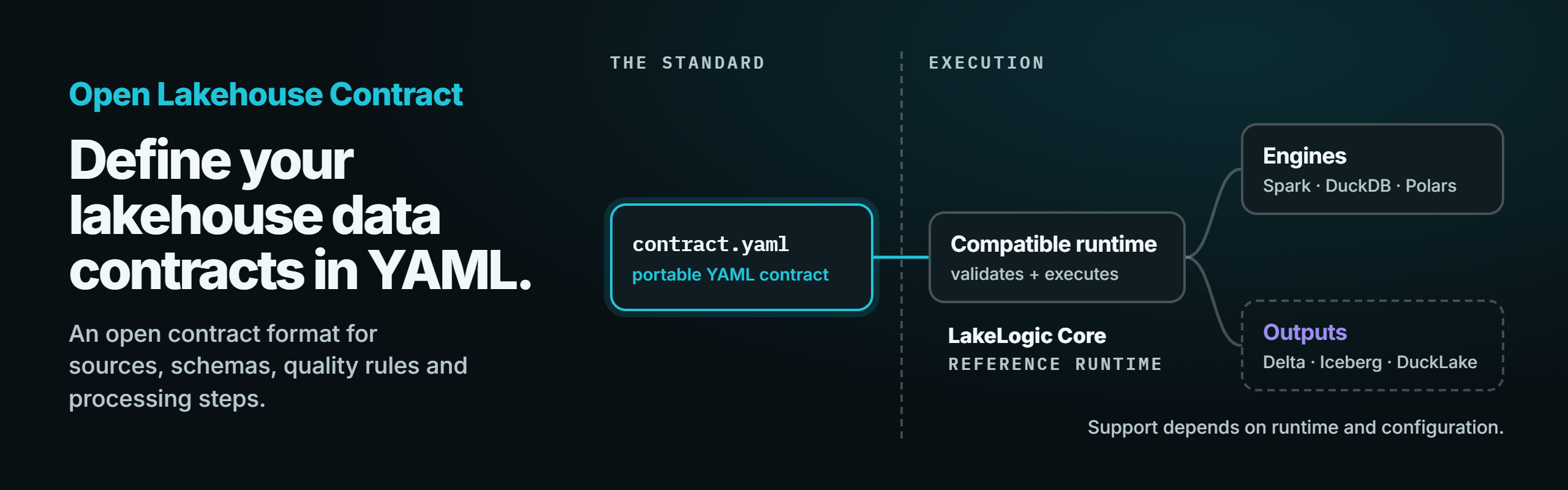
Open Lakehouse Contract
An open standard for lakehouse data contracts in YAML.
Documentation · Quickstart · Contract reference · Compatibility evidence
Define your data's structure, quality rules, ownership and processing steps in one YAML file. Keep the contract in Git so people and AI agents can review changes before they are applied.
Use the included Python CLI to check that your contract follows the Open Lakehouse Contract (OLC) schema. Use LakeLogic Core to execute supported transformations and data quality checks.
Validate your first YAML contract
version: 1.0.0
info:
  title: Orders
  table_name: orders
model:
  fields:
    - name: order_id
      type: integer
      required: true
quality:
  row_rules:
    - name: positive_order_id
      sql: "order_id > 0"
Clone the repository, install the CLI and validate the example:
git clone https://github.com/LakeLogic/open-lakehouse-contract.git
cd open-lakehouse-contract
python -m pip install -e .
olc validate examples/orders.olc.yaml
The validator checks the contract's structure against the published JSON Schema; it does not check the dataset itself. It does not require a data engine or LakeLogic Core.
What OLC gives you
- Earlier feedback. Reject invalid contracts in CI before a pipeline change reaches production.
- Clear accountability. Record who owns the data product and the downstream consumers that depend on it.
- Consistent governance. Keep schema, quality, PII handling, lineage and service-level expectations in one reviewable artifact.
- Executable intent. Let a conforming runtime validate, quarantine, transform and materialise data from the declaration.
- Portable definitions. Keep business intent separate from backend-owned engine, catalogue, storage and table-format settings.
- Safer automation. Give humans and AI agents a typed contract they can validate before proposing or applying changes.
Execute with LakeLogic Core
OLC is the standard. LakeLogic Core is the open-source reference runtime.
python -m pip install lakelogic
from lakelogic import DataProcessor

processor = DataProcessor("orders.olc.yaml", engine="duckdb", strict=True)
accepted, quarantined = processor.run(source_df)
You can use the OLC schema without LakeLogic Core, and another runtime may implement the same specification.
Contract coverage
| Concern | Examples |
|---|---|
| Sources and ingestion | Primary source, linked sources, load mode, watermark and post-ingestion lifecycle |
| Identity and ownership | Product metadata, accountable owner and downstream consumer ownership |
| Schema and keys | Fields, types, required values, primary keys and natural keys |
| Quality | Row rules, dataset rules, uniqueness and null thresholds |
| Transformation | SQL and typed transformation operations |
| Governance | PII classification, masking, compliance metadata and quarantine |
| Service levels | Freshness, availability and volume SLOs; downstream SLA expectations |
| Operations | Lineage, notifications and run controls |
| Materialisation and delivery | Write strategy, table format, target location and downstream consumers |
See the field reference for the complete vocabulary.
Compatibility and evidence
OLC separates portable contract intent from runtime and platform configuration. Support is demonstrated at different levels:
- Structural conformance proves a contract matches the public schema.
- Runtime conformance compares observable behaviour across supported engines.
- Provider evidence records what was deployed and materialised on each platform.
DuckDB and Polars run in the default executable-conformance suite. Other engines and platforms have their own stated scope and limitations. See the conformance suite and provider evidence matrix rather than assuming every engine × format × platform combination has identical coverage.
Documentation
- Getting started — validate and execute your first contract.
- What is OLC? — understand the contract/runtime boundary.
- Contract reference — define sources, ownership, quality, transformation, lineage, service levels and materialisation.
- Conformance — see how structural and runtime behaviour are tested.
- Providers — inspect evidence and limitations by platform.
- OLC and ODCS — understand how the standards complement each other.
Contributions are welcome. Start with the contributing guide.
Licence
Apache License 2.0. See LICENSE.
1 maintainer

Metadata
1 maintainer
Release files for open-lakehouse-contract 0.28.0
For a detailed explanation of source distributions (sdists) and built distributions (wheels), please see the package formats documentation.
Source distribution (sdist)
| File | Size | Uploaded | Provenance | |
|---|---|---|---|---|
| open_lakehouse_contract-0.28.0.tar.gz | 355.6 kB | Without provenance | Details |
Built distribution (wheel)
| File | Interpreter | ABI | Platform | Reset |
|---|---|---|---|---|
| open_lakehouse_contract-0.28.0-py3-none-any.whl | Python 3 | none | any | Details |
Total release size: 720.4 kB
Release files / open_lakehouse_contract-0.28.0.tar.gz
| Download URL | open_lakehouse_contract-0.28.0.tar.gz |
|---|---|
| Size | 355.6 kB |
| Tags | Source |
|
SHA-256 checksum How to use checksums |
d1f88a36aa9959803162a91f801fca8a79d189d07d0e44f16cb6916cb0927c18
|
|
BLAKE2b-256 checksum How to use checksums |
bc4fe065d931c1d45edb5f4d60105c8e4c126c69a962e3f653480c6a766c375b
|
| Upload date | |
|
Uploaded using Trusted Publishing? What is trusted publishing? |
Yes |
| Uploaded via |
uv/0.13.5 {"installer":{"name":"uv","version":"0.13.5","subcommand":["publish"]},"python":null,"implementation":{"name":null,"version":null},"distro":{"name":"Ubuntu","version":"26.04","id":"resolute","libc":null},"system":{"name":null,"release":null},"cpu":null,"openssl_version":null,"setuptools_version":null,"rustc_version":null,"ci":true}
|
Release files / open_lakehouse_contract-0.28.0-py3-none-any.whl
| Download URL | open_lakehouse_contract-0.28.0-py3-none-any.whl |
|---|---|
| Size | 364.8 kB |
| Tags | Python 3 |
|
SHA-256 checksum How to use checksums |
e7364ab42dcb103f6e1c9f747b8d7a3781eefc18ea2ee700aa27aa2ac6d69ccc
|
|
BLAKE2b-256 checksum How to use checksums |
48ebe66954607c233827105917e39e088b1ec9394c80b4aeb3a6648f486e071c
|
| Upload date | |
|
Uploaded using Trusted Publishing? What is trusted publishing? |
Yes |
| Uploaded via |
uv/0.13.5 {"installer":{"name":"uv","version":"0.13.5","subcommand":["publish"]},"python":null,"implementation":{"name":null,"version":null},"distro":{"name":"Ubuntu","version":"26.04","id":"resolute","libc":null},"system":{"name":null,"release":null},"cpu":null,"openssl_version":null,"setuptools_version":null,"rustc_version":null,"ci":true}
|
Security for open-lakehouse-contract 0.28.0
Provenance
Provenance describes where a file came from. On PyPI, provenance is shared via attestations, which provide a verifiable record of the build or publishing details. View details, limitations and caveats.
No provenance found
None of the files in this release were uploaded with provenance metadata.
A note on package security
PyPI is a repository for distributing packages, not a service for auditing them. While third-party security researchers and our staff do their best to detect and remove malicious packages, PyPI cannot guarantee the quality, security or suitability of any given package.
To learn more about protecting yourself from malicious actors, visit our package security documentation.














