
Open Shield Python SDK

Vendor-agnostic authentication and authorization enforcement SDK for Python.
Open Shield lets you enforce authentication (AuthN) and authorization (AuthZ) in your Python applications without coupling to a specific identity provider. Works with Logto, Keycloak, Auth0, Entra ID, Cognito, or any OIDC-compliant provider.
Architecture
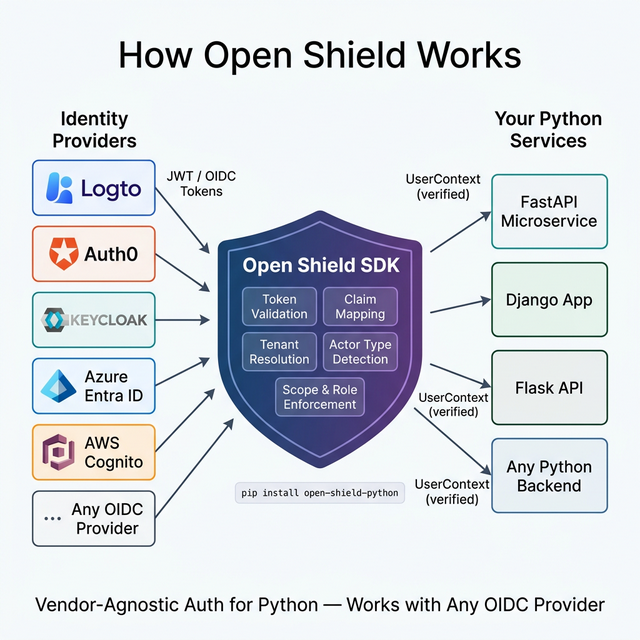
Open Shield sits as a thin, powerful layer between your identity provider and your Python backend — handling all the complexity of token validation, claim extraction, tenant resolution, and authorization enforcement so you don't have to.
How It Works
- Any OIDC Identity Provider (Logto, Auth0, Keycloak, Azure Entra ID, AWS Cognito, or your own) issues a JWT token when a user or service authenticates.
- Open Shield SDK intercepts the incoming request in your Python application and:
- Validates the token — verifies the signature using auto-fetched JWKS keys from the provider's OIDC discovery endpoint.
- Maps claims — extracts user ID, email, tenant, scopes, and roles from the JWT using your configurable claim mapping (every provider names claims differently — Open Shield normalizes them).
- Resolves the tenant — determines tenant isolation using the 3-step cascade (M2M lookup → org claim → sub fallback).
- Detects actor type — classifies the caller as
user,service, oragent. - Enforces authorization — checks scopes and roles before the request reaches your handler.
- Your Python service receives a clean, verified
UserContextobject — ready to use. No JWT parsing, no OIDC plumbing, no provider-specific code.
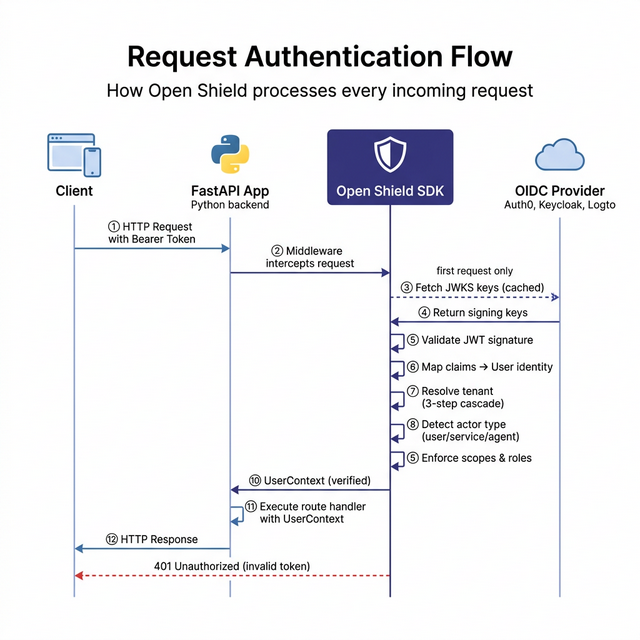
Request Authentication Flow
Why This Matters
- Works with any OIDC provider — Switch from Auth0 to Keycloak? Change two environment variables. Zero code changes.
- Works with any Python framework — First-class FastAPI support today, with Django and Flask coming soon. The core logic is pure Python with no framework dependency.
- Built on Clean Architecture — The domain layer has zero external dependencies. All I/O (JWT decoding, OIDC discovery) happens through abstract ports implemented by swappable adapters.
- Easy to test — Mock the
TokenValidatorPortfor fast unit tests without any HTTP calls. - Easy to extend — Implement
TenantResolverPortto wire in your own database for M2M tenant lookups.
Features
- Vendor Neutral — Works with any OIDC-compliant identity provider
- Configurable Claim Mapping — Map any JWT claim to user/tenant/role fields
- 3-Step Tenant Cascade — Correct isolation for individual users, SaaS orgs, and M2M clients
- Actor Type Inference — Automatically detect users, agents, and service accounts
- Framework Agnostic — Core logic is pure Python; first-class FastAPI support
- Clean Architecture — Domain ↔ Adapters ↔ API layers with strict dependency inversion
- Type Safe — Fully typed, checked with
mypy - Automatic JWKS Rotation — Fetches and caches keys from OIDC discovery
Installation
pip install open-shield-python
Quick Start (FastAPI)
1. Configure Environment
OPEN_SHIELD_ISSUER_URL=https://your-auth-domain.com/oidc
OPEN_SHIELD_AUDIENCE=my-api-identifier
2. Add Middleware
from fastapi import FastAPI, Depends
from open_shield.api.fastapi import (
    OpenShieldMiddleware,
    get_user_context,
    get_optional_user_context,
    RequireScope,
    RequireRole,
)
from open_shield.adapters import OpenShieldConfig
from open_shield.domain.entities import UserContext

app = FastAPI()
config = OpenShieldConfig()  # Reads from env vars

app.add_middleware(OpenShieldMiddleware, config=config)

@app.get("/health")
def health():
    return {"status": "ok"}

@app.get("/users/me")
def read_current_user(ctx: UserContext = Depends(get_user_context)):
    return {
        "id": ctx.user.id,
        "email": ctx.user.email,
        "actor_type": ctx.user.actor_type,
        "tenant": ctx.tenant.tenant_id if ctx.tenant else None,
        "scopes": ctx.user.scopes,
        "roles": ctx.user.roles,
    }

@app.get("/admin/dashboard")
def admin_dashboard(ctx: UserContext = Depends(RequireScope("read:admin"))):
    return {"data": "secret"}

@app.get("/manager/reports")
def reports(ctx: UserContext = Depends(RequireRole(["manager", "admin"]))):
    return {"reports": []}
Configurable Claim Mapping
Different identity providers use different JWT claim names. Open Shield lets you configure which claims map to which identity fields — zero code changes when switching providers.
Environment Variables
| Variable | Description | Default |
|---|---|---|
OPEN_SHIELD_ISSUER_URL |
OIDC Issuer URL (required) | — |
OPEN_SHIELD_AUDIENCE |
Expected aud claim |
None |
OPEN_SHIELD_ALGORITHMS |
Allowed signing algorithms | ["RS256"] |
OPEN_SHIELD_USER_ID_CLAIM |
Claim for user ID | sub |
OPEN_SHIELD_EMAIL_CLAIM |
Claim for email | email |
OPEN_SHIELD_TENANT_ID_CLAIM |
Claim for tenant/org ID | tid |
OPEN_SHIELD_SCOPE_CLAIM |
Claim for scopes | scope |
OPEN_SHIELD_ROLES_CLAIM |
Claim for roles | roles |
OPEN_SHIELD_TENANT_FALLBACK |
Fallback when tenant claim missing | none |
Provider Examples
Logto
OPEN_SHIELD_ISSUER_URL=https://my-logto.com/oidc
OPEN_SHIELD_AUDIENCE=https://my-api.com
OPEN_SHIELD_TENANT_ID_CLAIM=organization_id
OPEN_SHIELD_TENANT_FALLBACK=sub    # Individual users get isolation
Keycloak
OPEN_SHIELD_ISSUER_URL=https://keycloak.com/realms/myrealm
OPEN_SHIELD_AUDIENCE=my-client-id
OPEN_SHIELD_TENANT_ID_CLAIM=tenant     # Custom claim from mapper
OPEN_SHIELD_ROLES_CLAIM=roles          # Keycloak realm_access also supported
Auth0
OPEN_SHIELD_ISSUER_URL=https://my-tenant.auth0.com/
OPEN_SHIELD_AUDIENCE=https://my-api
OPEN_SHIELD_TENANT_ID_CLAIM=org_id
OPEN_SHIELD_SCOPE_CLAIM=permissions    # Auth0 uses 'permissions' for RBAC
Azure Entra ID
OPEN_SHIELD_ISSUER_URL=https://login.microsoftonline.com/{tenant-id}/v2.0
OPEN_SHIELD_AUDIENCE=api://my-api
OPEN_SHIELD_TENANT_ID_CLAIM=tid
OPEN_SHIELD_ROLES_CLAIM=roles
Programmatic Configuration
from open_shield.adapters import OpenShieldConfig

config = OpenShieldConfig(
    ISSUER_URL="https://my-auth.com/oidc",
    AUDIENCE="https://my-api",
    TENANT_ID_CLAIM="organization_id",
    TENANT_FALLBACK="sub",
)
Tenant Resolution Cascade
Tenant isolation is critical for data security. Open Shield uses a 3-step cascade to resolve the tenant for every request — supporting individual users, SaaS organizations, and M2M service accounts.
How It Works
Step 1: M2M client (sub == client_id)  → TenantResolverPort.resolve_tenant()
Step 2: Organization claim              → OPEN_SHIELD_TENANT_ID_CLAIM
Step 3: Sub fallback                    → sub (when TENANT_FALLBACK=sub)
| Use Case | Tenant Source | Config |
|---|---|---|
| Individual user | sub |
TENANT_FALLBACK=sub |
| SaaS with orgs | organization_id |
TENANT_ID_CLAIM=organization_id |
| M2M service | Registry lookup | Implement TenantResolverPort |
| No tenant needed | None | TENANT_FALLBACK=none (default) |
When to Use Each Strategy
Individual users (OSS, personal tools):
OPEN_SHIELD_TENANT_FALLBACK=sub
Each user = separate dataset. Simple. Works immediately.
SaaS with organizations (teams, billing per org):
OPEN_SHIELD_TENANT_ID_CLAIM=organization_id
OPEN_SHIELD_TENANT_FALLBACK=none        # Don't fall back to sub
Multiple users share org data. Required for team features.
M2M / AI agents (client_credentials flow):
from open_shield.domain.ports import TenantResolverPort

class MyTenantResolver(TenantResolverPort):
    """Look up tenant for machine clients from your registry."""

    def resolve_tenant(self, client_id: str) -> str | None:
        # Query your DB, config, or IdP management API
        return db.get_tenant_for_client(client_id)

# Pass resolver to middleware
config = OpenShieldConfig(...)
app.add_middleware(
    OpenShieldMiddleware,
    config=config,
    tenant_resolver=MyTenantResolver(),
)
Resolution Metadata
Every resolved tenant includes traceability:
ctx.tenant.metadata["resolution"] # "m2m_lookup" | "claim" | "sub_fallback"
Actor Type Inference
Open Shield automatically classifies the caller:
| Actor Type | Detection | Example |
|---|---|---|
user |
Default for human tokens | Normal login flow |
service |
sub == client_id |
M2M client_credentials |
agent |
sub == client_id + "agent" role |
AI agent with agent role |
ctx.user.actor_type # "user" | "service" | "agent"
Optional Authentication
For routes that work with or without auth (e.g., public APIs with enhanced features for logged-in users):
from open_shield.api.fastapi import get_optional_user_context

@app.get("/search")
def search(ctx: UserContext | None = Depends(get_optional_user_context)):
    if ctx:
        return personalized_results(ctx.user.id)
    return public_results()
Development
# Install dependencies
uv sync

# Run tests
uv run pytest

# Lint and format
uv run ruff check .

# Type check
uv run mypy src/
License
MIT
1 maintainer

Download files
Download the file for your platform. If you're not sure which to choose, learn more about installing packages.
Source Distribution
Built Distribution
Filter files by name, interpreter, ABI, and platform.
If you're not sure about the file name format, learn more about wheel file names.
Copy a direct link to the current filters
File details
Details for the file open_shield_python-0.2.7.tar.gz.
File metadata
- Download URL: open_shield_python-0.2.7.tar.gz
- Upload date:
- Size: 959.1 kB
- Tags: Source
- Uploaded using Trusted Publishing? No
- Uploaded via:
uv/0.9.17 {"installer":{"name":"uv","version":"0.9.17","subcommand":["publish"]},"python":null,"implementation":{"name":null,"version":null},"distro":{"name":"macOS","version":null,"id":null,"libc":null},"system":{"name":null,"release":null},"cpu":null,"openssl_version":null,"setuptools_version":null,"rustc_version":null,"ci":null}
File hashes
| Algorithm | Hash digest | |
|---|---|---|
| SHA256 |
7e4e185dc8451f5cfe84ea94a3f27366892b5dc12b80f09a91f5bd3e0eea676e
|
|
| MD5 |
549b6fcec1f144c8277e80d6be7943a0
|
|
| BLAKE2b-256 |
81c0fe08ec0c68525c93a0719f0d67bccaf33404c2feb23ff104e19579f55906
|
File details
Details for the file open_shield_python-0.2.7-py3-none-any.whl.
File metadata
- Download URL: open_shield_python-0.2.7-py3-none-any.whl
- Upload date:
- Size: 20.3 kB
- Tags: Python 3
- Uploaded using Trusted Publishing? No
- Uploaded via:
uv/0.9.17 {"installer":{"name":"uv","version":"0.9.17","subcommand":["publish"]},"python":null,"implementation":{"name":null,"version":null},"distro":{"name":"macOS","version":null,"id":null,"libc":null},"system":{"name":null,"release":null},"cpu":null,"openssl_version":null,"setuptools_version":null,"rustc_version":null,"ci":null}
File hashes
| Algorithm | Hash digest | |
|---|---|---|
| SHA256 |
ac2ecd360e457f4ade602d07306a53797b796c8f34bdace03952236811a7fd32
|
|
| MD5 |
61a58d484854d059ec327591c00ae230
|
|
| BLAKE2b-256 |
be3afc30265e725fcd2676d1dd5f14c07cb1e819e70cf99b2cdbdbac76d51a01
|














