
OpenABC
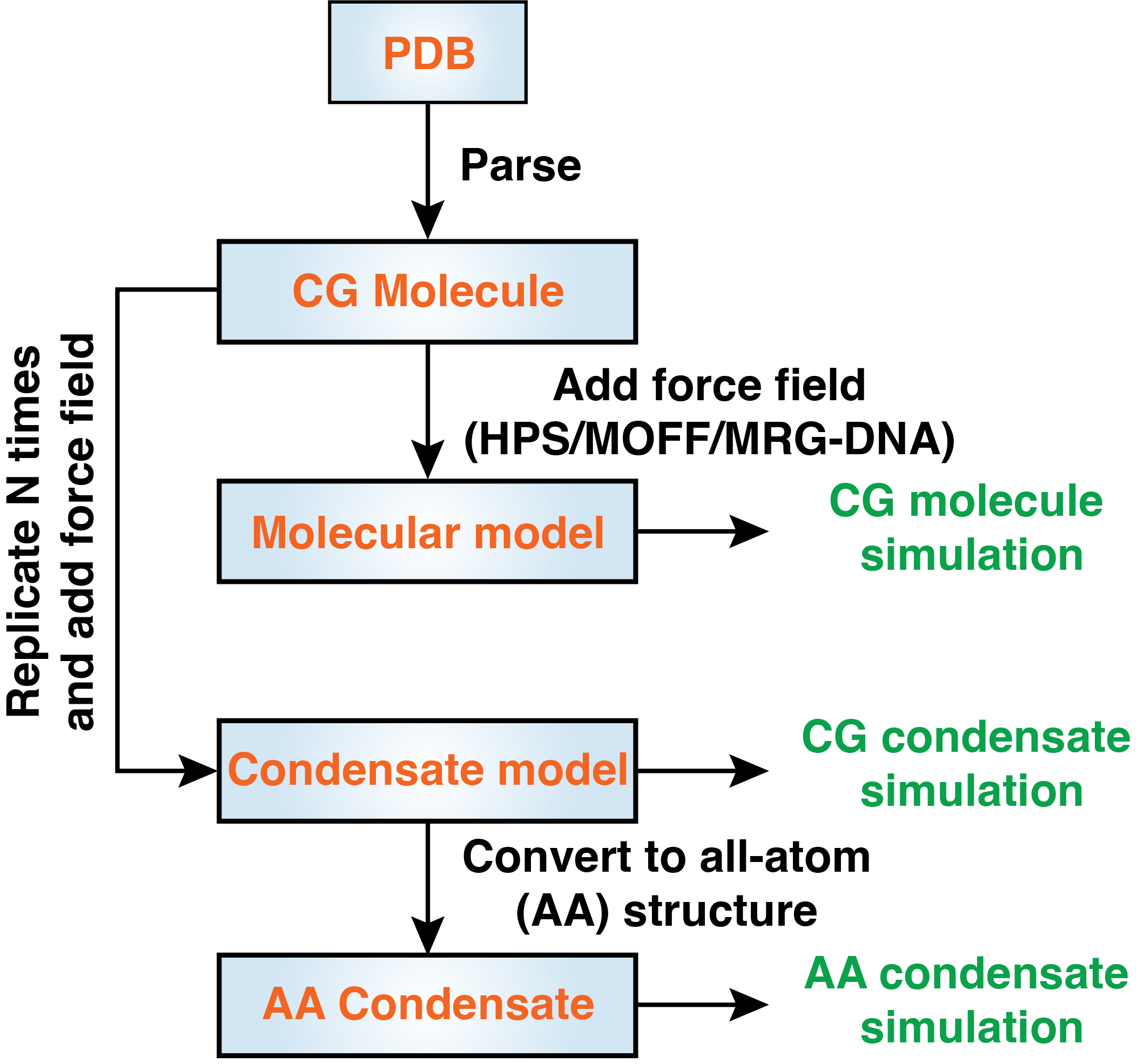
OpenABC stands for OpenMM GPU-Accelerated simulations of Biomolecular Condensates. It is flexible and implements multiple popular coarse-grained force fields for simulations, including the hydropathy scale (HPS) model, MOFF C$\alpha$ model, and the molecular renormalization group (MRG)-CG DNA model. The package dramatically simplifies the simulation setup: users only need a few lines of python code to carry out condensate simulations starting from initial configurations of a single protein or DNA. The package is integrated with OpenMM, a GPU-accelerated MD simulation engine, enabling efficient simulations with advanced sampling techniques. We include tools for converting coarse-grained configurations to atomistic structures for further simulations with all-atom force fields. We provide tutorials in Jupyter notebooks to demonstrate the various capabilities. We anticipate OpenABC to significantly facilitate the application of existing computer models for simulating biomolecular condensates and the continued development of new force fields.
Important notes and updates
Some important notes and updates are listed:
Version 1.0.2
The first version available with pip install.
Version 1.0.3
Update openabc.utils.insert.insert_molecules, MDAnalysis warnings will not appear. Both FastNS and distance_array methods are supported.
Version 1.0.4
OpenMM of version < 7.6 and >= 7.6 are both supported. Mpipi force field is included.
Version 1.0.5
SMOG+3SPN2 force fields are enabled. 3SPN2 is adapted from Wolynes groups' Open3SPN2. To run this, you may need to install pdbfixer and X3DNA. Other models do not require pdbfixer or X3DNA.
Version 1.0.7
Now functions defined in scripts at openabc/utils are available at openabc.utils level. For example, you can use from openabc.utils import parse_pdb.
For consistency, the 2d matrix for Discrete2DFunction is flattened in order 'F'. Note this does not change the result if the 2d matrix is symmetric, so please don't worry.
We also cancel default REMO path starting from this version. Please specify REMO path when using it.
For openabc.utils.insert.insert_molecules (equivalent to openabc.utils.insert_molecules), only FastNS is supported now.
Tutorials
Detailed tutorials with all the necessary input files are provided in "tutorials" directory.
Manual
The output html manual file is docs/index.html. The manual is also shown in: https://zhanggroup-mitchemistry.github.io/OpenABC/
Instructions for class methods and functions are also included as comments in the source code.
Environment
For versions >= 1.0.4, openmm versions < 7.6 and >= 7.6 are all supported. Install openmm with the following command:
conda install -c conda-forge openmm
For versions < 1.0.4, we recommend using openmm 7.5.1 for using OpenABC, as OpenABC is built based on openmm 7.5.1.
Install openmm 7.5.1 with the following command:
conda install -c conda-forge openmm=7.5.1
Other required packages: numpy, pandas, mdanalysis, mdtraj.
Users can also install openmm-plumed to run openmm simulations with plumed.
If running replica exchange with openabc.utils.replica_exchange, then torch is also required.
Installation
The user can either download the package from github, or use pip install:
pip install openabc
Update openabc with the following command:
pip install -U openabc
Usage
If openabc is not within the default python module searching paths, please add it to the searching paths. One way is to use sys.path.append(dir_path) or sys.path.insert(0, dir_path), and replace dir_path with the directory path where openabc is saved.
Here is an example of setting up a MOFF system composed of 100 copies of proteins.
from openabc.forcefields.parsers import MOFFParser
from openabc.forcefields import MOFFMRGModel
from openabc.utils.insert import insert_molecules
import simtk.openmm.app as app

# Parse structural and topological information
protein = MOFFParser.from_atomistic_pdb('all_atom.pdb', 'Calpha.pdb')

# Build initial condensate configuration with N = 100 proteins
N = 100
a, b, c = 100, 100, 100 # box sizes
insert_molecules('Calpha.pdb', 'start.pdb', n_mol=N, box=[a, b, c])

# Create molecule container and OpenMM system
condensate = MOFFMRGModel()
for i in range(N):
    condensate.append_mol(protein)
top = app.PDBFile('start.pdb').getTopology()
condensate.create_system(top, box_a=a, box_b=b, box_c=c)
condensate.add_all_default_forces()
Please read the tutorials for more instructions.
Tips
For version 1.0.2: When using openabc.utils.insert.insert_molecules, users may see such warnings: UserWarning: Found no information for attr: 'formalcharges' Using default value of '0' and warnings.warn("Found no information for attr: '{}'". Such warning can be ignored as atom charge is not required when we insert molecules. To suppress such warning, users can add such lines at the beginning of the script:
import warnings
warnings.filterwarnings('ignore')
Starting from version 1.0.3, we use other ways to write pdb file for openabc.utils.insert.insert_molecules, and such warning will not appear.
Extension
If the user intends to add new force fields, then the user has to write new parsers, new models, and expressions of new forces. Take HPS model as an example, the main components are openabc/forcefields/parsers/hps_parser.py and openabc/forcefields/hps_model.py. openabc/forcefields/parsers/hps_parser.py includes a parser that can parse each individual protein and get all the bonded interactions. openabc/forcefields/hps_model.py includes a container-like class that can hold multiple protein parser objects and add forces. Definitions of different potentials are saved in openabc/forcefields/functional_terms/*_terms.py.
Citations
Please cite the following paper if you use openabc package:
"OpenABC Enables Flexible, Simplified, and Efficient GPU Accelerated Simulations of Biomolecular Condensates", doi: https://doi.org/10.1101/2023.04.19.537533
References
Here are the references for the force fields and tools included in OpenABC. Please refer to these papers to find the most appropriate model for your study.
-
HPS model KR scale: Dignon, Gregory L., et al. "Sequence determinants of protein phase behavior from a coarse-grained model." PLoS computational biology 14.1 (2018): e1005941.
-
HPS model KR and Urry scale: Regy, Roshan Mammen, et al. "Improved coarse‐grained model for studying sequence dependent phase separation of disordered proteins." Protein Science 30.7 (2021): 1371-1379.
-
MOFF model: Latham, Andrew P., and Bin Zhang. "Consistent force field captures homologue-resolved HP1 phase separation." Journal of chemical theory and computation 17.5 (2021): 3134-3144.
-
MOFF + MRG model: Latham, Andrew P., and Bin Zhang. "On the stability and layered organization of protein-DNA condensates." Biophysical Journal 121.9 (2022): 1727-1737.
-
Mpipi model: Joseph, Jerelle A., et al. "Physics-driven coarse-grained model for biomolecular phase separation with near-quantitative accuracy." Nature Computational Science 1.11 (2021): 732-743.
-
SMOG model: Noel, Jeffrey K., et al. "SMOG 2: a versatile software package for generating structure-based models." PLoS computational biology 12.3 (2016): e1004794.
-
3SPN2 model: (1) Hinckley, Daniel M., et al. "An experimentally-informed coarse-grained 3-site-per-nucleotide model of DNA: Structure, thermodynamics, and dynamics of hybridization." The Journal of chemical physics 139.14 (2013). (2) Freeman, Gordon S., et al. "Coarse-grained modeling of DNA curvature." The Journal of chemical physics 141.16 (2014).
-
Open3SPN2 model: Lu, Wei, et al. "OpenAWSEM with Open3SPN2: A fast, flexible, and accessible framework for large-scale coarse-grained biomolecular simulations." PLoS computational biology 17.2 (2021): e1008308.
1 maintainer

Release files for openabc 1.0.9
For a detailed explanation of source distributions (sdists) and built distributions (wheels), please see the package formats documentation.
Source distribution (sdist)
| File | Size | Uploaded | |
|---|---|---|---|
| openabc-1.0.9.tar.gz | 403.4 kB | Details |
Built distribution (wheel)
| File | Interpreter | ABI | Platform | Reset |
|---|---|---|---|---|
| openabc-1.0.9-py3-none-any.whl | Python 3 | none | any | Details |
Total release size: 885.1 kB
Release files / openabc-1.0.9.tar.gz
| Download URL | openabc-1.0.9.tar.gz |
|---|---|
| Size | 403.4 kB |
| Tags | Source |
|
SHA-256 checksum How to use checksums |
77c9aef9809c48a1a6d79b198935b38bb584c9351957c4b4133e1c07964de5cb
|
|
BLAKE2b-256 checksum How to use checksums |
8e8245f608ca87f232de727eed36d42d9d635e074b2b497b75cb44829b5d471e
|
| Upload date | |
|
Uploaded using Trusted Publishing? What is trusted publishing? |
No |
| Uploaded via |
twine/6.2.0 CPython/3.10.20
|
Release files / openabc-1.0.9-py3-none-any.whl
| Download URL | openabc-1.0.9-py3-none-any.whl |
|---|---|
| Size | 481.7 kB |
| Tags | Python 3 |
|
SHA-256 checksum How to use checksums |
159604bb865d59ef522f286a17664c52561ca4bf6d659cbc09453b9b2dd07386
|
|
BLAKE2b-256 checksum How to use checksums |
a9b16609b6cf2225ef61ca595990ee4a59b4fc01a2889e39d1f93635deb267c1
|
| Upload date | |
|
Uploaded using Trusted Publishing? What is trusted publishing? |
No |
| Uploaded via |
twine/6.2.0 CPython/3.10.20
|














