
OpenCV Camera Calibration Dataset Audit



Validate checkerboard image datasets before cv2.calibrateCamera. Detect blur,
exposure problems, duplicate poses, weak image-plane coverage, limited pose
diversity, and high reprojection error, then generate an explainable offline
report.
The tool records why each image was accepted, warned, rejected, or unreadable and exports human-readable and machine-readable evidence. Analysis runs locally without telemetry or network requests and never modifies source images.
Read the documentation · Install from PyPI · View the main validation guide
Installation
python -m pip install opencv-calibration-audit
Python 3.10–3.13 is supported. The package uses headless OpenCV and tests both OpenCV 4.11 and 5.x.
30-second quick start
calibration-audit analyze ./calibration_images \
  --cols 9 \
  --rows 6 \
  --square-size 30 \
  --unit mm \
  --output ./audit_result
--cols and --rows count inner corners, not squares. A checkerboard with
10 × 7 squares has 9 × 6 inner corners.
Quality gates: PASSED
Accepted views: 12
OpenCV RMS: 0.284931 px
Report: audit_result/report.html
The command refuses a non-empty output directory unless
--overwrite-output is supplied. See the
CLI reference
for thresholds, recursion, quality gates, and exit codes.
Example report
The published report uses three redistributable real-camera images from OpenCV's sample data.
Small real-image smoke example — not a production-ready calibration dataset. Its coverage ratio is
0.0833, it contains two image warnings, and the checked-in run gates only the minimum valid-image count.
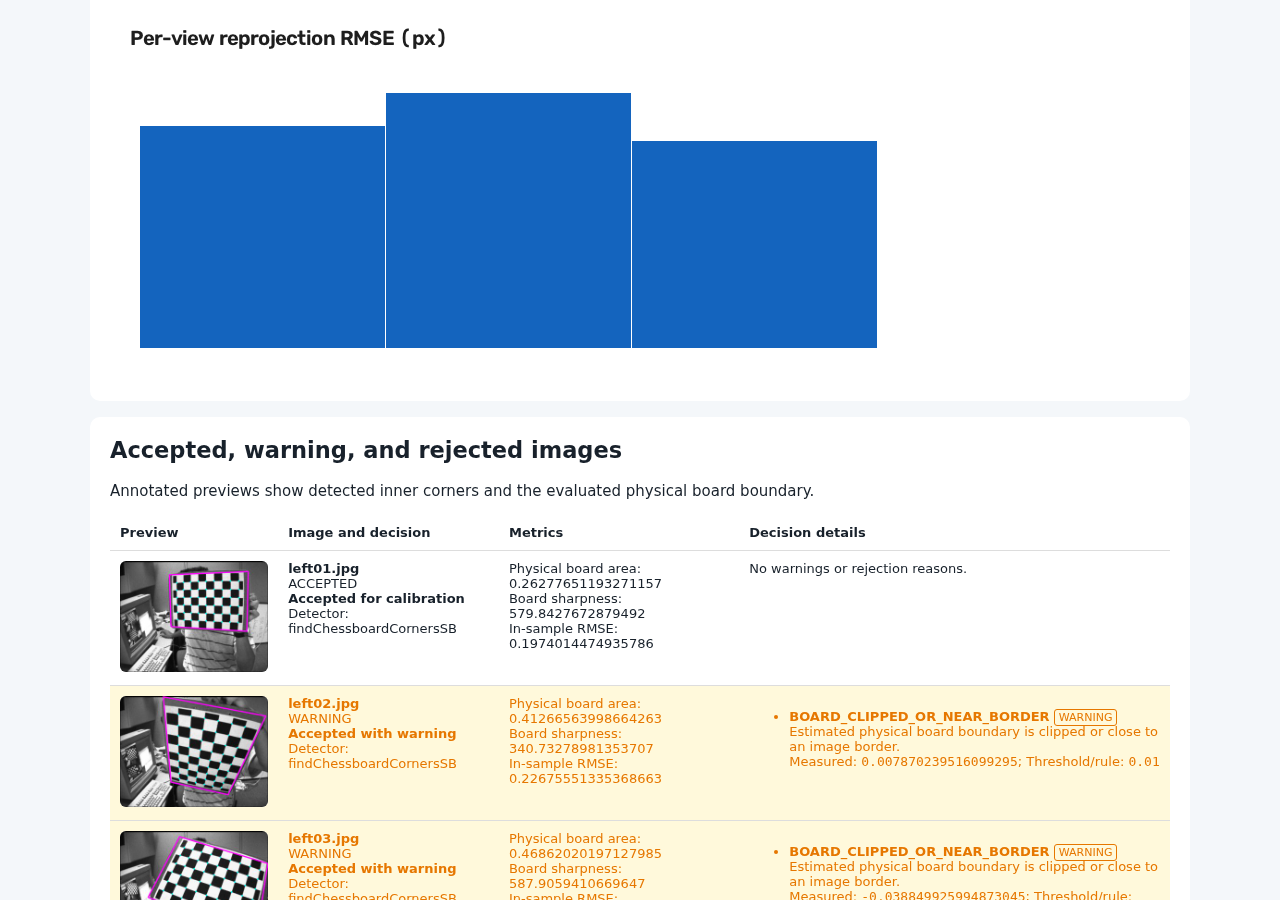
Open the self-contained example report or
inspect its summary.json.
The reproduction guide
includes source, license, exact commands, measurements, and an intentional
--fail-on-warning run.
What it measures
- Complete checkerboard detection and readable-image rate.
- Global and board-region sharpness plus exposure warnings.
- Physical board area, border safety, image-plane coverage, and corner density.
- Scale bins, circular rotation range, and signed perspective diversity.
- Near-duplicate pose using normalized position, area, rotation, and perspective.
- OpenCV pinhole RMS and per-view reprojection statistics.
Coverage, diversity, sharpness, and duplicate thresholds are heuristics, not a calibration certificate. Per-view reprojection error is in-sample because the same accepted images fit and evaluate the model.
Learn how the metrics work · Review decision codes
Output
audit_result/
├── report.html
├── summary.json
├── images.csv
├── calibration.yaml
├── accepted.txt
├── rejected.txt
├── report-manifest.json
└── assets/
    ├── coverage_heatmap.png
    ├── reprojection_errors.png
    └── thumbnails/
report.html is self-contained and works offline. summary.json contains
typed reason codes, runtime versions, configuration, dataset metrics, quality
gates, calibration parameters, and per-image results.
Read the complete output schema.
Python API
from pathlib import Path

from calibration_audit import AuditConfig, PatternSpec, audit_dataset

config = AuditConfig(
    pattern=PatternSpec(cols=9, rows=6, square_size=30.0, unit="mm"),
    min_valid_images=12,
)
result = audit_dataset(Path("./calibration_images"), config)

print(result.summary)
result.write_outputs(Path("./audit_result"))
Library functions raise typed CalibrationAuditError subclasses and never
call sys.exit(). See the
Python API reference.
Limitations
Version 0.2.2 supports standard black-and-white checkerboards, monocular calibration, and the pinhole camera model. It does not support stereo or fisheye calibration, ChArUco/ArUco, circle grids, live capture, ROS output, a GUI, automatic view pruning, or input-file modification.
Read the full scope and limitations.
Development
python -m pip install -e ".[dev,docs]"
ruff check .
mypy .
pytest --cov=calibration_audit --cov-report=term-missing --cov-fail-under=85
python -m build
twine check dist/*
mkdocs build --strict
CI tests Python 3.10–3.13, OpenCV 4.11/5.x, and Windows/macOS smoke installations. Documentation has a separate pull-request build and GitHub Pages deployment workflow.
License
MIT. See LICENSE.
1 maintainer

Metadata
1 maintainer
Release files for opencv-calibration-audit 0.2.2
For a detailed explanation of source distributions (sdists) and built distributions (wheels), please see the package formats documentation.
Source distribution (sdist)
| File | Size | Uploaded | |
|---|---|---|---|
| opencv_calibration_audit-0.2.2.tar.gz | 28.3 kB | Details |
Built distribution (wheel)
| File | Interpreter | ABI | Platform | Reset |
|---|---|---|---|---|
| opencv_calibration_audit-0.2.2-py3-none-any.whl | Python 3 | none | any | Details |
Total release size: 59.6 kB
Release files / opencv_calibration_audit-0.2.2.tar.gz
| Download URL | opencv_calibration_audit-0.2.2.tar.gz |
|---|---|
| Size | 28.3 kB |
| Tags | Source |
|
SHA-256 checksum How to use checksums |
e24ca3d7ae34520b743f1ca31dcd2dd9ae3dc99d7c1a7f459e3691ca1c585611
|
|
BLAKE2b-256 checksum How to use checksums |
ca9f403fb69bcfaf0e625791b8f825ee46f7c459cb3077d6fe47e00abdaf85d0
|
| Upload date | |
|
Uploaded using Trusted Publishing? What is trusted publishing? |
Yes |
| Uploaded via |
twine/7.0.0 CPython/3.13.14
|
Provenance
Provenance describes where a file came from. On PyPI, provenance is shared via attestations, which provide a verifiable record of the build or publishing details. View details, limitations and caveats.


PyPI Publish Attestation
PyPI verified that this artifact, at this checksum, originated from the publisher listed below.
Signed by GitHub Actions, verified by PyPI on Jul 31, 2026.
Transparency logRelease files / opencv_calibration_audit-0.2.2-py3-none-any.whl
| Download URL | opencv_calibration_audit-0.2.2-py3-none-any.whl |
|---|---|
| Size | 31.3 kB |
| Tags | Python 3 |
|
SHA-256 checksum How to use checksums |
85c72bb5faf561afc1b63477472d50ef8baa54cc050f060fb96b6f566288e880
|
|
BLAKE2b-256 checksum How to use checksums |
c91de7a710c3c144b2f82e6a9c71374c0cb0bf5bb3ed65e0ec71f52a3c011995
|
| Upload date | |
|
Uploaded using Trusted Publishing? What is trusted publishing? |
Yes |
| Uploaded via |
twine/7.0.0 CPython/3.13.14
|
Provenance
Provenance describes where a file came from. On PyPI, provenance is shared via attestations, which provide a verifiable record of the build or publishing details. View details, limitations and caveats.
PyPI Publish Attestation
PyPI verified that this artifact, at this checksum, originated from the publisher listed below.
Signed by GitHub Actions, verified by PyPI on Jul 31, 2026.
Transparency log













