
OpenNIW — NIW · EB-1A · O-1 · I-485
Free, open-source agent skills that help you organize and speed up your own U.S. immigration paperwork — the EB-2 NIW and EB-1A self-petitions, the O-1A petition kit, and the employment-based I-485 that follows. Your coding agent does the organizing, a local folder is the case file, and a browser wizard appears exactly when a GUI beats chat.
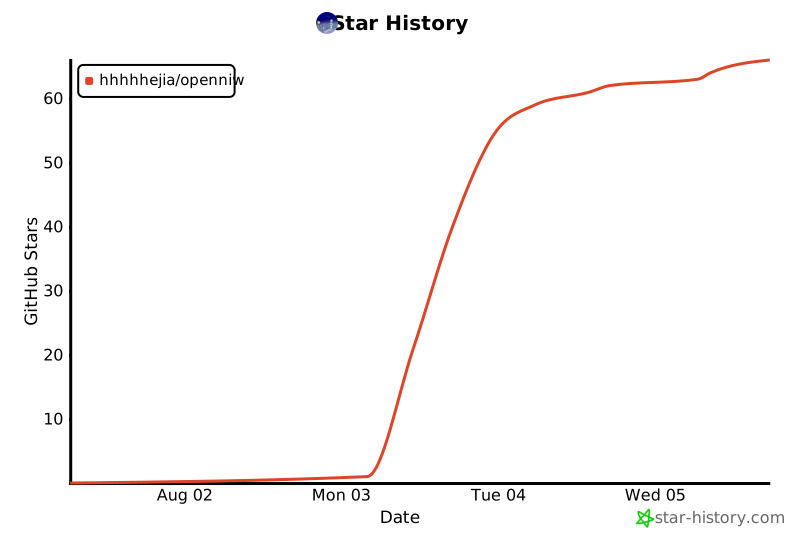
Star History
Website: openniw.com — project intro, install guide, and a free no-signup statistical evaluation against 10,999 approved cases (fully static; source in webpage/).
OpenNIW ships four Agent Skills —
niw-petition, eb1a-petition, o1-petition, and i485-adjustment.
Install them into
Claude Code, Codex, Cursor, or any Agent-Skills tool, and your existing AI
subscription runs the entire preparation workflow — evaluation, evidence,
drafting, official forms, filing package — with zero configuration:
- No account. Nothing to sign up for.
- No database. Your case lives in a local case folder you own.
- No API key. Your agent's subscription is the AI.
- No server. A localhost companion opens only when you reach a form-heavy step, and only talks to your case folder.
OpenNIW is a document-preparation and self-help tool, not a law firm, and does not provide legal advice. Immigration outcomes depend on individual facts and adjudicator discretion. Review everything before filing; consider consulting a licensed attorney.
Install
# cross-agent installer (Claude Code, Codex, Cursor, 70+ agents) —
# offers all four skills; install what you need:
npx skills add HHHHHejia/openniw

# or manually — Claude Code (swap in any of the four skill folders):
git clone https://github.com/HHHHHejia/openniw
mkdir -p ~/.claude/skills && cp -r openniw/.agents/skills/niw-petition ~/.claude/skills/

# or manually — Codex and other Agent-Skills tools:
mkdir -p ~/.agents/skills && cp -r openniw/.agents/skills/niw-petition ~/.agents/skills/
Then say "帮我准备 NIW 申请" or "evaluate my NIW case" in your agent — or "evaluate my EB-1A case" / "prepare my O-1 petition" / "help me file my I-485" for the sibling skills.
Two ways to run it
The terminal (default, recommended). The install above is all you need: your agent, your case folder, and a browser tab when a step calls for one. Nothing else to install, nothing else to trust.
A desktop window (beta, optional). If a terminal is the part that puts
you off, desktop/ is an Electron shell that puts the same two things in
one window — your agent on one side, the companion's pages on the other,
with a live stage bar and the statistical evaluation one click away. It
changes nothing about how OpenNIW works: it spawns the very same claude
or codex CLI you already installed, under your own subscription, on your
own files. It never reads, stores, or proxies a credential, runs no server
of its own, and its embedded view is locked to localhost.
You do not have to set it up yourself. On a new case the skills ask
once — terminal or window? — and if you want the window, your agent checks
for Node.js and does the install for you. Nothing is lost switching later
either: STATE.md carries the whole session, so you reopen the same case
folder in the window and pick up exactly where you were.
Or do it by hand:
git clone https://github.com/HHHHHejia/openniw ~/openniw
cd ~/openniw/desktop && npm install && npm start
It runs from source rather than a downloadable installer: a double-click DMG/EXE has to be code-signed or the OS shows scary "unidentified developer" warnings, and this project is not paying a certificate authority to say it is trustworthy. Source is honest and auditable — see desktop/readme.md.
The four skills
| Skill | Category | Status | What differs |
|---|---|---|---|
niw-petition |
EB-2 NIW self-petition (I-140 + ETA-9089 App. A) | shipped | Full flow incl. browser forms wizard, deterministic PDF fill, filing-package ZIP |
eb1a-petition |
EB-1A extraordinary ability self-petition (I-140, E11) | beta | All ten 8 CFR 204.5(h)(3) criteria, Kazarian two-step petition letter with Final Merits section, benchmark vs ~2,300 approved EB-1A cases; I-140 by field guide (wizard = roadmap) |
o1-petition |
O-1A petition kit (I-129; employer / agent / founder-owned entity) | beta | Petitioner-structure decision tree, consultation/advisory opinion, itinerary, signature-ready hand-off package for the petitioner; I-129 by field guide |
i485-adjustment |
Employment-based adjustment of status (I-485 on an approved or pending EB I-140) | beta | The step after the petition. Eligibility gating, status-history assembly, personalized document checklist, I-485 part-by-part guidance, package and post-filing timeline — assembly only, see below |
The beta skills were built from primary sources (USCIS Policy Manual, 8 CFR, current fee schedules — all cited inline with as-of dates), open-source MIT materials, and our 10,999-case approved-case dataset. They follow the same frozen-frame doctrine, exhibit-bound drafting, and RFE red-team pass as the NIW flagship. If you have been through an EB-1A, O-1 or I-485 filing — applicant or practitioner — we would love your review.
i485-adjustment is deliberately narrower — and here is why
The petition skills argue a case. The I-485 skill does not, because the downside is different in kind: in 2026, USCIS is adjudicating adjustment as a discretionary benefit, interviews are back for a meaningful share of employment-based cases, vetting has expanded — and a denial for someone with no other status can end in a Notice to Appear and removal proceedings.
So it is an assembly and completeness tool. It does the enormous clerical burden: eligibility gating against published answers (I-140 basis, the Visa Bulletin chart USCIS designated this month, 212(e)), reconstructing a continuous status/address/employment/travel history from your first entry, the document checklist personalized by what actually drives each requirement (including the birth-certificate substitute ladder and country-specific documents), part-by-part form guidance for every applicant in the family, package assembly, and the post-filing timeline.
And it stops, naming the fact that stopped it, on anything where being wrong can hurt you: any answer in Form I-485 Part 9 (the inadmissibility block — renumbered from Part 8 in the 01/20/25 edition), any criminal history at all, any overstay or unauthorized work, any 245(k)/245(c) day-count, misrepresentation, prior removal, unresolved 212(e), CSPA calculations, INA 204(j) "same or similar" determinations, and the decision to actually use an EAD or advance parole (holding one is harmless; using it ends your underlying nonimmigrant status). It will not help you phrase around an adverse fact. Those refusals are the product, and they are enforced by tests.
Family-based I-485 is out of scope (it needs Form I-864 and sponsor-income analysis that is not implemented).
How it works
        ┌──────────────────────────────────────┐
        │   Your agent + an OpenNIW skill      │   reads, organizes, drafts,
        │   (niw / eb1a / o1 / i485 · any agent)│   prefills — you decide
        └──────┬─────────────────────┬─────────┘
   reads/writes│                     │ launches at interaction-heavy steps
               ▼                     ▼
        ┌────────────┐   ┌───────────────────────────┐
        │ your case/ │◄──┤ openniw (pip companion)   │  the ORGAN — browser
        │ STATE.md   │   │ localhost form wizard +   │  wizard & deterministic
        │ case.json  │   │ citation review + PDF     │  compute; zero LLM,
        │ forms/ …   │   │ fill / package / harvest  │  zero keys, zero DB
        └────────────┘   └───────────────────────────┘
-
Each skill drives every stage and survives weeks of short sessions:
STATE.mdin the case folder is read at every session start and updated after every step, so any session resumes exactly where the last one ended. -
The companion (
pip install openniw, installed by your agent when first needed) serves a localhost-only, token-protected browser UI over your case folder for the steps where a GUI beats chat — reviewing 60+ form fields, or picking your best ~10 citations from scored quote cards — plus headless deterministic commands the agent uses directly:openniw ui forms|citations # browser session over the case folder openniw fill all # fill I-140 / ETA-9089 App. A / Final Det. / G-1145 openniw package # filing-package ZIP in lockbox order openniw harvest "Title" … # OpenAlex citing-paper harvest + screening openniw registry # lint the claim→evidence table (see below) openniw fetch-forms # download official blank PDFs openniw docx / highlight # DOCX export · exhibit highlightingThe browser session outlives your terminal: close everything, come back tomorrow, and the agent reconciles what you did from the session file. If the companion can't be installed (offline/sandboxed), the skill falls back to pure-stdlib scripts bundled with it — the GUI is an accelerator, never a requirement. Intake, benchmark, and citation pages work for all three categories; the forms wizard, PDF fill, and package ZIP are NIW-only today (EB-1A / O-1A run Stages IV–V as guided chat + field guides — wizard support is on the roadmap).
The workflow, stage by stage
The three petition skills follow the same shape — six stages to filing, plus the RFE-response stage if USCIS pushes back; each adapts to its law:
| Stage | NIW | EB-1A | O-1A |
|---|---|---|---|
| I — Evaluate | Tiered, Dhanasar prong-by-prong read | All ten 204.5(h)(3) criteria + Kazarian two-step test | 8 O-1A criteria + petitioner-feasibility read |
| II·a — Frame | FREEZE the canonical endeavor sentence | FREEZE field definition + target criteria + continue-work statement | FREEZE petitioner structure + field + role/itinerary + consultation plan |
| II·b — Evidence | Personalized checklist; citation pipeline (harvest → independence screen → full-text verify → browser portfolio pick) — shared by all three | ← same | ← same, plus contracts / deal memos / itinerary |
| III — Draft | PES → support letters → Dhanasar three-prong Petition Letter → exhibit index | Continue-work statement → letters → Kazarian two-step letter with Final Merits section | Petitioner support letter → consultation request → itinerary → expert letters |
| IV — Forms | Browser wizard over the 61-field answer set → deterministic I-140/ETA-9089 PDF fill | I-140 (E11) field-by-field guide | I-129 + O supplement field guide |
| V — Package | ZIP in lockbox order, state+premium-aware address | Assembly checklist, standard-vs-premium lockbox tables | Signature-ready hand-off kit for the petitioner |
| R — RFE response | Prong-by-prong diagnosis → evidence loop → government-letter line → supplemental PS → response package | Criterion-by-criterion + final-merits rebuttal → new-evidence loop → response package | Itinerary / consultation / agent-authority cures → petitioner-signed response kit |
RFE response is a full workflow, not a footnote (stage R, shown in the browser stepper once active): upload the RFE letter, get the deadline worked backward into a plan, diagnose every challenged point against its root cause, close evidence gaps item by item, refresh citation examples (harvested, independence-screened, highlighted PDFs), draft the letters and the supplemental statement, and assemble the response package — with an emergency entry for petitions that were NOT prepared with OpenNIW (attorney-filed or DIY): drop in the original petition + the RFE letter and the skill rebuilds the case file first. Every stage also bakes in RFE-prevention rules at filing time.
How the work is kept honest
An AI that drafts immigration arguments will produce fluent, plausible prose whether or not the evidence is there. Most of this project is the machinery that stops a plausible narrative from being filed as supported evidence — distilled from the structure of real, professionally-prepared filings and a real RFE cycle (fully de-identified, see docs/analysis/) plus USCIS primary sources cited inline with as-of dates.
Every claim carries its evidence — and a linter checks that it does
While drafting, the agent maintains documents/source-registry.md: one row
per factual claim. Load-bearing claims — what the letter argues from,
anything about a third-party entity, anything asserting impact — carry a
full row:
| column | why it exists |
|---|---|
| source | exhibit number, or URL + verbatim quote + retrieval date |
| locator | exhibit page and paragraph — an officer who cannot find the proof has not been given it |
| independent verifier | who attests this other than the applicant and anyone with a stake in the outcome. NONE — self-serving is a legitimate answer, and a decision to make before filing, not after |
| measure | impact claims only: the number and its as-of date |
| gap | what is still missing for the claim to stand |
openniw registry parses that table and reports unsourced claims,
load-bearing claims with no independent verifier, missing locators, exhibit
numbers absent from the exhibit index, and cells filled with - / N/A /
TBD / see above — which look filled in and say nothing. A
verification table that filler can satisfy is worse than no table: it
manufactures the appearance of having checked.
The independent-verifier column exists because exhibit-binding alone misses the real failure mode. An employer letter is an exhibit, so the claim binds — and still reads as an interested party vouching for itself. That is exactly what the RFE we studied block-quoted back as unsubstantiated.
The citation pipeline argues depth of use, not prestige
openniw harvest pulls citing papers from OpenAlex; the agent then screens
for independence (no shared author between citing and cited paper,
surname-collisions escalated), discards anything not formally published,
verifies in the citing full text that the citation actually exists
(observed false-positive rate in indexes: ~5%), and scores by how the work
was used — implemented / compared-favorably / utilized / verified beats a
passing background mention. You pick the final portfolio from scored quote
cards in a browser page; openniw highlight produces the exhibit PDFs with
only the in-text citation and its reference-list entry marked.
Emphasizing who cited you actively harms a petition — it invites the comparative test the regulations don't ask for. The pipeline is built to argue how.
The frame is frozen, and every document quotes it verbatim
The endeavor sentence (NIW), field definition and claimed criteria (EB-1A),
or petitioner structure and role (O-1) are frozen before any drafting
begins, because USCIS can treat post-filing rewording as a material change.
Lint checks that the frozen text appears identically everywhere it appears.
On an RFE for a petition prepared elsewhere, the skill extracts that text
from the as-filed record and marks it FROZEN (as filed) — it may never be
improved, only argued from.
Evidence is date-classed against the priority date
Eligibility is judged as of the filing date (8 CFR 103.2(b)(12)). Every exhibit is classed pre-filing / post-filing as continuation of a named pre-filing thread / not worth it, so that at RFE time — under a non-extendable deadline — the question of what may still be used is already answered rather than re-litigated.
A mock-officer pass before anything is printed
Stage V runs twelve RFE-prevention rules over the whole case from the adjudicator's perspective (no uncorroborated third-party claims, never expose a denominator, pre-empt "common among researchers", legal authorities in footnotes only, and more), plus a claim-verification log that extracts every factual claim and grades it CRITICAL (contradicts its source) / WARNING (unsupported) / INFO, with explicit passes for the two commonest defects: dates consistent across all documents, and titles consistent across CV, letters, and forms.
The agent never invents facts
Missing information becomes an explicit [TODO] or a question to you —
never a plausible guess. Identity numbers, dates, metrics, and quotes come
only from your sources or from you. Fields the agent derived rather than
you stating are flagged amber in the forms wizard until you confirm them.
The engineering follows the same rule
Contract tests fail the build when documentation and code drift apart: the
61-key answers.json contract is enforced three ways (what the PDFs
consume ≡ what the wizard edits ≡ what the skill documents), and the RFE
stage is enforced three ways (the STATE.md line the skills tell the agent
to write ≡ the regex the browser stepper parses it with ≡ the field ids of
the data-point issue form). Skill fallback scripts are byte-compared against
their package sources. Benchmark copy is held to one wording rule
everywhere: percentile among publicly posted approved cases, never an
individual's approval probability.
Filing facts (2026, verify before filing)
- NIW package: I-140 + ETA-9089 Appendix A + signed Final Determination + petition letter + evidence. Fees: I-140 $715 + Asylum Program Fee $300 (self-petitioner) = $1,015; optional premium processing (I-907) $2,965, 45 business days.
- EB-1A package: same I-140 fees ($715 + $300 self-petitioner), but no ETA-9089 pages and no ability-to-pay evidence; premium is 15 business days (vs NIW's 45) — and the premium lockbox state split differs from the standard split.
- O-1A package: Form I-129 + O supplement, filed by the employer or agent (never self-petitioned). I-129 (O) $1,055 ($530 small employer/nonprofit) + Asylum Program Fee by employer size; premium $2,965, 15 business days; consultation letter required.
- The package README and the wizard pick the correct USCIS lockbox automatically (standard: Dallas/Chicago; premium: Phoenix/Elgin — premium filings use a different lockbox) and follow the USCIS-recommended assembly order (payment form on top, then G-1145, then the forms).
- Primary sources baked into the templates: USCIS EB-2 page & NIW filing tips, I-140 initial-evidence checklist, tips for filing by mail, and I-140 direct filing addresses.
Privacy
Full detail — every network call the system can make, what the localhost companion is allowed to touch, and every command the skills may run — is in SECURITY.md.
- Everything runs on your machine. The case folder is the entire system of record — zip it, move it, or open it in any editor.
- The companion binds 127.0.0.1 only, requires a per-session random token, and does no AI: the only network calls in the whole system are your agent's own, plus the public OpenAlex API (citation metadata) and uscis.gov/dol.gov (blank form downloads).
- The repo contains no personal data; analyses in
docs/analysis/are structural, with all identifiers replaced by placeholders.
For maintainers
openniw/
├── .agents/skills/niw-petition/  # the flagship skill (EB-2 NIW)
│              └── eb1a-petition/ # EB-1A skill (beta)
│              └── o1-petition/   # O-1A skill (beta)
│              └── i485-adjustment/ # employment-based I-485 (beta)
├── src/openniw/                  # the pip companion: FastAPI folder-mode
│   │                             #   server + CLI + committed UI bundle
│   └── ui/                       # built Next.js static export (make ui)
│   └── services/                 # deterministic compute: formfill, citations,
│                                 #   papers, package, registry linter …
├── frontend/                     # UI source (Node needed by maintainers only)
├── desktop/                      # Electron shell: runs the user's own agent
│                                 #   CLI + the companion pages in one window
├── forms/                        # vendored official PDFs + field inventories
├── tests/                        # pytest: contracts, formfill, API, sentinel,
│                                 #   registry linter, version precision
├── scripts/                      # export_benchmark.py · sync_skill.py
└── docs/                         # design docs + de-identified analyses
make test— full suite (63 tests).make ui— rebuild the UI bundle fromfrontend/and vendor it into the package.make check— tests + skill script sync + UI-bundle freshness.make release— checked wheel build.- Contract tests are the backbone. The 61-key
answers.jsoncontract (tests/test_contract.py):formfill.py(what the PDFs consume) ≡ the wizard spec (what the UI edits) ≡references/forms.md(what the agent writes). The RFE stage (tests/test_rfe_contract.py): the STATE.md line the skills document ≡ the regexsession.tsxparses it with (lifted out of the TSX at test time, so changing it there fails here) ≡ the field ids in.github/ISSUE_TEMPLATE/data-point.yml. desktop/is a shell, not a service — it spawns theclaude/codexbinary the user already installed and renders the companion's own localhost pages, wired together by the singleOPENNIW_URL=line the CLI already prints. It must never read, store or proxy an AI credential (Anthropic's terms forbid consumer-subscription OAuth in third-party tools, including the Agent SDK), and the embedded view is hard-limited to loopback. See desktop/readme.md.openniw registryis pure-stdlib and side-effect-free (services/registry.py) — it reads the case folder and reports; it never edits a user's file. Same rule for every service: the agent decides, the companion computes.- Skill fallback scripts mirror package services between
# --- BEGIN/END SYNC ---markers across the three petition skills;scripts/sync_skill.pyregenerates them andmake checkfails on drift. - Versions in the storage layer are opaque strings, never JSON numbers:
st_mtime_nsexceedsNumber.MAX_SAFE_INTEGER, so a browser silently rounds it and every optimistic-concurrency save 409s (tests/test_version_precision.pypins this).
Contributing
OpenNIW is a fully open-source, free, public-interest project (开源利益众生). It gets better through three kinds of contribution:
- Code — issues and PRs welcome. High-value directions: more form mappings (I-907, an I-485 wizard), more browser pages (evidence ledger, document review), consular-processing variants, UI translations.
- Data points — file the anonymous data-point form with your (anonymized) numbers and outcome: category, field, citations/papers at filing, premium choice, timeline, RFE or not, result — plus anything we should improve. The skills offer this as an optional final step, and every real data point sharpens the benchmark that helps the next applicant calibrate honestly.
- Attorneys & practitioners — if you prepare NIW cases professionally, your frontier knowledge (what draws RFEs this quarter, what wording holds up, what evidence moves adjudicators) can be folded into the skill's playbooks. Open an issue or reach out directly — credited or anonymous, your choice.
Contact & collaboration
Read MAINTAINER-POLICY.md first. We answer questions about the software — installation, bugs, how something works, where a number came from, a stale USCIS citation. We decline case questions ("do I qualify", "should I file", "how should I word this", "how do I answer this RFE") and we do not review CVs, drafts, or notices — from anyone, at any price. For your actual case you need a licensed immigration attorney or a DOJ-accredited representative.
- GitHub issues: the preferred channel for anything public
- WeChat:
LittleGeng - X: x.com/hejia0530
EB-1A and O-1A are now here (beta) — built from USCIS primary sources, MIT-licensed open materials, and our approved-case dataset, not from firsthand filings. That is exactly why they need you: if you have actually been through an EB-1A or O-1 case — as applicant, or as practitioner — your review of the playbooks is the single highest-value contribution right now. OpenH1B · Open-anything-immigration — still on the wish list; the whole framework is reusable (agent skill + local companion + approved-case benchmark). Reach out and let's build the next one together.
References & acknowledgments
The skills' legal and procedural content is distilled from these sources (each skill's reference files carry inline citations with as-of dates):
Primary sources
- USCIS Policy Manual — Vol. 6 Part F Ch. 2 (EB-1A) & Ch. 5 (NIW), Vol. 2 Part M (O-1)
- 8 CFR 204.5 and 8 CFR 214.2(o) via eCFR; INA via uscode.house.gov
- uscis.gov form pages, filing checklists, direct-filing-address pages, and the G-1055 fee schedule; federalregister.gov (fee rules); travel.state.gov Visa Bulletin
- Case law: Matter of Dhanasar, 26 I&N Dec. 884 (AAO 2016); Kazarian v. USCIS, 596 F.3d 1115 (9th Cir. 2010); Matter of Price, 20 I&N Dec. 953
Open-source projects
- juntoku9/claude_immigration_attorney (MIT) — evidence-hierarchy, expert-letter assignment matrix, RFE root-cause taxonomy, and national-importance research-method patterns were adapted with gratitude
- razvanmarinescu/EB1A and Ryan-Rhys/EB1A — public approved self-petitions studied for structure (no text reused)
Data & practitioner knowledge
- Structure of real, professionally prepared NIW filings and a real RFE cycle (fully de-identified, see docs/analysis/), plus published analyses by immigration practitioners and university international offices consulted during research
License
MIT.
Disclaimer
OpenNIW is free software that helps you organize and prepare your own immigration paperwork. It is a completely open-source, free, public-interest project — no paid tier, no service, no upsell, ever. To be explicit:
-
Your data never reaches us. Your entire case is processed by YOUR own local AI agent in a folder on YOUR computer. Nothing is sent to us — we run no server that could even receive it. (The public website's evaluation page is fully static too: what you type stays in your browser.)
-
We are not attorneys and OpenNIW is not a law firm. Nothing here is legal advice, and using OpenNIW creates no attorney–client relationship.
-
The maintainers do not work on individual cases. OpenNIW provides no human legal services, no case representation, no individualized assistance from its maintainers, no filing service, and no attorney review. It is freely published software that you install and run yourself, with your own AI tools. There is no engagement, no representation, and no promise of any outcome; immigration results depend on your individual facts and on adjudicator discretion. See the maintainer policy — we decline case questions from everyone, and paying or donating does not change that.
-
The software does not decide whether you qualify. It organizes your materials against publicly available USCIS criteria, spots issues, and drafts documents for you to review, revise, or discard. It does not determine eligibility, does not tell you whether to file, and does not estimate your odds.
-
You are the petitioner and remain fully responsible for everything you sign and file. Review every document and form yourself before filing, and consider having a licensed immigration attorney review your case.
-
The software is provided "AS IS", without warranty of any kind; the authors and contributors accept no liability arising from its use (see the MIT license).
-
Benchmark data reflects publicly posted, self-reported approval notices (successful cases only) and describes distributions of approved profiles — it does not predict any individual outcome.
1 maintainer

Download files
Download the file for your platform. If you're not sure which to choose, learn more about installing packages.
Source Distribution
Built Distribution
Filter files by name, interpreter, ABI, and platform.
If you're not sure about the file name format, learn more about wheel file names.
Copy a direct link to the current filters
File details
Details for the file openniw-0.3.0.tar.gz.
File metadata
- Download URL: openniw-0.3.0.tar.gz
- Upload date:
- Size: 804.6 kB
- Tags: Source
- Uploaded using Trusted Publishing? No
- Uploaded via: twine/7.0.0 CPython/3.12.9
File hashes
| Algorithm | Hash digest | |
|---|---|---|
| SHA256 |
ed8c09cd99abb5d8a6f2c98558ff38200620b7fb9201f99efd7f89eebfc0c2c8
|
|
| MD5 |
673c45afc02d7901d224a82c0d0ef0e6
|
|
| BLAKE2b-256 |
32e7650d1e40e70fa0f5e9f28485590ff4cc88ad3364a1e258b00730cb981ab6
|
File details
Details for the file openniw-0.3.0-py3-none-any.whl.
File metadata
- Download URL: openniw-0.3.0-py3-none-any.whl
- Upload date:
- Size: 834.9 kB
- Tags: Python 3
- Uploaded using Trusted Publishing? No
- Uploaded via: twine/7.0.0 CPython/3.12.9
File hashes
| Algorithm | Hash digest | |
|---|---|---|
| SHA256 |
1ca7ddf655d44170762ee98b098bfff29d1ce7e1ca75465c1ed96ca265af719e
|
|
| MD5 |
2f9f933295abddbbe9d36248a18ea1aa
|
|
| BLAKE2b-256 |
86b86c410f63a5783699742a7df1f7d1db2534b53296781cdca68651a7bd2446
|







