
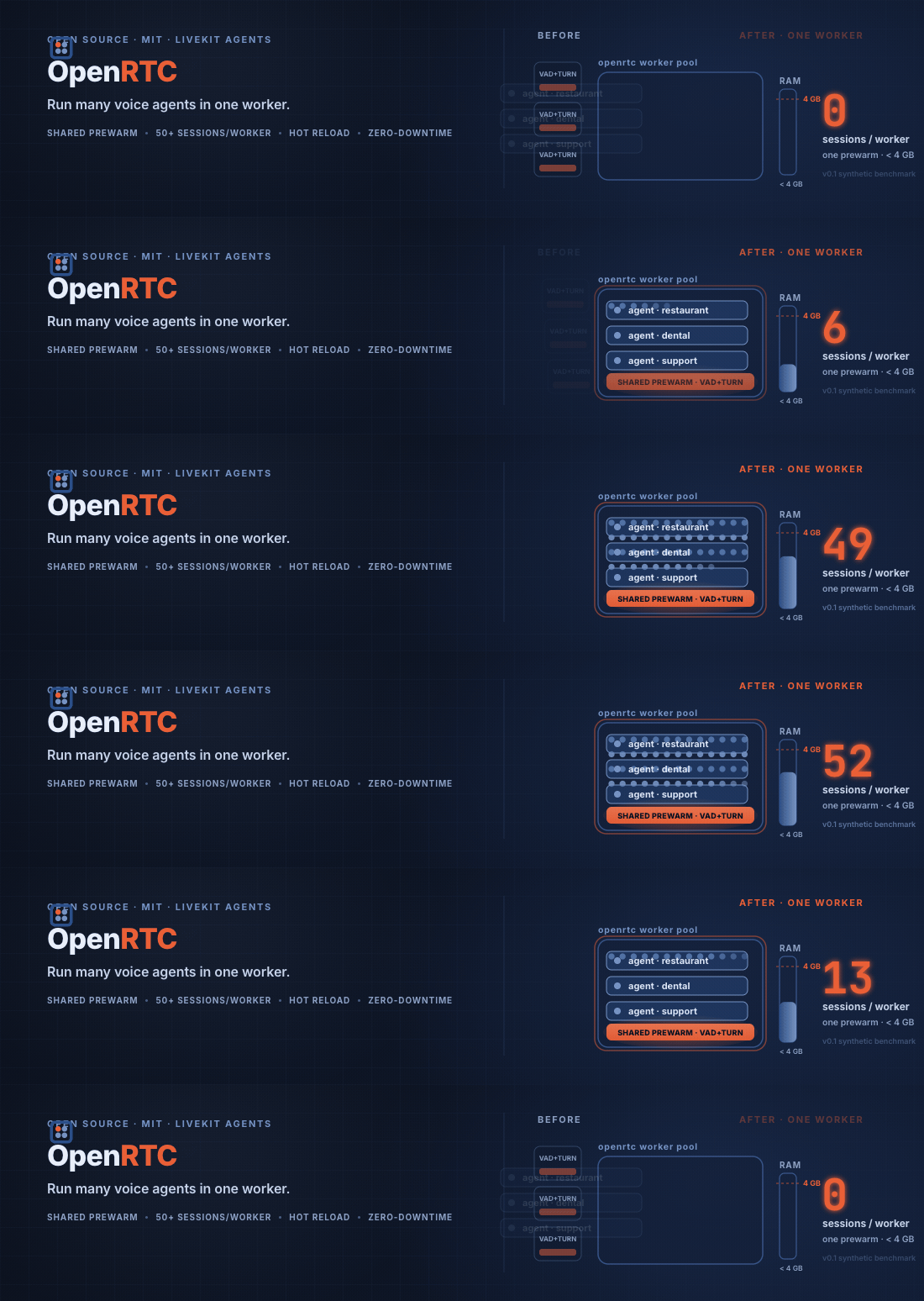





from openrtc import AgentPool
from my_agents import RestaurantAgent, DentalAgent, SupportAgent

pool = AgentPool()                       # one worker, prewarm once
pool.add("restaurant", RestaurantAgent)  # standard livekit.agents.Agent subclasses
pool.add("dental", DentalAgent)
pool.add("support", SupportAgent)
pool.run()                               # N agents share one Silero VAD + turn detector
A thin multi-agent layer for LiveKit Agents. Register many standard livekit.agents.Agent subclasses on one AgentPool and host them in a single worker: shared prewarm (Silero VAD, turn detector) loads once instead of once per worker, and every incoming call still gets its own AgentSession. OpenRTC never introduces a base class and never sits between you and @function_tool, RunContext, on_enter, on_exit, or the *_node hooks. You change how many workers you run, not how you write an agent.
Why OpenRTC
Running livekit-agents yourself usually means one deployment per agent and hand-rolled glue for routing, deploys, and visibility. OpenRTC answers the questions an operator actually asks:
- How many agents per box? One worker hosts every registered agent; each call is routed to the right one. You run one fleet instead of one deployment per agent.
- Do I rewrite my agents? No. Your
Agentsubclasses, tools, and provider objects are unchanged; you delete per-worker boilerplate (entrypoint,AgentSessionwiring,cli.run_app) and register classes on one pool. - What does it cost? In the default coroutine mode about 22 MB per call versus about 65 MB for stock
livekit-agents1.8 on the same machine, at about the same CPU on uvloop (measured, see Throughput and density). CPU, not memory, is usually what limits calls per box. - What if I need hard isolation? Pass
isolation="process"for the one-subprocess-per-session model with independent crashes, livekit's per-session memory caps, and all CPU cores.
Features
| Capability | What it gives you |
|---|---|
| One worker, many agents | Register N standard Agent subclasses on a single AgentPool; dispatch resolves one per call. |
| Shared prewarm | Silero VAD and the turn detector load once per worker in coroutine mode, not once per agent. |
| Coroutine or process isolation | Default coroutine runs each session as an asyncio.Task; process keeps one subprocess per session with hard isolation. |
| Metadata routing | Ordered resolution across job metadata, room metadata, room-name prefix, then first-registered fallback. |
| Hot reload | Edit an agent file and openrtc dev swaps live sessions on their next turn, no dropped calls. A bad save rolls back. |
| Session introspection | openrtc top shows per-session memory, CPU, and event-loop blocks live for the shared worker (htop-style). |
| Multi-tenancy | Per-tenant provider keys, session caps, and a blast-radius circuit breaker, so an agency runs every client in one pool safely. |
| Zero-downtime deploys | Blue-green drain: the new worker version takes new calls while the old drains its in-flight calls to hangup, then exits. No dropped calls. |
| Job scoping | Per-job accept/reject filter so several workers can share one LiveKit project, each taking only its own rooms. |
| Session observers | Structural-typed async start/end hooks for telemetry, isolated so a slow or raising observer never crashes the session. |
| JSONL metrics stream | Append-only JSON Lines of pool snapshots and lifecycle events for tail -f, jq, or a log shipper. |
| LiveKit-shaped CLI | start / dev / console / connect / download-files plus an OpenRTC-only list, with an optional Rich dashboard. |
| No base class | Your Agent subclasses, @function_tool, RunContext, and node hooks stay exactly as written. |
Full release history: changelog.
Quick start
pip install "openrtc[livekit]"        # or: uv add "openrtc[livekit]"
pip install "openrtc[livekit,cli]"    # adds the openrtc CLI (rich + typer)
Requires Python 3.11 to 3.13 (>=3.11,<3.14; the transitive onnxruntime behind Silero and the turn detector has no 3.10 wheels). livekit-agents is an opt-in extra: import openrtc does not pull it, and the core is just watchfiles. Install openrtc[livekit], which pulls livekit-agents[openai,silero,turn-detector]>=1.5,<1.9. Ships a PEP 561 py.typed marker. Set LIVEKIT_URL / LIVEKIT_API_KEY / LIVEKIT_API_SECRET as for any LiveKit worker.
Explicit registration with add() when you want every agent named and configured in one place:
from livekit.agents import Agent
from livekit.plugins import openai
from openrtc import AgentPool


class RestaurantAgent(Agent):
    def __init__(self) -> None:
        super().__init__(instructions="You help callers make restaurant bookings.")


pool = AgentPool(default_llm=openai.responses.LLM(model="gpt-4.1-mini"))
pool.add(
    "restaurant",
    RestaurantAgent,
    stt=openai.STT(model="gpt-4o-mini-transcribe"),
    tts=openai.TTS(model="gpt-4o-mini-tts"),
    greeting="Welcome to reservations.",
)
pool.run()
One file per agent with discover() when you prefer a module per agent and optional @agent_config(...):
from pathlib import Path
from livekit.plugins import openai
from openrtc import AgentPool

pool = AgentPool(
    default_stt=openai.STT(model="gpt-4o-mini-transcribe"),
    default_llm=openai.responses.LLM(model="gpt-4.1-mini"),
    default_tts=openai.TTS(model="gpt-4o-mini-tts"),
)
pool.discover(Path("./agents"))
pool.run()
# agents/restaurant.py
from livekit.agents import Agent
from openrtc import agent_config


@agent_config(name="restaurant", greeting="Welcome to reservations.")
class RestaurantAgent(Agent):
    def __init__(self) -> None:
        super().__init__(instructions="You help callers make restaurant bookings.")
Without @agent_config the agent name defaults to the filename stem, and STT/LLM/TTS/greeting fall back to the pool defaults. Provider slots accept either instantiated plugin objects (openai.STT(...)) or shorthand strings ("openai/gpt-4o-mini-transcribe"), which the LiveKit runtime resolves at session construction. OpenRTC installs a sensible default turn_handling (multilingual turn detector with VAD interruption); override it per agent via session_kwargs. Define classes at module scope so spawn-based worker reload can import them. Depth: how it works.
Isolation modes
AgentPool(isolation=...) picks how each session runs inside the worker. Coroutine is the default; pass isolation="process" to opt into the one-subprocess-per-session model.
pool = AgentPool(
    isolation="coroutine",         # default
    max_concurrent_sessions=50,    # advisory backpressure (coroutine only)
    consecutive_failure_limit=5,   # supervisor threshold (coroutine only)
    drain_timeout=30,              # seconds to wait for in-flight sessions on SIGTERM
    memory_warn_mb=1000,           # warn when worker RSS crosses this (0 disables)
    memory_limit_mb=0,             # 0 = disabled; >0 drains + restarts the worker
)
| Aspect | coroutine (default) |
process |
|---|---|---|
| Sessions per worker | Many. One asyncio.Task per session over a shared JobProcess. |
One. Each session is its own subprocess via livekit-agents ProcPool. |
| Prewarm (VAD, turn detector) | Loaded once per worker. | Loaded once per session subprocess. |
| Crash isolation | Cooperative: an unhandled exception is logged and the session marked FAILED; siblings continue. consecutive_failure_limit consecutive failures (default 5) schedule aclose() so the platform restarts the worker; one SUCCESS resets the counter. |
Hard: each subprocess crashes independently. |
| Memory cap | Worker-level (one process): warns at memory_warn_mb and drains + restarts the worker at memory_limit_mb, measured against whole-worker RSS, not per session. |
Per-session: livekit-agents enforces memory_limit_mb per subprocess. |
| Backpressure | current_load() reports the higher of active / max_concurrent_sessions and event-loop lag (smoothed; 60 ms of lag reads as full), so a CPU-saturated worker stops taking calls. Advisory only (not a hard gate); sessions LiveKit still sends are launched. |
livekit-agents default CPU-based load. |
| Dependency surface | Uses livekit-agents private job internals; pinned to >=1.5,<1.9. An unsupported version fails import with a message pointing to isolation="process". |
Public, version-stable API. |
| When to pick | Memory-bound hosts (small containers, memory-priced platforms); lowest memory per call. One process uses about one core of Python, so run one worker per core. | CPU-bound workloads (uses every core), hard crash isolation, per-session memory caps. |
max_concurrent_sessions (50), consecutive_failure_limit (5), and drain_timeout (30) are validated as positive integers; memory_warn_mb (1000) and memory_limit_mb (0 = disabled) as non-negative numbers. On SIGTERM the worker drains: it stops accepting jobs and waits up to drain_timeout seconds for in-flight sessions before cancelling.
Throughput and density
Two axes, two benchmarks. Throughput is the defensible "sessions per worker" number. N sessions share one event loop and one GIL, so the continuous cost is per-frame VAD inference (~50 fps per session). tests/benchmarks/throughput.py drives the real Silero VAD over synthetic 16 kHz PCM and measures steady-state event-loop p99. On one worker (macOS arm64, Python 3.13) it holds a flat ~1 to 2 ms p99 out to 100 concurrent sessions, far under a 100 ms SLO:
| Concurrent sessions | Steady-state loop p99 | Peak RSS |
|---|---|---|
| 10 | 0.9 ms | 134 MB |
| 25 | 1.2 ms | 154 MB |
| 50 | 2.0 ms | 197 MB |
| 100 | 1.1 ms | 264 MB |
Read that as an on-loop-CPU ceiling, not a full-pipeline guarantee: the harness stubs the WebRTC/STT/LLM/TTS network path. Shared CI runners are too noisy for a p99 gate, so throughput ships report-only for now.
Head-to-head with stock livekit-agents. Same agent, full pipeline (real rooms on a local livekit-server 1.13, WebRTC audio in and out, Silero VAD, turn detector, STT/LLM/TTS stand-ins with realistic latency), livekit-agents 1.8.3, worker pinned to 2 cores, memory as PSS (RSS double counts the pages forked job processes share):
| Mode (8 calls, two runs each) | Agents that answered | Memory per call | CPU (2 cores = 200%) |
|---|---|---|---|
stock livekit-agents (process per job) |
8/8 | ~65 MB | 120 / 121 |
stock livekit-agents (thread mode, one process) |
7/8 | ~28 MB | 140 / 142 |
| OpenRTC coroutine, asyncio loop | 8/8 | ~22 MB | 141 / 139 |
| OpenRTC coroutine, uvloop (default) | 8/8 | ~22 MB | 127 / 117 |
All idle at about 1.2 GB (runtime plus the shared turn-detector process). Stock livekit-agents 1.8 forks jobs from a preloaded forkserver, so a job costs tens of MB, not gigabytes. What this means in practice:
- Coroutine mode uses about 3x less memory per call. That matters on memory-bound hosts.
- One process costs extra CPU on asyncio (livekit's own thread mode pays it too): livekit's Rust runtime waits on the GIL to hand audio to Python. uvloop brings it back to about process-per-call CPU. Per-thread numbers are on the benchmark page.
- It does not raise the calls a machine can serve: one coroutine worker is one Python process. Run one worker per core, or use
isolation="process"for CPU-bound loads. - Measure on your own hardware before quoting a calls-per-worker number.
The stub-workload tests/benchmarks/density.py remains the memory regression gate in CI; it checks OpenRTC against itself, not against stock livekit-agents. Method and limits: benchmark.
Routing
One worker hosts several agent classes, so each session resolves to one registered name. The chain is evaluated in order, and the first match wins:
ctx.job.metadata["agent"]ctx.job.metadata["demo"]- room metadata
["agent"] - room metadata
["demo"] - room-name prefix match (agent name followed by a literal hyphen, e.g.
restaurant-call-123) - first registered agent (fallback)
Within a source, agent outranks demo. Metadata may be a JSON object string or a mapping; blank strings, non-JSON strings, and JSON scalars are ignored and defer to the next strategy. The room-metadata strategies read ctx.job.room.metadata first (authoritative before ctx.connect(), when ctx.room.metadata is still empty).
A value naming an unregistered agent raises eagerly instead of falling through: ValueError("Unknown agent '<name>' requested via <job metadata|room metadata>."). An empty pool raises RuntimeError("No agents are registered in the pool."). Routing never falls back silently. Full rules: routing.
Scoping which rooms a worker accepts
Routing decides which agent handles a job the worker has already accepted. When several workers (or an OpenRTC worker beside a non-OpenRTC agent) share one LiveKit project, automatic dispatch offers every room to every worker, and the fallback above means a pool would accept foreign rooms and route them onto its first agent. Filter jobs at acceptance time so a worker only takes rooms it owns:
# Convenience: accept a job only when an explicit signal (job/room metadata
# naming a registered agent, or a "<agent>-" room-name prefix) maps it to one
# of this pool's agents. Everything else is rejected.
pool = AgentPool(accept_only_registered_rooms=True)

# Full control: your own per-job accept/reject hook (typed with RequestFilter).
from openrtc import AgentPool, RequestFilter
from livekit.agents import JobRequest


async def only_support_rooms(req: JobRequest) -> None:
    if req.room.name.startswith("support-"):
        await req.accept()
    else:
        await req.reject()


support_filter: RequestFilter = only_support_rooms
pool = AgentPool(request_fnc=support_filter)
request_fnc is LiveKit's on_request hook, threaded straight through. The default is None (accept every job, unchanged). The two options are mutually exclusive.
Named worker (explicit dispatch). By default the pool registers an unnamed worker: LiveKit uses automatic dispatch and offers it every room, and OpenRTC's router picks the agent. If your caller instead requests an explicit dispatch by name (agent_dispatch.create_dispatch(agent_name="realty"), or a room created with roomConfig.agents[].agentName), name the pool so LiveKit routes the dispatch (and its per-dispatch metadata) to this worker:
pool = AgentPool(agent_name="realty") # register for explicit dispatch as "realty"
LiveKit only hands an explicit dispatch to a worker registered under that name, so an unnamed pool never receives one. agent_name is orthogonal to routing: it decides which worker LiveKit picks, while the routing chain decides which registered agent handles a job the worker already accepted.
Session observers
Attach external telemetry to every session without subclassing or touching internals. Any object with two async methods satisfies the SessionObserver protocol (structural typing, no base class):
from openrtc import AgentPool, SessionInfo, SessionOutcome


class LoggingObserver:
    async def on_session_start(self, info: SessionInfo, session: object) -> None:
        print(f"live: {info.agent_name} in {info.room_name}")

    async def on_session_end(self, info: SessionInfo, outcome: SessionOutcome) -> None:
        print(f"done: {info.agent_name} -> {outcome.status.value}")


pool = AgentPool(observers=[LoggingObserver()])   # or pool.add_observer(...)
on_session_start receives the live AgentSession (subscribe to its metrics there). on_session_end receives a SessionOutcome with status SUCCESS, FAILED, or CANCELLED, and may fire without a matching start if a session dies before going live. Observer calls are isolated: a slow or raising observer is logged and skipped, never crashing the session. Register before run(); under process isolation an observer must be picklable, so build live resources lazily inside on_session_start.
Hot reload
Edit an agent file while calls are in flight, and OpenRTC swaps every live session to the new class on its next turn. This is something livekit-agents cannot do (each session is its own process); OpenRTC can because the agent class is a shared-memory object.
openrtc dev ./agents        # coroutine mode watches your files; on by default
openrtc dev ./agents --no-watch          # opt out
openrtc dev ./agents --watch-path ./lib  # watch extra paths
On save, the module is re-imported into a fresh namespace and validated (compile + import) before any swap. livekit's update_agent blocks new turns and drains the in-flight one, so the current turn finishes on the old class and the next runs the new, with no dropped audio. Guarantees:
-
Rollback-safe. A
SyntaxError,ImportError, or missingAgentsubclass keeps the running class and logs the error withfile:line. A bad save never poisons the pool. -
Loud feedback. Each reload logs
[reload] agent.py changed -> swapped N sessions in Xms. -
Opt-out for critical flows. Wrap a block that must not change class mid-flight:
from openrtc import pin_reload

with pin_reload(ctx.session):
    ...  # payment confirmation, multi-step auth: no swap until this exits
Hot reload is coroutine-mode only (process mode runs one subprocess per session). openrtc start never hot reloads. Enable it programmatically with AgentPool(enable_hot_reload=True).
Session introspection
Because coroutine mode runs many sessions in one process, OpenRTC attributes memory, CPU, and event-loop blocks back to individual sessions and surfaces them live. Run openrtc top next to a worker for an htop-style view:

openrtc dev ./agents      # coroutine mode, introspection on by default
openrtc top               # live inspector (q quit · r refresh · s sort · f filter)
openrtc top --once        # one snapshot for scripts / CI
mem(MB) is an equal share of process RSS (per-session numbers sum back to the real RSS); cpu% is a sampled share of on-CPU time; a session shows slow when it recently blocked the shared loop (a sync call starving the others). These are honest approximations of a shared process, documented with their caveats in how it works. In process mode openrtc top lists each call's own process instead: its PSS and CPU, without slow, since calls share no loop. Introspection is on by default; disable it with AgentPool(enable_introspection=False).
This is a runtime density tool. For cost, pipeline latency (STT/LLM/TTS), and quality metrics, use voicegateway: it consumes the
agent_nameandmetadata["tenant"]OpenRTC emits and owns that lane. OpenRTC does not duplicate it.
Multi-tenancy
Run every client (tenant) in one pool, isolated. A tenant is the tenant key in dispatch metadata (no key means the "default" tenant, so single-tenant setups are unchanged). Each tenant gets its own provider keys, its own session budget, and a blast-radius circuit breaker:
pool = AgentPool(
    agent=SupportAgent,
    tenant_config={                                  # per-tenant STT/LLM/TTS + keys
        "acme": {"llm": openai.LLM(api_key="acme-key")},
        "globex": {"llm": anthropic.LLM(api_key="glx-key")},
        # omitted providers fall back to the agent's; a missing tenant warns once
    },
    max_sessions_per_tenant={"acme": 50, "globex": 100},   # one tenant can't starve others
    enable_tenant_circuit_breaker=True,              # a failing tenant is confined for a cooldown
)
Provider keys are never shared across tenants; a tenant at its cap is rejected while siblings keep accepting; and a tenant whose calls start failing has its new sessions rejected for a cooldown (then auto-recovers) without touching the healthy tenants. The tenant is on every worker-internal signal (openrtc top --tenant, scoped logs, runtime_snapshot().sessions_by_tenant) and on the SessionObserver payload, so voicegateway attributes per-tenant cost with no extra config. Agent code reads it with from openrtc.context import current_tenant_id.
Coroutine mode is shared-process isolation, not an OS sandbox: for a hard compliance wall run isolation="process" or a worker per tenant. The per-agent and per-tenant caps work in both modes; the circuit breaker needs coroutine mode (isolation="process" rejects it). Full model and limits: tenants.
Zero-downtime deploys
Upgrade a worker fleet without dropping calls, using blue-green drain. The new version takes new calls; the old version stops accepting and lets its in-flight calls finish naturally, then exits. No live call is ever moved, so none is dropped (a live WebRTC session with in-flight STT/LLM/TTS streams is not migratable: see the state inventory).
pool = AgentPool(agent=MyAgent, deployment_version="v2.0.0", audit_sink=to_siem)

snap = pool.runtime_snapshot()          # snap.deployment_version, snap.draining
pool.begin_drain()                      # stop taking new calls; in-flight run to hangup, then exit
OpenRTC runs one worker and supplies the primitives; the fleet orchestration (start the new version, shift traffic, retire the old) is your platform's job (a Kubernetes rolling update, a LiveKit worker rotation). The primitives: a deployment_version tag, graceful drain (pool.begin_drain() or SIGTERM), and an audit_sink that receives a deployment.drain_started event (emit your own deploy steps with pool.audit_log.emit(...)). Mid-call migration is out of scope by design (drain sidesteps it). Details: deploys.
CLI
Install openrtc[cli] to put openrtc on your PATH. Five subcommands mirror the LiveKit Agents shape (start, dev, console, connect, download-files), plus an OpenRTC-only list. Pass the agents directory as the first positional path instead of --agents-dir.
openrtc list ./agents \
  --default-stt openai/gpt-4o-mini-transcribe \
  --default-llm openai/gpt-4.1-mini \
  --default-tts openai/gpt-4o-mini-tts

openrtc start ./agents                           # production worker (after exporting LIVEKIT_*)
openrtc dev   ./agents ./openrtc-metrics.jsonl   # 2nd positional path = --metrics-jsonl
Flags are scoped per command: --json / --plain / --resources on list; --isolation / --max-concurrent-sessions on the worker commands; --no-watch / --watch-path control hot reload on dev; the metrics and dashboard flags on the worker commands and connect. --metrics-jsonl appends one JSON object per line (an envelope of schema_version, kind (snapshot or event), seq, wall_time_unix, and payload), interleaving pool snapshots with session_started / session_finished / session_failed events for tail -f or jq. OpenRTC-only flags are stripped before the handoff to LiveKit's CLI parser. Full flag lists: CLI.
Architecture
flowchart TB
    LK[LiveKit dispatch] --> POOL[AgentPool: one worker process]
    POOL --> PW[Shared prewarm: Silero VAD plus turn detector, loaded once]
    POOL --> ROUTE{Routing chain}
    ROUTE -->|job metadata| REG[Registered Agent subclasses]
    ROUTE -->|room metadata| REG
    ROUTE -->|room-name prefix| REG
    ROUTE -->|first-registered fallback| REG
    REG --> SESS[Per-session AgentSession: one asyncio.Task each]
    PW --> SESS
    SESS --> OBS[SessionObservers]
    SESS --> SINK[runtime_snapshot plus JSONL metrics sink]
Prewarm runs once as the worker's setup function and caches VAD and turn detector in proc.userdata. For each job the universal entrypoint runs the routing chain, instantiates the chosen Agent subclass, builds an AgentSession from cached defaults plus per-agent overrides, and starts it as a task on the shared loop. Registration data is spawn-safe, so it survives serialization to worker subprocesses. How it works.
Public API at a glance
The public surface is exactly openrtc.__all__, 15 names. Everything else is internal and not treated as stable.
| Export | What it is |
|---|---|
AgentPool |
The pool facade. Register agents, run one worker. |
AgentConfig |
Per-agent registration record from add() / discover() (spawn-safe dataclass). |
AgentDiscoveryConfig |
Per-file discovery metadata attached by @agent_config. |
agent_config |
Keyword-only decorator tagging an Agent subclass with name/stt/llm/tts/greeting. |
ProviderValue |
Type alias str | object for STT/LLM/TTS slots (provider ID string or plugin instance). |
RequestFilter |
Type alias Callable[[JobRequest], Awaitable[None]] for a per-job accept/reject hook. |
SessionObserver |
@runtime_checkable protocol: async on_session_start / on_session_end. |
SessionInfo |
Frozen dataclass: agent_name, room_name, job_id, metadata, started_at. |
SessionOutcome |
Frozen dataclass: status, error, ended_at, duration_seconds. |
SessionStatus |
Enum: SUCCESS, FAILED, CANCELLED. |
FileWatcher / FileChange |
watchfiles-backed hot-reload watcher and its change record. |
pin_reload / is_pinned |
Context manager to exclude a session from mid-flow class swaps, and its predicate. |
__version__ |
Resolved from importlib.metadata. |
AgentPool(...) (all keyword-only, all optional):
| Parameter | Default | Purpose |
|---|---|---|
default_stt / default_llm / default_tts / default_greeting |
None |
Pool-wide defaults applied when add() / discover() does not override them. |
observers |
None |
Sequence[SessionObserver] registered during init. |
isolation |
"coroutine" |
"coroutine" or "process" worker isolation mode. |
max_concurrent_sessions |
50 |
Coroutine backpressure threshold (positive int). |
consecutive_failure_limit |
5 |
Coroutine supervisor threshold (positive int). |
drain_timeout |
30 |
Seconds to wait for in-flight sessions after SIGTERM (positive int). |
memory_warn_mb / memory_limit_mb |
1000 / 0 |
Worker memory watermarks in MB (non-negative; 0 disables). Worker-level RSS in coroutine mode; per-subprocess in process mode. |
enable_hot_reload |
False |
Watch agent files and swap live sessions on the next turn (coroutine mode only). |
watch_paths |
None |
Extra paths to watch; None auto-discovers the worker's user modules. |
request_fnc |
None |
Per-job accept/reject hook (RequestFilter). None accepts every job. |
accept_only_registered_rooms |
False |
Convenience filter: accept only rooms mapping to a registered agent. Mutually exclusive with request_fnc. |
Methods: add, discover, list_agents, get, remove, add_observer, run, runtime_snapshot, drain_metrics_stream_events. Read-only properties: isolation, max_concurrent_sessions, consecutive_failure_limit, drain_timeout, memory_warn_mb, memory_limit_mb, enable_hot_reload, server, request_fnc. add() raises on an empty or duplicate name and on an agent_cls that is not a livekit.agents.Agent subclass; direct **session_options override the same keys in session_kwargs.
Project structure
src/openrtc/
├── __init__.py
├── py.typed
├── core/                  # foundational, flat (pool, config, discovery, wiring)
│   ├── pool.py            # AgentPool facade
│   ├── config.py          # AgentConfig, AgentDiscoveryConfig, agent_config
│   ├── discovery.py       # file-system discovery helpers
│   ├── serialization.py   # spawn-safe config serialization
│   ├── turn_handling.py   # turn-detector integration
│   └── wiring.py          # AgentSession assembly helpers
├── routing/               # base_routing.py + variant siblings + resolver
│   ├── base_routing.py    # RoutingStrategy protocol
│   ├── metadata_routing.py
│   ├── room_prefix_routing.py
│   ├── default_routing.py
│   ├── request_filter.py  # per-job accept/reject (scope which rooms a worker takes)
│   └── resolver.py        # ordered strategy chain
├── runtime/               # base_runtime.py + variant siblings + registry
│   ├── base_runtime.py    # RuntimeBackend protocol
│   ├── coroutine_runtime.py
│   ├── process_runtime.py
│   ├── coroutine_server.py
│   ├── prewarm.py         # shared prewarm helpers
│   ├── resources.py       # shared resource cache
│   ├── file_watcher.py    # FileWatcher / FileChange, hot reload
│   └── registry.py        # selects active runtime
├── observability/         # base_observer.py + base_sink.py + concretes
│   ├── base_observer.py   # SessionObserver protocol
│   ├── base_sink.py       # metrics sink protocol
│   ├── jsonl_sink.py      # JSONL metrics schema and writer
│   ├── metrics.py         # RuntimeMetricsStore, footprint helpers
│   ├── snapshot.py        # PoolRuntimeSnapshot dataclass
│   ├── resident_set.py    # RSS memory helpers
│   └── footprint.py       # per-session memory footprint
├── cli/                   # base_cli.py + variant siblings
│   ├── base_cli.py        # shared Typer args and parameter bundles
│   ├── main_cli.py        # top-level Typer app and subcommands
│   ├── dashboard_cli.py   # Rich dashboard and list output
│   ├── entry_cli.py       # lazy console entry / missing-extra hint
│   ├── livekit_cli.py     # LiveKit argv/env handoff, pool run
│   └── reporter_cli.py    # background metrics reporter thread
└── utils/                 # foundational, flat
    ├── types.py           # ProviderValue and related typing
    └── validation.py      # input validation helpers
Contributing
git clone https://github.com/mahimailabs/openrtc-runtime
cd openrtc-runtime
uv sync --group dev
uv run pytest
Read CONTRIBUTING.md before opening a PR. CI runs Ruff and mypy (strict) alongside the suite, with a combined line + branch coverage gate at 99%.
Community

License
MIT. Fork it, ship it.
Built by Mahimai Raja, founder of Mahimai AI, a voice AI company, in public. Standing on LiveKit Agents.
1 maintainer

Release files for openrtc 0.20.0
For a detailed explanation of source distributions (sdists) and built distributions (wheels), please see the package formats documentation.
Source distribution (sdist)
| File | Size | Uploaded | |
|---|---|---|---|
| openrtc-0.20.0.tar.gz | 2.3 MB | Details |
Built distribution (wheel)
| File | Interpreter | ABI | Platform | Reset |
|---|---|---|---|---|
| openrtc-0.20.0-py3-none-any.whl | Python 3 | none | any | Details |
Total release size: 2.4 MB
Release files / openrtc-0.20.0.tar.gz
| Download URL | openrtc-0.20.0.tar.gz |
|---|---|
| Size | 2.3 MB |
| Tags | Source |
|
SHA-256 checksum How to use checksums |
7fe4c7c60a9d03bc2784000b76f447ffb1e255e8d7f1fde66b945c527728f2a9
|
|
BLAKE2b-256 checksum How to use checksums |
4ad48c4ab14e794d9b44f1f7abd6beb3e733c5bba9988de3426d341d57cdf934
|
| Upload date | |
|
Uploaded using Trusted Publishing? What is trusted publishing? |
No |
| Uploaded via |
twine/7.0.0 CPython/3.13.14
|
Release files / openrtc-0.20.0-py3-none-any.whl
| Download URL | openrtc-0.20.0-py3-none-any.whl |
|---|---|
| Size | 148.7 kB |
| Tags | Python 3 |
|
SHA-256 checksum How to use checksums |
4c0f003ea8fbe04edbdce6d9d59eb94288693a829c75a310b247738d748cc0b8
|
|
BLAKE2b-256 checksum How to use checksums |
ecddd891be5d1ccc701e347542b7e9739b9e81c49560cda7d3cfd184ec20e42b
|
| Upload date | |
|
Uploaded using Trusted Publishing? What is trusted publishing? |
No |
| Uploaded via |
twine/7.0.0 CPython/3.13.14
|














