

OpenTine
Git for agent runs: record, verify, fork, compare, attest, and synchronize execution history.




A tine is the prong of a fork. OpenTine forks agent runs.
OpenTine 0.9.2 has two deliberately separate compatibility surfaces:
- Portable
*.tinefiles remain format v2. ExistingRun,Agent, signing, replay, andtotal_costAPIs continue to work. - A
.tine/repository stores verified v3blob,event,run,attestation, andannotationobjects, refs, reflogs, packs, and indexes.
The v3 repository compares agent behavior semantically; it does not line-merge transcripts.
How it works
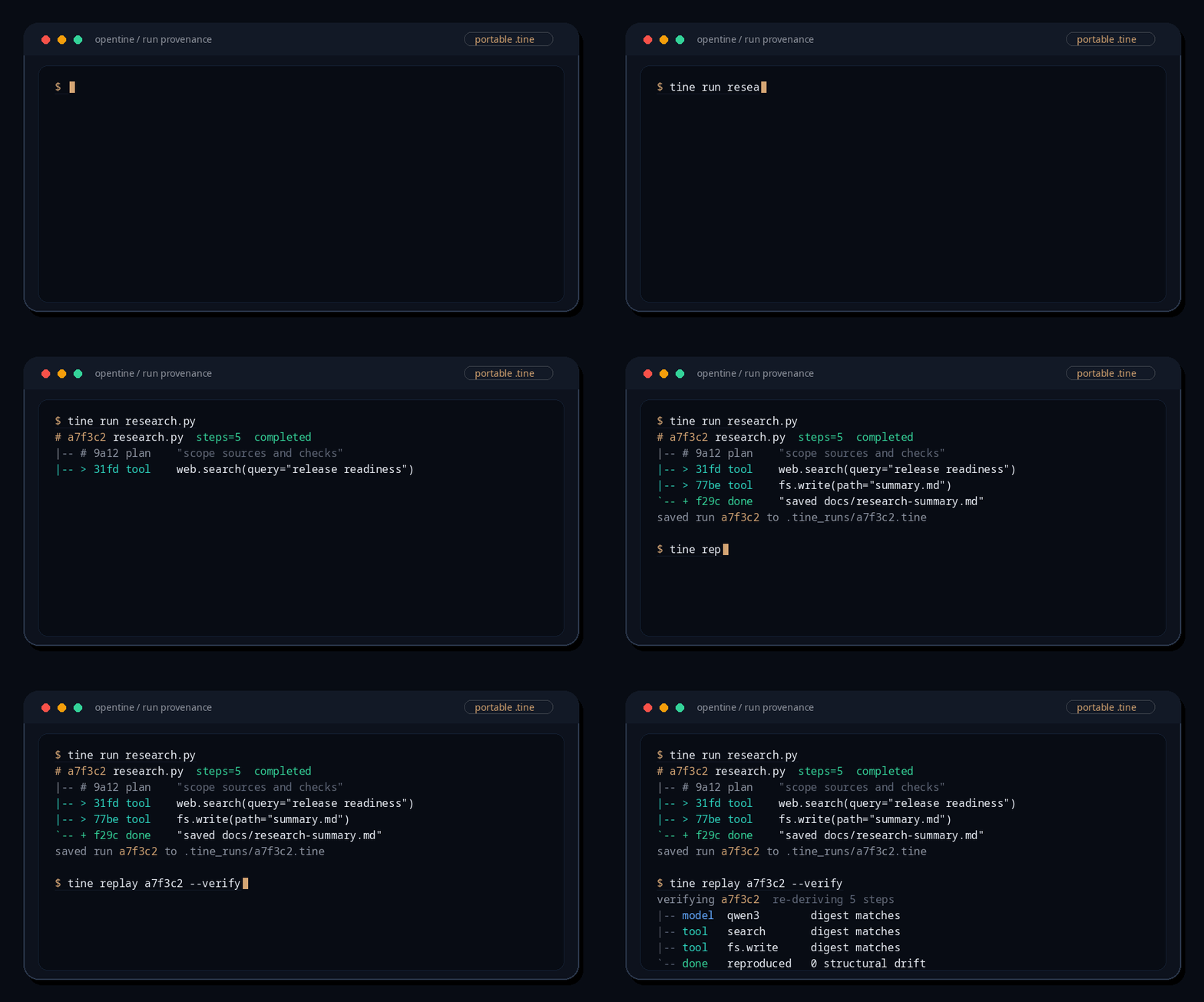
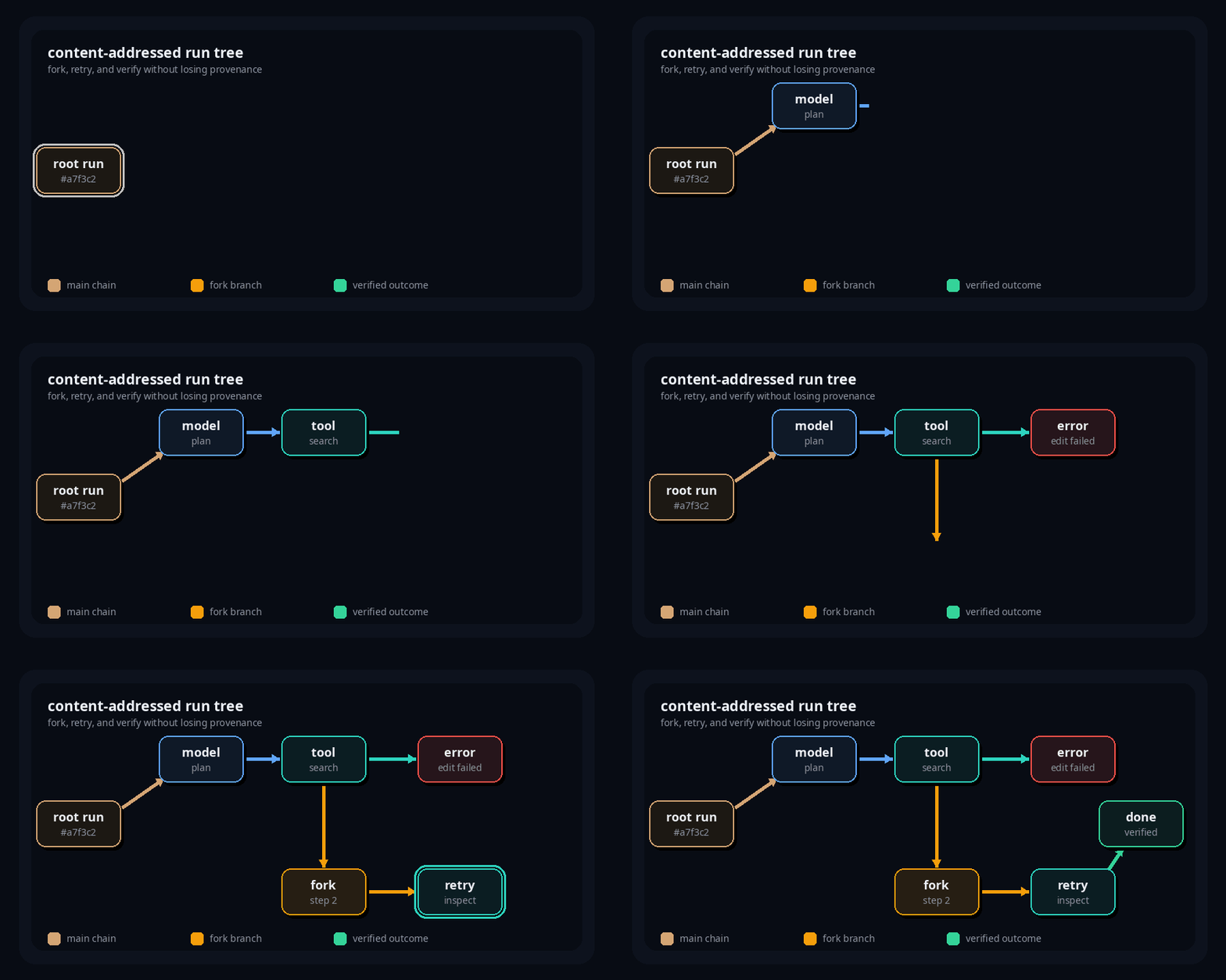
Every run becomes a content-addressed graph — model steps, tool calls, and
outcomes, each named by digest. Fork from any step to retry a different way;
tine replay --verify re-derives the run and proves it reproduces (digests
intact, no structural drift) — all without losing provenance.
Install
OpenTine 0.9.x supports Python 3.11 through 3.14.
pip install opentine
Provider SDKs are optional:
pip install "opentine[anthropic]"
pip install "opentine[openai]"
pip install "opentine[google]"
pip install "opentine[compat]"  # hosted and local OpenAI-compatible APIs
pip install "opentine[mcp]"
pip install "opentine[langchain]" # live callback capture for LangChain/LangGraph
pip install "opentine[crypto]" # compatibility alias only; see below
pip install "opentine[all,mcp]" # every provider SDK plus MCP
all installs the Anthropic, OpenAI, and Google SDKs; it does not include
mcp or langchain. Ollama needs no extra because it uses the core httpx
dependency.
crypto is retained for older installation instructions and installs nothing
new: cryptography is already a required core dependency, so Ed25519 signing,
signed pricing catalogs, and the encrypted reference remote work from a plain
pip install opentine.
Provider credentials come from the environment. .env.example shows the
provider API keys plus the search-tool, pricing, and self-hosted-remote settings
OpenTine reads; adapters additionally honour provider-specific *_BASE_URL
overrides and GLM_REGION.
Quickstart
This example calls Anthropic, so it needs the anthropic extra and a key:
pip install "opentine[anthropic]"
export ANTHROPIC_API_KEY=sk-ant-...
Without the extra the first model call raises
ImportError: pip install opentine[anthropic]; without the key the provider
rejects the request. Swap in opentine.models.openai, opentine.models.google,
or opentine.models.ollama and the matching variable from .env.example to run
against something else.
The shortest first run needs no Python at all — tine run --model drives a
bundled adapter straight from the command line and saves the run it produces:
tine run --model anthropic --prompt "Explain the current branch"
tine run --model openai:gpt-6.1-sol --prompt "Explain the current branch" --save result.tine
--model takes provider or provider:model; without a model id the adapter
keeps its own default. Valid providers are anthropic, openai, google, and
ollama; every hosted OpenAI-compatible adapter — deepseek, glm/zai,
grok, groq, hermes, kimi, ministral, mistral, openrouter, qwen,
and together; and every local OpenAI-compatible runtime — jan, koboldcpp,
litellm, llama-cpp-python, llamacpp, lmstudio, localai, mlx-lm,
nvidia-nim, sglang, tensorrt-llm, tgi, unsloth, and vllm, each of
which resolves to the localhost URL its server conventionally listens on:
tine run --model vllm:served-model --prompt "Explain the current branch"
tine run --model lmstudio --prompt "Explain the current branch"
A local runtime has no rate card, so its runs record usage with the API cost
unmetered — the same treatment ollama gets; naming one buys capture, not a
price. (litellm is the exception: it proxies possibly-paid backends, so it
reports unknown cost rather than unmetered.) A name outside the list is
reported with the full list. The mode is exclusive with a script argument and
with --harness.
For anything with tools, a budget, or more than one prompt, build the agent yourself:
from opentine import Agent
from opentine.models.anthropic import Anthropic

agent = Agent(model=Anthropic("claude-sonnet-5-5"))
run = agent.run_sync("Explain the current branch")
run.save("result.tine")
tine show result.tine
tine verify result.tine
tine cost result.tine
tine fork result.tine --from-step 0 --save retry.tine
tine replay result.tine --mode cache --save replayed.tine
tine diff result.tine retry.tine
Run.load() reads v1 and v2, migrates v1 in memory, and writes v2. HMAC-SHA256
and Ed25519 signatures are implemented through tine sign, tine keygen, and
fail-closed tine verify options. See TINE_FORMAT.md.
The model-agnostic core
OpenTine records (provider, model, usage) on every step as opaque data. It
does not have to recognize the provider, the model id, or the shape of the usage
dictionary to store them, and nothing in the kernel — verify, fork, diff, replay
— reads them. Dollars are applied afterwards, by a separate signed catalog:
tine cost run.tine                    # the cost recorded at capture time
tine price run.tine                   # re-derive it now from (provider, model, usage)
tine price run.tine --at 2026-07-15   # …against the catalog effective that day
tine import trace.json --format otel-json --price --save run.tine
tine cost sums what was recorded when the run happened; tine price computes
the cost post-hoc from the record and writes nothing, so an imported or uncosted
run can be priced too, and a step no card covers is reported unknown rather
than as free. A provider OpenTine has never heard of still produces a complete,
verifiable, diffable, forkable run — and becomes priceable the day someone
writes a card for it, with no new release and no adapter.
So opentine.models is a capture convenience, not the boundary of what
OpenTine supports: it is there so a first run costs one command, not because a
run has to come from it. The universal, model-agnostic on-ramp is
OpenTelemetry GenAI — tine import --format otel-json needs no adapter, no key,
and no rate card, and prices the result afterwards if you ask it to. See
CAPTURE.md.
Universal usage and billing
Every built-in model adapter returns the compatible text, tool_calls, and
numeric cost fields plus normalized usage and explicit billing metadata.
cost is always the known subtotal; it is never silently borrowed from another
provider or model.
Billing status distinguishes:
complete: all observed dimensions have pinned rates;partial: a known subtotal exists but at least one dimension is unpriced;unknown: no exact price can be determined;unmetered: local API usage has no API charge, though infrastructure can still cost money.
Calculations use Decimal, exclusive input/output/cache/reasoning buckets,
effective dates, context thresholds, and service-tier modifiers. Provider APIs
normally report token consumption—not the final invoice—so the result is an
estimate tied to the pinned catalog and local overlays.
Inference never performs a live price lookup. Inspect or update pricing only through explicit commands:
tine pricing list --provider kimi
tine pricing show xai grok-4.5
tine pricing show mistral ministral-14b-2512 --json
tine pricing check
tine pricing update ./new-signed-catalog.json
The signed bundled snapshot covers OpenAI, Anthropic, Kimi, DeepSeek, Gemini,
Grok/xAI, GLM/Z.AI, Qwen, Groq, Together, Mistral/Ministral, and OpenRouter
Hermes models. Direct Nous/Hermes pricing is marked dynamic and requires a local
overlay rather than pretending it is free. Unknown hosted models remain
runnable and visibly unpriced. Budget(strict_cost=True) stops before the next
call after billing becomes indeterminate.
Current exact cards include Claude Opus 5.5, Sonnet 5.5, Haiku 5.5, Fable 5.1
and Mythos 5.1, GPT-6.1 Sol, GPT-6 Astra/Sol/Luna and the GPT-5.6 family, Kimi K3
(with cache writes), GLM-5.3 and 5.3-Flash/FlashX, Gemini 3.8/3.7/3.6 Flash,
Grok 4.7, Qwen 3.8 Max/2.4T-A95B/27B/Flash/Omni-Flash, DeepSeek V4.1-Flash and
V4 Pro (priced peak/off-peak, with Chinese public holidays off-peak), and
current Mistral/Ministral families. Catalog coverage is intentionally curated rather
than an allowlist: any model identifier remains runnable, and models without an
exact effective card are reported as unknown instead of receiving a guessed
price.
See PRICING.md for resolution order, provenance, and the catalog maintenance boundary.
Model adapters
Native adapters:
from opentine.models.anthropic import Anthropic
from opentine.models.google import Google
from opentine.models.ollama import Ollama
from opentine.models.openai import OpenAI

OpenAI("gpt-6.1-sol")             # native Responses API
Anthropic("claude-sonnet-5-5")
Google("gemini-3.8-flash")
Ollama("qwen3")                  # usage/timing retained; API is unmetered
Hosted OpenAI-compatible adapters use Chat Completions with provider-scoped usage and prices:
from opentine.models.compat import (
    DeepSeek, GLM, Grok, Groq, Hermes, Kimi, Ministral,
    Mistral, OpenRouter, Qwen, Together,
)

Kimi()                            # kimi-k3, api.moonshot.ai
DeepSeek()                        # deepseek-flash (V4.1-Flash)
GLM()                             # glm-5.3 / Z.AI global endpoint
Grok()                            # grok-4.7
Qwen()                            # qwen3.8-max international endpoint
Ministral()                       # ministral-14b-2512
OpenRouter()                      # nousresearch/hermes-4-70b
Hermes()                          # direct Nous; local price overlay expected
GLM_REGION=china (or a legacy dotted GLM key) selects the BigModel China
endpoint and provider identity glm-cn; add a regional catalog overlay rather
than applying Z.AI global USD rates to that endpoint.
OpenAI native calls use Responses API items, tool-call continuation state, refusals, and final usage. Anthropic handles cache-write buckets, reported inference geography, and adaptive sampling restrictions. Kimi omits unsupported temperature fields and preserves reasoning continuation. Google extracts usage instead of reporting zero, and Ollama retains token counts plus load/evaluation timing.
Local and generic compatible runtimes
OpenTine has native Ollama support and one exact-base OpenAI-compatible surface
for the broader local ecosystem. The named presets are conveniences, not
separate protocol forks — and each one is also a tine run --model word, so a
server already listening on localhost is one command away with no Python:
tine run --model sglang:served-model --prompt "…" # http://localhost:30000/v1
The CLI word is the preset's own recorded provider string, and the same
adapters are available in Python:
from opentine.models.compat import LMStudio, LocalOpenAICompatible, OpenAICompatible, SGLang

LMStudio("loaded-model")
SGLang("served-model")

# `base_url` is exact; it is never changed or given a second `/v1` suffix.
local = LocalOpenAICompatible(
    "served-model",
    base_url="http://localhost:3000/api",  # for example, Open WebUI
    api_key="local-secret",
    supports_tools=False,
    include_usage=True,
    extra_body={"chat_template_kwargs": {"enable_thinking": True}},
)

# Hosted gateways default to unknown billing, not local/unmetered billing.
gateway = OpenAICompatible(
    "provider/model",
    base_url="https://gateway.example/openai",
    api_key="gateway-secret",
)
LocalOpenAICompatible(host=...) appends /v1 once; pass base_url=... for
an exact nonstandard prefix. OpenAICompatible and custom OpenAI endpoints do
not inherit ambient proxy settings, do not follow redirects, and never forward
OPENAI_API_KEY implicitly. Use OPENAI_COMPAT_API_KEY or an explicit key.
Configured provider endpoints are trusted infrastructure: SDKs can buffer a
provider response before OpenTine applies retained-content limits.
Common compatible endpoints are:
| Runtime | Typical exact base | OpenTine surface |
|---|---|---|
| LM Studio | http://localhost:1234/v1 |
LMStudio |
| vLLM / Unsloth | http://localhost:8000/v1 |
VLLM / Unsloth |
| llama.cpp | http://localhost:8080/v1 |
LlamaCpp |
| LocalAI | http://localhost:8080/v1 |
LocalAI |
| Jan | http://localhost:1337/v1 |
Jan |
| llama-cpp-python | http://localhost:8000/v1 |
LlamaCppPython |
| MLX-LM | http://localhost:8080/v1 |
MLXLM |
| NVIDIA NIM / TensorRT-LLM | http://localhost:8000/v1 |
NvidiaNIM / TensorRTLLM |
| SGLang | http://localhost:30000/v1 |
SGLang |
| Hugging Face TGI | http://localhost:8080/v1 |
TGI |
| Open WebUI | http://localhost:3000/api |
exact base_url |
| LiteLLM Proxy | http://localhost:4000/v1 |
LiteLLM; may route paid APIs |
| llamafile | http://localhost:8080/v1 |
LocalOpenAICompatible |
| GPT4All | http://localhost:4891/v1 |
LocalOpenAICompatible |
| KoboldCpp | http://localhost:5001/v1 |
KoboldCpp |
| text-generation-webui | http://localhost:5000/v1 |
LocalOpenAICompatible |
| MLC-LLM and llama-swap | configured server base, usually /v1 |
LocalOpenAICompatible |
Every row above that names a preset class is also a CLI provider word —
jan, koboldcpp, litellm, llama-cpp-python, llamacpp, lmstudio,
localai, mlx-lm, nvidia-nim, sglang, tensorrt-llm, tgi, unsloth,
vllm — resolving to exactly the base above. The rows answered by
LocalOpenAICompatible or an exact base_url stay Python-only: there is no
conventional host for tine run --model to assume.
Model IDs, tool calling, reasoning fields, multimodal input, and usage reporting
depend on the loaded model, chat template, runtime version, and server flags.
Set supports_tools=False where needed and request include_usage=True only
when the server implements final stream usage. Local API cost is unmetered by
default; supply rates= to account for infrastructure. The LiteLLM preset
and OpenAICompatible deliberately default to unknown billing because a
gateway may route paid hosted APIs.
V3 repository
tine init .
tine migrate-v3 result.tine --repo . --ref heads/main
tine fsck --repo .
tine repo-log heads/main --repo .
tine repo-fork heads/main --from-event event:sha256:... --ref experiments/alt --repo .
tine repo-resume heads/main --ref experiments/live --repo .
tine promote experiments/alt --name released --repo .
tine object run:sha256:... --repo . --resolve-blobs
tine pack --repo . --output run.pack
Every v3 MCP tool has a CLI verb and vice versa, and the map is a CI gate. The
two surfaces differ in exactly four documented places, all of them trust
decisions: promote is unconditional on the CLI but opt-in over MCP,
repo-fork/repo-resume are confined to experiments/* only over MCP (whose
threat model is model-chosen refs, not an operator), CLI --json receipts are a
superset of the MCP return, and the CLI refuses non-finite evaluation scores at
the argument door. See
REPOSITORY.md for the table and the reasoning.
Python API:
from opentine import Repo

repo = Repo.init(".")
blob = repo.put("blob", b"prompt")
assert repo.get(blob).body == b"prompt"
assert repo.fsck().ok
Object IDs are SHA-256 over object type, schema version, and canonical stored
bytes. Client-side redaction happens before canonicalization and hashing.
fsck recomputes IDs, validates typed links and refs, and detects event cycles.
Refs update with compare-and-swap semantics.
The two layers identify runs differently. A v3 repository id is a content
hash, so two identical forks deduplicate to one object. A v2 fork id names the
fork act: it is derived from the lineage, retained slice, branch, declared
intent, and a recorded nonce, stored in metadata.fork, and provable with
verify_fork_id, so forking the same point twice yields two distinct runs
instead of colliding. Both are always digests; a run id read from an untrusted
artifact never steers an output path.
The dependency-free trusted semantic kernel is kept at no more than 250
physical lines. scripts/check_architecture.py runs in CI and enforces three
gates: no production Python module may exceed 250 physical lines, kernel.py
may import nothing outside the standard library (the gate constrains what the
kernel depends on, not what depends on the kernel), and each of the billing,
models, remote, repository, and trace layers declares the layers it may
not import. billing may import none of models, remote, repository, or
runtime; models may import neither remote nor repository; repository
and trace may import neither models nor remote; and remote may not
import models.
The v2→v3 migrator preserves the exact original artifact as a legacy blob,
records its original integrity/signature result, rebuilds redacted v3 objects,
and stores an old→new ID map. A legacy signature is explicitly scoped to the
legacy blob; it is never presented as a signature over new v3 objects. Bad
integrity or a requested signature failure is refused unless
--allow-unverified is explicit. Because the legacy blob is byte-exact, it can
retain source secrets and should be reviewed before synchronization.
See REPOSITORY.md for object semantics and synchronization.
Live agent recording
Recorder records code, dirty patch, environment, policy, budget, and pricing
manifests, then appends immutable events of seven kinds: model, tool,
human, policy, approval, subagent, and error. Record a failed step as
an error event rather than dropping it, so a partial run stays inspectable.
Code-capture failures are recorded explicitly rather than appearing as a clean
repository:
from opentine import Recorder, Repo, TraceEvent

repo = Repo.open(".")
recording = Recorder.start(repo, ref="heads/main")
recording.append(TraceEvent(
    kind="model", timestamp=0, trace_id="trace", span_id="model-1",
    model="kimi-k3", inputs={"prompt": "hello"}, outputs={"text": "hi"},
))
run_id = recording.finalize()
evaluation = recording.evaluate({"quality": 0.9}, evaluator="judge")
recording.promote("production")
Importers normalize OpenTine traces, JSONL, and OpenTelemetry GenAI spans or
complete OTLP/JSON exports, including camelCase keys and typed AnyValue
attributes. Framework importers
best-effort normalize common serialized shapes from LangChain, LlamaIndex,
AutoGen, CrewAI, and OpenAI Agents logs. tine import (see the CLI reference)
is the shell-level front end for exactly these importers.
Live framework capture
Importing a serialized log is after the fact and only as complete as whatever
the framework wrote down. opentine[langchain] records a run as it happens
instead, through langchain-core's callback protocol — which LangChain and
LangGraph both dispatch, so one handler covers both:
from opentine.integrations.langchain import OpenTineCallbackHandler
from opentine.repository import Repo

handler = OpenTineCallbackHandler(Repo.init("runs"))
graph.invoke({"question": "..."}, config={"callbacks": [handler]})
run_id = handler.run_id  # one .invoke() is one finalized v3 run
run_id becomes the callback run_id of each span, parent_run_id the parent
edge, the run's name the actor, and LLMResult token usage the run's usage —
the same mapping framework_events applies post hoc, recorded through the same
TraceEvent schema and the same Recorder. Nothing here is imported by
import opentine, so the extra is needed only to use the handler. CrewAI has
no live adapter yet: its event bus identifies work by object reference rather
than by a run/parent id pair, so its logs are still imported post hoc.
Export runs the other way with to_otel_genai, which renders any run — a v2
Run, a loaded .tine file, a v3 repository run from repo.load_run(ref), or
a list of TraceEvents — as GenAI spans in the same shape the importer reads,
and to_otel_genai_document wraps them in a complete OTLP/JSON export:
from opentine import Repo, to_otel_genai_document

repo = Repo.open(".")
document = to_otel_genai_document(repo.load_run("heads/main"), service_name="agent")
Spans carry gen_ai.operation.name, request/response model, nanosecond
start/end times, trace/span/parent IDs, links for causal edges, and a span kind
per step (a model call is CLIENT, in-process work is INTERNAL). Content goes
out twice, so one document renders everywhere: gen_ai.prompt /
gen_ai.completion for readers that know the v1.27.0 conventions, and the
structured gen_ai.input.messages / gen_ai.output.messages arrays current
backends (Arize Phoenix, Langfuse) render, with the scope's schemaUrl naming
the v1.36.0 conventions they follow. Usage goes out in the current
conventions' shape — input_tokens / output_tokens totals that include
the cache_read.input_tokens, cache_creation.input_tokens and
reasoning.output_tokens sub-counts beside them — so any backend sees every
token a step consumed; what no convention spells (the 1-hour cache-write TTL,
an extra dimension) rides exactly in opentine.usage. Every key is spelled
once in opentine.trace._genai_semconv so import and export cannot drift.
Import and export are inverses: re-importing exported spans yields the events
they came from, usage included. Cost has no GenAI convention, so it travels
under the one documented opentine.cost_usd attribute (billing under
opentine.billing); the importer reads both back onto the event, so a priced run
comes home priced — the amount as the exact decimal string. Export is read-only
over provenance and writes nothing. The same document is one command away from a
terminal or a CI job: see tine export in the CLI reference.
Search, minimal causal context slices, semantic diff, fork/resume, evaluation,
and attestation are also available as MCP tools. Promotion is still not
exposed to a model by default: promote_run is registered only when the host
passes allow_promotion=True, and the shipped opentine.mcp_server never
passes it. Run content an MCP client reads is untrusted input, so text recorded
inside a run can ask a model to promote a run of an attacker's choosing;
creating a release gate stays an operator action. For the same reason MCP
fork/resume may only write experiments/* refs. Mainline heads/*,
promotions/*, tags/*, and remote-tracking refs are operator-only, so an MCP
call that names heads/main is refused.
Operators get all three writes on the command line, which is the point: the person at the terminal is authenticated by having the shell, a model reached over MCP is not.
tine keygen --hmac --out ~/.keys/release.hmac            # a strong shared secret
tine attest heads/main --signer release-manager --claim '{"kind":"approval"}' \
    --key-file ~/.keys/release.hmac --key-id release-2026   # signs the claim
tine evaluate heads/main --evaluator judge --score quality=0.9 --score safety=1
tine promote heads/main --name production            # creates the release gate
tine promote <run-oid> --name production --expected-old <current-oid>   # moves it
tine repo-verify heads/main --key-file ~/.keys/release.hmac \
    --signer release-manager --claim '{"kind":"approval"}'   # the release gate
Each takes a ref name or a run oid, resolves it, and makes one engine call, so a
CLI-written attestation is byte-identical to the MCP one. promote defaults to
expect no existing ref: moving a promotion that already exists requires
--expected-old naming the value being replaced, and there is no --force.
Adding the CLI verb does not widen the MCP surface — allow_promotion stays
False — it just stops the operator having to write Python to do their job.
Attestations are content-addressed, and from 0.9.0 they can also be signed:
give attest/evaluate a key (--key-env/--key-file/--ed25519-key-file,
exactly as tine sign takes one) and the signer label is bound to that key at
tine-attest/1, covering the target run, the claim, the signer, and the
evidence. tine repo-verify checks one attestation or every attestation on a
run, with tine verify's own verdicts (verified, unsigned, no-key,
mismatch, error) and the same fail-closed rule — --require-signature makes
an unsigned or mismatched approval exit non-zero. A CI gate should also name the
claim it is about (--signer, --claim): then one verified matching approval
passes, and no other attestation on the run can pass or block it.
Without a key nothing changes: the object written is byte-identical to what
0.3.0-0.8.1 wrote, the label is self-asserted, and the receipt prints
unsigned. MCP attest_run has no key options, deliberately — untrusted run
content must not be able to sign as an operator.
Self-hosted remote
The minimal HTTP remote provides capability discovery, missing-object negotiation, filtered/shallow fetch, resumable pack upload, and CAS ref updates. The reference backend uses encrypted filesystem object storage and SQLite metadata/audit records.
export TINE_REMOTE_TOKEN="$(openssl rand -hex 32)"
export TINE_KMS_KEY="$(openssl rand -base64 32)"
tine serve --root /srv/opentine --cert cert.pem --key key.pem
TLS is mandatory unless --insecure-dev is explicit, and --insecure-dev
binds a loopback --host only (--insecure-dev-any-host to override). Static bearer tokens are
for development; OIDC, reader/writer/admin RBAC, tenant namespaces, KMS key
providers, authorization, retention, audit, and admission-policy interfaces are
pluggable. The repository and extension seams are the enterprise foundation;
the bundled WSGI server is a bounded reference deployment for development and
small self-hosted installations, not a turnkey HA service, hosted control plane,
or payment product.
Audit rows use a serialized HMAC chain and authenticated head outside SQLite;
legacy rows require explicit trust-on-migration and remain reported as
legacy-unverified. The reference app derives the audit key from its local KMS
master. A custom KMS adapter must provide stable external audit-key derivation
(or an explicit audit key); startup fails closed rather than falling back to a
key beside the database. Interrupted post-commit anchor writes heal one step
forward only after the committed row authenticates; a cross-process lock spans
the commit and checkpoint update. Other anchor recovery requires an exact
--reanchor-audit-head value.
Protect the audit key, checkpoint, and backups.
tine push https://runs.example --tenant team --repo .
tine clone https://runs.example ./clone --tenant team
Harnesses and tools
graph LR
    Task["agent task"] --> Wrap["opentine capture"]
    Wrap --> Codex["codex"]
    Wrap --> Kimi["kimi-code"]
    Wrap --> Generic["generic CLI"]
    Wrap --> SDK["anthropic · openai<br/>google · ollama"]
    Codex --> Tine
    Kimi --> Tine
    Generic --> Tine
    SDK --> Tine
    Tine[["portable .tine<br/>+ .tine/ repo"]] --> Verify["replay --verify"]
    Tine --> Fork["fork · resume"]
    Tine --> Diff["repo-diff · repo-search"]
    Tine --> Attest["attest · promote"]
    classDef hub fill:#d4a574,stroke:#b98a56,color:#1a1206,font-weight:bold;
    class Tine hub;
OpenTine can capture external CLI agents:
tine run --harness codex --prompt "Inspect this repo" --save run.tine
tine run --harness kimi-code --prompt "Summarize README.md" --save run.tine
tine run --harness generic --harness-command "agent run" --prompt "Fix tests"
Process harnesses default to a one-hour wall timeout, 4-million-character total
output ceiling, and 10,000 parsed events. Override them with
--harness-timeout, --harness-max-output, --harness-max-events, and
--harness-max-line-bytes.
Filesystem, network, shell, Python, and harness execution use restrictive policies. Tool schemas hide host-owned policy/resource parameters and runtime dispatch rejects attempts by a model to override them; bind an explicit policy in an application wrapper when enabling shell, Python, or filesystem writes. Harnesses do not inherit the parent environment by default. Review free-form model/tool output before sharing: credential redaction is typed and path-aware, but no automatic redactor can prove arbitrary prose is secret-free. Enabled shell/Python timeouts terminate the owned process group or Windows Job Object and return only bounded partial output, with space reserved for stderr diagnostics. These subprocess controls are resource boundaries, not an OS sandbox. See SECURITY_MODEL.md.
CLI Reference
tine ships 40 subcommands. Each one prints its own --help, which is
authoritative when this page has drifted. tine --version (-V) prints the
installed version.
Portable .tine artifacts:
tine run <script.py>                  Execute a Python script and save the Run it builds
tine run --model anthropic --prompt P Call a bundled model adapter directly, no script
tine run --harness codex --prompt P   Record an external CLI agent as a run
tine show <run>                       Pretty-print a run tree
tine cost <run>                       Show cost, tokens, and budget state as recorded
tine price <run> --at 2026-07-15      Re-price a run from the catalog (also prices imports)
tine verify <run>                     Verify integrity, and authenticity when a key is given
tine sign <run> --key-env TINE_KEY    Sign an artifact (hmac-sha256 or ed25519)
tine keygen --out key --pub key.pub   Generate an Ed25519 keypair (private key 0600)
tine keygen --hmac --out release.hmac Generate a 32-byte HMAC key
tine fork <run> --from-step 3         Branch from a step and continue there
tine replay <run> --mode cache        Reuse recorded steps; --mode rerun re-executes
tine replay <run> --verify            Check the replay reproduces the run: exit 0/1
tine diff <run_a> <run_b>             Compare two runs step by step; --exit-code for 0/1
tine resume <run>                     Continue a run whose manifest declares resume support
tine migrate <run> --in-place         Upgrade a legacy artifact to format v2
tine ls --tag prod --limit 20         List indexed runs from .tine_runs
tine search "tag:prod model:kimi"     Query that index
tine tag <run> --add prod             Add, remove, or list tags
tine reindex                          Rebuild .tine_runs/index.json
Interoperability:
tine import <trace> --format otel-json --save run.tine
tine import - --format jsonl --repo . --ref heads/main
tine import agent.log --format langchain --save run.tine
tine import <trace> --format otel-json --price --save run.tine   # price it from the catalog
tine export <run> > spans.json
tine export <run> --output spans.json
tine export <run> --endpoint http://127.0.0.1:4318          # local OTLP collector
tine export <run> --endpoint https://collector.example/v1/traces
tine import reads a foreign agent trace — otel-json (a complete OTLP/JSON
export document), otel-spans (a JSON array of GenAI spans, or one per line),
jsonl (OpenTine TraceEvent records), or one of langchain, llamaindex,
autogen, crewai, openai-agents — from a file or - for stdin, and records
it as an ordinary run. At least one destination is required: --save PATH
writes a portable v2 .tine artifact (refusing an existing file without
--force), --repo PATH records it into a v3 repository and advances --ref
(default heads/main). Both may be given. It prints the resulting run id.
Importing introduces no format change, and --ref is refused without --repo.
tine export is the other direction: it renders a run as an OTLP/JSON GenAI
document — the exact shape --format otel-json imports, so the two round-trip.
With the default --format otel-json the document goes to stdout, or to
--output PATH (refusing an existing file without --force). --endpoint URL
POSTs it to an OTLP/HTTP collector instead and implies --format otlp, which on
its own falls back to $OTEL_EXPORTER_OTLP_ENDPOINT; /v1/traces is appended
unless the endpoint already ends there. The push prints a receipt naming the
endpoint, the span count, and the HTTP status, and exits non-zero if the
collector is unreachable or answers anything but 2xx. Spans carry both the
v1.27.0 and the v1.36.0 GenAI content shapes and current-convention usage counters;
cost, which the conventions do not define, rides in opentine.cost_usd. Because
a run carries
prompts and completions, a cleartext push is refused unless the endpoint is a
loopback IP (e.g. 127.0.0.1) or --allow-insecure says otherwise — the same
rule the v3 transport verbs apply. --service-name sets the service.name the spans arrive under.
Exporting is read-only: the artifact is never rewritten.
Machine-readable output:
tine show|verify|ls|search|stats|cost|price ... --json
tine replay <run> --verify --json
tine diff <run_a> <run_b> [--json] [--exit-code]
tine import <trace> --format FMT [--save PATH] [--repo PATH] [--price] --json
tine tag <run> [--list] --json
tine pricing list|show|check|update ... --json
tine repo-log|repo-show|repo-diff|repo-search|context ... --json
tine repo-fork|repo-resume|attest|evaluate|promote ... --json
--json replaces the rich rendering with exactly one JSON object on stdout;
without it the human rendering is unchanged. Every one of these objects is
written by the single serializer opentine/_cli_json.py:serialize — keys
sorted, two-space indent, every value passed through json_safe — so two
commands cannot disagree about how JSON is spelled, and tine export uses the
same function for stdout, --output, and the OTLP body it puts on the wire.
The fields of each object are
enumerated in opentine/_cli_json.py — for the two commands that compare runs
in opentine/_cli_json_flow.py, for import and tag in
opentine/_cli_json_surface.py, and for pricing in
opentine/_cli_json_pricing.py — and are added to but never renamed
within a major version. Five v3 plumbing verbs — fsck, object,
migrate-v3, fetch, and push — take no --json flag by design: they are
machine reports with no human rendering to replace, so they always print bare
JSON. Their exact bytes predate the shared writer and are pinned by tests, so
they are left as they are rather than reformatted.
tine tag --json describes a listing: --list and
the implicit default (neither --add nor --remove) emit the same object, and
the mutating path refuses --json rather than dropping it. tine diff and tine replay --verify publish the same
drift object (structural, accounting, only_source, only_replay) from
one builder. With --exit-code, tine diff follows git diff: 0 when the
runs are identical, 1 when they differ, and never 2 — argparse keeps 2 for a
usage error. Without --exit-code a successful comparison always exits 0. A failure that stops the command producing a result stays human
text and a non-zero exit; a failure that is the result still comes out as the
object — verify reports a failed check as "ok": false and cost a breached
budget as "over_budget": true, both exiting 1.
Signed pricing catalogs:
tine pricing list [--provider P] [--model M] [--at YYYY-MM-DD] [--json]
tine pricing show <provider> <model> [--at YYYY-MM-DD] [--json]
tine pricing check [path] [--allow-unsigned] [--json]
tine pricing update <file-or-https-url> [--dest PATH] [--json]
All four take --json; every payload names the catalog_id and catalog_hash
it answered from, because a rate only means something against the catalog it
was read out of. A catalog that will not load stays human text and exits 1.
V3 repository:
tine init [path] [--bare]
tine migrate-v3 <run.tine> --repo . --ref heads/main [--allow-unverified] \
    [--key-env VAR | --key-file PATH | --pubkey PATH | --trust-embedded-key] [--pin FINGERPRINT]...
tine fsck --repo . [--shallow]
tine repo-log [ref] --repo . [--limit N] [--json]
tine repo-show <ref-or-run-oid> --repo . [--json]
tine repo-diff <left> <right> --repo . [--exit-code] [--json]
tine repo-search [query] --repo . [--limit N] [--min-score S] [--model M] [--json]
tine context <event-oid> --repo . [--depth N] [--json]
tine repo-fork <ref-or-run-oid> --from-event <oid> --ref REF \
    [--model M] [--prompt P] [--policy JSON] [--repo .] [--json]
tine repo-resume <ref-or-run-oid> --ref REF [--repo .] [--json]
tine attest <ref-or-run-oid> --signer NAME (--claim JSON | --claim-file PATH) \
    [--key-env VAR | --key-file PATH | --ed25519-key-file PATH] [--key-id ID] [--json]
tine evaluate <ref-or-run-oid> --evaluator NAME --score NAME=VALUE... \
    [--key-env VAR | --key-file PATH | --ed25519-key-file PATH] [--key-id ID] [--json]
tine promote <ref-or-run-oid> --name NAME [--expected-old OID] [--json]
tine repo-verify <attestation-oid|ref-or-run-oid> --repo . \
    [--key-env VAR | --key-file PATH | --pubkey PATH | --trust-embedded-key] \
    [--pin FINGERPRINT]... [--require-signature] [--signer NAME]... [--claim JSON] [--json]
tine object <object-id> --repo . [--resolve-blobs]
tine pack --repo . --output run.pack [object-id ...]
A v3 verb takes a repo- prefix only where a legacy v2 verb already owns the
plain name — show, search, diff, fork, resume, verify. context, attest,
evaluate, and promote have no v2 namesake and stay unprefixed. The two
families are different stores: tine fork branches a .tine file, tine repo-fork branches a run object and moves a repository ref.
Self-hosted remote:
tine serve --root DIR --cert cert.pem --key key.pem [--insecure-dev] [--writer-promotes]
tine serve --root DIR [--tenant T] refs | delete-ref NAME [--expect OID] | associations OID
tine serve --root DIR [--tenant T] delete-objects OID... [--from FILE|-] [--dry-run]
tine serve --root DIR [--tenant T] purge [--grace-seconds N] [--dry-run]
tine fetch <remote> --repo . [--tenant T] [--token-file PATH] [--ref R] [--depth N]
tine push <remote> --repo . [--tenant T] [--token-file PATH] [--ref R] [--remote-ref R]
tine clone <remote> <path> [--tenant T] [--token-file PATH] [--ref R] [--depth N]
Flag details that are easy to get wrong:
--from-stepaccepts a decimal step index, a full step id, or a unique step-id prefix.--save PATHchooses the output file.run,fork, andreplayotherwise write.tine_runs/<run-id>.tine;forkandreplayrefuse to overwrite an existing--savedestination unless--forceis passed, andkeygen --forceoverwrites an existing key file.tine replay --verifywrites nothing unless--savenames a destination: it replays into a temporary directory, reads the artifact back, derives the replay a second time from the source file, and compares. It exits 0 when the replay is reproduced and 1 on drift or a source that will not load;--ignore-cost-driftlets cost/usage/billing differences alone still pass, while structural drift always fails.--inspectpreviews exactly the steps the replay retains — the ancestors of--from-step, the same slice--verifyexpects. With--harnessthe run is re-executed twice and the two artifacts compared, which is how a nondeterministic agent is caught.tine migrateonly previews unless--in-placeor--saveis given, and it drops any existing signature, so re-sign after migrating. Its single--forcedoes two jobs: it overwrites an existing--savedestination, and it waives the refusal to migrate a source whose integrity digest already failed.tine signspells the destination guard--overwrite, not--force. Its separate--forcewaives the pre-sign integrity refusal, so it can produce a valid signature over a body that already failed verification.tine verifyfails closed as soon as any of--key-env,--key-file,--pubkey,--require-signature,--trust-embedded-keyor--pinis present. With none of them it checks the integrity digest only, and says so when the artifact is signed.tine searchunderstandstag:,model:,status:,cost:,after:, andbefore:predicates plus free text.model:matches a substring of the model id,status:is exact, andcost:accepts>,>=,<,<=, andmin..max.tine lsexposes the same filters as flags, with--sinceand--untilfor the date bounds.tine ls,tine search,tine tag, andtine reindexread the legacy file index under.tine_runs, not a v3 repository.
Validation
uv sync --locked --all-extras
uv run ruff check .
uv run ruff format --check .
uv run python scripts/check_architecture.py
uv run pytest tests -m "not live and not live_harness" -q
uv build --no-build-isolation --sdist --wheel --out-dir dist
uv run python scripts/check_release_inventory.py dist
uv run python -m twine check dist/*
uv run python scripts/wheel_smoke.py
CI runs these gates on Linux, macOS, and Windows with Python 3.11–3.14. Live provider and CLI-harness tests remain opt-in because they require credentials or installed services.
Tagged releases reuse one validated wheel/sdist pair for GitHub and PyPI. PyPI
publication uses OIDC Trusted Publishing behind the protected pypi GitHub
environment; no long-lived package-index token is stored. See
RELEASING.md for the required one-time configuration and release
checklist.
Documentation
Start here:
- GETTING_STARTED.md: install to a promoted v3 run, one command at a time.
- CONCEPTS.md: the mental model — run graphs, digests, refs, verify/fork/diff.
- CAPTURE.md: capture the agent you already have, and export it back out.
- API.md: the public Python surface, one line per name.
Reference:
- CHANGELOG.md: release-level changes and compatibility.
- SPEC.md: the normative, byte-level format specification — written for someone implementing a reader, writer or verifier in another language.
- conformance/: 523 runnable conformance vectors for that specification, language-neutral, with a stdlib-only runner and an ~80-line adapter contract.
- TINE_FORMAT.md: portable v2 and repository v3 boundaries.
- PRICING.md: signed catalogs and billing semantics.
- REPOSITORY.md: objects, packs, migration, remote, and MCP.
- SECURITY_MODEL.md: trust, redaction, signing, and remote security.
- RELEASING.md: trusted publication and release verification.
- SUPPORT.md: supported runtimes and support levels.
- TROUBLESHOOTING.md: common install, provider, and verification failures.
- CONTRIBUTING.md: dev setup, the gate list, and the standing rules.
Examples
examples/ holds runnable scripts. Four of them need no API key, no provider
SDK, and no network, and tests/test_examples_smoke.py executes all four on
every test run so they cannot drift from the code:
python examples/v3_repository.py     # init, record, repo-fork, repo-diff, evaluate, attest, promote, fsck
python examples/otel_interop.py      # OTel GenAI import -> run -> tine export, round-tripped
python examples/forked_debug.py      # fork a failed run past the failure, then pause and resume
python examples/harness_comparison.py # three scripted harnesses under one run format
v3_repository.py and otel_interop.py take an optional output directory; the
other two write into the current directory. The remaining examples —
cross_model.py, demo_research.py, and live_demo.py — call real providers
and need the matching key.
Comparison
Git stores content-addressed source history. OpenTine stores content-addressed
agent execution provenance: objects are hashed, refs move under compare-and-swap,
and fsck recomputes every id. The analogy stops at merge: OpenTine compares
two runs semantically and reports the common ancestor and the divergent steps,
and it never line-merges transcripts.
LangGraph is the closest technical comparison for checkpoint replay and time
travel, but its checkpoints live inside the framework and its checkpointer
rather than in a standalone artifact another tool can read. An OpenTine run is a
portable .tine file or a .tine/ repository with a documented format.
LangSmith is a stronger observability and evaluation product than anything here,
and CrewAI is an agent framework rather than a provenance store; OpenTine tries
to replace neither. It imports from that side of the fence instead:
opentine.trace.importers best-effort normalizes serialized LangChain,
LlamaIndex, AutoGen, CrewAI, and OpenAI Agents records, as well as OpenTelemetry
GenAI spans and OTLP/JSON exports, into the same event model, and
opentine.trace.to_otel_genai emits GenAI spans back out, so a verified run can
be shipped to whatever observability backend already runs beside it. What
OpenTine adds is the verification and branching layer underneath —
signed artifacts, fail-closed verification, forks, cache replay, semantic diff,
and pinned-catalog cost accounting — with an optional self-hosted remote rather
than a mandatory hosted backend.
The Name
A tine is a prong of a fork. The .tine extension stores serialized run
graphs, and tine is the CLI command.
Contributing
CONTRIBUTING.md is the full guide — dev setup, the gate list, and the standing rules (the 250-line architecture gate, backwards compatibility with every release from 0.3.0 on, the git-shelling test contract, and why a new module must be tracked). The short version:
git clone https://github.com/0xcircuitbreaker/opentine.git
cd opentine
uv sync --locked --all-extras
uv run pytest tests -m "not live and not live_harness"
uv run ruff check .
uv run ruff format --check .
uv run python scripts/check_architecture.py
That pytest marker selection is the one CI uses: live and live_harness
tests are deselected because they need provider credentials or an installed
agent CLI. Run the full local gate list from the Validation section above before
opening a pull request.
When Docker is available, uv run python scripts/ci_docker.py rehearses the
Ubuntu lane — lint, format check, the same deselected pytest run, uv build,
and the wheel smoke test — in one container per Python version, defaulting to
3.11, 3.12, and 3.13. --python VERSION is repeatable and replaces that default
set, so --python 3.14 covers the remaining CI version. The preflight does not
run the architecture, release-inventory, or twine gates, and GitHub Actions
remains authoritative for macOS and Windows.
Report bugs on the issue tracker. Report vulnerabilities through SECURITY.md, not a public issue.
License
Apache-2.0. See LICENSE.
1 maintainer

Metadata
1 maintainer
Release files for opentine 0.9.2
For a detailed explanation of source distributions (sdists) and built distributions (wheels), please see the package formats documentation.
Source distribution (sdist)
| File | Size | Uploaded | |
|---|---|---|---|
| opentine-0.9.2.tar.gz | 1.7 MB | Details |
Built distribution (wheel)
| File | Interpreter | ABI | Platform | Reset |
|---|---|---|---|---|
| opentine-0.9.2-py3-none-any.whl | Python 3 | none | any | Details |
Total release size: 2.2 MB
Release files / opentine-0.9.2.tar.gz
| Download URL | opentine-0.9.2.tar.gz |
|---|---|
| Size | 1.7 MB |
| Tags | Source |
|
SHA-256 checksum How to use checksums |
688f66ad8bd9ded7a5686e1372d6d44f5ce388559953482a596ed1239e1e05ef
|
|
BLAKE2b-256 checksum How to use checksums |
e36258ee6528dad357a0f70e54f7d2f0be34978541a7d0990eb7f92a4cfc6a77
|
| Upload date | |
|
Uploaded using Trusted Publishing? What is trusted publishing? |
Yes |
| Uploaded via |
twine/6.1.0 CPython/3.13.13
|
Provenance
Provenance describes where a file came from. On PyPI, provenance is shared via attestations, which provide a verifiable record of the build or publishing details. View details, limitations and caveats.


PyPI Publish Attestation
PyPI verified that this artifact, at this checksum, originated from the publisher listed below.
Signed by GitHub Actions, verified by PyPI on Oct 13, 2026.
Transparency logRelease files / opentine-0.9.2-py3-none-any.whl
| Download URL | opentine-0.9.2-py3-none-any.whl |
|---|---|
| Size | 570.0 kB |
| Tags | Python 3 |
|
SHA-256 checksum How to use checksums |
f351d94d085dffd2d8ccd8944545d55a7ff4bb44478e073b1fc5d10b3907df71
|
|
BLAKE2b-256 checksum How to use checksums |
76426dc977d891a5e26c88e730fc3eaca92940fa9839fb85ceb99ff72f2e06ae
|
| Upload date | |
|
Uploaded using Trusted Publishing? What is trusted publishing? |
Yes |
| Uploaded via |
twine/6.1.0 CPython/3.13.13
|
Provenance
Provenance describes where a file came from. On PyPI, provenance is shared via attestations, which provide a verifiable record of the build or publishing details. View details, limitations and caveats.
PyPI Publish Attestation
PyPI verified that this artifact, at this checksum, originated from the publisher listed below.
Signed by GitHub Actions, verified by PyPI on Oct 13, 2026.
Transparency log













