
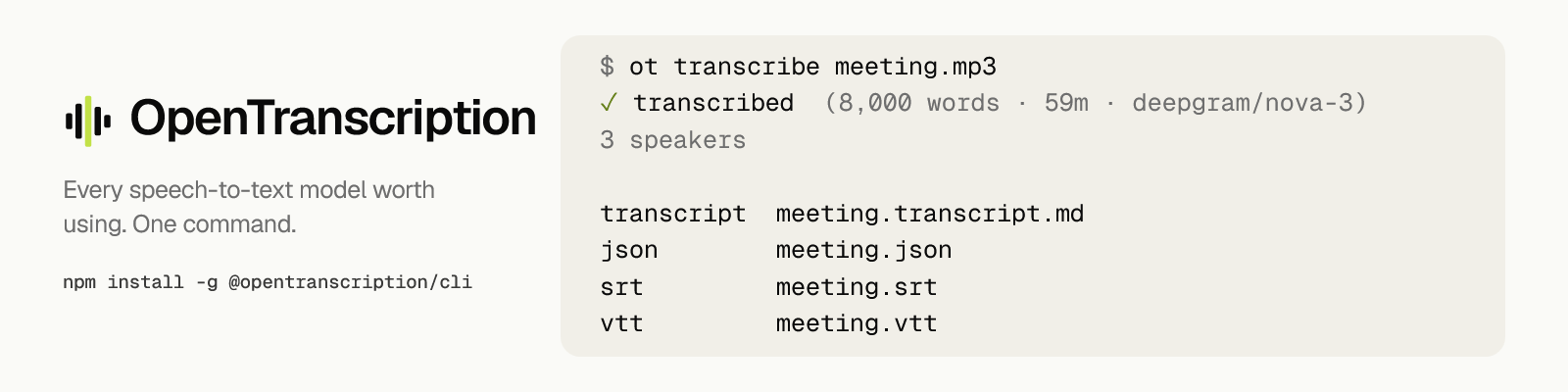
opentranscription



Python client for the OpenTranscription API. Upload a file, transcribe it against any model in the catalogue, and wait for the result.
pip install opentranscription
Usage
from opentranscription import OpenTranscription

ot = OpenTranscription(api_key=os.environ["OT_API_KEY"])

job = ot.transcribe(
    "earnings-call.mp3",
    # Primary plus backups, tried in order when a provider fails. Use `model`
    # instead for a single id, or for auto/best, auto/cheapest, auto/fastest.
    models=["assemblyai/best", "deepgram/nova-3"],
    language="en",
    diarization=True,
    # Names and jargon the model has the weakest prior for, which are usually
    # the reason you wanted the transcript.
    custom_words=["EBITDA", "Sanjay Bhattacharya", "Nasdaq", "ARR"],
)

done = ot.wait_for_job(job["id"])
print(done["transcript"]["text"])
transcribe does three things: requests a signed upload URL, PUTs the bytes
straight to storage, and creates the job. The API key never travels to the
storage host.
The first argument is a path, an open binary file, or raw bytes with
file_name= alongside it.
async
The same surface, awaited. Both classes come from one package and share their implementation.
from opentranscription import AsyncOpenTranscription

async with AsyncOpenTranscription(api_key=os.environ["OT_API_KEY"]) as ot:
    job = await ot.transcribe("earnings-call.mp3", model="auto/best")
    done = await ot.wait_for_job(job["id"])
Use the context manager, on either class, or the connection pool outlives the
work. The sync client also has close(), the async one aclose().
Request fields
The audio is required. Everything else is optional, and leaving a field out is
not the same as passing False or None: left out means the server's own
default applies.
| Field | Notes |
|---|---|
model |
One id, or auto/best, auto/cheapest, auto/fastest. Use this or models, not both. |
models |
Two to five ids: primary first, backups tried in order when one fails. |
language |
ISO 639-1, two letters. Omit to let the model detect it. |
diarization |
True forces speaker labels on, False forces them off, omitted follows the model's own default. |
word_timestamps |
False declines word timing: the transcript comes back word_timestamps="disabled" with a null words. Omitted leaves the server default, which is on. |
custom_words |
Up to 1000 terms, 100 characters each. Only models whose capabilities.features list custom_vocabulary read them; the rest ignore them instead of failing. |
vocabulary_list_id |
A list saved in the web app, under Settings then Vocabulary. Merged with custom_words when both are given. |
code_switching |
Audio that changes language mid-sentence. |
code_switching_confidence_threshold |
0 to 1. AssemblyAI only; ignored elsewhere. |
webhook_url |
Public HTTPS URL for a signed transcription.completed event, so a long job needs no wait_for_job. |
metadata |
Returned untouched on the job. Yours to correlate with. |
title |
Display name in the web app. Falls back to the file name. |
use_own_key |
Bill the provider directly against your own key instead of platform credits. |
audio_retention_days |
Whole days, 0 to delete on completion, or None to keep indefinitely. Omitting it leaves the organization default in force, which is why None is a real value here. |
custom_model_id |
A fine-tuned model you uploaded, by id. |
That last row is why the defaults are NOT_GIVEN rather than None. None
already means something to the API on two of these fields, so it cannot also
mean "the caller said nothing".
The field list is checked against the published OpenAPI document on every test run. A field the API adds that this client does not offer fails the build by name, and so does one this client offers that the API no longer accepts.
API
| Method | Purpose |
|---|---|
transcribe(file, **fields) |
Upload and create a job. Returns immediately, before transcription finishes. |
wait_for_job(job_id, poll_interval) |
Poll until the job completes. Raises JobFailedError if it fails. poll_interval is seconds, default 2. No timeout. |
get_job(job_id) |
Read one job, including its transcript once ready. job["metadata"]["quality_warning"] is set when the platform's quality gate flagged the result. |
list_jobs(limit) |
Recent jobs, newest first. |
list_models() |
The public model catalogue: pricing, accuracy, supported languages, lifecycle (active/deprecated) and successor_model_id. |
OpenTranscription(api_key, base_url=..., timeout=..., http_client=..., sleep=...)
accepts your own httpx.Client when you need custom transport, proxies, or
retries, and an injectable sleep so tests need no real waiting. base_url
defaults to https://opentranscription.io.
Passing your own client means your settings, not ours: the follow_redirects
default this sets is yours to decide. The audio upload opts out of redirects
per request either way, so that one is not yours to get wrong.
Rate limits (429) are retried automatically, up to four waits. The API sends
X-RateLimit-Reset (an epoch second) and that is what paces the retry;
Retry-After is honoured first if a response ever carries one. A single transcribe can trip a
ten-per-minute limit on its own, since it is an upload, a create, and then a
poll every couple of seconds.
Errors
ApiErroris any request the API did not answer properly: a non-2xx response, or a 2xx whose body is not JSON (abase_urlpointing at a locale-prefixed page such ashttps://opentranscription.io/engets the website's HTML with a 200). It carriesstatusand, when the API sent one,code.JobFailedErrormeans the job ran and failed, so retrying the request is pointless. It carriescode(also onjob["error_code"]), which is what tells you whether to re-encode the audio, pick another model, or give up.- Both subclass
OpenTranscriptionError.
Branch on code, not on the message, which is prose and may be reworded.
Getting a key
Create one in your dashboard, or
run npx @opentranscription/cli login to mint one through the browser.
Requires Python 3.10 or newer, and httpx.
License
MIT
1 maintainer

Release files for opentranscription 0.6.0
For a detailed explanation of source distributions (sdists) and built distributions (wheels), please see the package formats documentation.
Source distribution (sdist)
| File | Size | Uploaded | |
|---|---|---|---|
| opentranscription-0.6.0.tar.gz | 21.1 kB | Details |
Built distribution (wheel)
| File | Interpreter | ABI | Platform | Reset |
|---|---|---|---|---|
| opentranscription-0.6.0-py3-none-any.whl | Python 3 | none | any | Details |
Total release size: 38.3 kB
Release files / opentranscription-0.6.0.tar.gz
| Download URL | opentranscription-0.6.0.tar.gz |
|---|---|
| Size | 21.1 kB |
| Tags | Source |
|
SHA-256 checksum How to use checksums |
039038043832d5c8cd58e6842c6b102bacc55b1bdbe9ebcce6c4d68176b9ae77
|
|
BLAKE2b-256 checksum How to use checksums |
2814f4f3bdaefc8a93de44a0da6bc82f01105a50e1772d962c8037df83aca43e
|
| Upload date | |
|
Uploaded using Trusted Publishing? What is trusted publishing? |
Yes |
| Uploaded via |
twine/7.0.0 CPython/3.13.14
|
Provenance
Provenance describes where a file came from. On PyPI, provenance is shared via attestations, which provide a verifiable record of the build or publishing details. View details, limitations and caveats.


PyPI Publish Attestation
PyPI verified that this artifact, at this checksum, originated from the publisher listed below.
Signed by GitHub Actions, verified by PyPI on Sep 8, 2026.
Transparency logRelease files / opentranscription-0.6.0-py3-none-any.whl
| Download URL | opentranscription-0.6.0-py3-none-any.whl |
|---|---|
| Size | 17.3 kB |
| Tags | Python 3 |
|
SHA-256 checksum How to use checksums |
d3ad88290b5b5f86e172ddf7d6e69242e58e5198a853c884a73d55c41af9aa40
|
|
BLAKE2b-256 checksum How to use checksums |
8a05dbe62ec3ccf52f103d327ab678fa8301b428679be86c833fb0d3c71589f8
|
| Upload date | |
|
Uploaded using Trusted Publishing? What is trusted publishing? |
Yes |
| Uploaded via |
twine/7.0.0 CPython/3.13.14
|
Provenance
Provenance describes where a file came from. On PyPI, provenance is shared via attestations, which provide a verifiable record of the build or publishing details. View details, limitations and caveats.
PyPI Publish Attestation
PyPI verified that this artifact, at this checksum, originated from the publisher listed below.
Signed by GitHub Actions, verified by PyPI on Sep 8, 2026.
Transparency log













