Open-source AI toolkit for fashion tech and virtual try-on
Project description
OpenTryOn: Open-source AI toolkit for fashion tech and virtual try-on
OpenTryOn is an open-source AI toolkit designed for fashion technology and virtual try-on applications. This project provides a comprehensive suite of tools for garment segmentation, human parsing, pose estimation, and virtual try-on using state-of-the-art diffusion models.
๐ Documentation: Comprehensive documentation is available at https://tryonlabs.github.io/opentryon/
๐ฏ Features
- Virtual Try-On:
- Amazon Nova Canvas virtual try-on using AWS Bedrock
- Kling AI virtual try-on using Kolors API
- Segmind Try-On Diffusion API integration
- Advanced diffusion-based virtual try-on capabilities using TryOnDiffusion
- Image Generation:
- Nano Banana (Gemini 2.5 Flash Image) for fast, efficient image generation
- Nano Banana Pro (Gemini 3 Pro Image Preview) for advanced 4K image generation with search grounding
- FLUX.2 [PRO] high-quality image generation with text-to-image, image editing, and multi-image composition
- FLUX.2 [FLEX] flexible image generation with advanced controls (guidance, steps, prompt upsampling)
- Photon-Flash-1 (Luma AI): Fast and cost efficient image generation, ideal for rapid iteration and scale
- Photon-1 (Luma AI): High-fidelity default model for professional-grade quality, creativity and detailed prompt handling
- GPT-Image-1 & GPT-Image-1.5 (OpenAI): High-quality image generation with strong prompt understanding, consistent composition, and reliable visual accuracy. GPT-Image-1.5 offers enhanced quality and better consistency
- Video Generation:
- Luma AI Video Generation Model (Dream Machine): High-quality video generation with text-to-image and image-to-video modes.
- Google Veo 3 Video Generation Model: Generate high-quality, cinematic videos from text or images with realistic motion, temporal consistency, and fine-grained control over style and camera dynamics.
- Datasets Module:
- Fashion-MNIST dataset loader with automatic download
- VITON-HD dataset loader with lazy loading via PyTorch DataLoader
- Class-based adapter pattern for easy dataset integration
- Support for both small and large datasets
- Garment Preprocessing:
- Garment segmentation using U2Net
- Garment extraction and preprocessing
- Human segmentation and parsing
- Pose Estimation: OpenPose-based pose keypoint extraction for garments and humans
- Outfit Generation: FLUX.1-dev LoRA-based outfit generation from text descriptions
- Model Swap: Swap garments on different models
- Interactive Demos: Gradio-based web interfaces for all features
- Preprocessing Pipeline: Complete preprocessing pipeline for training and inference
- AI Agents:
- Virtual Try-On Agent: LangChain-based agent for intelligent virtual try-on operations
- Model Swap Agent: AI agent for replacing models while preserving outfits using multiple AI models (Nano Banana, Nano Banana Pro, FLUX 2 Pro, FLUX 2 Flex)
๐ Table of Contents
- Documentation
- Installation
- Quick Start
- Usage
- Datasets Module
- Virtual Try-On with Amazon Nova Canvas
- Virtual Try-On with Kling AI
- Virtual Try-On with Segmind
- Virtual Try-On Agent
- Model Swap Agent
- Image Generation with Nano Banana
- Image Generation with FLUX.2
- Image Generation with Luma AI
- Image Generation with OpenAI
- Video Generation with Luma AI
- Video Generation with Google Veo 3
- Preprocessing Functions
- Demos
- Project Structure
- TryOnDiffusion Roadmap
- Contributing
- License
๐ Documentation
Complete documentation for OpenTryOn is available at https://tryonlabs.github.io/opentryon/
The documentation includes:
- Getting Started guides
- API Reference for all modules
- Usage examples and tutorials
- Datasets documentation (Fashion-MNIST, VITON-HD)
- API adapters documentation (Segmind, Kling AI, Amazon Nova Canvas)
- Interactive demos and examples
- Advanced guides and troubleshooting
Visit the documentation site to explore all features, learn how to use OpenTryOn, and get started quickly!
๐ Installation
Prerequisites
- Python 3.10
- CUDA-capable GPU (recommended)
- Conda or Miniconda
Step 1: Clone the Repository
git clone https://github.com/tryonlabs/opentryon.git
cd opentryon
Step 2: Create Conda Environment
conda env create -f environment.yml
conda activate opentryon
Alternatively, you can install dependencies using pip:
pip install -r requirements.txt
Step 3: Install Package
pip install -e .
Step 4: Environment Variables
Create a .env file in the project root with the following variables:
U2NET_CLOTH_SEG_CHECKPOINT_PATH=cloth_segm.pth
# AWS Credentials for Amazon Nova Canvas (optional, can use AWS CLI default profile)
AWS_ACCESS_KEY_ID=your_access_key
AWS_SECRET_ACCESS_KEY=your_secret_key
AMAZON_NOVA_REGION=us-east-1 # Optional: us-east-1, ap-northeast-1, eu-west-1
AMAZON_NOVA_MODEL_ID=amazon.nova-canvas-v1:0 # Optional
# Kling AI Credentials (required for Kling AI virtual try-on)
KLING_AI_API_KEY=your_kling_api_key
KLING_AI_SECRET_KEY=your_kling_secret_key
KLING_AI_BASE_URL=https://api-singapore.klingai.com # Optional, defaults to Singapore endpoint
# Segmind Credentials (required for Segmind virtual try-on)
SEGMIND_API_KEY=your_segmind_api_key
# Google Gemini Credentials (required for Nano Banana image generation and Google Veo 3 Video generation)
GEMINI_API_KEY=your_gemini_api_key
# BFL API Credentials (required for FLUX.2 image generation)
BFL_API_KEY=your_bfl_api_key
# Luma AI Credentials (required for Luma AI image generation and Luma AI Video generation)
LUMA_AI_API_KEY=your_luma_ai_api_key
# OpenAI Credentials (required for OpenAI GPT-Image-1 image generation)
OPENAI_API_KEY=your_openai_api_key
# LLM Provider Credentials (required for Virtual Try-On Agent)
OPENAI_API_KEY=your_openai_api_key # For OpenAI (default)
# OR
ANTHROPIC_API_KEY=your_anthropic_api_key # For Anthropic Claude
# OR
GOOGLE_API_KEY=your_google_api_key # For Google Gemini
Notes:
-
Download the U2Net checkpoint file from the huggingface-cloth-segmentation repository
-
For Amazon Nova Canvas, ensure you have AWS credentials configured (via
.envfile or AWS CLI) and Nova Canvas enabled in your AWS Bedrock console -
For Kling AI, obtain your API key and secret key from the Kling AI Developer Portal
-
For Segmind, obtain your API key from the Segmind API Portal
-
For Nano Banana and Google Veo 3, obtain your API key from the Google AI Studio
-
For FLUX.2 models, obtain your API key from BFL AI
-
For FLUX.2 models, obtain your API key from BFL AI
-
For Luma AI, obtain your API key from Luma Labs AI
-
For OpenAI, obtain your API key from OpenAI Platform
-
For Virtual Try-On Agent, obtain LLM API keys from:
- OpenAI: OpenAI API Keys
- Anthropic: Anthropic API Keys
- Google: Google AI Studio
๐ฎ Quick Start
Basic Preprocessing
from dotenv import load_dotenv
load_dotenv()
from tryon.preprocessing import segment_garment, extract_garment, segment_human
# Segment garment
segment_garment(
inputs_dir="data/original_cloth",
outputs_dir="data/garment_segmented",
cls="upper" # Options: "upper", "lower", "all"
)
# Extract garment
extract_garment(
inputs_dir="data/original_cloth",
outputs_dir="data/cloth",
cls="upper",
resize_to_width=400
)
# Segment human
segment_human(
image_path="data/original_human/model.jpg",
output_dir="data/human_segmented"
)
Command Line Interface
# Segment garment
python main.py --dataset data --action segment_garment --cls upper
# Extract garment
python main.py --dataset data --action extract_garment --cls upper
# Segment human
python main.py --dataset data --action segment_human
๐ Usage
Datasets Module
The tryon.datasets module provides easy-to-use interfaces for downloading and loading datasets commonly used in fashion and virtual try-on applications. The module uses a class-based adapter pattern for consistency and extensibility.
Supported Datasets
- Fashion-MNIST: A dataset of Zalando's article images (60K training, 10K test, 10 classes, 28ร28 grayscale images)
- VITON-HD: A high-resolution virtual try-on dataset (11,647 training pairs, 2,032 test pairs, 1024ร768 RGB images)
- Subjects200K: A large-scale dataset with 200,000 paired images for subject consistency research (loaded from HuggingFace)
Quick Example
from tryon.datasets import FashionMNIST, VITONHD
from torchvision import transforms
# Fashion-MNIST: Small dataset, loads entirely into memory
fashion_dataset = FashionMNIST(download=True)
(train_images, train_labels), (test_images, test_labels) = fashion_dataset.load(
normalize=True,
flatten=False
)
print(f"Training set: {train_images.shape}") # (60000, 28, 28)
# VITON-HD: Large dataset, uses lazy loading via DataLoader
viton_dataset = VITONHD(data_dir="./datasets/viton_hd", download=False)
transform = transforms.Compose([
transforms.Resize((512, 384)),
transforms.ToTensor(),
transforms.Normalize(mean=[0.5, 0.5, 0.5], std=[0.5, 0.5, 0.5])
])
train_loader = viton_dataset.get_dataloader(
split='train',
batch_size=8,
shuffle=True,
transform=transform
)
# Subjects200K: Large-scale paired images from HuggingFace
from tryon.datasets import Subjects200K
subjects_dataset = Subjects200K()
hf_dataset = subjects_dataset.get_hf_dataset()
sample = hf_dataset['train'][0]
image = sample['image'] # PIL Image with paired images
collection = sample['collection'] # 'collection_1', 'collection_2', or 'collection_3'
# Get PyTorch DataLoader with quality filtering
dataloader = subjects_dataset.get_dataloader(
batch_size=16,
transform=transform,
collection='collection_2',
filter_high_quality=True
)
Documentation
For comprehensive documentation, API reference, usage examples, and best practices, see the Datasets Module Documentation.
Key Features:
- โ Automatic download for Fashion-MNIST
- โ Lazy loading for large datasets (VITON-HD)
- โ PyTorch DataLoader integration
- โ Consistent API across datasets
- โ Class-based and function-based interfaces
- โ Support for custom transforms and preprocessing
Virtual Try-On with Amazon Nova Canvas
Generate realistic virtual try-on images using Amazon Nova Canvas through AWS Bedrock. This feature combines a source image (person/model) with a reference image (garment/product) to create realistic try-on results.
Prerequisites
-
AWS Account Setup:
- Ensure you have an AWS account with access to Amazon Bedrock
- Enable Nova Canvas model access in the AWS Bedrock console (Model access section)
- Configure AWS credentials (via
.envfile or AWS CLI)
-
Image Requirements:
- Maximum image size: 4.1M pixels (equivalent to 2,048 x 2,048)
- Supported formats: JPG, PNG
- Both source and reference images must meet size requirements
Command Line Usage
# Basic usage with GARMENT mask (default) - Nova Canvas
python vton.py --provider nova --source data/person.jpg --reference data/garment.jpg
# Specify garment class - Nova Canvas
python vton.py --provider nova --source person.jpg --reference garment.jpg --garment-class LOWER_BODY
# Use IMAGE mask type with custom mask - Nova Canvas
python vton.py --provider nova --source person.jpg --reference garment.jpg --mask-type IMAGE --mask-image mask.png
# Use different AWS region - Nova Canvas
python vton.py --provider nova --source person.jpg --reference garment.jpg --region ap-northeast-1
# Basic usage - Kling AI
python vton.py --provider kling --source person.jpg --reference garment.jpg
# Specify model version - Kling AI
python vton.py --provider kling --source person.jpg --reference garment.jpg --model kolors-virtual-try-on-v1-5
# Basic usage - Segmind
python vton.py --provider segmind --source person.jpg --reference garment.jpg --category "Upper body"
# Specify inference parameters - Segmind
python vton.py --provider segmind --source person.jpg --reference garment.jpg --category "Lower body" --num-steps 35 --guidance-scale 2.5
# Save output to specific directory
python vton.py --provider nova --source person.jpg --reference garment.jpg --output-dir results/
Python API Usage
from dotenv import load_dotenv
load_dotenv()
from tryon.api import AmazonNovaCanvasVTONAdapter
from PIL import Image
# Initialize adapter
adapter = AmazonNovaCanvasVTONAdapter(region="us-east-1")
# Generate virtual try-on images
images = adapter.generate_and_decode(
source_image="data/person.jpg",
reference_image="data/garment.jpg",
mask_type="GARMENT", # Options: "GARMENT", "IMAGE"
garment_class="UPPER_BODY" # Options: "UPPER_BODY", "LOWER_BODY", "FULL_BODY", "FOOTWEAR"
)
# Save results
for idx, image in enumerate(images):
image.save(f"outputs/vton_result_{idx}.png")
Mask Types
-
GARMENT (Default): Automatically detects and masks garment area based on garment class
UPPER_BODY: Tops, shirts, jackets, hoodiesLOWER_BODY: Pants, skirts, shortsFULL_BODY: Dresses, jumpsuitsFOOTWEAR: Shoes, boots
-
IMAGE: Uses a custom black-and-white mask image
- Black areas = replaced with garment
- White areas = preserved from source image
Supported AWS Regions
us-east-1(US East - N. Virginia) - Defaultap-northeast-1(Asia Pacific - Tokyo)eu-west-1(Europe - Ireland)
Example: Complete Workflow
from tryon.api import AmazonNovaCanvasVTONAdapter
# Initialize adapter
adapter = AmazonNovaCanvasVTONAdapter(region="us-east-1")
# Generate try-on for upper body garment
images = adapter.generate_and_decode(
source_image="data/person.jpg",
reference_image="data/shirt.jpg",
mask_type="GARMENT",
garment_class="UPPER_BODY"
)
# Generate try-on for lower body garment
images = adapter.generate_and_decode(
source_image="data/person.jpg",
reference_image="data/pants.jpg",
mask_type="GARMENT",
garment_class="LOWER_BODY"
)
# Save all results
for idx, image in enumerate(images):
image.save(f"outputs/result_{idx}.png")
Reference: Amazon Nova Canvas Virtual Try-On Documentation
Virtual Try-On with Kling AI
Generate realistic virtual try-on images using Kling AI's Kolors virtual try-on API. This feature combines a source image (person/model) with a reference image (garment/product) to create realistic try-on results with automatic task polling until completion.
Prerequisites
-
Kling AI Account Setup:
- Sign up for a Kling AI account at Kling AI Developer Portal
- Obtain your API key (access key) and secret key from the developer portal
- Configure credentials in your
.envfile (see Environment Variables section)
-
Image Requirements:
- Maximum image size: 16M pixels (equivalent to 4,096 x 4,096)
- Maximum dimension: 4,096 pixels per side
- Supported formats: JPG, PNG
- Both source and reference images must meet size requirements
Command Line Usage
# Basic usage
python vton.py --provider kling --source person.jpg --reference garment.jpg
# Specify model version
python vton.py --provider kling --source person.jpg --reference garment.jpg --model kolors-virtual-try-on-v1-5
# Use custom base URL
python vton.py --provider kling --source person.jpg --reference garment.jpg --base-url https://api-singapore.klingai.com
# Save output to specific directory
python vton.py --provider kling --source person.jpg --reference garment.jpg --output-dir results/
Python API Usage
from dotenv import load_dotenv
load_dotenv()
from tryon.api import KlingAIVTONAdapter
from PIL import Image
# Initialize adapter (uses environment variables by default)
adapter = KlingAIVTONAdapter()
# Or specify credentials directly
adapter = KlingAIVTONAdapter(
api_key="your_api_key",
secret_key="your_secret_key",
base_url="https://api-singapore.klingai.com" # Optional
)
# Generate virtual try-on images
images = adapter.generate_and_decode(
source_image="data/person.jpg",
reference_image="data/garment.jpg",
model="kolors-virtual-try-on-v1-5" # Optional, uses API default if not specified
)
# Save results
for idx, image in enumerate(images):
image.save(f"outputs/vton_result_{idx}.png")
Model Versions
Kling AI supports multiple model versions:
kolors-virtual-try-on-v1: Original model versionkolors-virtual-try-on-v1-5: Enhanced version
If not specified, the API uses the default model version.
Asynchronous Processing
Kling AI processes virtual try-on requests asynchronously. The adapter automatically:
- Submits the request and receives a
task_id - Polls the task status endpoint until completion
- Returns image URLs when the task succeeds
- Raises errors if the task fails or times out (default timeout: 5 minutes)
You can customize polling behavior:
# Manual polling
adapter = KlingAIVTONAdapter()
# Submit task
response = adapter.generate(
source_image="person.jpg",
reference_image="garment.jpg"
)
# This automatically polls until completion
# Or poll manually with custom settings
task_id = "your_task_id"
image_urls = adapter.poll_task_until_complete(
task_id=task_id,
poll_interval=2, # Check every 2 seconds
max_wait_time=600 # Maximum 10 minutes
)
Example: Complete Workflow
from tryon.api import KlingAIVTONAdapter
# Initialize adapter
adapter = KlingAIVTONAdapter()
# Generate try-on
images = adapter.generate_and_decode(
source_image="data/person.jpg",
reference_image="data/shirt.jpg",
model="kolors-virtual-try-on-v1-5"
)
# Save all results
for idx, image in enumerate(images):
image.save(f"outputs/result_{idx}.png")
Supported Base URLs
https://api-singapore.klingai.com(Singapore) - Default- Other regional endpoints may be available (check Kling AI documentation)
Reference: Kling AI API Documentation
Virtual Try-On with Segmind
Generate realistic virtual try-on images using Segmind's Try-On Diffusion API. This feature combines a model image (person) with a cloth image (garment/product) to create realistic try-on results.
Prerequisites
-
Segmind Account Setup:
- Sign up for a Segmind account at Segmind API Portal
- Obtain your API key from the Segmind dashboard
- Configure credentials in your
.envfile (see Environment Variables section)
-
Image Requirements:
- Images can be provided as file paths, URLs, or base64-encoded strings
- Supported formats: JPG, PNG
- Both model and cloth images must be valid image files
Command Line Usage
# Basic usage
python vton.py --provider segmind --source person.jpg --reference garment.jpg --category "Upper body"
# Specify garment category
python vton.py --provider segmind --source person.jpg --reference garment.jpg --category "Lower body"
# Use custom inference parameters
python vton.py --provider segmind --source person.jpg --reference garment.jpg --category "Dress" --num-steps 35 --guidance-scale 2.5 --seed 42
# Save output to specific directory
python vton.py --provider segmind --source person.jpg --reference garment.jpg --category "Upper body" --output-dir results/
Python API Usage
from dotenv import load_dotenv
load_dotenv()
from tryon.api import SegmindVTONAdapter
from PIL import Image
# Initialize adapter (uses environment variable by default)
adapter = SegmindVTONAdapter()
# Or specify API key directly
adapter = SegmindVTONAdapter(api_key="your_api_key")
# Generate virtual try-on images
images = adapter.generate_and_decode(
model_image="data/person.jpg",
cloth_image="data/garment.jpg",
category="Upper body", # Options: "Upper body", "Lower body", "Dress"
num_inference_steps=35, # Optional: 20-100, default: 25
guidance_scale=2.5, # Optional: 1-25, default: 2
seed=42 # Optional: -1 to 999999999999999, default: -1
)
# Save results
for idx, image in enumerate(images):
image.save(f"outputs/vton_result_{idx}.png")
Garment Categories
Segmind supports three garment categories:
"Upper body": Tops, shirts, jackets, hoodies (default)"Lower body": Pants, skirts, shorts"Dress": Dresses, jumpsuits
Inference Parameters
- num_inference_steps: Number of denoising steps (default: 25, range: 20-100)
- Higher values may produce better quality but take longer
- guidance_scale: Scale for classifier-free guidance (default: 2, range: 1-25)
- Higher values make the model follow the input more closely
- seed: Seed for reproducible results (default: -1 for random, range: -1 to 999999999999999)
Example: Complete Workflow
from tryon.api import SegmindVTONAdapter
# Initialize adapter
adapter = SegmindVTONAdapter()
# Generate try-on for upper body garment
images = adapter.generate_and_decode(
model_image="data/person.jpg",
cloth_image="data/shirt.jpg",
category="Upper body"
)
# Generate try-on for lower body garment with custom parameters
images = adapter.generate_and_decode(
model_image="data/person.jpg",
cloth_image="data/pants.jpg",
category="Lower body",
num_inference_steps=35,
guidance_scale=2.5,
seed=42
)
# Save all results
for idx, image in enumerate(images):
image.save(f"outputs/result_{idx}.png")
Reference: Segmind Try-On Diffusion API Documentation
Virtual Try-On Agent
A LangChain-based agent that intelligently selects and uses the appropriate virtual try-on adapter based on user prompts. The agent analyzes natural language requests and automatically chooses between Kling AI, Amazon Nova Canvas, or Segmind.
Prerequisites
-
LangChain Installation:
pip install langchain langchain-openai langchain-anthropic langchain-google-genai
-
LLM Provider Setup:
- Choose an LLM provider: OpenAI, Anthropic Claude, or Google Gemini
- Set the appropriate API key in your
.envfile:OPENAI_API_KEY=your_openai_api_key # OR ANTHROPIC_API_KEY=your_anthropic_api_key # OR GOOGLE_API_KEY=your_google_api_key
-
Virtual Try-On API Credentials:
- Ensure you have credentials for at least one VTON provider (Kling AI, Nova Canvas, or Segmind)
- See the individual provider sections above for setup instructions
Command Line Usage
# Basic usage with default OpenAI provider
python vton_agent.py --person person.jpg --garment shirt.jpg --prompt "Create a virtual try-on using Kling AI"
# Specify LLM provider
python vton_agent.py --person person.jpg --garment shirt.jpg --prompt "Use Nova Canvas for virtual try-on" --llm-provider anthropic
# Use Google Gemini as LLM
python vton_agent.py --person person.jpg --garment shirt.jpg --prompt "Generate try-on with Segmind" --llm-provider google
# Specify LLM model
python vton_agent.py --person person.jpg --garment shirt.jpg --prompt "Use Kling AI" --llm-model gpt-4-turbo-preview
# Save output to specific directory
python vton_agent.py --person person.jpg --garment shirt.jpg --prompt "Create virtual try-on" --output-dir results/
# Use URLs instead of file paths
python vton_agent.py --person https://example.com/person.jpg --garment https://example.com/shirt.jpg --prompt "Use Kling AI"
# Verbose output to see agent reasoning
python vton_agent.py --person person.jpg --garment shirt.jpg --prompt "Use Kling AI" --verbose
Python API Usage
from tryon.agents.vton import VTOnAgent
# Initialize the agent with your preferred LLM provider
agent = VTOnAgent(llm_provider="openai")
# Generate virtual try-on using natural language prompt
result = agent.generate(
person_image="person.jpg",
garment_image="shirt.jpg",
prompt="Use Kling AI to create a virtual try-on of this shirt"
)
if result["status"] == "success":
print(f"Generated {len(result['images'])} images using {result['provider']}")
Provider Selection
The agent automatically selects the provider based on keywords in your prompt:
- Kling AI: "kling ai", "kling", "kolors"
- Nova Canvas: "nova canvas", "amazon nova", "aws", "bedrock"
- Segmind: "segmind"
Examples:
# Uses Kling AI
result = agent.generate(
person_image="person.jpg",
garment_image="shirt.jpg",
prompt="Use Kling AI to generate the try-on"
)
# Uses Nova Canvas
result = agent.generate(
person_image="person.jpg",
garment_image="shirt.jpg",
prompt="Generate with Amazon Nova Canvas"
)
# Uses Segmind
result = agent.generate(
person_image="person.jpg",
garment_image="shirt.jpg",
prompt="Try Segmind for this virtual try-on"
)
Using Different LLM Providers
# OpenAI
agent = VTOnAgent(llm_provider="openai", llm_model="gpt-4-turbo-preview")
# Anthropic Claude
agent = VTOnAgent(llm_provider="anthropic", llm_model="claude-3-opus-20240229")
# Google Gemini
agent = VTOnAgent(llm_provider="google", llm_model="gemini-pro")
Complete Example
from tryon.agents.vton import VTOnAgent
# Initialize agent
agent = VTOnAgent(llm_provider="openai")
# Generate virtual try-on
result = agent.generate(
person_image="https://example.com/person.jpg",
garment_image="https://example.com/shirt.jpg",
prompt="Create a virtual try-on using Kling AI for best quality"
)
# Handle results
if result["status"] == "success":
images = result["images"] # List of image URLs or base64 strings
provider = result["provider"] # "kling_ai", "nova_canvas", or "segmind"
print(f"Successfully generated {len(images)} images using {provider}")
else:
print(f"Error: {result.get('error')}")
Supported Providers
- Kling AI: High-quality virtual try-on with asynchronous processing
- Amazon Nova Canvas: AWS Bedrock-based virtual try-on with automatic garment detection
- Segmind: Fast and efficient virtual try-on generation
Model Swap Agent
A LangChain-based AI agent that intelligently replaces models/people in images while preserving outfits and styling. Perfect for e-commerce sellers and fashion brands to create professional product imagery with diverse models.
Overview
The Model Swap Agent:
- Extracts person attributes from natural language prompts (gender, age, ethnicity, body type, pose)
- Generates professional model-swapped images while preserving exact outfit details
- Supports multiple AI models: Nano Banana, Nano Banana Pro (default), FLUX 2 Pro, and FLUX 2 Flex
- Maintains high-quality photography with up to 4K resolution support
Prerequisites
-
LangChain Installation:
pip install langchain langchain-openai langchain-anthropic langchain-google-genai
-
API Keys Required:
# For Nano Banana models (Gemini API key) export GEMINI_API_KEY="your_gemini_api_key" # For FLUX 2 models (BFL API key) export BFL_API_KEY="your_bfl_api_key" # LLM provider (choose one) export OPENAI_API_KEY="your_openai_api_key" # Default export ANTHROPIC_API_KEY="your_anthropic_api_key" export GOOGLE_API_KEY="your_google_api_key"
Command Line Usage
# Basic usage - replace with professional male model (uses Nano Banana Pro by default)
python model_swap_agent.py \
--image model.jpg \
--prompt "Replace with a professional male model in his 30s, athletic build"
# Use FLUX 2 Pro for high-quality results
python model_swap_agent.py \
--image model.jpg \
--prompt "Replace with a professional female model" \
--model flux2_pro
# Use FLUX 2 Flex for advanced control
python model_swap_agent.py \
--image model.jpg \
--prompt "Replace with an athletic Asian model" \
--model flux2_flex
# Use Nano Banana for fast generation
python model_swap_agent.py \
--image model.jpg \
--prompt "Replace with a professional model" \
--model nano_banana
# Specify detailed attributes with specific model
python model_swap_agent.py \
--image outfit.jpg \
--prompt "Asian female model, mid-20s, athletic, confident pose" \
--model nano_banana_pro \
--resolution 4K
# Use Google Search grounding for style references (Nano Banana Pro only)
python model_swap_agent.py \
--image model.jpg \
--prompt "Model like professional fashion runway" \
--model nano_banana_pro \
--search-grounding
# Use different LLM provider
python model_swap_agent.py \
--image model.jpg \
--prompt "Plus-size woman, African American, 40s, friendly" \
--llm-provider anthropic \
--model flux2_pro
# Use URLs instead of file paths
python model_swap_agent.py \
--image https://example.com/model.jpg \
--prompt "Professional female model in her 30s" \
--model flux2_pro
# Verbose output to see agent reasoning
python model_swap_agent.py \
--image model.jpg \
--prompt "Male model in 30s" \
--verbose
Python API Usage
from tryon.agents.model_swap import ModelSwapAgent
# Initialize the agent with default Nano Banana Pro
agent = ModelSwapAgent(llm_provider="openai")
# Generate model swap
result = agent.generate(
image="model_wearing_outfit.jpg",
prompt="Replace with a professional Asian female model in her 30s, athletic build, confident pose",
resolution="4K", # Only for Nano Banana Pro
verbose=True
)
# Handle results
if result["status"] == "success":
images = result['images'] # List of PIL Images
for idx, image in enumerate(images):
image.save(f"result_{idx}.png")
print(f"Generated {len(images)} images using {result['provider']}")
else:
print(f"Error: {result.get('error')}")
# Using different models
# FLUX 2 Pro
agent = ModelSwapAgent(llm_provider="openai", model="flux2_pro")
result = agent.generate(
image="model.jpg",
prompt="Replace with a professional male model in his 30s"
)
# FLUX 2 Flex
agent = ModelSwapAgent(llm_provider="openai", model="flux2_flex")
result = agent.generate(
image="model.jpg",
prompt="Replace with a professional female model"
)
# Nano Banana (fast)
agent = ModelSwapAgent(llm_provider="openai", model="nano_banana")
result = agent.generate(
image="model.jpg",
prompt="Replace with a professional model"
)
Example Prompts
Basic Descriptions:
"Professional male model in his 30s"
"Female model, mid-20s, athletic build"
"Plus-size woman, friendly expression"
Detailed Descriptions:
"Professional Asian female model in her early 30s, athletic build,
confident posture, sharp features, editorial style photography"
"Athletic male model, African American, late 20s, muscular build,
casual confident pose, commercial photography style"
"Plus-size woman, Caucasian, 40s, warm friendly expression,
lifestyle photography, natural lighting"
Style References:
"Professional fashion runway model style"
"Commercial lifestyle photography model"
"Editorial high-fashion model aesthetic"
Model Options
- Nano Banana: Fast generation at 1024px resolution, ideal for quick iterations
- Nano Banana Pro (default): High-quality up to 4K resolution with search grounding support
- FLUX 2 Pro: Professional quality with custom width/height control
- FLUX 2 Flex: Advanced controls (guidance scale, steps) for fine-tuned generation
Resolution Options (Nano Banana Pro)
- 1K (1024px): Draft quality, fast generation, testing
- 2K (2048px): High-quality, good for web use
- 4K (4096px): Professional e-commerce quality (default, recommended)
Advanced Features
Search Grounding:
result = agent.generate(
image="model.jpg",
prompt="Professional fashion runway model",
use_search_grounding=True # Enables Google Search for style references
)
Multi-LLM Support:
# OpenAI GPT (default)
agent = ModelSwapAgent(llm_provider="openai", llm_model="gpt-4")
# Anthropic Claude
agent = ModelSwapAgent(llm_provider="anthropic", llm_model="claude-3-opus-20240229")
# Google Gemini
agent = ModelSwapAgent(llm_provider="google", llm_model="gemini-2.5-pro")
Use Cases
- E-commerce Sellers: Create professional product photos with diverse models
- Fashion Brands: Showcase clothing on different body types and demographics
- Clothing Brands: Generate consistent product imagery across model portfolios
- Product Photography: Maintain styling and composition while varying models
How It Works
- Prompt Analysis: LLM agent extracts person attributes (gender, age, ethnicity, body type, pose, styling)
- Prompt Construction: Agent builds detailed, professional prompt emphasizing outfit preservation
- Model Selection: Uses the specified model (or default Nano Banana Pro) to generate images
- Image Generation: Selected model generates images with perfect outfit preservation (up to 4K with Nano Banana Pro)
Complete Example
from tryon.agents.model_swap import ModelSwapAgent
# Initialize agent
agent = ModelSwapAgent(
llm_provider="openai",
llm_model="gpt-4"
)
# Generate model swap with detailed prompt
result = agent.generate(
image="original_model.jpg",
prompt=(
"Professional Asian female model in her early 30s, "
"athletic build, confident posture, sharp features, "
"editorial style photography"
),
resolution="4K",
use_search_grounding=False,
verbose=True
)
# Save results
if result["status"] == "success":
for idx, image in enumerate(result['images']):
image.save(f"swapped_model_{idx}.png")
print(f"Model swap complete! Generated {len(result['images'])} images")
print(f"Model description: {result['model_description']}")
else:
print(f"Error: {result['error']}")
Best Practices
- Be Specific: Include age, gender, ethnicity, body type in prompts
- Describe Pose: Mention confident, casual, professional, etc.
- Mention Style: Editorial, commercial, lifestyle photography
- Use 4K Resolution: For professional e-commerce quality
- Trust the Agent: Outfit preservation is automatic
Documentation
For complete documentation, API reference, architecture details, and advanced usage examples, see:
๐ Model Swap Agent Documentation โ
Reference: Model Swap Agent Documentation
Image Generation with Nano Banana
Generate high-quality images using Google's Gemini image generation models (Nano Banana and Nano Banana Pro). These models support text-to-image generation, image editing, multi-image composition, and batch generation.
Prerequisites
-
Google Gemini Account Setup:
- Sign up for a Google AI Studio account at Google AI Studio
- Obtain your API key from the API Keys page
- Configure credentials in your
.envfile (see Environment Variables section)
-
Model Selection:
- Nano Banana (Gemini 2.5 Flash Image): Fast, efficient, 1024px resolution - ideal for high-volume tasks
- Nano Banana Pro (Gemini 3 Pro Image Preview): Advanced, up to 4K resolution, search grounding - ideal for professional production
Command Line Usage
# Text-to-image with Nano Banana (Fast)
python image_gen.py --provider nano-banana --prompt "A stylish fashion model wearing a modern casual outfit in a studio setting"
# Text-to-image with Nano Banana Pro (4K)
python image_gen.py --provider nano-banana-pro --prompt "Professional fashion photography of elegant evening wear on a runway" --resolution 4K
# Image editing
python image_gen.py --provider nano-banana --mode edit --image person.jpg --prompt "Change the outfit to a formal business suit"
# Multi-image composition
python image_gen.py --provider nano-banana --mode compose --images outfit1.jpg outfit2.jpg --prompt "Create a fashion catalog layout combining these clothing styles"
# Batch generation
python image_gen.py --provider nano-banana --batch prompts.txt --output-dir results/
Python API Usage
Nano Banana (Fast):
from dotenv import load_dotenv
load_dotenv()
from tryon.api.nano_banana import NanoBananaAdapter
# Initialize adapter
adapter = NanoBananaAdapter()
# Text-to-image generation
images = adapter.generate_text_to_image(
prompt="A stylish fashion model wearing a modern casual outfit in a studio setting",
aspect_ratio="16:9" # Optional: "1:1", "2:3", "3:2", "3:4", "4:3", "4:5", "5:4", "9:16", "16:9", "21:9"
)
# Image editing
images = adapter.generate_image_edit(
image="person.jpg",
prompt="Change the outfit to a formal business suit"
)
# Multi-image composition
images = adapter.generate_multi_image(
images=["outfit1.jpg", "outfit2.jpg"],
prompt="Create a fashion catalog layout combining these clothing styles"
)
# Batch generation
results = adapter.generate_batch([
"A fashion model showcasing summer collection",
"Professional photography of formal wear",
"Casual street style outfit on a model"
])
# Save results
for idx, image in enumerate(images):
image.save(f"outputs/generated_{idx}.png")
Nano Banana Pro (Advanced):
from tryon.api.nano_banana import NanoBananaProAdapter
# Initialize adapter
adapter = NanoBananaProAdapter()
# Text-to-image with 4K resolution
images = adapter.generate_text_to_image(
prompt="Professional fashion photography of elegant evening wear on a runway",
resolution="4K", # Options: "1K", "2K", "4K"
aspect_ratio="16:9",
use_search_grounding=True # Optional: Use Google Search for real-world grounding
)
# Image editing with 2K resolution
images = adapter.generate_image_edit(
image="person.jpg",
prompt="Change the outfit to a formal business suit",
resolution="2K"
)
# Save results
images[0].save("result.png")
Supported Features
- Text-to-Image: Generate images from text descriptions
- Image Editing: Edit images using text prompts (add, remove, modify elements)
- Multi-Image Composition: Combine multiple images with style transfer
- Batch Generation: Generate multiple images in batch
- Aspect Ratios: 10 supported aspect ratios (1:1, 2:3, 3:2, 3:4, 4:3, 4:5, 5:4, 9:16, 16:9, 21:9)
- High Resolution: Up to 4K resolution with Nano Banana Pro
- Search Grounding: Real-world grounding using Google Search (Nano Banana Pro only)
Aspect Ratios
Nano Banana (1024px):
"1:1"(1024x1024)"16:9"(1344x768)"9:16"(768x1344)- And 7 more options
Nano Banana Pro (1K/2K/4K):
- Same aspect ratios with resolution-specific dimensions
"1K": Standard resolution"2K": High resolution"4K": Ultra-high resolution
Reference: Gemini Image Generation Documentation
Image Generation with FLUX.2
Generate high-quality images using FLUX.2 [PRO] and FLUX.2 [FLEX] models from BFL AI. These models support text-to-image generation, image editing, multi-image composition, and advanced controls.
Prerequisites
-
BFL AI Account Setup:
- Sign up for a BFL AI account at BFL AI
- Obtain your API key from the BFL AI dashboard
- Configure credentials in your
.envfile (see Environment Variables section)
-
Model Selection:
- FLUX.2 [PRO]: High-quality image generation with standard controls - ideal for most use cases
- FLUX.2 [FLEX]: Flexible generation with advanced controls (guidance scale, steps, prompt upsampling) - ideal for fine-tuned control
Command Line Usage
# Text-to-image with FLUX.2 PRO
python image_gen.py --provider flux2-pro --prompt "A professional fashion model wearing elegant evening wear" --width 1024 --height 1024
# Text-to-image with FLUX.2 FLEX (Advanced controls)
python image_gen.py --provider flux2-flex --prompt "A stylish fashion model wearing elegant evening wear" --width 1024 --height 1024 --guidance 7.5 --steps 50
# Image editing
python image_gen.py --provider flux2-pro --mode edit --image person.jpg --prompt "Change the outfit to casual streetwear"
# Multi-image composition
python image_gen.py --provider flux2-pro --mode compose --images outfit1.jpg outfit2.jpg --prompt "Combine these clothing styles into a cohesive outfit"
Python API Usage
FLUX.2 [PRO]:
from dotenv import load_dotenv
load_dotenv()
from tryon.api import Flux2ProAdapter
# Initialize adapter
adapter = Flux2ProAdapter()
# Text-to-image generation
images = adapter.generate_text_to_image(
prompt="A professional fashion model wearing elegant evening wear on a runway",
width=1024,
height=1024,
seed=42
)
# Image editing
images = adapter.generate_image_edit(
prompt="Change the outfit to casual streetwear style",
input_image="model.jpg",
width=1024,
height=1024
)
# Multi-image composition
images = adapter.generate_multi_image(
prompt="Create a fashion catalog layout combining these clothing styles",
images=["outfit1.jpg", "outfit2.jpg", "accessories.jpg"],
width=1024,
height=1024
)
# Save results
images[0].save("result.png")
FLUX.2 [FLEX]:
from tryon.api import Flux2FlexAdapter
# Initialize adapter
adapter = Flux2FlexAdapter()
# Text-to-image with advanced controls
images = adapter.generate_text_to_image(
prompt="A stylish fashion model wearing elegant evening wear",
width=1024,
height=1024,
guidance=7.5, # Higher guidance = more adherence to prompt (1.5-10)
steps=50, # More steps = higher quality (default: 28)
prompt_upsampling=True, # Enhance prompt quality
seed=42
)
# Image editing with advanced controls
images = adapter.generate_image_edit(
prompt="Transform the outfit to match a vintage 1920s fashion style",
input_image="model.jpg",
width=1024,
height=1024,
guidance=8.0,
steps=50,
prompt_upsampling=True
)
# Save results
images[0].save("result.png")
Supported Features
- Text-to-Image: Generate images from text descriptions
- Image Editing: Edit images using text prompts (add, remove, modify elements)
- Multi-Image Composition: Combine up to 8 images with style transfer
- Custom Dimensions: Control width and height (minimum: 64 pixels)
- Advanced Controls (FLEX only): Guidance scale (1.5-10), steps (default: 28), prompt upsampling
- Reproducibility: Seed support for consistent results
- Safety Controls: Moderation tolerance (0-5, default: 2)
- Output Formats: JPEG or PNG
Key Differences: PRO vs FLEX
- FLUX.2 [PRO]: Simpler API, faster generation, good for most use cases
- FLUX.2 [FLEX]: Advanced controls (guidance, steps, prompt upsampling), more fine-tuned control over generation quality
Reference: FLUX.2 API Documentation
Luma AI Image Generation
Generate high-quality images using Luma AIโs (Photon-Flash-1 and Photon-1) models. Supports text-to-image generation, image reference, style reference, character reference and precise image modification for production workflows.
Prerequisites
-
Luma AI Account Setup:
- Sign up for a Luma AI account at the Luma AI Developer Console
- Create and copy your API key from the API Keys section
- Add the key to your
.envfile (see Environment Variables section)
-
Model Selection:
- Luma AI (Photon-Flash-1): Fast and cost efficient image generation, ideal for rapid iteration and scale
- Luma AI (Photon-1): High-fidelity default model for professional-grade quality, creativity and detailed prompt handling
Command Line Usage
# Text-to-image with Luma AI ((default) photon-1, photon-flash-1)
python luma_image.py --provider photon-1 --prompt "A stylish fashion model wearing a modern casual outfit in a studio setting"
# Text-to-image with Luma AI (with aspect ratio)
python luma_image.py --provider photon-1 --prompt "A model wearing a red saree" --aspect_ratio "16:9"
# Ouptput to a particular directory
python luma_image.py --provider photon-1 --prompt "A model wearing a red saree" --aspect_ratio "16:9" --output_dir folder_name
# Image generation using Image Reference (single image)
python luma_image.py --provider photon-1 --mode img-ref --prompt "model wearing sunglasses" --images person.jpg --weights 0.8 --aspect_ratio "1:1"
# Image generation using Image Reference (multiple images)
python luma_image.py --provider photon-flash-1 --mode img-ref --prompt "model wearing sunglasses" --images person_1.jpg person_2.jpg --weights 0.8 0.9 --aspect_ratio "9:21"
# Image generation using Style Reference(single image)
python luma_image.py --provider photon-flash-1 --mode style-ref --prompt "model wearing a blue shirt" --images person.jpg --weights 0.75 --aspect_ratio "16:9"
# Image generation using Style Reference(multiple images)
python luma_image.py --provider photon-flash-1 --mode style-ref --prompt "hat" --images person_1.jpg person_2.jpg --weights 0.75 0.9 --aspect_ratio "16:9"
# Image generation using Character Reference
python luma_image.py --provider photon-flash-1 --mode char-ref --char_id identity0 --prompt "Professional fashion photography of elegant evening wear on a runway" --char_images person.jpg --aspect_ratio "16:9"
# Image modification (only single image)
python luma_image.py --provider photon-flash-1 --mode modify --prompt "change the suit color to yellow" --images person.jpg --weights 0.85
Python API Usage
Luma AI:
from dotenv import load_dotenv
load_dotenv()
from tryon.api.lumaAI import LumaAIAdapter
adapter = LumaAIAdapter()
list_of_images = []
images = adapter.generate_text_to_image(
prompt="person with a hat",
aspect_ratio= "16:9"
)
list_of_images.extend(images)
images = adapter.generate_with_image_reference(
prompt="hat",
aspect_ratio= '16:9',
image_ref= [
{
"url": "person.jpg",
"weight": 0.85
}
]
)
list_of_images.extend(images)
images = adapter.generate_with_style_reference(
prompt="tiger",
aspect_ratio= '16:9',
style_ref= [
{
"url": "person.jpg",
"weight": 0.8
}
]
)
list_of_images.extend(images)
images = adapter.generate_with_character_reference(
prompt="man as a pilot",
aspect_ratio= '16:9',
character_ref= {
"identity0": {
"images": [
"person.jpg"
]
}
}
)
list_of_images.extend(images)
images = adapter.generate_with_modify_image(
prompt="transform all flowers to oranges",
images= "person.jpg",
weights= 0.9,
aspect_ratio= '16:9'
)
list_of_images.extend(images)
for idx, img in enumerate(list_of_images):
img.save(f"outputs/generated_{idx}.png")
Supported Features
- Text-to-Image: Generate images from text descriptions
- Image Reference: Useful when you want to create variations of an image
- Style Reference: Apply specific style to the generation
- Character Reference: A feature that allows you to create consistent and personalized characters
- Modify Image: Make changes to an image
- Weights: weight value can be any float value from (0 - 1)
- Aspect Ratios: 7 supported aspect ratios (1:1, 3:4, 4:3, 9:16, 16:9, 21:9, 9:21)
- Multiple Images: Accepts upto 4 images for image-reference, style-reference and character-reference modes
- Output Format: JPEG
Aspect Ratios
LUMA AI:
"1:1"(1536x1536)"16:9"(2048x1152)"9:16"(1152x2048)- And 4 more options
Reference: Luma AI Image Generation Documentation
Image Generation with OpenAI GPT-Image
Generate high-quality images using OpenAI's GPT-Image models (GPT-Image-1 and GPT-Image-1.5). These models support precise prompt-driven image generation, image editing with masks, multi-image conditioning with consistent visual quality.
Available Models:
- GPT-Image-1: High-quality image generation with strong prompt understanding
- GPT-Image-1.5: Enhanced quality, better consistency, improved prompt understanding (recommended)
Prerequisites
- OpenAI Account Setup:
- Sign up for an OpenAI account at OpenAI Platform
- Obtain your API key from the API Keys page
- Configure credentials in your
.envfile (see Environment Variables section)
Command Line Usage
# Text-to-image (uses GPT-Image-1.5 by default)
python gpt_image.py --mode text --prompt "A female model in a traditional green saree" --size 1024x1024 --quality high
# Specify model version explicitly
python gpt_image.py --mode text --prompt "A fashion model in elegant attire" --model gpt-image-1.5 --size 1024x1024 --quality high
# Use GPT-Image-1 (previous version)
python gpt_image.py --mode text --prompt "A fashion model" --model gpt-image-1 --size 1024x1024 --quality high
# With transparent background and output directory
python gpt_image.py --mode text --prompt "A female model in a traditional green saree" --size 1024x1024 --quality high --background transparent --output_dir outputs/
# Image-to-Image
python gpt_image.py --mode image --prompt "change the flowers in the background" --images "person.jpg" --size 1536x1024 --quality medium --n 2
# Image-to-Image with input fidelity (preserve input image details better)
python gpt_image.py --mode image --prompt "change the flowers in the background" --images "person.jpg" --size 1536x1024 --quality medium --inp_fid high
# Image-to-Image with mask Image
python gpt_image.py --mode image --images "scene.png" --mask "mask.png" --prompt "Replace the masked area with a swimming pool"
Python API Usage
Using GPT-Image-1.5 (Latest - Recommended):
from dotenv import load_dotenv
load_dotenv()
import os
from tryon.api.openAI.image_adapter import GPTImageAdapter
# Default uses GPT-Image-1.5 (latest model)
adapter = GPTImageAdapter()
list_of_images = []
# ---------- Text โ Image ----------
images = adapter.generate_text_to_image(
prompt="A person wearing a leather jacket with sun glasses",
size="1024x1024",
quality="high",
n=1
)
list_of_images.extend(images)
# ---------- Image โ Image ----------
images = adapter.generate_image_edit(
images= "data/image.png",
prompt="Make the hat red and stylish",
size="1024x1024",
quality="high",
n=1
)
list_of_images.extend(images)
# ---------- Save outputs ----------
os.makedirs("outputs", exist_ok=True)
for idx, img_bytes in enumerate(list_of_images):
with open(f"outputs/generated_{idx}.png", "wb") as f:
f.write(img_bytes)
print(f"Saved {len(list_of_images)} images.")
Using GPT-Image-1 (Previous Version):
from tryon.api.openAI.image_adapter import GPTImageAdapter
# Explicitly use GPT-Image-1
adapter = GPTImageAdapter(model_version="gpt-image-1")
images = adapter.generate_text_to_image(
prompt="A fashion model in elegant attire",
size="1024x1024",
quality="high"
)
with open("output.png", "wb") as f:
f.write(images[0])
Supported Features
- Text-to-Image: Generate Images from text descriptions
- Image Editing: Edit images using a multiple base images
- Edit with Mask: Edit an image using a masked image
- Size: Supported sizes (1024x1024, 1536x1024, 1024x1536, auto)
- Quality: Supported quality Options (low, high, medium, auto)
- Background: Supported background Options (transparent, opaque, auto)
- Input Fidelity: Supported Options (low, high)
References:
Video Generation with OpenAI Sora
Generate high-quality videos using OpenAI's Sora models (Sora 2 and Sora 2 Pro). These models support text-to-video and image-to-video generation with flexible durations (4-12 seconds) and multiple resolutions.
Available Models:
- Sora 2: Fast, high-quality video generation (recommended for most use cases)
- Sora 2 Pro: Enhanced quality with superior temporal consistency and prompt understanding
Prerequisites
- OpenAI Account Setup:
- Sign up for an OpenAI account at OpenAI Platform
- Obtain your API key from the API Keys page
- Configure credentials in your
.envfile (see Environment Variables section)
Command Line Usage
# Basic text-to-video (uses Sora 2 by default)
python sora_video.py --prompt "A fashion model walking down a runway" --output runway.mp4
# High-quality with Sora 2 Pro
python sora_video.py --prompt "Cinematic fashion runway show" \
--model sora-2-pro \
--duration 12 \
--resolution 1920x1080 \
--output runway_hd.mp4
# Image-to-video (animate a static image)
python sora_video.py --image model_photo.jpg \
--prompt "The model turns and smiles at the camera" \
--duration 4 \
--output animated.mp4
# Asynchronous mode (non-blocking)
python sora_video.py --prompt "Fabric flowing in slow motion" \
--duration 8 \
--async \
--output fabric.mp4
# With verbose output
python sora_video.py --prompt "A person trying on different outfits" \
--duration 8 \
--resolution 1280x720 \
--verbose \
--output outfit_changes.mp4
Python API Usage
Text-to-Video (Synchronous):
from dotenv import load_dotenv
load_dotenv()
from tryon.api.openAI.video_adapter import SoraVideoAdapter
# Initialize adapter (uses Sora 2 by default)
adapter = SoraVideoAdapter()
# Generate video from text prompt
video_bytes = adapter.generate_text_to_video(
prompt="A fashion model walking down a runway wearing an elegant evening gown",
duration=8, # seconds (4, 8, or 12)
resolution="1920x1080" # Full HD
)
# Save the video
with open("runway_walk.mp4", "wb") as f:
f.write(video_bytes)
print("Video generated successfully!")
Using Sora 2 Pro for Higher Quality:
# Initialize with Sora 2 Pro
adapter = SoraVideoAdapter(model_version="sora-2-pro")
video_bytes = adapter.generate_text_to_video(
prompt="Cinematic slow-motion shot of fabric flowing in the wind",
duration=12,
resolution="1920x1080"
)
with open("fabric_flow.mp4", "wb") as f:
f.write(video_bytes)
Image-to-Video (Animate Static Images):
adapter = SoraVideoAdapter()
# Animate a static image with a text prompt
video_bytes = adapter.generate_image_to_video(
image="model_portrait.jpg",
prompt="The model turns around and smiles at the camera",
duration=4,
resolution="1280x720"
)
with open("animated_model.mp4", "wb") as f:
f.write(video_bytes)
Asynchronous Generation with Callbacks:
adapter = SoraVideoAdapter()
# Define callback functions
def on_complete(video_bytes):
with open("output.mp4", "wb") as f:
f.write(video_bytes)
print("โ
Video generation complete!")
def on_error(error):
print(f"โ Error: {error}")
def on_progress(status):
print(f"Status: {status['status']}, Progress: {status.get('progress', 'N/A')}")
# Start async generation
video_id = adapter.generate_text_to_video_async(
prompt="A person trying on different outfits in a fashion boutique",
duration=8,
resolution="1920x1080",
on_complete=on_complete,
on_error=on_error,
on_progress=on_progress
)
print(f"Video generation started with ID: {video_id}")
# Script continues immediately, callbacks will be invoked when ready
Manual Status Tracking:
import time
# Start generation without waiting
video_id = adapter.generate_text_to_video(
prompt="Fashion runway show with multiple models",
duration=12,
resolution="1920x1080",
wait=False # Return immediately
)
# Check status manually
while True:
status = adapter.get_video_status(video_id)
print(f"Status: {status['status']}")
if status['status'] == 'completed':
video_bytes = adapter.download_video(video_id)
with open("runway_show.mp4", "wb") as f:
f.write(video_bytes)
break
elif status['status'] == 'failed':
print(f"Failed: {status.get('error')}")
break
time.sleep(5)
Supported Features
- Text-to-Video: Generate videos from text descriptions
- Image-to-Video: Animate static images with text prompts
- Durations: 4, 8, or 12 seconds
- Resolutions:
720x1280(9:16 vertical)1280x720(16:9 horizontal)1080x1920(9:16 Full HD vertical)1920x1080(16:9 Full HD horizontal)1024x1792(tall vertical)1792x1024(wide horizontal)
- Wait Modes:
- Synchronous (blocking, wait for completion)
- Asynchronous (callbacks, non-blocking)
- Manual tracking (custom control flow)
- Output Format: MP4 (H.264)
Model Comparison
| Feature | Sora 2 | Sora 2 Pro |
|---|---|---|
| Speed | Fast โก | Slower ๐ข |
| Quality | High | Superior |
| Temporal Consistency | Good | Excellent |
| Prompt Understanding | Good | Superior |
| Best For | Rapid iteration, previews | Final production, marketing |
References:
Video Generation with Luma AI
Generate smooth, high-fidelity videos using Luma AIโs Ray models (Ray 1.6, Ray 2, and Ray Flash 2). These models support text-to-video and image-to-video generation with optional keyframe interpolation. Image-to-video accepts either a single image or two keyframe images (frame0, frame1) for controlled motion.
Prerequisites
-
Luma AI Account Setup:
- Sign up for a Luma AI account at the Luma AI Developer Console
- Create and copy your API key from the API Keys section
- Add the key to your
.envfile (see Environment Variables section)
-
Model Selection:
- Ray 1.6 (ray-1-6): Balanced quality model for general video generation; slower but stable.
- Ray 2 (ray-2): High-quality flagship model with the best motion, detail, and consistency.
- Ray Flash 2 (ray-flash-2): Fast, lower-latency model optimized for quick iterations and previews.
Command Line Usage
# Text to Video with Luma AI
python video_gen.py --provider ray-2 --mode text_video --prompt "A model walking in red saree on a ramp" --resolution 720p --duration 5s --aspect 16:9 --output_dir outputs
# Text to Video with loop
python video_gen.py --provider ray-2 --mode image_video --prompt "A model walking in red saree on a ramp" --resolution 720p --duration 5s --aspect 16:9 --loop
# Image to Video with start keyframe
python video_gen.py --provider ray-flash-2 --mode image_video --prompt "Model walking" --start_image person.jpg --resolution 4k --duration 10s --aspect 21:9
# Image to Video with End Keyframe
python video_gen.py --provider ray-flash-2 --mode image_video --prompt "Model walking" --end_image person.jpg --resolution 720p --duration 10s --aspect 21:9
# Image to Video with start and End Keyframe
python video_gen.py --provider ray-2 --mode image_video --prompt "Model sitting on a fence" --start_image person.jpg --end_image person.jpg --resolution 4k --duration 10s --aspect 21:9
Python API Usage
Luma AI:
from dotenv import load_dotenv
load_dotenv()
from tryon.api.lumaAI import LumaAIVideoAdapter
from pathlib import Path
adapter = LumaAIVideoAdapter()
video_list = []
def save_video(video_bytes: bytes, idx: int):
Path("outputs").mkdir(exist_ok=True)
out_path = Path("outputs") / f"generated_{idx}.mp4"
with open(out_path, "wb") as f:
f.write(video_bytes)
print(f"[SAVED] {out_path}")
# TEXT โ VIDEO
video = adapter.generate_text_to_video(
prompt="a model riding a car with long hair",
resolution="540p",
duration="5s",
model="ray-2",
)
video_list.append(video)
# IMAGE โ VIDEO (start + end)
video = adapter.generate_image_to_video(
prompt="Man riding a bike",
start_image="start_img.png",
end_image="end_img.png",
resolution="540p",
duration="5s",
model="ray-2",
)
video_list.append(video)
# IMAGE โ VIDEO (only end image; no start)
video = adapter.generate_image_to_video(
prompt="A man walking on a ramp",
end_image="end_img_only.png",
resolution="540p",
duration="5s",
model="ray-2",
)
video_list.append(video)
# SAVE ALL RESULTS
for idx, vid_bytes in enumerate(video_list):
save_video(vid_bytes, idx)
Supported Features
- Text to Video: Generate videos using text descriptions.
- Image to Video: Generate videos using keyframes.
- Keyframe Generation: Generate videos using a start keyframe or an end keyframe or both.
- Duration: Durations in seconds (5s, 9s, 10s)
- Resolution: Quality of the Video (540p, 720p, 1080p, 4k)
- Aspect Ratios: 7 supported aspect ratios (1:1, 3:4, 4:3, 9:16, 16:9, 21:9, 9:21)
- Loop: Enable seamless looping when generating video from a single image or text prompt. Works for single image when only start_image is provided.
Aspect Ratios
LUMA AI:
"1:1"(1024x1024)"16:9"(1280x720)"9:16"(720x1280)- And 4 more options
Reference: Luma AI Video Generation Documentation
Video Generation with Google Veo 3
Generate high-quality, cinematic videos using Googleโs Veo 3 models (Veo 3.0 and Veo 3.1), including (veo-3.1-generate-preview, veo-3.1-fast-generate-preview, veo-3.0-generate-001, and veo-3.0-fast-generate-001). These models support text-to-video, image-to-video, reference-images-to-video, and frames-to-video generation for controlled motion, realistic dynamics, and consistent visual quality.
Prerequisites
-
Google Gemini Account Setup:
- Sign up for a Google AI Studio account at Google AI Studio
- Obtain your API key from the API Keys page
- Configure credentials in your
.envfile (see Environment Variables section)
-
Model Selection:
- veo-3.1-generate-preview: Generate high-quality cinematic videos with enhanced motion realism and temporal consistency using the latest Veo 3.1 model.
- veo-3.1-fast-generate-preview: Create videos quickly with optimized inference speed while retaining strong visual quality and motion coherence.
- veo-3.0-generate-001: Produce stable, high-fidelity videos using the proven Veo 3.0 generation model with reliable motion and style control.
- veo-3.0-fast-generate-001: Generate videos faster with the Veo 3.0 fast variant, balancing speed and visual quality for rapid iteration.
Command Line Usage
# Text to Video with Google Veo 3
python veo_video.py --provider veo-3.1-generate-preview --mode text --prompt "model at a fashion show" --aspect 16:9 --duration 8 --resolution 1080p --output_dir outputs
# Video generation with negative prompt
python veo_video.py --provider veo-3.1-generate-preview --mode text --prompt "person with a hat" --resolution 1080p --negative_prompt "cartoon, anime, kids"
# Image to Video
python veo_video.py --provider veo-3.1-generate-preview --mode image --prompt "model at a fashion show" --images person.jpg --aspect 16:9 --duration 8 --resolution 1080p
# Video generation with reference images (up to 3)
python veo_video.py --provider veo-3.1-generate-preview --mode reference --prompt "create a fashion week video" --images person1.jpg person2.jpg person3.jpg --resolution 1080p
# Video generation with frames
python veo_video.py --provider veo-3.1-generate-preview --mode frames --prompt "create a cinematic video" --start_image person1.jpg --end_image person2.jpg --aspect 16:9 --resolution 720p
Python API Usage
Google Veo 3
from dotenv import load_dotenv
load_dotenv()
from pathlib import Path
from tryon.api.veo import VeoAdapter
adapter = VeoAdapter()
video_list = []
def save_video(video_bytes: bytes, idx: int):
Path("outputs").mkdir(exist_ok=True)
out_path = Path("outputs") / f"generated_{idx}.mp4"
with open(out_path, "wb") as f:
f.write(video_bytes)
print(f"[SAVED] {out_path}")
# TEXT โ VIDEO
video = adapter.generate_text_to_video(
prompt="A cinematic neon city with cars moving at night",
duration_seconds="4",
aspect_ratio="16:9",
resolution="720p",
model="veo-3.1-generate-preview",
)
video_list.append(video)
# IMAGE โ VIDEO
video = adapter.generate_image_to_video(
image="model.jpg",
prompt="Two monsters fighting with each other",
duration_seconds="4",
aspect_ratio="16:9",
resolution="720p",
model="veo-3.1-generate-preview",
negative_prompt="cartoon, anime, for kids",
)
video_list.append(video)
# REFERENCE IMAGES โ VIDEO
video = adapter.generate_video_with_references(
prompt="A fashion model walking on a runway",
reference_images=[
"test_assets/ref1.jpg",
"test_assets/ref2.jpg",
],
duration_seconds="8",
aspect_ratio="16:9",
resolution="720p",
model="veo-3.1-generate-preview",
)
video_list.append(video)
# FIRST + LAST FRAME โ VIDEO
video = adapter.generate_video_with_frames(
prompt="Smooth cinematic transition from grizzly bear to polar bear",
first_image="person1.jpg",
last_image="person2.jpg",
duration_seconds="8",
aspect_ratio="16:9",
resolution="720p",
model="veo-3.1-generate-preview",
negative_prompt="cartoon, anime, kids",
)
video_list.append(video)
# SAVE ALL RESULTS
for idx, vid_bytes in enumerate(video_list):
save_video(vid_bytes, idx)
Supported Features
- Text to Video: Generate Video using text descriptions.
- Image to Video: Generate Video using a single image.
- Video Generation with Reference Images: Generate Video using reference Images (up to 3).
- Video Generation with Frames: Video Generation with first frame and last frame.
- Duration: Durations in seconds (4s, 6s, 8s)
- Resolution: Quality of the video (720p, 1080p)
- Aspect Ratio: Aspect Ratio of videos (16:9, 9:16)
- Negative Prompt: Negative Prompt tells the Veo model what to avoid generating in the video.
Reference: Google Veo 3 Video Generation Documentation
Preprocessing Functions
Segment Garment
Segments garments from images using U2Net model.
from tryon.preprocessing import segment_garment
segment_garment(
inputs_dir="path/to/input/images",
outputs_dir="path/to/output/segments",
cls="upper" # "upper", "lower", or "all"
)
Extract Garment
Extracts and preprocesses garments from images.
from tryon.preprocessing import extract_garment
extract_garment(
inputs_dir="path/to/input/images",
outputs_dir="path/to/output/garments",
cls="upper",
resize_to_width=400
)
Segment Human
Segments human subjects from images.
from tryon.preprocessing import segment_human
segment_human(
image_path="path/to/human/image.jpg",
output_dir="path/to/output/directory"
)
๐จ Demos
The project includes several interactive demos for easy experimentation:
Virtual Try-On Demo (Web App) โญ NEW
A modern, full-stack virtual try-on web application with FastAPI backend and Next.js frontend.
Features:
- Support for 4 AI models: Nano Banana, Nano Banana Pro, FLUX 2 Pro, FLUX 2 Flex
- Multi-image upload with drag & drop
- Real-time credit estimation
- Modern, responsive UI
- Production-ready API server
Quick Start:
- Start the backend:
python api_server.py
- In a new terminal, start the frontend:
cd demo/virtual-tryon
npm install
npm run dev
- Open
http://localhost:3000in your browser
Documentation: See demo/virtual-tryon/README.md and README_API_SERVER.md for detailed instructions.
Extract Garment Demo
python run_demo.py --name extract_garment
Model Swap Demo
python run_demo.py --name model_swap
Outfit Generator Demo
python run_demo.py --name outfit_generator
Fashion Prompt Builder Demo
A modern Next.js web application for generating prompts for fashion model generation.
cd demo/fashion-prompt-builder
npm install
npm run dev
Open http://localhost:3000 to access the prompt builder interface.
Features:
- Template-based prompt generation
- Prompt gallery with examples
- Raw prompt editor with tips
- Real-time preview and validation
- Support for multiple AI models
Gradio demos launch a web interface where you can interact with the models through a user-friendly UI.
๐ Project Structure
opentryon/
โโโ tryon/ # Main try-on preprocessing module
โ โโโ api/ # API adapters
โ โ โโโ nova_canvas.py # Amazon Nova Canvas VTON adapter
โ โ โโโ kling_ai.py # Kling AI VTON adapter
โ โ โโโ lumaAI/ # Luma AI Image generation adapter
โ โ โ โโโ adapter.py # LumaAIAdapter
โ โ โโโ segmind.py # Segmind Try-On Diffusion adapter
โ โ โโโ nano_banana/ # Nano Banana (Gemini) image generation adapters
โ โ โ โโโ adapter.py # NanoBananaAdapter and NanoBananaProAdapter
โ โ โโโ flux2.py # FLUX.2 [PRO] and [FLEX] image generation adapters
โ โโโ datasets/ # Dataset loaders
โ โ โโโ base.py # Base dataset interface
โ โ โโโ fashion_mnist.py # Fashion-MNIST dataset
โ โ โโโ viton_hd.py # VITON-HD dataset
โ โ โโโ example_usage.py # Usage examples
โ โ โโโ README.md # Datasets documentation
โ โโโ preprocessing/ # Preprocessing utilities
โ โ โโโ captioning/ # Image captioning
โ โ โโโ sam2/ # SAM2 segmentation
โ โ โโโ u2net/ # U2Net segmentation models
โ โ โโโ utils.py # Utility functions
โ โโโ models/ # Model implementations
โ โโโ ootdiffusion/ # OOTDiffusion model
โโโ tryondiffusion/ # TryOnDiffusion implementation
โ โโโ diffusion.py # Diffusion model
โ โโโ network.py # Network architecture
โ โโโ trainer.py # Training utilities
โ โโโ pre_processing/ # Preprocessing for training
โ โโโ utils/ # Utility functions
โโโ demo/ # Interactive demos
โ โโโ virtual-tryon/ # Virtual try-on demo (Nextjs+Tailwindcss)
โ โโโ extract_garment/ # Garment extraction demo (Gradio)
โ โโโ model_swap/ # Model swap demo (Gradio)
โ โโโ outfit_generator/ # Outfit generator demo (Gradio)
โ โโโ fashion-prompt-builder/ # Fashion prompt builder (Next.js)
โโโ scripts/ # Installation scripts
โโโ api_server.py # FastAPI server for virtual try-on demo
โโโ main.py # Main CLI entry point
โโโ run_demo.py # Demo launcher (Gradio demos)
โโโ vton.py # Virtual try-on CLI (Amazon Nova Canvas, Kling AI, Segmind)
โโโ vton_agent.py # Virtual try-on agent CLI (LangChain-based intelligent provider selection)
โโโ image_gen.py # Image generation CLI (Nano Banana, FLUX.2)
โโโ requirements.txt # Python dependencies
โโโ environment.yml # Conda environment
โโโ README_API_SERVER.md # API server documentation
โโโ setup.py # Package installation
๐บ๏ธ TryOnDiffusion: Roadmap
Based on the TryOnDiffusion paper:
Prepare initial implementation- Test initial implementation with small dataset (VITON-HD)
- Gather sufficient data and compute resources
- Prepare and train final implementation
- Publicly release parameters
๐ค Contributing
We welcome contributions! Please follow these steps:
1. Open an Issue
We recommend opening an issue (if one doesn't already exist) and discussing your intended changes before making any modifications. This helps us provide feedback and confirm the planned changes.
2. Fork and Set Up
- Fork the repository
- Set up the environment using the installation instructions above
- Install dependencies
- Make your changes
3. Create Pull Request
Create a pull request to the main branch from your fork's branch. Please ensure:
- Your code follows the project's style guidelines
- You've tested your changes
- Documentation is updated if needed
4. Review Process
Once the pull request is created, we will review the code changes and merge the pull request as soon as possible.
Writing Documentation
If you're interested in improving documentation, you can:
- Add content to
README.md - Create new documentation files as needed
- Submit a pull request with your documentation improvements
For detailed contribution guidelines, see CONTRIBUTING.md.
๐ Requirements
Key dependencies include:
- PyTorch (== 2.1.2)
- torchvision (== 0.16.2)
- diffusers (== 0.29.2)
- transformers (== 4.42.4)
- opencv-python (== 4.8.1.78)
- scikit-image (== 0.22.0)
- numpy (== 1.26.4)
- einops (== 0.7.0)
- requests (>= 2.31.0)
- PyJWT (>= 2.10.1)
- boto3 (== 1.40.64)
- python-dotenv (== 1.0.1)
- google-genai (>= 1.52.0)
- fastapi (== 0.124.0)
- uvicorn[standard] (== 0.38.0)
- python-multipart (== 0.0.20)
- lumaai (== 1.18.1)
- langchain (>= 1.0.0) - Latest LangChain 1.x API
- langchain-openai (>= 0.2.0)
- langchain-anthropic (>= 0.2.0)
- langchain-google-genai (>= 2.0.0)
See requirements.txt or environment.yml for the complete list of dependencies.
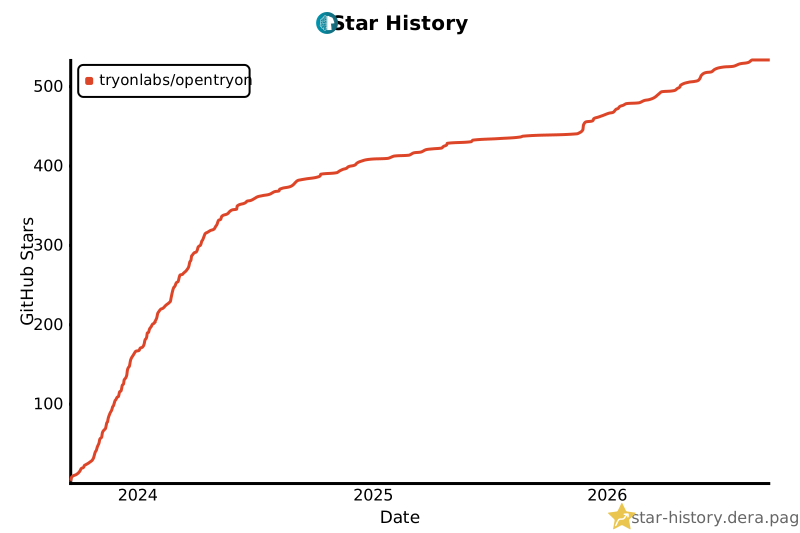
Star History
๐ Additional Resources
- TryOnDiffusion Paper: arXiv:2306.08276
- Amazon Nova Canvas: AWS Blog Post
- Kling AI: Kling AI API Documentation
- Segmind: Segmind Try-On Diffusion API
- Nano Banana: Gemini Image Generation Documentation
- FLUX.2: BFL AI Documentation
- Luma AI: Luma AI Image Generation Documentation
- Discord Community: Join our Discord
- Outfit Generator Model: FLUX.1-dev LoRA Outfit Generator
๐ License
All material is made available under Creative Commons BY-NC 4.0.
You can use the material for non-commercial purposes, as long as you:
- Give appropriate credit by citing our original GitHub repository
- Indicate any changes that you've made to the code
Made with โค๏ธ by TryOn Labs
Project details
Release history Release notifications | RSS feed
Download files
Download the file for your platform. If you're not sure which to choose, learn more about installing packages.
Source Distribution
Built Distribution
Filter files by name, interpreter, ABI, and platform.
If you're not sure about the file name format, learn more about wheel file names.
Copy a direct link to the current filters
File details
Details for the file opentryon-0.0.2.tar.gz.
File metadata
- Download URL: opentryon-0.0.2.tar.gz
- Upload date:
- Size: 168.6 kB
- Tags: Source
- Uploaded using Trusted Publishing? No
- Uploaded via: twine/6.2.0 CPython/3.11.13
File hashes
| Algorithm | Hash digest | |
|---|---|---|
| SHA256 |
3dc5c3cc8106d1101b924ad6ba064041032f29c7d34eabf40040cc6f8f9e652b
|
|
| MD5 |
b6edd9f45df9d1035f47a38334e78a4f
|
|
| BLAKE2b-256 |
75de02f1cc97dd198433ddb5e8c778c9f2ccb6ca7159bd3fa2fdfb5a38c05d7d
|
File details
Details for the file opentryon-0.0.2-py3-none-any.whl.
File metadata
- Download URL: opentryon-0.0.2-py3-none-any.whl
- Upload date:
- Size: 156.6 kB
- Tags: Python 3
- Uploaded using Trusted Publishing? No
- Uploaded via: twine/6.2.0 CPython/3.11.13
File hashes
| Algorithm | Hash digest | |
|---|---|---|
| SHA256 |
088df6bc2d9849404d48eb63639ea1873c94eb838fe407b071f1ea73d5fb4fbc
|
|
| MD5 |
e7dbb32542cdb84632b6ab69fda0c26e
|
|
| BLAKE2b-256 |
5eed88929808cd605e4db3aae853695a15ebb0469983ec0efed83ab63417682f
|